

#1 Searched Person on Google in the US 2026? Polymarket Analysis
Pop Culture · Prediction Market Analysis
#1 Searched Person on Google in the US 2026? Polymarket Analysis
The market title says “#1 searched person,” but the resolution source is more specific: Google’s official U.S. Year in Search People list. I’m PredictBoy, and that distinction matters because Google says Year in Search ranks top trending queries—the fastest-rising search interest versus the prior year—not the people with the highest raw number of searches.
Research snapshot: September 5, 2026, 18:26 UTC (September 6, 2026, 01:26 ICT). Market prices can move after this snapshot.
Evidence labels: verified facts come from Polymarket, Google, FIFA, the NFL and cited reporting. Polymarket-implied probabilities are market prices at the snapshot. Scores and probabilities labeled PredictBoy are analytical assumptions, not facts or guarantees.
If prediction markets are new to you, start with How Prediction Markets Work?. This market is especially easy to misread because a famous person can have huge total search volume and still lose Google’s trending ranking to someone whose searches exploded relative to a much lower 2025 baseline.
What This Polymarket Market Asks
Verified fact: Polymarket resolves this event to the individual ranked #1 in Google’s official Year in Search United States People list for 2026. The market contains more than 55 named binary outcomes. The displayed price of each named person is therefore a market-implied probability for that person’s contract, not a normalized multi-outcome probability table.
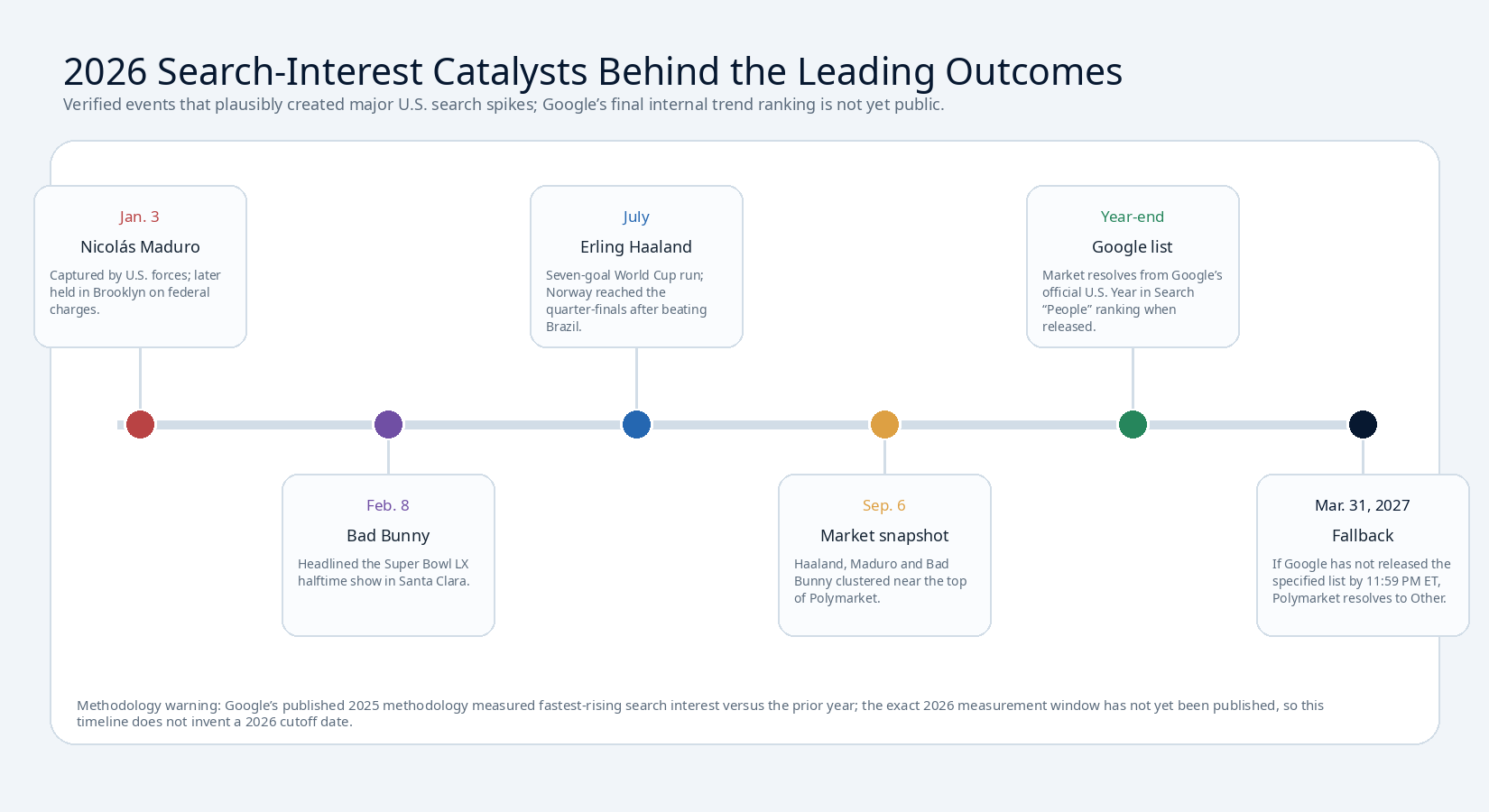
At the locked snapshot, the leading displayed outcomes were Erling Haaland 11.8%, Nicolás Maduro 11.3%, Bad Bunny 11.0%, and Donald Trump 6.5%, with roughly $133,097 in event volume.
Resolution Rules and What Counts
Polymarket points to Google’s Year in Search hub and specifies the United States → Trending → People list. The market may resolve as soon as Google publishes the 2026 list. If Google has not released the specified list by March 31, 2027 at 11:59 PM ET, the market resolves to Other.
The most important resolution nuance comes from Google itself. Its published Year in Search methodology for 2025 says the lists represent the queries that increased the fastest in search interest, measured against the same period in the prior year. Google explicitly says the lists should be described as trending searches, not “most searched.” For the People list, Google also says it covers people who were alive during the measurement period and excludes those who passed away.
PredictBoy interpretation: I use Google’s 2025 methodology as the best official precedent for interpreting 2026, but I do not assume the exact 2026 measurement cutoff will be identical until Google publishes it. That uncertainty belongs in the model.
Current Market Snapshot
| Outcome | Displayed Polymarket probability | Context |
|---|---|---|
| Erling Haaland | 11.8% | World Cup breakout and viral Norway run |
| Nicolás Maduro | 11.3% | Extraordinary U.S. capture and federal court story |
| Bad Bunny | 11.0% | Super Bowl LX halftime + major music cycle |
| Donald Trump | 6.5% | Persistent U.S. politics and midterm coverage |
| Taylor Swift | 2.0% | Enormous cultural reach but a high prior-year search baseline |
The leaderboard is unusually flat. Haaland, Maduro and Bad Bunny are clustered close together, and the long tail matters because Google rewards year-over-year breakout growth. A person who is not currently among the top market prices can still dominate the final list after one late-year event.
Main Outcomes
Erling Haaland
Verified evidence: FIFA records Haaland scoring seven goals at the 2026 World Cup as Norway reached the quarter-finals after eliminating Brazil. Reuters described “Haaland mania” during the U.S.-hosted tournament, giving him a strong combination of performance, spectacle and viral cultural spillover.
Analytical read: Haaland is the cleanest sports breakout in the current market. The question is whether his 2025 U.S. search baseline was already high enough to limit his year-over-year growth advantage.
Nicolás Maduro
Verified evidence: Reuters reported that Maduro was captured by U.S. forces in Caracas on January 3, 2026, transported into U.S. custody, and is now litigating federal criminal charges from Brooklyn. That is an extraordinary U.S.-specific geopolitical event centered directly on one person.
Analytical read: Maduro’s edge is the shape of the spike: a dramatic event in early 2026 against a much smaller U.S. consumer-search baseline than mega-celebrities or a sitting U.S. president. That is exactly the structure Google’s trending methodology can reward.
Bad Bunny
Verified evidence: the NFL named Bad Bunny the Super Bowl LX halftime headliner for February 8, 2026 in Santa Clara. The event put him in front of one of the largest U.S. television audiences of the year and followed a major album/award cycle.
Analytical read: his U.S. event peak is exceptionally broad, but his already-massive 2025 profile raises the baseline hurdle. A huge search total is not enough by itself if the year-over-year growth rate is smaller than a breakout rival’s.
Donald Trump
Trump has the deepest volume of any individual contract on this page and remains embedded in daily U.S. political, economic, foreign-policy and midterm coverage. That persistence gives him multiple search waves, but it also creates his structural problem: his 2025 U.S. search baseline was already enormous.
Taylor Swift and the Remaining Field
Taylor Swift remains a plausible cultural-event candidate, but she faces the same high-baseline problem. More importantly, the remaining field cannot be treated as noise. Google Year in Search is designed to surface what was unusually new about the year, so a late-breaking legal case, viral athlete, political figure, creator or entertainment story could still jump from near-zero market pricing to #1.
Key Factors
Primary factors: year-over-year breakout intensity; magnitude of the biggest U.S.-specific search event; and whether the candidate generated repeated search waves rather than one short burst.
Secondary factors: cross-category media reach; People-list eligibility; and the still-unpublished details of Google’s 2026 measurement window.
Weighted Outcome Comparison
| Factor | Weight | Erling Haaland | Nicolás Maduro | Bad Bunny | Donald Trump | Taylor Swift | Key Evidence | Impact |
|---|---|---|---|---|---|---|---|---|
| Year-over-year breakout intensity | 30% | 8.4 | 9.5 | 6.4 | 3.0 | 3.5 | Google Year in Search ranks fastest-rising search interest versus the prior year, not raw search totals. | Rewards a sharp 2026 increase from the candidate’s 2025 baseline. |
| U.S.-specific peak event magnitude | 25% | 8.8 | 9.7 | 9.1 | 8.7 | 6.7 | Maduro’s U.S. capture/court case, the U.S.-hosted World Cup, and the Super Bowl created unusually large U.S.-specific moments. | Large national spikes can dominate a trending list even when they are concentrated in time. |
| Persistence / multiple search waves | 20% | 7.4 | 7.2 | 8.4 | 9.6 | 8.4 | Repeated news or event cycles reduce dependence on one short-lived peak. | Helps distinguish a durable trend from a single news burst. |
| Cross-category media reach | 15% | 8.3 | 8.7 | 9.0 | 9.6 | 9.3 | Sports, geopolitics, music, politics and celebrity coverage can widen the search audience. | Broader reach can sustain query growth across different user groups. |
| People-list eligibility / timing | 10% | 9.5 | 9.5 | 9.5 | 9.5 | 9.5 | Google’s People list covers living people during the measurement period; all five remain valid candidates at this snapshot. | Mostly neutral among the major candidates, but critical to resolution mechanics. |
Weighted totals: Maduro 8.97/10; Haaland 8.39/10; Bad Bunny 8.18/10; Trump 7.38/10; Taylor Swift 6.75/10.
Maduro leads my framework because the model heavily rewards a singular U.S.-specific event that was radically different from his 2025 search baseline. Haaland is close because the World Cup was hosted across North America and his seven-goal run produced repeated, high-visibility sports moments. The uncertainty is large because Google’s internal Year in Search ranking is not publicly reproducible in real time.
Topic-Specific Evidence Analysis
Google’s methodology makes baseline more important than fame
Google’s 2025 methodology says Year in Search looks for the fastest increases in search traffic compared with the same period a year earlier. The 2025 U.S. People list was led by Zohran Mamdani rather than a universally famous celebrity or the sitting president. That precedent is a useful reminder: breakout growth can beat raw fame.
The 2026 World Cup created a rare U.S. search environment for Haaland
FIFA says Norway returned to the World Cup after 28 years, eliminated Brazil and reached the quarter-finals. Haaland scored seven goals. Because the tournament itself took place in the United States, Canada and Mexico, his breakthrough was unusually exposed to U.S. audiences.
Maduro’s January event was uniquely U.S.-specific
Maduro’s capture by U.S. forces and subsequent New York court process created an event that crossed geopolitics, law, crime, foreign policy and breaking news. In a trending-growth framework, this type of one-year shock can be more powerful than persistent celebrity interest.
Bad Bunny combined mass entertainment with a national live event
The Super Bowl halftime show is precisely the kind of concentrated national attention event that can create a search spike. The catch is baseline: Bad Bunny was already one of the world’s most streamed artists before 2026, so the question is the magnitude of incremental U.S. growth versus 2025.
What the Market May Be Underestimating
The largest underappreciated risk is the late-breakout field. The current top three together account for only about a third of the displayed headline probabilities. Because this is a trending-growth race, one unexpected person can produce a 5,000%-style breakout from a tiny base and change the ranking quickly.
The market may also be over-reading raw celebrity scale. A candidate with constant high search interest in both 2025 and 2026 can lose to a person whose interest went from niche to nationwide in a matter of days.
Bull and Bear Cases for the Major Outcomes
Haaland bull case
The World Cup was the defining U.S. sports search event of the summer, Norway’s run was historic, and Haaland’s seven goals plus the Brazil upset created repeated spikes rather than a one-day curiosity burst.
Haaland bear case
His U.S. baseline was already substantial as a global football superstar, and the tournament ended in July, leaving time for another person to generate a larger late-year breakout.
Maduro bull case
The January capture and continuing U.S. criminal case are unusually dramatic, U.S.-specific and person-centered. His 2025 baseline was likely much smaller than Trump, Swift or Bad Bunny.
Maduro bear case
The biggest spike may have been concentrated around January; if Google’s internal methodology rewards sustained or repeated growth more than the market assumes, that concentration can hurt.
Bad Bunny bull case
The Super Bowl created nationwide attention across music, sports, culture and politics, with follow-on award and tour coverage.
Bad Bunny bear case
His 2025 popularity was already enormous, making the year-over-year growth hurdle much harder than it is for a true breakout person.
Risks and Uncertainties
- Google’s 2026 Year in Search list is not yet public.
- The exact 2026 measurement dates and internal filters have not been published; 2025 methodology is a precedent, not a guarantee.
- Public Google Trends does not reproduce Google’s full internal Year in Search calculation.
- Polymarket displays separate binary contracts; headline prices do not form a clean normalized 100% probability distribution.
- A late-year breakout person can change the ranking quickly.
PredictBoy Probability Assessment
| Outcome / analysis bucket | PredictBoy probability | Interpretation |
|---|---|---|
| Nicolás Maduro | 22% | Best breakout-shock profile in my model |
| Erling Haaland | 20% | Strongest sports breakout; repeated World Cup search waves |
| Bad Bunny | 14% | Mass U.S. event, but high prior-year baseline |
| Donald Trump | 8% | Huge persistence but very difficult YoY baseline |
| Taylor Swift | 4% | Massive cultural reach, also constrained by baseline |
| Remaining field / late breakout | 32% | Aggregate analytical bucket, not one Polymarket contract |
Overall probability outlook: fragmented. I do not have any candidate above 22%, because a top-trending-person list is intrinsically vulnerable to late shocks and because Google’s internal ranking cannot be reconstructed exactly before publication.
Market Odds vs. PredictBoy

I am modestly above the market on Maduro and Haaland, closer on Bad Bunny, and cautious on established mega-famous names whose 2025 search baselines were already very high. The largest difference is my explicit 32% field bucket, which represents model uncertainty and the possibility of a late breakout—not a single tradable “Other” position.
What Could Change Before Resolution
- A major legal ruling or court appearance involving Maduro.
- A new football milestone, injury, transfer or viral event involving Haaland.
- A major release, controversy or performance cycle for Bad Bunny.
- U.S. midterm-election events that trigger an unusually large Trump search spike.
- An unexpected viral, legal, entertainment or geopolitical breakout from outside the current top prices.
- Google publishing the 2026 methodology or final Year in Search list.

Final Take
PredictBoy analysis, not fact: I give Nicolás Maduro a narrow analytical edge at 22%, with Erling Haaland close behind at 20%. The market currently has Haaland first, but Google’s Year in Search methodology makes year-over-year breakout intensity more important than raw celebrity scale. Maduro’s January capture and U.S. court process fit that structure unusually well; Haaland’s U.S.-hosted World Cup run is the strongest competing breakout narrative.
My highest-confidence conclusion is not the name at the top—it is that this market should remain spread out. A 32% remaining-field bucket is justified because Google’s final ranking is built to surface what was uniquely explosive about 2026, and September still leaves room for a person the current market is barely pricing.
Sources
- Polymarket — #1 Searched Person on Google in the US 2026?
- Google Trends — Year in Search Data Methodology
- Google Year in Search 2025 — United States
- FIFA — Norway’s road to the quarter-finals
- Reuters — Haaland mania at the 2026 World Cup
- Reuters — Maduro immunity filing and U.S. custody context
- NFL — Super Bowl LX Halftime Show
Disclosure: PredictFact is an independent informational site. This article is not financial, investment, legal or trading advice. Prediction-market prices can change quickly and products can involve loss. Always read the current market rules and platform terms.