

Clarity Act (H.R. 3633) Signed Into Law in 2026? Polymarket Analysis
Politics · Prediction Market Analysis
Clarity Act (H.R. 3633) Signed Into Law in 2026? Polymarket Analysis
Polymarket gives the Digital Asset Market Clarity Act a relatively narrow 2026 path even though the bill has already passed the House and is headed toward a September Senate procedural test. I’m PredictBoy, and this analysis separates the live market signal from verified legislative status, procedural risk, political assumptions, and my own probability assessment.
Research snapshot: September 5, 2026, 17:20 UTC (September 6, 2026, 00:20 ICT). Prediction-market prices can move after this snapshot.
How to read this article: Verified facts come from Polymarket’s published resolution rules, official congressional records, Senate committee material, the White House, or clearly identified reporting. Market-implied probabilities are Polymarket’s displayed prices at the snapshot. Analytical assumptions are my scoring choices. PredictBoy assessment is analysis—not fact, not a guarantee, and not financial advice.
The biggest mistake in reading this market is to treat “crypto market-structure legislation” and “H.R. 3633 becomes law” as interchangeable. Polymarket’s rule is specific: the Digital Asset Market Clarity Act of 2025 (H.R. 3633) must pass both chambers of Congress and be signed into law by the end of 2026. A similar regulatory framework, agency rulemaking, or a separate bill does not automatically satisfy that literal condition.
The bill is substantially further along than it was at the start of the year. The House passed H.R. 3633 by 294–134 in July 2025. The Senate Banking Committee then advanced an amended version 15–9 on May 14, 2026, and the measure was placed on the Senate calendar on June 1. Senate Majority Leader John Thune filed cloture on the motion to proceed on August 8. The Senate’s official Daily Press schedule says that cloture motion will ripen on September 15, 2026 at 2:15 p.m.
That is real progress—but it is not final passage. Cloture on the motion to proceed is a procedural gate requiring 60 votes. If it succeeds, the Senate still must debate and pass a final version, and any version different from the House-passed text must be reconciled or accepted by the House before the bill can go to the President.
What This Polymarket Market Asks
Verified market rule: this is a binary Yes/No market on whether H.R. 3633 is passed by both the House and Senate and signed into law by December 31, 2026 at 11:59 PM ET.
- Yes: H.R. 3633 completes both chambers and receives the President’s signature by the deadline.
- No: any required step remains incomplete after the deadline.
- Primary resolution source: Congress.gov’s H.R. 3633 tracker and other official U.S. government information; credible reporting may also be used.
Resolution Rules and What Counts
The rule has no “substantially similar policy” escape hatch. The named legislative object is H.R. 3633. That matters because the Senate is considering an amended substitute and because digital-asset market structure can also move through other bills, amendments, or agency actions. For this Polymarket contract, the cleanest Yes path is still the same legislative vehicle completing the constitutional process before year-end.
There is also a deadline distinction worth emphasizing: a Senate cloture vote, Senate passage, House concurrence, conference agreement, or White House announcement is not enough by itself. The signing must actually occur by 11:59 PM ET on December 31, 2026.

Current Market Snapshot
Market-implied snapshot: the Polymarket event page retrieved for this analysis showed a headline probability of approximately 15% Yes and total trading volume of $13,976,893. Because this is a binary contract, the corresponding No side is approximately 85%. The page’s FAQ text can lag the headline by a point during live updates; I locked the top-level 15% display for this research snapshot.
| Outcome | Market-implied probability | What it means |
|---|---|---|
| Yes | 15% | Traders see a narrow path to full congressional passage plus signature before the deadline. |
| No | 85% | The market expects at least one legislative or timing gate to fail or slip into 2027. |
My reading of the snapshot is that the market is pricing the bill as alive but procedurally fragile. The September 15 vote is a genuine catalyst because it tests whether leadership can assemble the 60 votes needed even to close debate on the motion to proceed. A positive cloture result would not make Yes inevitable, but it would remove one of the biggest immediate blockers.
Main Outcomes
Yes — signed into law by December 31, 2026
The strongest Yes evidence is the combination of prior bipartisan votes and a defined Senate floor path. The House vote was 294–134, including 78 Democratic Yes votes. Senate Banking advanced its version 15–9 in a vote the committee described as bipartisan. Leadership has now filed cloture rather than leaving the bill stranded on the calendar.
The presidential step is also less threatening than the congressional steps. In a July 2025 Statement of Administration Policy, the White House said the administration supported the goals of H.R. 3633 and that senior advisers would recommend a presidential signature if the House version were presented in its then-current form. That does not guarantee approval of every later Senate amendment, but it is a meaningful positive signal once an acceptable final bill reaches the desk.
No — the 2026 deadline is missed
No has the cleaner structural case. The Senate’s 53 Republicans cannot invoke cloture alone if the caucus is unified; with 45 Democrats and 2 Independents, leadership needs cross-party votes. Reuters reported in August that the bill faces disputes over ethics restrictions, anti-money-laundering safeguards and protections for community banks. Other Senate-linked coverage has highlighted developer protections, crypto rewards and how commodities-jurisdiction language is integrated.
Even after a successful procedural vote, the Senate can amend the bill. Because the Banking Committee reported an amendment in the nature of a substitute, there is already a meaningful risk that the Senate product will not be identical to what the House passed in 2025. The chambers must ultimately agree on the same legislative text before presentation to the President.
Key Factors
Primary factors
- The September 15 cloture vote. This is the next hard, scheduled test of whether the Senate can assemble 60 votes to move forward.
- Bipartisan Senate vote math. The committee vote shows some cross-party support, but the floor threshold is higher and the exact coalition is uncertain.
- Policy bargaining. Ethics, illicit finance, bank/rewards provisions, developer protections and jurisdictional language can change vote counts and consume calendar time.
Secondary factors
- House reconciliation. A materially amended Senate bill creates another chamber step.
- Calendar compression. The Senate has a long state-work period from October 5 through November 6 on its tentative schedule, then a post-election window before its December 18 target adjournment.
- Presidential support. The administration’s prior support reduces the final-step risk relative to the Senate and inter-chamber risks, assuming the final text remains acceptable.
Weighted Outcome Comparison
Analytical assumption: I score the Yes path and the No/deadline-missed path from 1 to 10 across five factors. The weights total 100%. These scores are not tuned to reproduce Polymarket’s price.
| Factor | Weight | Candidate/Outcome Scores | Key Evidence | Impact |
|---|---|---|---|---|
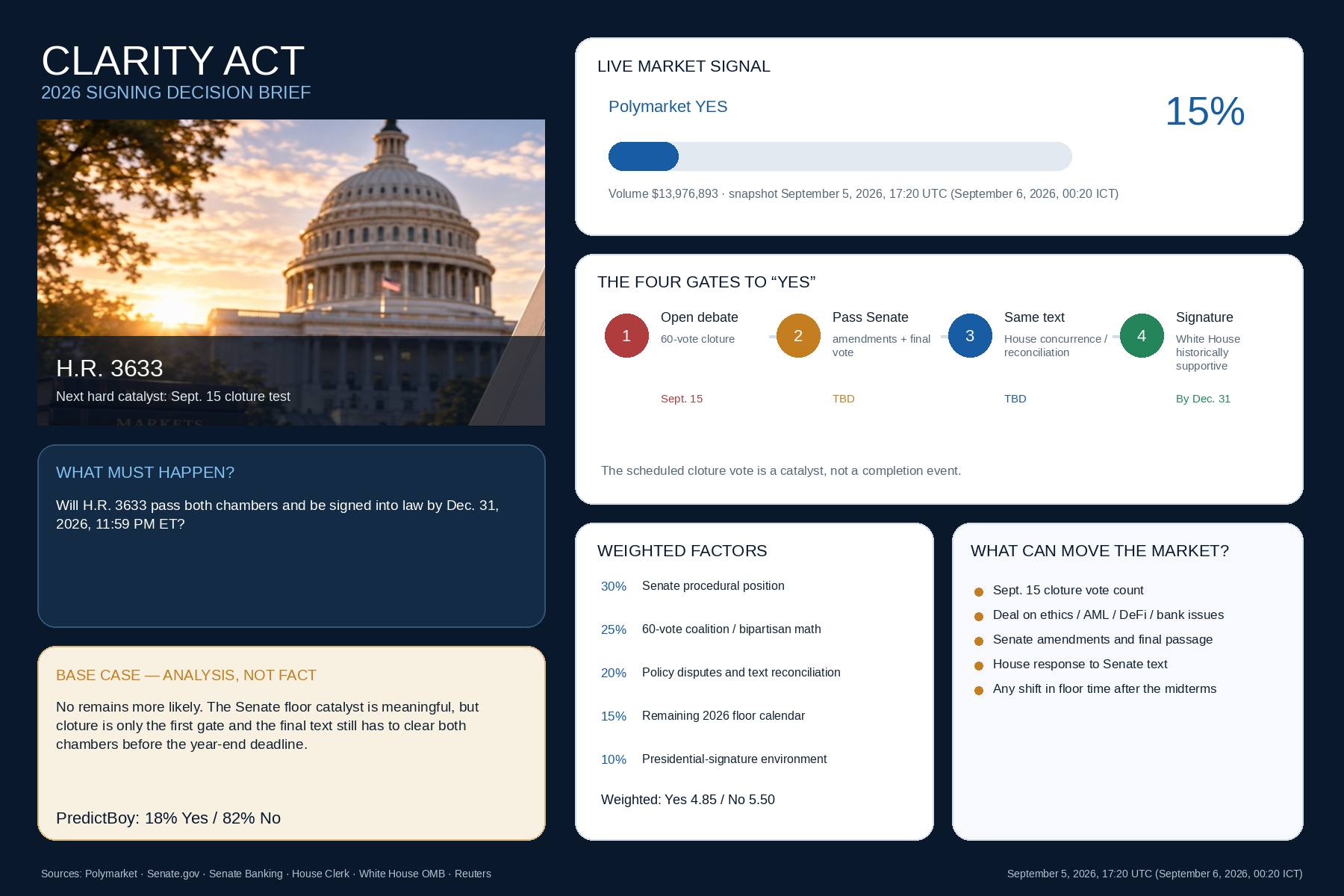
| Senate procedural position | 30% | Yes 6.0/10 · No 4.0/10 | Committee advanced H.R. 3633 15-9; cloture on the motion to proceed is set to ripen September 15. | A real floor catalyst exists, but it is only the gateway to debate. |
| 60-vote coalition / bipartisan math | 25% | Yes 4.0/10 · No 6.5/10 | Cloture requires 60 votes; the Senate lineup is 53 Republicans, 45 Democrats and 2 Independents. | Leadership needs cross-party support even if every Republican backs cloture. |
| Policy disputes and text reconciliation | 20% | Yes 3.5/10 · No 7.0/10 | Reuters and Senate materials identify unresolved ethics, illicit-finance, bank/rewards, developer-protection and commodities-text issues. | Amendments can consume time and may create a text the House must reconsider. |
| Remaining 2026 floor calendar | 15% | Yes 3.0/10 · No 7.5/10 | The Senate returns September 14, then has an extended October-to-election state-work period; target adjournment is December 18. | The path must fit Senate debate, House agreement and presentation to the President before December 31. |
| Presidential-signature environment | 10% | Yes 9.0/10 · No 1.5/10 | The July 2025 Statement of Administration Policy said senior advisers would recommend signing H.R. 3633 in its then-current form. | If Congress sends an acceptable final H.R. 3633 to the President, the signature step looks comparatively less risky. |
| Weighted total | 100% | Yes 4.85/10 · No 5.50/10 | No leads the model, but the September floor catalyst prevents me from treating the bill as dead. | |
The weighted framework favors No because three sequential risks stack together: a 60-vote procedural gate, unresolved policy/text negotiations, and a shrinking congressional calendar. The strongest counterweight is that the bill is not starting from zero—it has already passed the House, cleared Senate Banking, and has an announced floor catalyst plus historically supportive executive-branch messaging.
Congressional and Policy Evidence Analysis
The House result was genuinely bipartisan
The House Clerk records H.R. 3633 passing 294–134 on July 17, 2025. Republicans voted 216–0 among those voting, while Democrats split 78 Yes to 134 No. That history matters because a later House concurrence vote is not automatically impossible if the Senate sends back a modified bill.
Senate Banking cleared a substitute, not the finish line
On May 14, 2026, the Senate Banking Committee advanced H.R. 3633 by 15–9 with an amendment in the nature of a substitute. On June 1 it was placed on the Senate Legislative Calendar as Calendar No. 423. Those are substantial milestones, but they also create a reconciliation issue: the Senate text can diverge from the House text.
September 15 is a 60-vote gateway
The official Senate cloture ledger records the August 8 filing on H.R. 3633, and the Senate Daily Press schedule says the motion ripens September 15 at 2:15 p.m. Cloture on a motion to proceed is not a vote to enact the bill. It is a vote to limit debate on whether to take the measure up. A failure there would be a major negative signal because leadership would have to find another path with even less calendar room.
Policy disputes are not cosmetic
Reuters reported that the bill faced long odds after the August delay, citing unresolved disagreements over ethics provisions, anti-money-laundering safeguards and protections for community banks. Senate Banking minority staff has separately criticized the bill on investor protection, illicit finance, systemic risk and ethics grounds. These disagreements can affect both Democratic support and the form of any floor amendments.
What the Market May Be Underestimating
The market may be slightly underestimating how quickly congressional momentum can change after a successful cloture vote. A 60-vote result would provide a public signal that a cross-party coalition exists, and the House’s 2025 vote shows that digital-asset market structure can attract more than a bare partisan majority. The administration’s stated willingness to sign the House version also means the final presidential step is not the principal bottleneck.
That is why my Yes estimate is modestly above Polymarket’s locked 15% headline value. I am not assuming passage; I am assigning some option value to a favorable procedural surprise followed by accelerated bargaining.
Bull and Bear Case for the Major Outcomes
Yes bull case
- September 15 cloture clears 60 votes with a visible bipartisan coalition.
- Leadership contains the amendment process and settles the main ethics/AML/bank/jurisdiction disputes quickly.
- The Senate passes a version the House can accept without a long conference process.
- The White House remains supportive of the final product and signs promptly.
No bear case
- Cloture fails or barely succeeds, exposing a fragile coalition.
- Floor amendments reopen negotiations or split supporters.
- The Senate and House cannot agree on identical text before the holiday adjournment window.
- The bill slips into 2027—even if lawmakers still intend to legislate later, that would be No for this contract.
Risks and Uncertainties
The largest uncertainty is vote counting. Public statements do not always reveal how senators will vote on a specific procedural motion, especially when negotiations remain active. The second uncertainty is text: a late compromise can simultaneously improve the vote count and create new House-reconciliation risk. The third is calendar control. Leadership can change the floor schedule, but competing nominations, appropriations and post-election business can crowd out time.
There is also a resolution-mechanics risk for traders: if Congress enacts similar crypto market-structure policy through another vehicle, that does not necessarily satisfy a Polymarket rule explicitly naming H.R. 3633. Traders should read the final legislative vehicle and the market’s published rule, not only headlines saying “crypto clarity passed.”
PredictBoy Probability Assessment
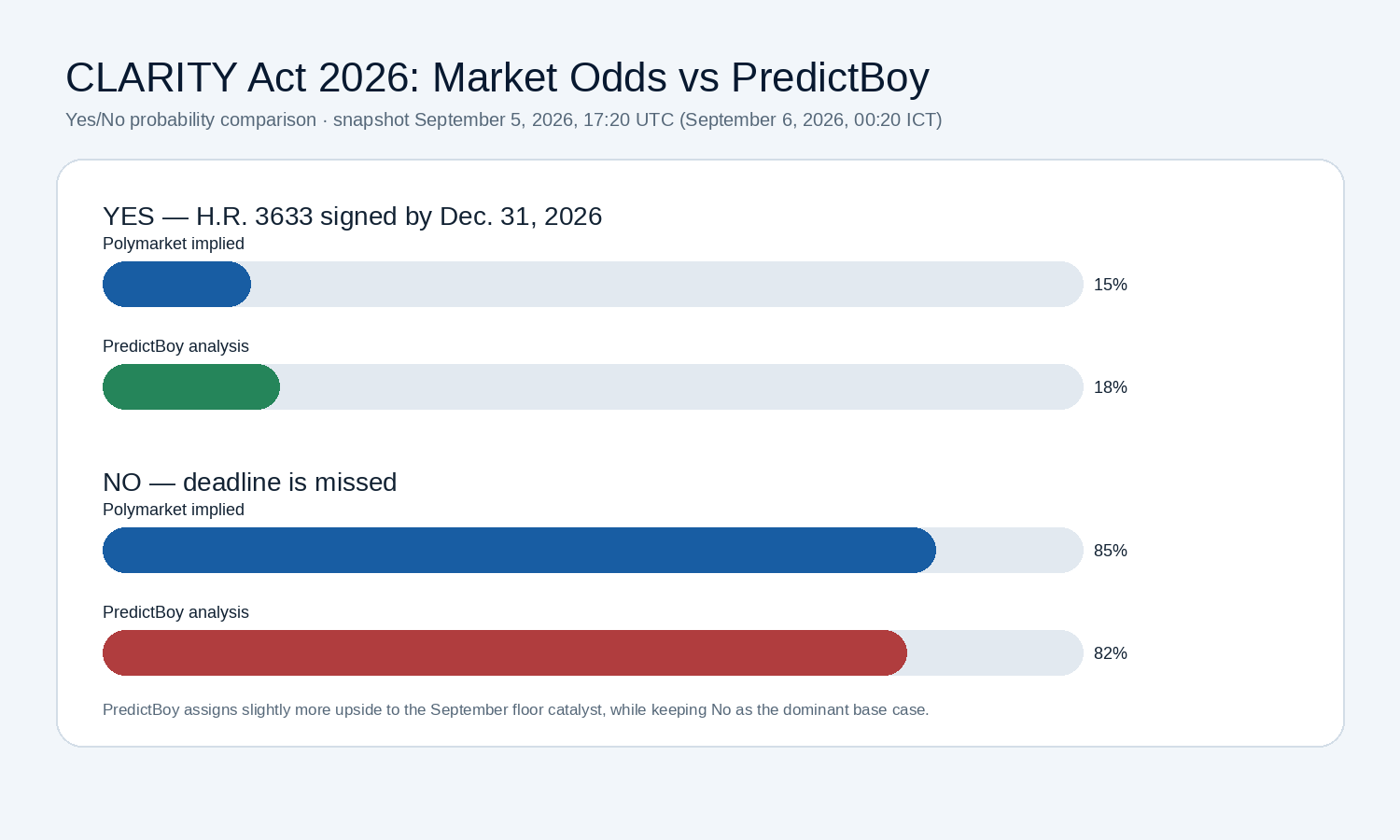
PredictBoy analysis: I assign 18% Yes and 82% No as of the research snapshot. This is an analytical judgment, not a verified fact or guaranteed probability.
The gap between my 18% and the market’s approximately 15% is small on purpose. I think the scheduled cloture test and historical bipartisan House support give Yes a little more upside than the current market headline suggests, but I still see the compounded Senate, reconciliation and calendar hurdles as decisive.
Market Odds vs. PredictBoy
| Outcome | Polymarket | PredictBoy | Difference |
|---|---|---|---|
| Yes | 15% | 18% | PredictBoy +3 pts |
| No | 85% | 82% | PredictBoy -3 pts |
What Could Change Before Resolution
- September 15 cloture result: the single most immediate catalyst.
- Named Democratic/Independent support: public commitments can clarify whether the 60-vote threshold is reachable.
- Manager’s amendment or bipartisan floor package: could resolve—or expose—remaining policy disputes.
- Senate final passage: would shift attention sharply to House concurrence and the legislative calendar.
- House scheduling: a quick concurrence vote would materially improve the Yes path.
- White House position on the final Senate text: important if material amendments differ from the 2025 House version the administration previously supported.
Final Take
PredictBoy analysis, not fact: No is still my base case. H.R. 3633 is alive, has already cleared meaningful milestones, and has a concrete September 15 Senate catalyst. But the market is not asking whether the bill receives attention or even whether the Senate takes it up—it requires both chambers to finish the same bill and the President to sign it before the end of 2026. With a 60-vote procedural gate, substantive unresolved disputes and limited floor time, I put the Yes path at 18% and the No path at 82% today.
Sources
- Polymarket — Clarity Act (H.R. 3633) signed into law in 2026?
- Congress.gov — H.R. 3633 tracker
- U.S. House Clerk — Roll Call 199, H.R. 3633 passage
- Senate Banking Committee — May 14, 2026 markup result
- U.S. Senate — 119th Congress cloture motions
- U.S. Senate Daily Press — September floor schedule
- U.S. Senate — Tentative 2026 Legislative Schedule
- White House OMB — Statement of Administration Policy on H.R. 3633
- Reuters — Senate delay and unresolved issues, August 10, 2026
Disclosure: PredictFact provides educational analysis of prediction markets. Market prices are dynamic signals, not guaranteed probabilities. Nothing here is financial, investment, legal, or trading advice.