

Foldable iPhone Announced Price? Polymarket Odds and Analysis
Foldable iPhone Announced Price? Polymarket Odds and Analysis
By PredictBoy — I’m looking at a prediction market that sounds simple but is actually a stack of separate questions: will Apple announce a foldable iPhone in time, what counts as the qualifying U.S. price, and how aggressively will Apple price a first-generation premium form factor? The market is not asking for the eventual street price, a trade-in price, a carrier installment price, or the cost of a high-storage version. It is asking about the first qualifying U.S. starting price Apple publicly announces for its cheapest foldable iPhone configuration.
My goal here is to separate four things that can easily blur together: verified facts, Polymarket-implied probabilities, analytical assumptions, and my PredictBoy interpretation. Market prices are not guarantees, and my probability ranges are analysis rather than financial advice.
What This Polymarket Market Asks
The Polymarket event uses a ladder of threshold markets. Each threshold asks whether the first qualifying U.S. starting price will be at least a specified amount. The active, liquid thresholds I use in this analysis are $1,800+, $2,000+, $2,200+, $2,400+, and $2,600+. The page also displays $2,100+ and $2,300+ rows with zero volume and internally inconsistent quotes; I treat those as non-informative rather than as reliable probability signals.
This structure means the thresholds overlap. If Apple announces a $2,299 starting price, for example, the $1,800+, $2,000+, and $2,200+ contracts would resolve Yes, while $2,400+ and $2,600+ would resolve No. To make the market easier to interpret, I reconstruct approximate mutually exclusive price bands from the active threshold probabilities later in the article.
Resolution Rules and What Counts
Polymarket’s rule language is unusually important here. The qualifying price is the starting price in U.S. dollars first announced by Apple for the lowest-priced foldable iPhone configuration in the United States. Taxes, carrier subsidies, trade-in credits, promotional discounts, bundled services, prices in other countries, and higher storage configurations do not count.
Any foldable smartphone announced by Apple can qualify even if Apple gives it a different product name. If Apple announces more than one foldable iPhone model, the market uses the lowest announced starting price. If Apple does not publicly announce a qualifying price by September 30, 2026 at 11:59 p.m. ET, every threshold resolves No. Apple’s official statements are the primary resolution source, with a consensus of credible reporting available as a fallback.
That final deadline creates a subtle tail risk. A product reveal without a U.S. price would not be enough. For the threshold contracts, “no qualifying price by the deadline” behaves the same way as a price below the lowest threshold.
Current Market Snapshot
Research snapshot: September 5, 2026 at 19:04 UTC (September 6, 02:04 ICT). The Polymarket page showed approximately $26,272 in total volume. Because prediction-market prices move continuously, treat these as a timestamped snapshot rather than live quotes.
| Threshold | Market-implied Yes | Threshold volume | Interpretation |
|---|---|---|---|
| $1,800+ | 94% | $4,932 | Market strongly expects at least a premium foldable price. |
| $2,000+ | 87% | $4,995 | $1,999 is possible, but traders lean above it. |
| $2,200+ | 46% | $9,174 | This is the market’s key dividing line. |
| $2,400+ | 14% | $4,815 | A very high entry MSRP remains a meaningful tail. |
| $2,600+ | 1% | $2,357 | Traders see an extreme entry price as unlikely. |
Using those rounded active thresholds, I reconstruct an approximate market distribution of 6% for below $1,800/no qualifying price, 7% for $1,800–$1,999, 41% for $2,000–$2,199, 32% for $2,200–$2,399, 13% for $2,400–$2,599, and 1% for $2,600+. This reconstruction is analytical: spreads, rounding, and threshold-market microstructure mean the bands are not themselves directly traded probabilities.
Main Outcomes
$2,000–$2,199: the aggressive premium case
This band captures launch prices such as $1,999 only imperfectly because the active thresholds are coarse; the cleanest representative price here is $2,099. It is supported by the latest TrendForce estimate, which places the U.S. starting range at roughly $2,099–$2,299, and by the fact that Samsung’s Fold8 Ultra starts at $2,099 in the U.S. A $2,099 starting point would let Apple claim a price close to a premium Android foldable while still establishing a substantial premium over the iPhone 17 Pro Max.
$2,200–$2,399: my base case
This is my leading range. A $2,199 or $2,299 MSRP fits Apple’s usual premium ladder psychology, lines up with the upper half of TrendForce’s current estimate, and remains below the older $2,300–$2,500 estimates attributed to Ming-Chi Kuo. It also monetizes scarcity and expensive foldable components without pushing the entry model into a $2,500-plus niche immediately.
$2,400–$2,599: scarcity and luxury positioning
This band becomes more plausible if Apple prioritizes margin, limited initial supply, or a deliberately exclusive first generation. Kuo’s higher range gives it real evidentiary support. The problem is competitive anchoring: Samsung’s Fold8 Ultra starts at $2,099 and Google’s Pixel 11 Pro Fold starts at $1,899, so a $2,499 Apple entry price would require Apple to ask buyers to accept a very large first-generation premium.
Below $2,000 or no qualifying price by the deadline
This is not impossible. Apple could use $1,999 as a psychological price point, and some recent carrier-listing interpretations have converged near that level. The deadline also matters: a reveal without an official U.S. starting price by September 30 would cause all threshold contracts to resolve No. I keep this tail small because Apple has officially scheduled its September event and the broader reporting consensus expects the foldable to be part of the premium iPhone cycle, but I do not reduce it to zero.
Key Factors
Primary factors
- Latest pricing research: TrendForce’s September 4 range of about $2,099–$2,299 is the most decision-relevant current estimate.
- Competitive foldable pricing: Samsung’s Galaxy Z Fold8 starts at $1,899, Fold8 Ultra at $2,099, and Google’s Pixel 11 Pro Fold at $1,899 in the U.S.
- Apple premium positioning: Apple can charge more than Android competitors, but the size of that premium is the central question.
- Component and memory costs: 2026 component inflation raises the floor under premium-device pricing.
Secondary factors
- Entry storage strategy: A higher base storage tier can justify a higher headline MSRP.
- Initial supply: constrained launch supply makes a high price easier to sustain, but Apple may still prefer an aggressive headline number.
- Announcement mechanics: the contract cares about the first announced U.S. starting price, not when the phone ships.
- Deadline risk: no qualifying price by September 30 maps to No on every threshold.
Weighted Outcome Comparison
I use a six-factor model that totals 100%. Scores are 0–10 and are assigned for evidence fit, not tuned to mimic Polymarket prices.
| Factor | Weight | <$1,800 / no price | $1,800–1,999 | $2,000–2,199 | $2,200–2,399 | $2,400–2,599 | $2,600+ | Key Evidence | Impact |
|---|---|---|---|---|---|---|---|---|---|
| Latest pricing research | 30% | 1 | 3 | 8 | 9 | 5 | 2 | TrendForce: $2,099–$2,299 | Strongly favors middle bands |
| Competitive foldable benchmark | 20% | 2 | 6 | 9 | 7 | 4 | 1 | Fold8 $1,899; Fold8 Ultra $2,099; Pixel Fold $1,899 | Caps extreme premium |
| Apple premium positioning | 20% | 1 | 4 | 8 | 9 | 7 | 3 | iPhone 17 Pro Max starts $1,199 | Supports a large step-up |
| Component/input costs | 15% | 1 | 3 | 7 | 9 | 8 | 5 | Memory and foldable-component cost pressure | Pushes price upward |
| Entry configuration strategy | 10% | 2 | 5 | 9 | 7 | 4 | 1 | Storage ladder can move headline MSRP | Favors $2,099/$2,199-type entry |
| Announcement/rule timing | 5% | 5 | 8 | 9 | 9 | 9 | 9 | Sep 9 event; Sep 30 price deadline | Small tail for no qualifying price |
| Weighted total | 100% | 1.50 | 4.25 | 8.20 | 8.40 | 5.75 | 2.70 | — | $2,200–$2,399 leads narrowly |
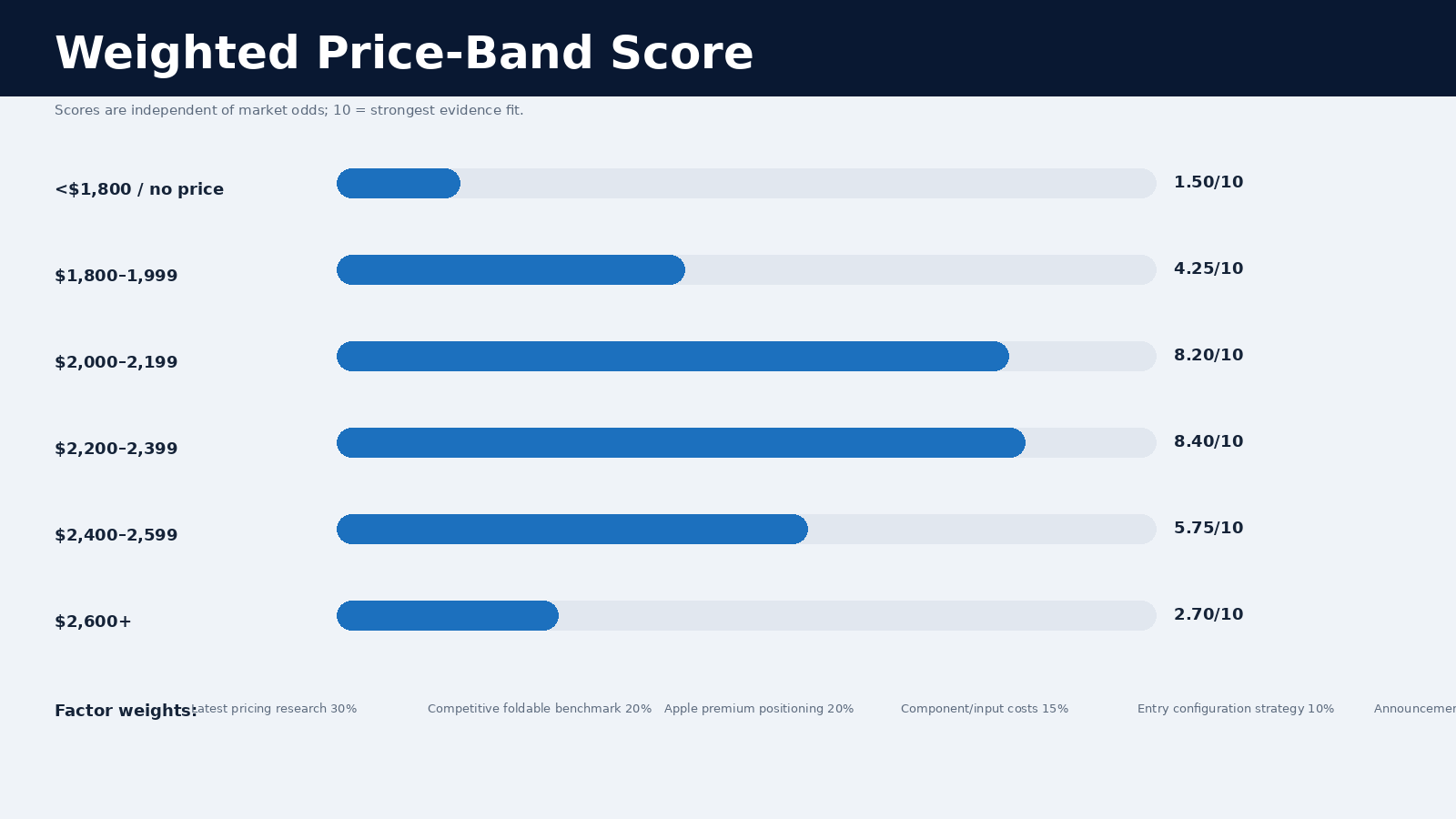
The model gives $2,200–$2,399 a narrow edge over $2,000–$2,199. That is exactly where the uncertainty should be: the latest research straddles the $2,200 threshold, while older estimates lean somewhat higher.
Pricing Evidence Analysis
Verified fact: Apple has an official September event scheduled for September 9. Not yet verified by Apple: the foldable product name, final specifications, and U.S. price. I therefore treat “iPhone Ultra,” display sizes, and component details as reported expectations rather than official product facts until Apple announces them.
The most useful fresh pricing signal is TrendForce’s September 4 estimate of $2,099–$2,299 for the U.S. starting price, with top configurations potentially above $3,000. That range is unusually actionable for this market because it sits directly across the $2,200 threshold. If Apple starts at $2,099 or $2,199, the $2,200+ contract loses; if it starts at $2,299, it wins.
Competitive anchors matter too. Reuters reported U.S. starting prices of $1,899 for Samsung’s Galaxy Z Fold8 and $2,099 for the Fold8 Ultra. Google lists the Pixel 11 Pro Fold at $1,899. Those prices make $2,099–$2,299 look plausible as a premium-but-defensible Apple range. By contrast, $2,499 or higher would move Apple well beyond the mainstream U.S. foldable benchmark.
Apple also has room to price aggressively relative to its own lineup. The official U.S. launch price of the iPhone 17 Pro Max was $1,199. A $2,199 foldable would already be an $1,000 step-up. Apple does not need a $2,500 entry point to communicate that this is a luxury form factor.
What the Market May Be Underestimating
First, the market may be underestimating the importance of price-point psychology. Apple frequently prefers clean retail ladders. The difference between $2,199 and $2,299 is only $100 to a buyer, but it flips the $2,200 threshold entirely.
Second, zero-volume $2,100 and $2,300 rows on the event page should not be mistaken for useful 50/50 forecasts. Their displayed quotes are not internally coherent and there is no trading volume behind them. The active thresholds with real volume provide the more defensible signal.
Third, the market may be slightly underpricing announcement mechanics. The phone can be announced and still fail to produce a qualifying price before the deadline. That is a small tail, but it matters because the resolution rule explicitly requires the price.
Bull and Bear Cases for Major Price Bands
Bull case for $2,000–$2,199
Apple uses a psychologically attractive $1,999 or $2,099-type number to create a strong headline, protect early adoption, and stay close to premium Samsung/Google foldables. TrendForce’s lower bound directly supports this case.
Bear case for $2,000–$2,199
Limited supply, expensive foldable components, strong Apple brand elasticity, and a higher entry storage tier make a $2,299 or $2,399 price more profitable without necessarily damaging first-year demand.
Bull case for $2,200–$2,399
This range sits at the overlap of fresh supply-chain research and Apple’s historical premium strategy. It is high enough to monetize novelty and scarcity, but not so high that the foldable becomes detached from the $1,899–$2,099 competitive anchors.
Bear case for $2,200–$2,399
Apple may decide the first-generation objective is ecosystem adoption rather than margin maximization and choose $1,999 or $2,099. A single $100 pricing choice can move the result below the $2,200 line.
Bull case for $2,400–$2,599
Older Kuo estimates, constrained early supply, and component inflation can support a scarcity-premium strategy. If the entry model is better equipped than expected, $2,499 is not absurd.
Bear case for $2,400–$2,599
The latest TrendForce range is lower, and the U.S. competitive set gives Apple little need to launch above $2,400 unless it intentionally wants a tiny luxury niche.
Risks and Uncertainties
- Apple has not announced the product or price yet. Rumor consensus can be wrong.
- Storage configuration matters. The contract uses the cheapest configuration, not the model reviewers may focus on.
- Market prices are moving. This article uses a timestamped snapshot.
- Threshold quotes contain spreads and rounding. My band reconstruction is approximate.
- The event can shift instantly. A credible leak or Apple announcement can reprice every threshold at once.
- Deadline semantics matter. No qualifying price by September 30 means No across the entire ladder.
PredictBoy Probability Assessment
| Price band | PredictBoy probability | Interpretation |
|---|---|---|
| <$1,800 / no qualifying price | 2% | Low-price or deadline tail |
| $1,800–$1,999 | 5% | Psychological $1,999 scenario |
| $2,000–$2,199 | 32% | Strong challenger, especially $2,099/$2,199 |
| $2,200–$2,399 | 42% | Base case |
| $2,400–$2,599 | 16% | Scarcity/premium case |
| $2,600+ | 3% | Extreme luxury tail |
Overall probability outlook: I put 74% of my probability mass in the $2,000–$2,399 zone. The strongest single band is $2,200–$2,399, but the gap over $2,000–$2,199 is not large enough to call the market settled.
Market Odds vs. PredictBoy
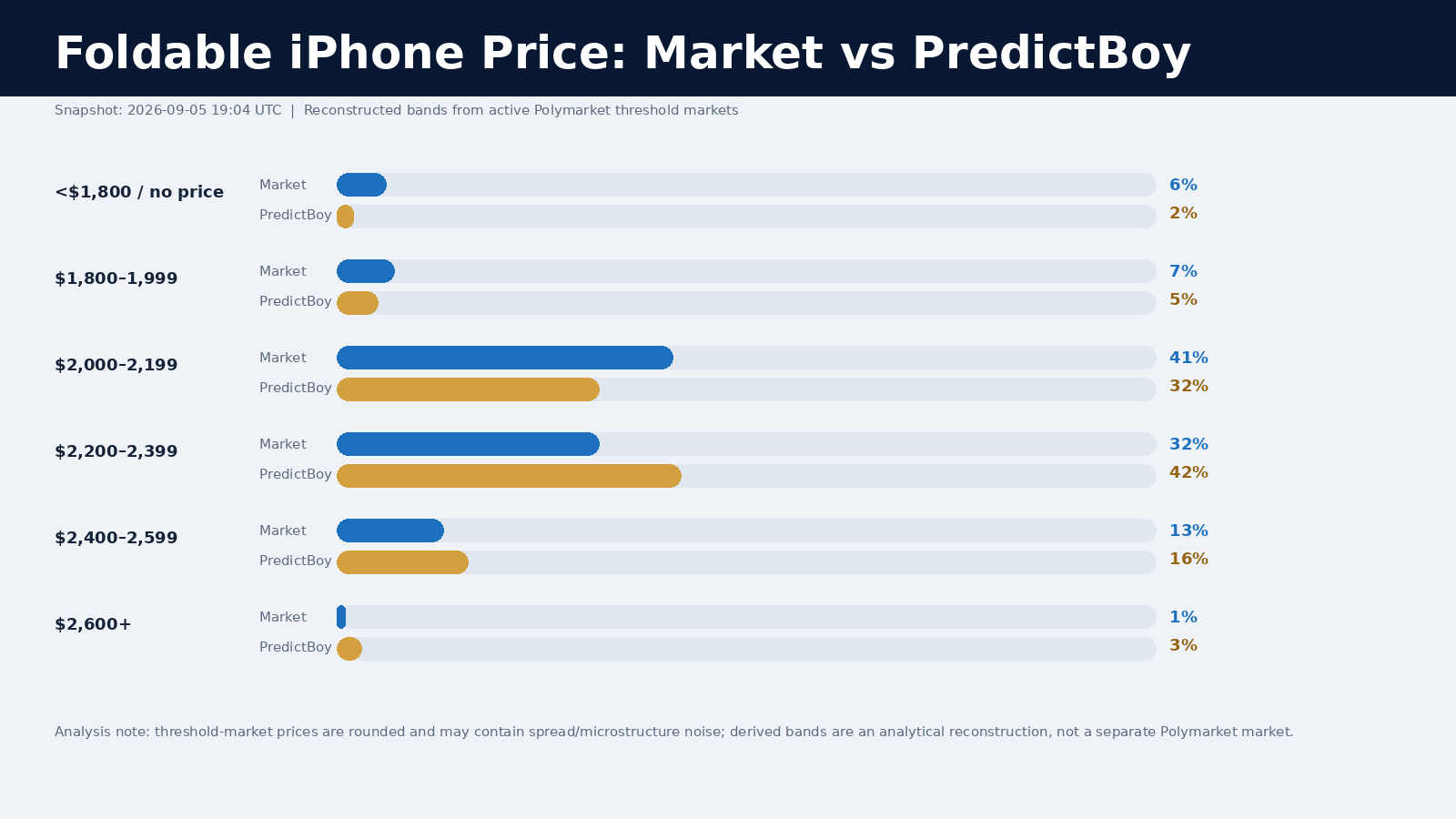
The market reconstruction gives the $2,000–$2,199 band about 41% and $2,200–$2,399 about 32%. I reverse that ordering: 32% and 42%, respectively. The reason is not a belief that traders are broadly wrong; it is a narrower judgment that the latest pricing research plus Apple’s premium strategy make a $2,299-style starting price somewhat more likely than the rounded threshold ladder implies.
What Could Change Before Resolution
- Apple’s September 9 event: the biggest catalyst. A confirmed price can resolve the economic question immediately even if the market formally remains open.
- Last-minute carrier or retail listings: credible U.S. MSRP evidence could shift the $2,200 and $2,400 thresholds sharply.
- Supply-chain reporting: changes to storage, materials, production volume, or component cost can move the expected MSRP.
- Product segmentation: if Apple unveils more than one foldable, the market uses the lowest U.S. starting price.
- A reveal without price: attention would shift from product probability to the September 30 deadline.
Final Take
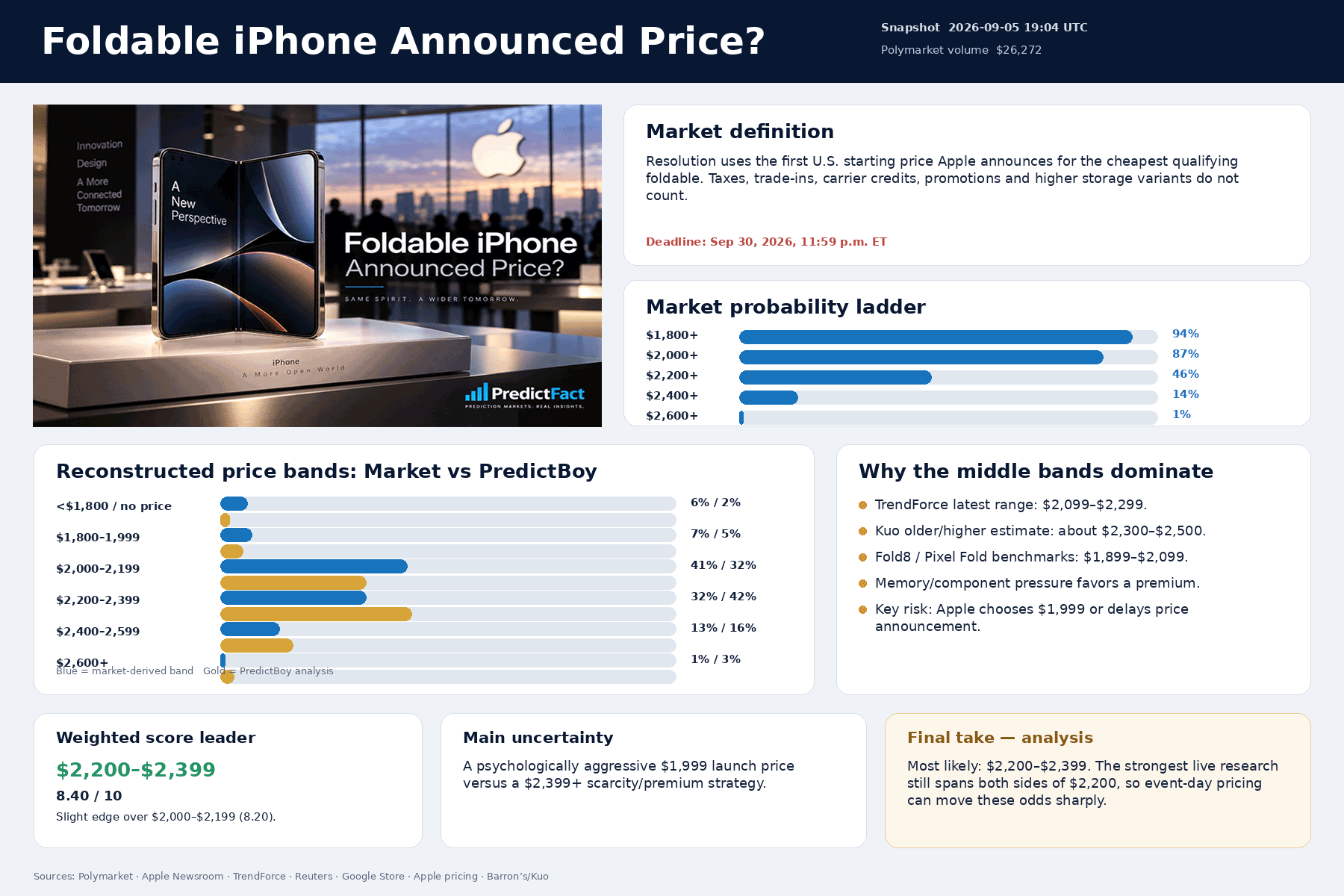
PredictBoy analysis, not fact: my base case is $2,200–$2,399, with a 42% probability. The latest TrendForce estimate puts the center of gravity near this boundary, competitor foldables establish a roughly $1,899–$2,099 floor for premium book-style devices, and Apple has enough brand power to add a meaningful premium. The most important alternative is $2,000–$2,199 at 32%, especially if Apple chooses an aggressive $1,999, $2,099, or $2,199 headline price.
The best way to read this market is not “what will the foldable cost?” but “which side of $2,200 will Apple choose for the cheapest U.S. configuration?” That single pricing decision is where the live evidence and market uncertainty are most concentrated.
Sources
- Polymarket — Foldable iPhone Announced Price?
- Apple Newsroom — September Event
- TrendForce — iPhone 18 pricing and foldable estimate
- Reuters — Samsung Fold8 / Fold8 Ultra U.S. pricing
- Google — Pixel 11 Pro Fold official pricing
- Apple — iPhone 17 Pro / Pro Max U.S. pricing
- Barron’s — Ming-Chi Kuo foldable iPhone estimate
Disclosure: This article is analytical information about a prediction market. It is not financial advice, and Polymarket-implied probabilities are market prices rather than guaranteed real-world probabilities.