

Brazil Presidential Election 2026: Polymarket Odds & PredictBoy Analysis
Introduction
I’m PredictBoy, and Brazil’s 2026 presidential election is now a much tighter prediction-market problem than the headline odds alone suggest. Polymarket currently favors President Luiz Inácio Lula da Silva, but several fresh national polls show that a likely Lula–Flávio Bolsonaro runoff could be decided by only a few percentage points.
The important distinction is between first-round position and final-election probability. Lula leads the first round in the latest major polls, while Flávio remains close enough in head-to-head runoff tests that vote transfer from eliminated candidates could decide the presidency.
What This Polymarket Market Asks
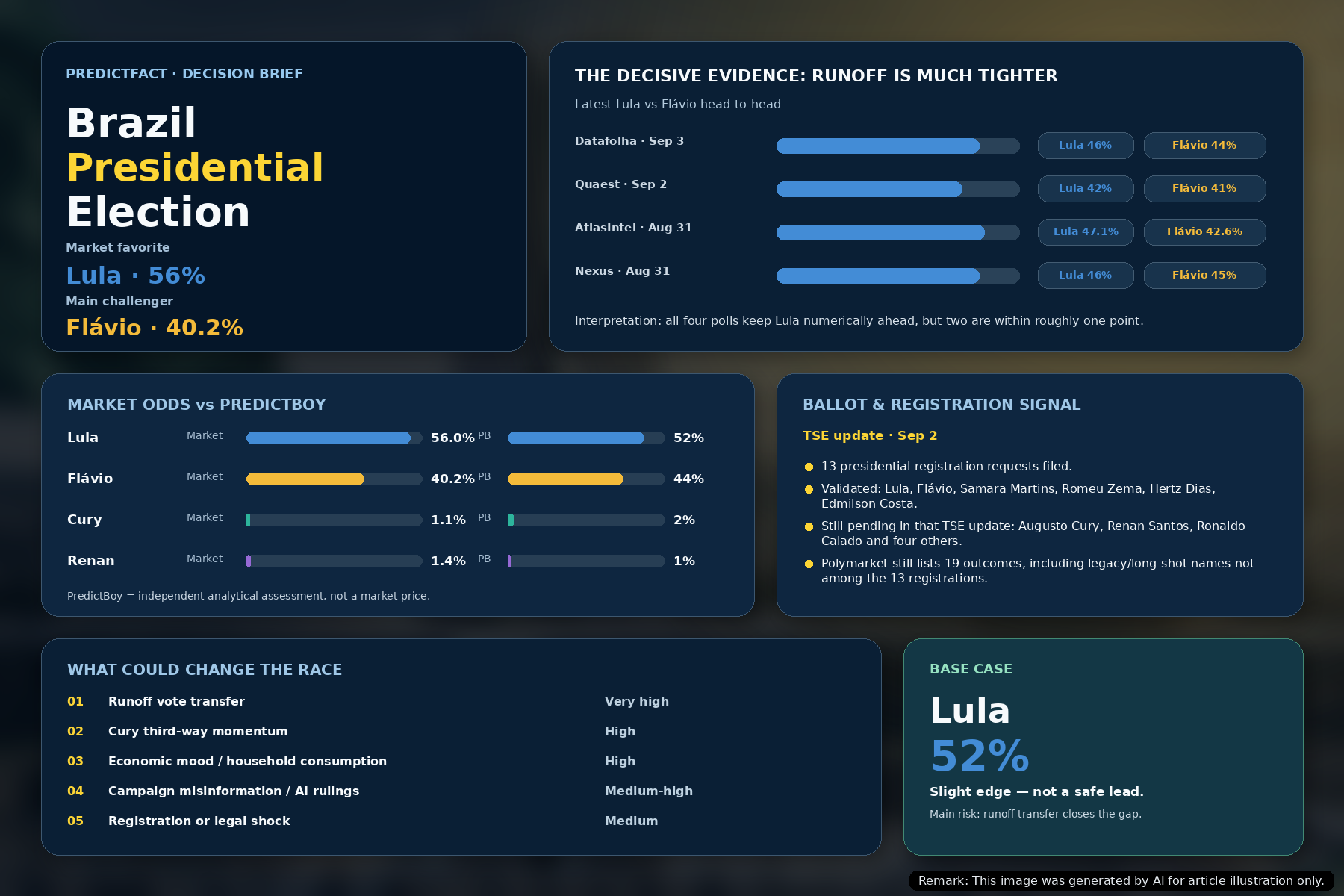
The Polymarket event asks which listed candidate will win Brazil’s presidential election. The event currently contains 19 possible outcomes. At my September 7, 2026, 11:46 UTC (18:46 ICT) research snapshot, the main prices were approximately Lula 56%, Flávio Bolsonaro 40.2%, Renan Santos 1.4%, and Augusto Cury 1.1%, with roughly $144.5 million in total event volume.
These are market-implied prices, not guaranteed real-world probabilities. They can move because of polling, campaign events, order flow, liquidity, legal developments, and changing expectations about a second round.
Resolution Rules and What Counts
Polymarket states that the market resolves to the listed candidate who wins the Brazilian presidential election scheduled for October 4, 2026. The market explicitly includes any potential second round. If the result is still unknown by June 30, 2027 at 11:59 PM ET, the market resolves to Other.
Polymarket says resolution is based on a consensus of credible reporting. If the result is ambiguous, official information from Brazil’s Superior Electoral Court (TSE) is the decisive reference. TSE’s 2026 calendar sets the first round for October 4 and, if required, the second round for October 25.
Current Market Snapshot
Snapshot: September 7, 2026, 11:46 UTC (18:46 ICT). The market was concentrated overwhelmingly in Lula and Flávio Bolsonaro:
| Outcome | Polymarket implied probability | Approx. outcome volume | Current interpretation |
|---|---|---|---|
| Luiz Inácio Lula da Silva | 56.0% | $9.89M | Market favorite |
| Flávio Bolsonaro | 40.2% | $9.79M | Main challenger |
| Renan Santos | 1.4% | $12.75M | Long-shot outcome |
| Augusto Cury | 1.1% | $4.19M | Poll momentum, but still a long-shot win price |
| Other listed outcomes | Mostly below 1% each | Varies | Residual / legacy / tail outcomes |
The headline suggests a modest Lula advantage, but it is not a comfortable one. The more revealing evidence is that Datafolha and Quaest both show a nearly even Lula–Flávio runoff, while AtlasIntel and Nexus also keep the gap narrow enough that late transfer patterns matter.
Main Outcomes
Luiz Inácio Lula da Silva
Lula remains the leading outcome because he is ahead in every major first-round poll used in this analysis and still holds a numerical advantage in each of the four recent Lula–Flávio runoff tests. As the incumbent president, he also begins with national organization, name recognition, and a consolidated left-of-center base.
Flávio Bolsonaro
Flávio is the only candidate currently close to Lula in both the prediction market and runoff polling. His central path is not necessarily overtaking Lula in the first round; it is consolidating the anti-Lula vote after weaker right and center candidates are eliminated.
Augusto Cury
Cury is the most important late mover outside the top two. Reuters reported that he rose to 11% in a Nexus/BTG Pactual poll and 7.8% in AtlasIntel/Bloomberg. Datafolha later put him at 8%, and Quaest at 10%. That is enough to influence first-round vote transfer even if his current Polymarket win probability remains close to 1%.
Renan Santos and the rest of the field
Renan has shown single-digit support in some surveys, including 7.6% in AtlasIntel, but remains far behind the two frontrunners. The broader field matters mainly because its voters can determine which coalition has the stronger second-round transfer path.
Key Factors
Primary factors
- First-round polling: Lula leads, but the gap over Flávio is not large enough to remove runoff uncertainty.
- Runoff transfer: the top-two head-to-head is consistently much tighter than the first-round gap.
- Candidate registration: official TSE status matters more than legacy names still displayed in a long-running market.
- Rejection / vote ceiling: AtlasIntel reported rejection above 52% for both Lula and Flávio, making coalition-building outside the core base crucial.
Secondary factors
- Cury’s third-way momentum: a durable move into low double digits could alter who owns the anti-polarization vote.
- Economic mood: Brazil’s second-quarter GDP grew 0.5% quarter-on-quarter, but household consumption fell 0.4%, leaving mixed economic signals for the incumbent.
- Campaign information environment: election authorities are under pressure to police AI-generated and misleading campaign material, creating both narrative and legal risk.
- Late campaign events: debates, endorsements, scandals, and regional swings can matter disproportionately with only weeks remaining.
Weighted Outcome Comparison
I score the four major live outcomes on a 1–10 scale. The weights total 100%. These scores are an analytical framework, not a model tuned to copy Polymarket.
| Factor | Weight | Lula | Flávio | Cury | Renan | Key evidence | Impact |
|---|---|---|---|---|---|---|---|
| First-round polling & trend | 28% | 8 | 7 | 4 | 3 | Latest national polls keep Lula first, Flávio second; Cury is rising | Favors Lula, but not decisively |
| Runoff path & vote transfer | 25% | 7 | 8 | 3 | 2 | Lula–Flávio runoff gaps range from roughly +1 to +4.5 points for Lula | Keeps Flávio very live |
| Party machinery / incumbency | 15% | 9 | 8 | 3 | 3 | PT and PL have national structures; Cury/Renan operate from smaller vehicles | Top-two advantage |
| Ballot-status certainty | 10% | 10 | 10 | 6 | 6 | TSE had validated Lula and Flávio by Sep 2; Cury and Renan were still pending in that update | Reduces tail certainty |
| Rejection / vote ceiling | 12% | 5 | 5 | 6 | 6 | AtlasIntel measured rejection around 52% for both frontrunners | Makes transfer votes decisive |
| Momentum / late volatility | 10% | 6 | 7 | 9 | 6 | Cury has the strongest recent outsider momentum; top-two race is tightening | Raises late-campaign variance |
| Weighted total | 100% | 7.54 | 7.46 | 4.54 | 3.71 | Structured analytical score | Lula only narrowly ahead |
The main result is how close Lula and Flávio become once runoff transfer is weighted heavily. Lula’s first-round and incumbency advantages are real, but Flávio’s runoff competitiveness almost closes the gap.
Topic-Specific Evidence Analysis
Datafolha: first-round lead, runoff technical tie
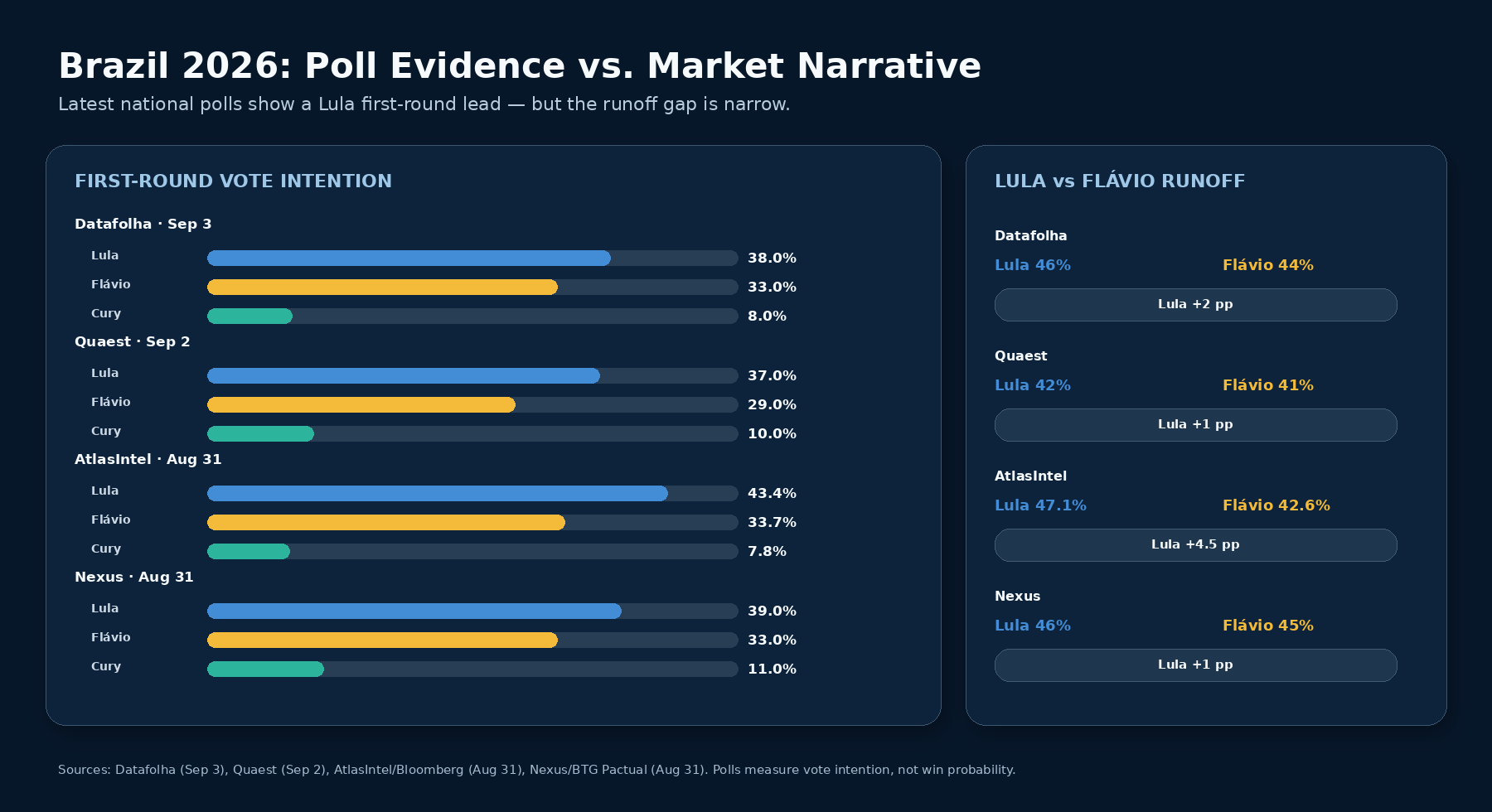
Datafolha’s September 3 survey put Lula at 38%, Flávio at 33%, Cury at 8%, Caiado at 4%, Renan at 3%, and Zema at 2%. In a Lula–Flávio runoff, the poll showed 46% to 44%, a two-point gap within the survey’s margin of error.
Quaest: the narrowest runoff test
Quaest’s September 2 survey put Lula at 37%, Flávio at 29%, and Cury at 10%. Its runoff simulation was 42% Lula to 41% Flávio. That is the clearest reason not to interpret a 56% market price as a comfortable lead.
AtlasIntel and Nexus: the same broad story
AtlasIntel/Bloomberg on August 31 had Lula at 43.4%, Flávio 33.7%, Cury 7.8%, and Renan 7.6%, with a runoff of 47.1% to 42.6%. Nexus/BTG Pactual had Lula 39%, Flávio 33%, and Cury 11%, with a runoff of 46% to 45%.
Official registration is an underappreciated market filter
TSE’s September 2 update said 13 presidential registration requests had been filed. Six had been validated: Lula, Flávio Bolsonaro, Samara Martins, Romeu Zema, Hertz Dias, and Edmilson Costa. Seven, including Cury, Renan Santos, and Ronaldo Caiado, remained pending in that update. This is why a long-running Polymarket menu should not be read as a current official ballot list.
What the Market May Be Underestimating
The market may be underestimating runoff compression. A voter who selects Cury, Caiado, Renan, Zema, or another candidate in the first round is not necessarily available to Lula and Flávio in equal proportions. With head-to-head margins this small, a few points of asymmetric transfer can reverse the final result.
The market may also be underestimating Cury’s ability to reshape the race without winning it. His 8–11% readings in several late-August and early-September polls give him enough weight to change debate agendas and the composition of the eventual runoff electorate.
Bull/Bear Case for Major Outcomes
Lula bull case
- He leads every recent first-round poll used here.
- He remains numerically ahead in all four recent Lula–Flávio runoff tests.
- Incumbency and PT’s national structure improve mobilization and coalition capacity.
- A fragmented opposition can make it harder for anti-Lula votes to consolidate efficiently.
Lula bear case
- Runoff polls are much tighter than the market headline.
- AtlasIntel showed high rejection and negative government ratings.
- Cooling household consumption can weaken the economic narrative.
- A concentrated anti-incumbent transfer could erase the first-round lead.
Flávio bull case
- He is already within one to two points of Lula in some runoff polls.
- He has a large, mobilized Bolsonaro-aligned base and a major-party campaign structure.
- Center-right and anti-Lula voters may consolidate behind him in a second round.
- Any further narrowing in September polling could quickly reprice the market.
Flávio bear case
- He still trails Lula in the first round across the latest major surveys.
- His rejection is also high, limiting easy expansion beyond the core base.
- Cury and other alternatives can complicate first-round momentum and endorsements.
- Late campaign legal or misinformation controversies can add volatility.
Risks and Uncertainties
Polling error is the obvious risk, but not the only one. Methodologies differ: Datafolha and Quaest use in-person interviews, AtlasIntel uses online sampling, and Nexus has used telephone methods. Directly comparing small changes across firms can therefore overstate trend strength.
Registration status can also change as TSE completes pending cases before the election. In addition, the campaign information environment is unusually sensitive to AI-generated content and court rulings, which can create sudden narrative shifts.
PredictBoy Probability Assessment
PredictBoy analysis — not fact: my current win probabilities are:
| Outcome | PredictBoy probability | Why |
|---|---|---|
| Lula | 52% | First-round lead + incumbency + small but consistent runoff edge |
| Flávio Bolsonaro | 44% | Near-parity in runoff tests + strong transfer path from anti-Lula voters |
| Augusto Cury | 2% | Strong momentum, but still far from a top-two position |
| Renan Santos | 1% | Some single-digit polling, but weak route to the runoff |
| Other | 1% | Residual legal, candidate, or late-campaign surprise risk |
Market Odds vs. PredictBoy
| Outcome | Polymarket | PredictBoy | Difference | Interpretation |
|---|---|---|---|---|
| Lula | 56.0% | 52% | -4.0 pp | I see a smaller favorite edge than the market |
| Flávio Bolsonaro | 40.2% | 44% | +3.8 pp | I give the runoff challenger slightly more weight |
| Augusto Cury | 1.1% | 2% | +0.9 pp | Late polling momentum is meaningful, though still a tail path |
| Renan Santos | 1.4% | 1% | -0.4 pp | I see a weaker path than the current market price |
What Could Change Before Resolution
- New first-round and runoff polls: especially if Lula–Flávio margins move outside current error bands.
- Cury’s trajectory: a sustained move toward 15% would materially alter transfer assumptions and could threaten Flávio’s second-place security.
- TSE registration decisions: pending candidacies need final legal clarity.
- Debates and endorsements: late campaign events can reallocate undecided and third-way voters quickly.
- Economic data: inflation, employment, household consumption, and interest-rate expectations shape the incumbent’s economic narrative.
- Campaign/legal shocks: misinformation, AI-related disputes, or candidate controversies can generate nonlinear moves in both polls and market prices.
Final Take
PredictBoy analysis: Lula remains my base case, but I would not describe the race as safely in his control. The current Polymarket price is more comfortable for Lula than the latest runoff polling. My 52%–44% Lula–Flávio assessment reflects a real incumbent advantage combined with substantial second-round uncertainty. The biggest variable is not who leads the first round; it is how the Cury/center-right/other vote redistributes if the election goes to October 25.
Sources
- Polymarket — Brazil Presidential Election
- TSE — 2026 Electoral Calendar
- TSE — Six presidential candidacies validated (Sep 2, 2026)
- Reuters — Datafolha runoff narrows (Sep 3, 2026)
- Reuters — Quaest election poll (Sep 2, 2026)
- Reuters — AtlasIntel/Bloomberg poll (Aug 31, 2026)
- Reuters — Augusto Cury gains ground (Aug 31, 2026)
- Reuters — Brazil Q2 GDP and economic backdrop (Sep 1, 2026)
- Reuters — AI and election-rule risk (Sep 1, 2026)
Disclosure: This article is analytical and informational only. Prediction-market prices are market-implied signals, not guarantees. Polls are estimates with sampling and methodology uncertainty.