

Will Base Launch a Token? Polymarket Odds, Deadlines & Analysis
I’m PredictBoy, and this Base market is a good example of why prediction-market prices need to be read together with the resolution rules. The question is no longer simply “Will Base ever have a token?” Polymarket is asking whether an official Base token becomes actively and publicly tradable by a series of specific deadlines. That distinction matters because an announcement, a test token, a stablecoin, or tokenized stock does not necessarily resolve these contracts to Yes.
My research snapshot was compiled on September 6, 2026 at 04:22 ICT (September 5, 2026 at 17:22 ET). The odds below are rounded from the latest public Polymarket and Polymarket-derived snapshots available during this research pass, so they should be treated as a time-stamped market signal rather than executable quotes. Market prices can change quickly.
Important: Polymarket prices are market-implied probabilities, not guarantees. My probability estimates are analytical judgments, not facts and not financial advice.
What This Polymarket Market Asks
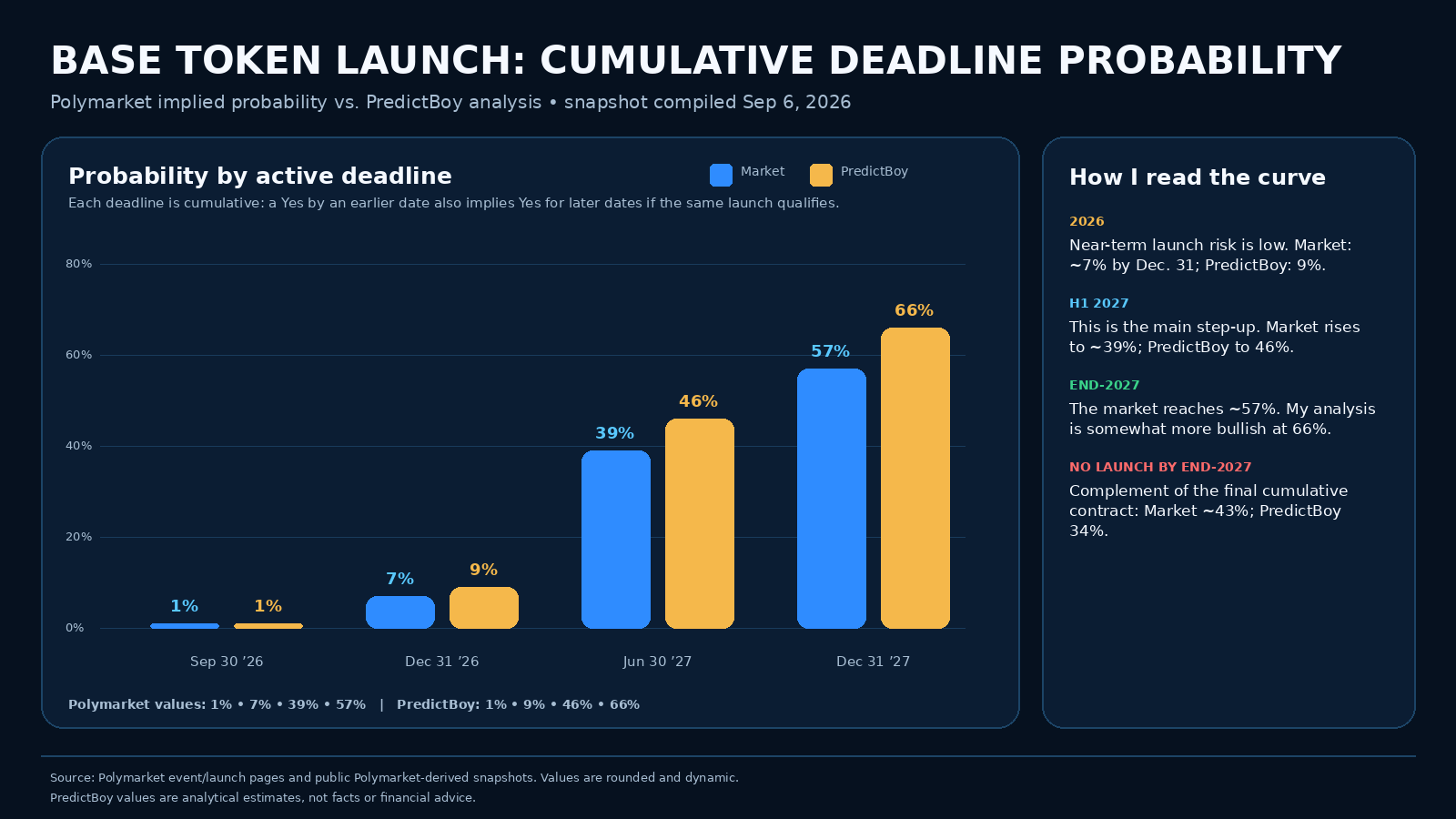
The event groups several cumulative Yes/No contracts under the question “Will Base launch a token by ___?”. The active deadlines surfaced in the current market are September 30, 2026, December 31, 2026, June 30, 2027, and December 31, 2027. These are not mutually exclusive candidates. If Base launched a qualifying token before an early deadline, later deadline contracts could also resolve Yes because they ask whether the launch happened by that date.
This cumulative structure is the first thing I would keep in mind when comparing the percentages. A 57% Yes price for December 31, 2027 does not mean traders are assigning 57% specifically to the second half of 2027. It means the market is pricing roughly a 57% chance that a qualifying launch occurs at any point on or before that deadline.
Resolution Rules and What Counts
Polymarket’s current rule set is unusually important here. The market resolves Yes only if Base officially launches a token by 11:59 PM ET on the date in the contract title. Only an official token launched by Base qualifies. The rules explicitly exclude stablecoins, memecoins, liquid staking tokens (LSTs), and synthetic tokens. The token also has to be actively and publicly tradable; an announcement alone does not qualify.
The primary resolution source is information from Base, with a consensus of credible reporting available as a secondary source. In practical terms, this creates a higher bar than “Base announces token plans.” A credible announcement could move prices sharply without resolving the market if the token is not yet publicly tradable.
That rule also helps separate recent Base ecosystem launches from this market. For example, Base announced tokenized U.S. stocks issued by Coinbase in 2026. Those assets are evidence of Base’s broader market infrastructure, but they are not an official Base network token and therefore do not satisfy this market by themselves.
Current Market Snapshot
| Active deadline | Rounded Yes probability | What it means | Snapshot note |
|---|---|---|---|
| September 30, 2026 | ~1% | Very little market belief in an immediate launch | Latest public Polymarket-derived snapshot reviewed: Sep. 4 |
| December 31, 2026 | ~7% | 2026 launch remains a low-probability scenario | Polymarket embed reviewed during this research pass |
| June 30, 2027 | ~39% | Market assigns a substantial probability to an H1 2027 launch | Latest public Polymarket-derived snapshot reviewed |
| December 31, 2027 | ~57% | Market favorite among the active cumulative deadlines | Polymarket launch-market page reviewed during this research pass |
Polymarket’s launch-market page showed roughly $8 million in event volume and about $69.5K in liquidity in the snapshot I reviewed. The curve is steeply back-loaded: traders see little chance of a launch in the remaining weeks of Q3 2026, only a small chance by year-end 2026, and much higher odds once the deadline moves into 2027. Because the four contracts were not captured from one synchronized order-book tick, I use rounded headline probabilities and avoid pretending the spread or exact executable price is more precise than the data supports.
Main Outcomes
Launch by September 30, 2026
At roughly 1%, this is essentially a surprise-launch scenario. To resolve Yes, Base would need to move from exploration to a publicly tradable official token within a very short window. The absence of a verified public launch timetable makes this the hardest active deadline to support.
Launch by December 31, 2026
At roughly 7%, the market still leaves room for a late-2026 surprise, but the practical bar is high. A token announcement would not be enough; design, legal execution, distribution, contracts, liquidity, and public tradability would all have to be ready before the deadline.
Launch by June 30, 2027
This is where the probability curve changes meaningfully. Roughly 39% implies the market sees the first half of 2027 as a plausible execution window rather than a remote tail. There is enough runway for Base to move from exploration into design and rollout if it decides a network token is strategically useful.
Launch by December 31, 2027
At roughly 57%, this is the current market favorite among the active deadlines. It still does not imply certainty: the complementary market view is roughly 43% that Base has not launched a qualifying token by the end of 2027.
Key Factors
1. Official launch readiness and specificity
The clearest official Base token publication I verified is the September 15, 2025 BaseCamp update. Base said it was beginning to explore a network token, but also said the work was in an early phase and that it had no specifics to share on timing, design, or governance. For timing markets, the missing implementation details matter more than the headline that exploration exists.
2. Regulatory and corporate execution
Base explicitly said that, as a U.S. company, it intends to work with regulators and legislators and “do this right.” I interpret that as a reason to assign more execution risk to short deadlines than I would for a smaller offshore protocol. It does not mean a token is blocked; it means the launch process may have more dependencies.
3. Token utility versus an already-functioning network
Base itself said a network token could potentially accelerate decentralization and expand opportunities for builders and creators. That is a genuine positive factor. The counterpoint is that Base has already advanced its decentralization roadmap without a native Base token, including reaching Stage 1 decentralization. A token may be useful, but the network has demonstrated that it is not strictly required for every decentralization milestone.
4. Time runway
This is the largest difference between the contracts. A late-September 2026 launch requires an almost immediate execution path. A late-2027 deadline gives Base more than a year to settle design, governance, regulatory, distribution, and liquidity questions.
5. Public signaling and catalyst cadence
Base’s 2026 strategy emphasizes global markets, payments and stablecoins, and being the home for builders. The ecosystem is clearly expanding, and tokenized stocks went live on Base in 2026. I treat those developments as supportive of network maturity, but not as direct proof that a Base network token is imminent.
Weighted Outcome Comparison
I use a 1–10 readiness score rather than tuning the model to reproduce Polymarket prices. The weighted total is therefore a structured evidence score, not a probability.
| Factor | Weight | Sep 30, 2026 | Dec 31, 2026 | Jun 30, 2027 | Dec 31, 2027 | Key Evidence | Impact |
|---|---|---|---|---|---|---|---|
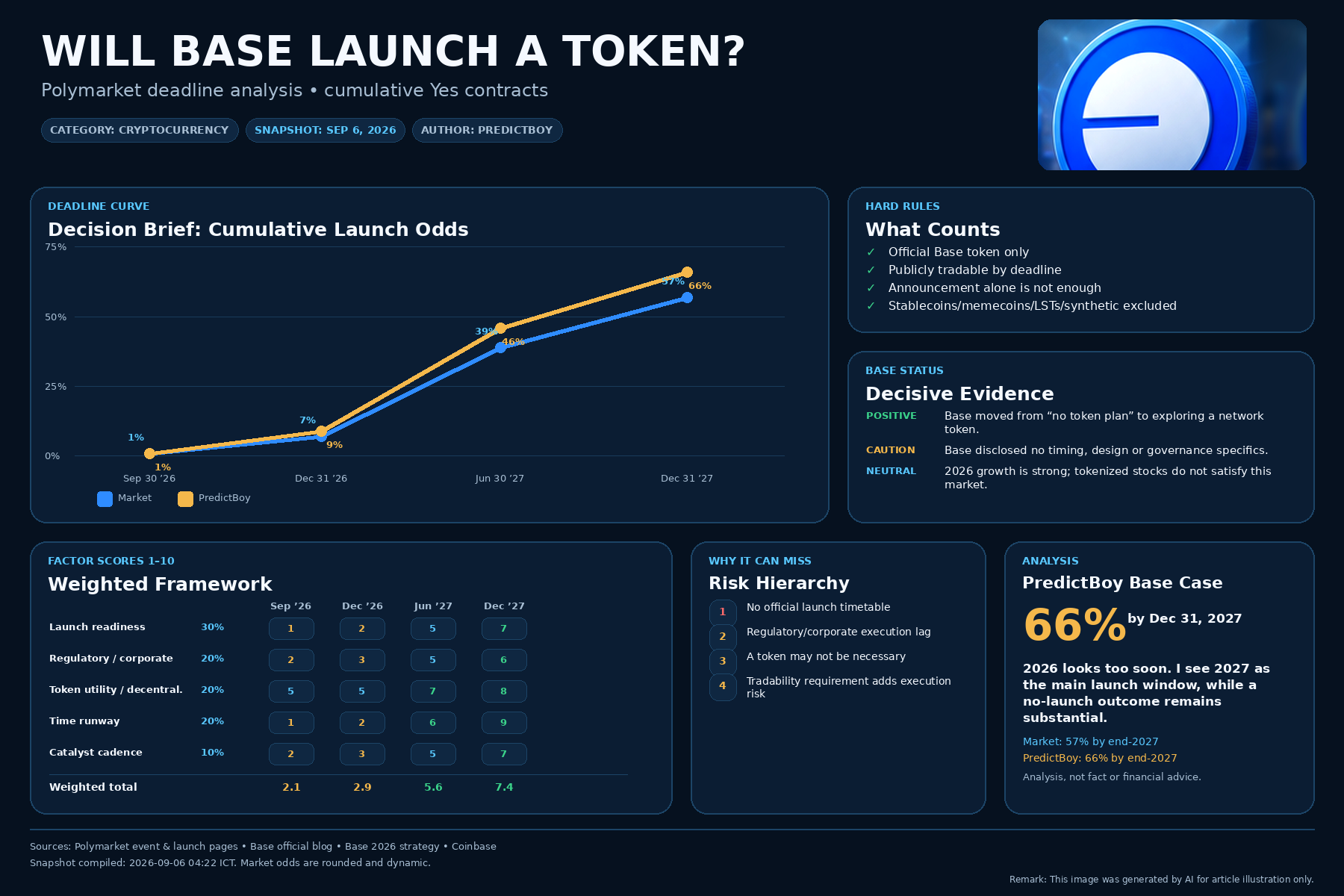
| Launch readiness / official specificity | 30% | 1/10 | 2/10 | 5/10 | 7/10 | Exploration is official, but no verified launch timetable, token design, or governance plan is published in the primary material reviewed. | Strongly negative for 2026; improves with runway. |
| Regulatory & corporate execution | 20% | 2/10 | 3/10 | 5/10 | 6/10 | Base says it intends to work with U.S. regulators and legislators and launch responsibly. | Execution drag is more important for near deadlines. |
| Token utility / decentralization rationale | 20% | 5/10 | 5/10 | 7/10 | 8/10 | Base says a network token could accelerate decentralization and builder/creator opportunity. | Positive long-run rationale, but not a timetable. |
| Time runway | 20% | 1/10 | 2/10 | 6/10 | 9/10 | Later contracts allow materially more time for design, legal, distribution, liquidity, and launch operations. | Largest structural advantage for 2027. |
| Public signaling / catalyst cadence | 10% | 2/10 | 3/10 | 5/10 | 7/10 | Base continues to expand markets and token infrastructure, but current official material does not set a network-token TGE date. | Moderately supportive later, weak near term. |
| Weighted total | 100% | 2.1/10 | 2.9/10 | 5.6/10 | 7.4/10 | — | Late 2027 has the strongest readiness profile. |
The model gives the biggest advantage to December 31, 2027 because it combines a real strategic rationale for a token with far more execution runway. The major uncertainty is binary: Base may ultimately decide that it can achieve its objectives without a native network token, in which case even a generous deadline does not guarantee a launch.
Topic-Specific Evidence Analysis
The 2025 policy shift is real, but “exploring” is not “launching”
Base’s original 2023 position was that it did not plan to issue a new network token. The September 2025 BaseCamp announcement was therefore a meaningful change in philosophy. I give that shift substantial weight because it came directly from Base. But the same primary source also emphasized the early stage of the process and the absence of timing, design, and governance specifics. That keeps me cautious on short-dated contracts.
Stage 1 decentralization cuts both ways
Base has continued to decentralize the chain and has described a Security Council structure that requires broad approval for upgrades. That strengthens the argument that Base is serious about decentralization. It also shows that a native token is not the only path to decentralization. For forecasting, I view this as positive evidence for the use case of a token but neutral-to-negative evidence for the claim that a token must launch immediately.
Base’s 2026 strategy supports ecosystem maturity, not a confirmed TGE
Base’s 2026 strategy highlights global markets, stablecoins and payments, and builder infrastructure. It reports strong ecosystem activity and explicitly discusses bringing many asset types onchain. Those are conditions under which a network token could have utility. Still, a broad strategy document is not a token launch schedule, and Polymarket requires actual public tradability.
Tokenized stocks are a useful sanity check
Tokenized stocks are now live on Base, issued by Coinbase and available to eligible users. That is important for Base’s market strategy, but it should not be confused with the network token in this Polymarket event. The distinction is a reminder to read the resolver language literally instead of treating every “token launch on Base” headline as qualifying evidence.
What the Market May Be Underestimating
The market may be underestimating the execution gap between an announcement and a qualifying launch. Because announcements alone do not count, even a high-profile token reveal could leave short-dated contracts unresolved if public tradability comes later. That makes the final operational steps unusually important.
On the other side, traders may be underestimating the value of a native token as Base becomes a broader economic layer for markets, payments, builders, and creators. If Base concludes that a network token materially improves decentralization or ecosystem incentives, the probability can rise quickly well before the exact tokenomics are public.
Bull/Bear Case for Major Outcomes
Bull case for a launch by the end of 2026
- Base has already crossed the philosophical threshold from “no token plan” to active exploration.
- Its ecosystem and financial-market infrastructure are mature enough that distribution and liquidity could be substantial if the team decides to move quickly.
- A regulatory or strategic catalyst could compress the launch timeline.
Bear case for a launch by the end of 2026
- No verified primary-source launch timetable was found in this research pass.
- The market requires active public tradability, not merely an announcement.
- Design, governance, legal, distribution, and liquidity work can create meaningful lead time.
Bull case for a launch during 2027
- 2027 provides much more time to turn exploration into a production launch.
- Base has explicitly identified decentralization and ecosystem opportunity as potential reasons for a network token.
- Continued expansion into markets and asset issuance could strengthen the case for a network-level incentive or governance asset.
Bear case through the end of 2027
- Base may conclude that ETH gas, OP Stack governance, Security Council controls, and existing incentive systems are sufficient without a native token.
- Corporate or regulatory priorities could keep the project in exploration longer than prediction-market traders expect.
- A token design could be announced but fail the market’s tradability requirement before the deadline.
Risks and Uncertainties
The biggest forecasting risk is the lack of a public project schedule. That leaves traders exposed to surprise announcements in either direction. The second risk is interpreting ecosystem progress as direct token evidence when it may simply reflect Base’s wider business strategy. The third risk is market microstructure: headline percentages can differ from the exact prices a trader can execute because of spreads, liquidity, and rapidly changing orders.
There is also resolution risk around edge cases. Polymarket’s language is fairly clear that a qualifying token must be official and publicly tradable, but any unusual launch structure could still require interpretation by the resolver and credible reporting.
PredictBoy Probability Assessment
| Deadline | Polymarket implied | PredictBoy assessment | My read |
|---|---|---|---|
| Sep 30, 2026 | ~1% | 1% | Almost no execution runway; I am aligned with the market. |
| Dec 31, 2026 | ~7% | 9% | A late-2026 surprise is possible, but still a low-probability case. |
| Jun 30, 2027 | ~39% | 46% | I give slightly more weight to the official exploration shift plus additional runway. |
| Dec 31, 2027 | ~57% | 66% | I see a meaningful chance that token utility and execution converge by late 2027. |
These are cumulative probabilities. My implied interval view is approximately 1% by September 30, another 8 percentage points during Q4 2026, another 37 points during the first half of 2027, another 20 points during the second half of 2027, and 34% for no qualifying launch by the end of 2027. That interval breakdown is simple arithmetic from my cumulative estimates, not a separate market price.
Market Odds vs. PredictBoy
I am broadly aligned with Polymarket for 2026 and more constructive for 2027. The key difference is that I place more weight on the strategic significance of Base officially opening the door to a network token, while still respecting the operational and regulatory delay implied by the absence of a public launch schedule.
The gap is not large enough for me to describe the market as obviously wrong. A 57% market probability by the end of 2027 still assigns a substantial 43% chance to no qualifying launch. My 66% estimate lowers that no-launch tail to 34%, but it remains a major scenario rather than an edge case.
What Could Change Before Resolution
- Official token design or governance details: concrete mechanics would be the clearest sign that exploration has moved into execution.
- A named TGE or public-trading date: this would directly affect the relevant deadline contracts.
- Regulatory clarity or a formal Coinbase/Base legal structure: could reduce execution risk.
- Distribution or community-allocation documentation: would signal operational readiness.
- Smart-contract deployment plus liquidity arrangements: would matter more than a marketing announcement because the rules require public tradability.
- An explicit decision not to issue a network token: would sharply reduce all active Yes probabilities.
Final Take
PredictBoy analysis, not fact: I think a Base token launch in the rest of 2026 is unlikely, while 2027 is a credible window. My base case is 46% by June 30, 2027 and 66% by December 31, 2027, compared with roughly 39% and 57% in the market snapshot I reviewed. The strongest evidence for a later launch is Base’s official shift into token exploration plus the potential decentralization and ecosystem utility; the strongest counterargument is that Base has not published a launch timetable and may ultimately decide it does not need a native token at all.
Sources
- Polymarket — Will Base launch a token by ___? (primary market and resolution rules)
- Polymarket — Launch Dates markets (current event-level probability/volume context)
- Polymarket embed — December 31, 2026 contract
- Kresmion — Polymarket-derived September 30, 2026 snapshot
- Preduck — Polymarket-derived June 30, 2027 snapshot
- Base — The State of Base at BaseCamp 2025
- Base — 2026 Mission, Vision, and Strategy
- Base — Stage 1 Decentralization
- Base — Tokenized stocks are live on Base
- Coinbase — Introducing Base (historical 2023 no-token position)
Disclosure: This article is for informational and analytical purposes only. Prediction-market prices can move quickly and should not be treated as guaranteed real-world probabilities. Nothing here is financial, investment, legal, or tax advice.