
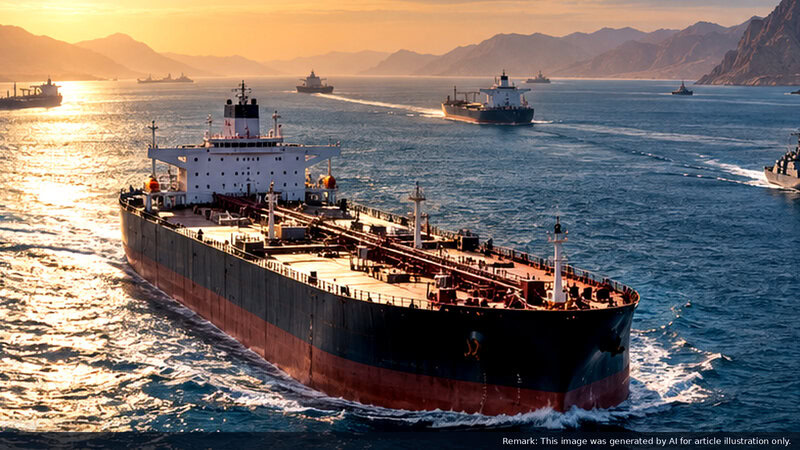
Strait of Hormuz Traffic Returns to Normal by December 31? Polymarket Analysis
Introduction
The Strait of Hormuz prediction market is not asking whether shipping “looks better” or whether oil volumes recover. It asks a very specific, mechanical question: will the International Monetary Fund’s PortWatch dataset publish a seven-day moving average of at least 60 transit calls for the Strait of Hormuz by December 31, 2026? That distinction matters because alternative ship-tracking services, barrel-flow estimates, military statements, and headlines can all point in different directions without resolving this contract.
What This Polymarket Market Asks
The market has two outcomes: Yes if the PortWatch threshold is reached by the deadline, and No if it is not. The market was created during the 2026 disruption in Gulf shipping, so the real decision is whether traffic can recover from very low observed levels to a sustained, PortWatch-counted pace that crosses the contractual threshold.
Resolution Rules and What Counts
Polymarket’s rules say the market resolves Yes if IMF PortWatch publishes a seven-day moving average of transit calls (“Arrivals of Ships”) at or above 60 for any date from market creation through December 31, 2026. Daily transit calls include container, dry bulk, roll-on/roll-off, general cargo, and tanker ships. Ships not reported by IMF PortWatch do not count.
The market can resolve immediately once a qualifying value is published. If no qualifying value appears, it resolves after data for the final date is available. If the final-date data are not published within 14 calendar days (ET) after the period ends, resolution uses the data available at that point. In-window revisions can be considered, but later revisions cannot erase a previously qualifying published point. This makes IMF PortWatch the decisive source hierarchy, even when other maritime datasets disagree.
Current Market Snapshot
| Metric | Snapshot | Interpretation |
|---|---|---|
| Polymarket Yes | 27% | Market-implied chance that the 60-call 7-day threshold is reached by Dec. 31 |
| Polymarket No | 73% | Current market favorite |
| Total volume | $10.4M | Rounded Polymarket market volume |
| 24h volume | $64.3K | Rounded snapshot |
| Liquidity | $422K | Rounded snapshot |
| Snapshot time | 2026-09-05 22:04 UTC | Prices can change after this timestamp |
At this snapshot, Polymarket gives Yes roughly 27% and No 73%. I treat those prices as the market’s collective signal, not as objective probabilities. The key question is whether the remaining calendar time is enough for a sudden operational normalization.
Main Outcomes
Yes — PortWatch reaches a 7-day average of 60 or more
A Yes result does not require traffic to stay normal permanently. One qualifying published seven-day moving average is enough. That “any date” rule creates a step-function payoff: a short but powerful reopening wave could settle the market even if conditions later deteriorate.
No — No qualifying 7-day average appears by the deadline
No wins if traffic improves but never reaches the exact threshold, if non-PortWatch datasets look healthier while PortWatch remains below 60, or if security and commercial constraints prevent a large enough rebound before year-end.
Key Factors
Primary factors: the PortWatch threshold gap; current kinetic/security risk; and commercial carrier/insurance readiness. Secondary factors: mine-clearing and naval escort capacity, diplomacy, and the remaining time available for a traffic ramp.
Weighted Outcome Comparison
| Factor | Weight | Yes Score | No Score | Key Evidence | Impact |
|---|---|---|---|---|---|
| PortWatch threshold gap | 30% | 3/10 | 9/10 | Latest 7-day mean is 4.29 vs. 60 required. | Strong No |
| Kinetic / security risk | 22% | 2/10 | 9/10 | Fresh vessel attacks and U.S.-Iran escalation persist. | Strong No |
| Carrier & insurance readiness | 16% | 4/10 | 8/10 | Operators still use contingency arrangements and elevated risk controls. | No |
| Mine-clearance / escort capacity | 12% | 6/10 | 5/10 | Mine-clearing and naval coordination can enable a faster rebound. | Slight Yes |
| Diplomacy / de-escalation | 12% | 4/10 | 7/10 | A durable political settlement is not yet visible. | No |
| Time remaining / ramp dynamics | 8% | 7/10 | 4/10 | Almost four months remain and the contract needs only one qualifying 7-day window. | Yes |
| Weighted total | 100% | 3.74 | 7.72 | Directional framework; these totals are not probabilities. | |
The weighted framework favors No because the current resolution-source gap is enormous and fresh security events are still discouraging routine commercial traffic. The biggest offsetting factor is time: almost four months remain, and the market only needs one qualifying seven-day window.
Topic-Specific Evidence Analysis
1. PortWatch traffic is still far below the contract threshold
The latest PortWatch series available in my research runs through August 30. The seven daily transit counts from August 24 through August 30 are 3, 4, 5, 2, 7, 3, and 6, for a seven-day average of 4.29. The contract threshold is 60. Put differently, the qualifying pace is about 14 times the latest seven-day average.
For context, the seven days from February 22 through February 28 averaged about 92.9 calls per day in the same series. The current gap is therefore not a small normalization step; it is a major regime change in shipping activity.
2. Alternative flow metrics can look better without resolving the market
Reuters reported that U.S. Energy Secretary Chris Wright said 17 million barrels of oil transited the strait on September 1, a sign that energy flow can rebound materially. But barrel volume is not the Polymarket resolution metric. Another Reuters report using Kpler counted only four commodity vessels on September 3, versus a 10-day average of 15. Those data are useful context, but neither Kpler counts nor barrel volumes can directly resolve this contract.
3. Security conditions remain the biggest operational brake
Reuters reported new U.S.-Iran attacks on vessels on September 5. Iran also expanded a blacklist of ships trying to use the strait, while commercial operators have continued to use contingency arrangements. Maersk’s August 31 operational update still described temporary empty-container arrangements linked to navigation and port risks. These are not the conditions I would normally associate with a rapid return to routine, high-frequency traffic.
4. There is still a credible reopening mechanism
The bearish case is not the same as “reopening is impossible.” U.S. military and maritime coordination has supported commercial transits, and mine-clearing / escort capacity can reduce operational risk. If a durable political arrangement emerges, insurers and shipowners could respond quickly because the Gulf has strong economic incentives to restore normal routes.

What the Market May Be Underestimating
The market may be underestimating nonlinear recovery. Once security rules, routing permissions, insurance, and carrier risk limits move together, traffic could jump much faster than a slow trend model implies. The “any qualifying seven-day window” rule makes that especially important.
At the same time, traders may be underestimating resolution-source risk: a headline about oil volumes, a Kpler rebound, or a military escort success does not automatically help Yes unless IMF PortWatch’s counted transit series crosses 60.
Bull/Bear Case for Major Outcomes
Bull case for Yes
- A durable ceasefire or enforceable transit agreement materially lowers attack risk.
- Mine-clearing and naval coordination make routine passage practical.
- War-risk insurance and carrier policies normalize quickly.
- Queued commercial demand creates a fast surge in PortWatch-counted calls.
- Only one seven-day moving average at or above 60 is required.
Bear case for Yes / Bull case for No
- The latest PortWatch seven-day average is only 4.29, versus 60 required.
- Fresh attacks and blacklisting keep shipowners cautious.
- Commercial contingency measures remain in place.
- Oil can move via fewer large vessels or alternative arrangements without generating enough ship calls.
- Diplomatic progress can reverse quickly in a high-conflict environment.
Risks and Uncertainties
The largest analytical risks are sudden de-escalation, an unexpected maritime-security agreement, PortWatch data lag, and qualifying revisions to already-published observations. There is also a measurement mismatch across datasets: one provider can report more traffic than another because coverage, vessel classes, AIS behavior, and counting rules differ. For this market, only the IMF PortWatch series governs settlement.
PredictBoy Probability Assessment
PredictBoy analysis — not fact: I assign a 23% probability to Yes and 77% to No. My assessment is slightly more bearish than Polymarket’s 27% Yes price at this snapshot because the latest PortWatch data remain dramatically below the threshold and security conditions are still fragile.
Market Odds vs. PredictBoy
| Outcome | Polymarket-implied | PredictBoy analysis | Difference |
|---|---|---|---|
| Yes | 27% | 23% | -4 pts |
| No | 73% | 77% | +4 pts |
The difference is modest. I do not think the market is wildly mispriced; I think the balance of evidence is a little more favorable to No than the current price suggests.
What Could Change Before Resolution
- A durable U.S.-Iran ceasefire or transit framework with clearly enforceable navigation rules.
- A visible rise in IMF PortWatch daily calls toward the 50–70 range.
- Carrier announcements that normal Gulf loops are resuming rather than operating under contingency rules.
- Material declines in war-risk insurance premiums and security surcharges.
- More effective mine-clearing, escort, and deconfliction arrangements.
- New attacks, blocklists, sanctions, or route restrictions that push traffic back down.

Final Take
PredictBoy analysis: No is my base case as of 2026-09-05 22:04 UTC. The market has enough time for a late-year rebound, but the current PortWatch rate is so far below 60 that Yes requires a genuine regime shift, not incremental improvement. The clearest signal to watch is simple: sustained PortWatch daily counts rising toward the threshold range, backed by commercial carriers returning under normal operating and insurance conditions.
Sources
- Polymarket — Strait of Hormuz traffic returns to normal by December 31?
- Polymarket — Strait of Hormuz markets / current odds hub
- IMF PortWatch — Strait of Hormuz transit calls
- Reuters — Gulf shipping traffic remains below recent average, Sep. 4, 2026
- Reuters — U.S.-Iran vessel escalation, Sep. 5, 2026
- Reuters — 17 million barrels transited, Sep. 2, 2026
- Reuters — Iran expands ship blacklist, Sep. 2, 2026
- Maersk — Middle East Operational Update 44, Aug. 31, 2026
- U.S. Navy / MSC — commercial-shipping coordination in Hormuz, Aug. 2026
Disclosure: This analysis is for informational and educational purposes only. Prediction-market prices change continuously and are not guarantees of future events. Nothing here is financial advice.