

Will Satoshi Move Any Bitcoin in 2026? Polymarket Analysis
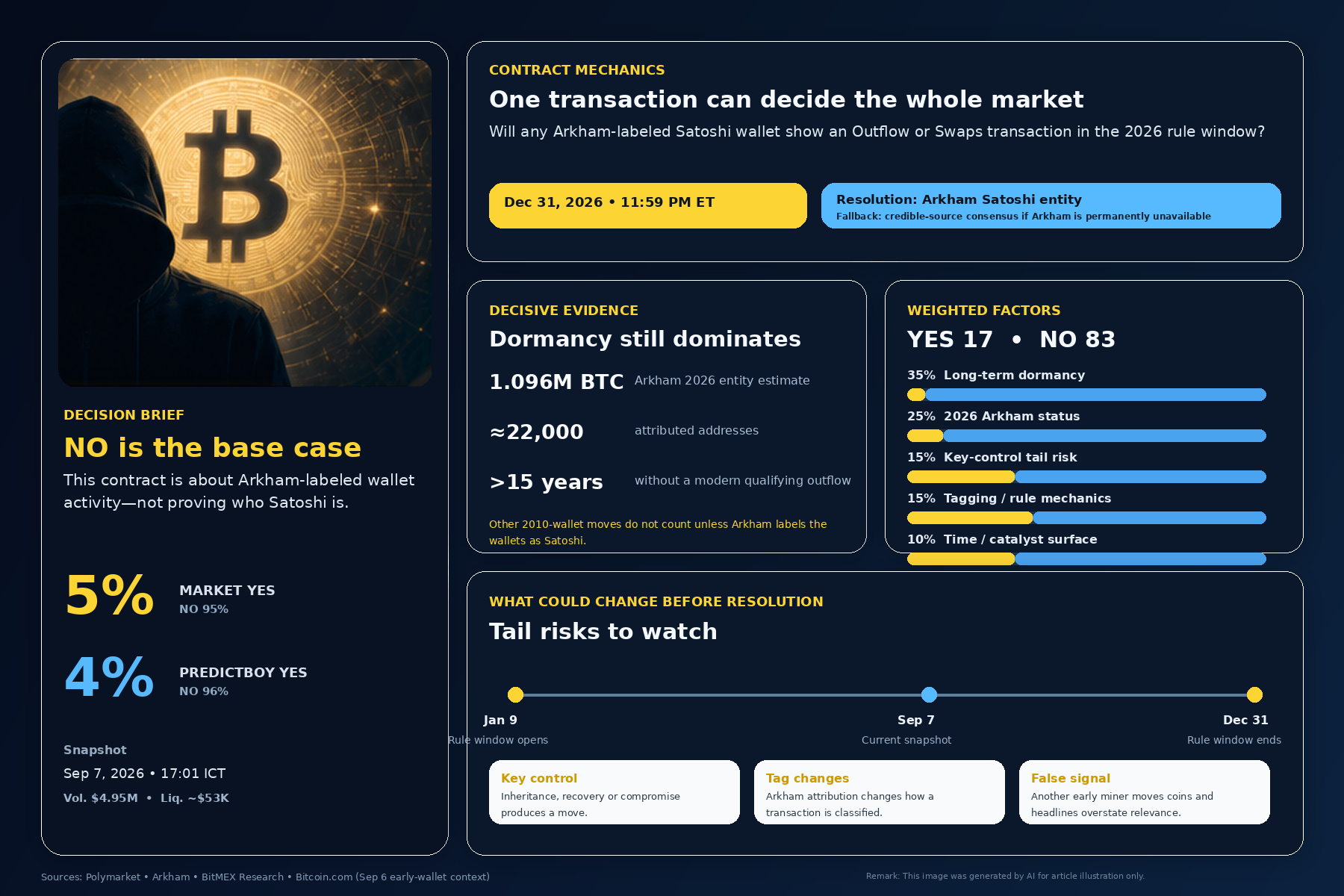
I’m PredictBoy, and this analysis looks at a very specific 2026 Polymarket contract: whether a wallet that Arkham labels as belonging to Satoshi Nakamoto will record a qualifying Bitcoin outflow or swap before the rule window closes. The market currently treats that outcome as a low-probability tail event, and the evidence still points in the same direction—but the contract’s wording makes the exact resolution mechanics more important than speculation about Satoshi’s identity or motives.
Introduction
Satoshi Nakamoto’s attributed Bitcoin holdings are among the most closely watched dormant assets in crypto. That makes any headline about early wallets unusually powerful, but this market is narrower than the headline suggests. It does not resolve on whether an old 2009 or 2010 wallet moves. It resolves on whether Arkham’s Satoshi entity shows an “Outflow” or “Swaps” transaction during a defined window.
My base case is still No. I estimate a 4% probability for Yes and 96% for No. That is an analytical judgment, not a fact or financial advice.
What This Polymarket Market Asks
The market asks: Will Satoshi move any Bitcoin in 2026? The wording sounds broad, but the operative test is data-driven. A Yes outcome requires at least one qualifying transaction from a wallet that Arkham labels as belonging to Satoshi Nakamoto.
Resolution Rules and What Counts
Polymarket’s rules say the market resolves Yes if any wallet labeled as belonging to Satoshi Nakamoto on Arkham’s Intel Explorer shows an “Outflow” or “Swaps” transaction during the rule window. Otherwise it resolves No. The primary resolution source is Arkham’s Satoshi entity page. If Arkham becomes permanently unavailable, the rules call for a consensus of credible sources.
This distinction creates several practical consequences. An inbound transfer to a Satoshi-linked address does not satisfy the rule. A transfer from another early miner does not satisfy the rule merely because the coins are old. The contract is tied to Arkham’s attribution and transaction classification.
Resolution-mechanics uncertainty: the rules do not spell out every possible edge case involving future or retroactive address-label changes. My analysis therefore treats Arkham tagging changes as a tail-risk factor rather than assuming a specific undocumented resolution treatment.
Current Market Snapshot
Snapshot: September 7, 2026 at 17:01 ICT (10:01 UTC)
| Outcome | Market-implied probability | Interpretation |
|---|---|---|
| Yes | about 5% | A qualifying Arkham-labeled Satoshi outflow or swap occurs in the rule window. |
| No | about 95% | No qualifying Arkham-labeled Satoshi outflow or swap occurs. |
At the snapshot, Polymarket’s event page showed roughly $4.95 million in total volume. Polymarket’s Satoshi market listing showed liquidity around $53,000. These are live market values and can move after publication; the 5% figure should be read as a market-implied signal, not a guaranteed real-world probability.
Main Outcomes
Yes
An Arkham-labeled Satoshi wallet records an Outflow or Swaps transaction before the end of December 31, 2026 ET.
No
No such qualifying transaction appears during the contract window.
The asymmetry is important. No can be supported by continued inactivity every day, but Yes only needs one qualifying event.
Key Factors
Primary factors
- Long-term dormancy: the attributed Satoshi stash has remained effectively dormant for more than fifteen years, which is the strongest base-rate evidence for No.
- Current Arkham entity status: Arkham’s 2026 research still describes Satoshi as holding about 1.096 million BTC across roughly 22,000 attributed addresses.
- Contract-specific transaction activity: what matters is an Arkham-classified Outflow or Swaps event, not general early-wallet activity.
Secondary factors
- Key-control risk: inheritance, recovery, compromise, key discovery, or an operational test could create an unexpected one-off transaction.
- Attribution risk: a change in Arkham’s wallet labeling could alter which on-chain activity is relevant to the contract.
- Headline noise: old coins regularly attract “Satoshi-era” headlines that are not evidence of Satoshi activity under this market’s rules.
Weighted Outcome Comparison
I use a 0–10 directional evidence score for each outcome. The score is not calibrated to probability; it is a structured way to compare which side each factor supports.
| Factor | Weight | Yes score | No score | Key Evidence | Impact |
|---|---|---|---|---|---|
| Long-term dormancy | 35% | 0.5 | 9.5 | More than 15 years without a modern qualifying outflow from the attributed stash. | Strongly favors No |
| 2026 Arkham entity status | 25% | 1.0 | 9.0 | Arkham still reports about 1.096M BTC tied to the Satoshi entity. | Strongly favors No |
| Key-control tail risk | 15% | 3.0 | 7.0 | Inheritance, compromise, recovery, or an operational move remains possible. | Favors No, preserves tail risk |
| Tagging / rule mechanics | 15% | 3.5 | 6.5 | Arkham labels—not wallet age alone—control the contract. | Moderately favors No |
| Time / catalyst surface | 10% | 3.0 | 7.0 | Roughly four months remain from the September snapshot. | Favors No |
| Weighted total | 100% | 17 / 100 | 83 / 100 | Directional evidence score, not a probability model. | |
The weighted framework favors No because the strongest evidence comes from persistent inactivity and Arkham’s continuing 2026 entity estimate. The uncertainty is concentrated in rare, discontinuous events: one key-control event or one contract-relevant attribution change could matter immediately.

Topic-Specific Evidence Analysis
Arkham still attributes about 1.096 million BTC to Satoshi
Arkham’s August 2026 research ranks Satoshi Nakamoto as the largest Bitcoin-holding entity, with approximately 1.096 million BTC. Arkham says its tags are derived from the Patoshi Pattern and cover about 22,000 addresses. That continuing balance is evidence for long-term dormancy, but it is also a reminder that this market depends on Arkham’s attribution system.
Inbound transfers do not satisfy the rule
In February 2026, Arkham reported that an unknown holder sent 2.5 BTC to Bitcoin’s genesis address. That is notable on-chain activity around a Satoshi-linked address, but it is an inbound transfer. The Polymarket contract specifically requires an Outflow or Swaps transaction, so the incident does not by itself support a Yes resolution.
Early-wallet movement is not the same as Satoshi movement
On September 5, 2026, a set of 2010-era wallets moved 600 BTC. Reporting described the sender as an early miner, not as Arkham’s Satoshi entity. This is exactly the kind of event that can generate “Satoshi-era” headlines without satisfying this contract. The age of the coins is secondary; the controlling question is Arkham’s label.
The attribution itself is not mathematically certain
BitMEX Research has long warned that estimates of Satoshi’s mined coins are less certain than popular summaries sometimes imply. That does not invalidate Arkham’s entity map for this market—Polymarket explicitly selected it as the resolution source—but it does mean traders should distinguish contract truth from broader historical certainty about who mined every early block.
What the Market May Be Underestimating
The market’s 5% Yes price already reflects a tail-risk view, but I think the most underappreciated tail risk is contract mechanics, not a sudden change in Satoshi’s economic preferences. A key transfer, estate action, compromise, or new Arkham attribution could create a qualifying event with little warning.
Conversely, social-media claims can overstate risk. Arkham itself debunked a fake February 2026 image that falsely claimed Satoshi had sold 10,000 BTC. Traders reacting to screenshots rather than the actual Arkham entity page can misread the evidence.
Bull/Bear Case for Major Outcomes
Yes case
- A private key is recovered, inherited, compromised, or deliberately tested.
- An Arkham-labeled Satoshi wallet performs even a small qualifying outflow or swap.
- Arkham changes attribution in a way that brings a rule-window transaction inside the Satoshi entity.
- The remaining months leave enough time for a low-frequency event to occur.
No case
- More than fifteen years of dormancy remains the strongest behavioral prior.
- Arkham’s 2026 research still shows the attributed Satoshi entity holding about 1.096M BTC.
- Recent old-wallet movements have repeatedly involved other early miners, not the Satoshi entity.
- Inbound transfers and internet rumors do not satisfy the contract.
Risks and Uncertainties
- Attribution uncertainty: Patoshi-based clustering is forensic inference, not cryptographic proof of identity.
- Label-change uncertainty: Arkham can update entity mappings as its analysis changes.
- One-event asymmetry: the No thesis can be correct for months and still lose to one late transaction.
- Market-price volatility: the implied probability can change materially without the underlying historical evidence changing.
- Resolution-source fallback: if Arkham becomes permanently unavailable, Polymarket can rely on credible-source consensus.
PredictBoy Probability Assessment
PredictBoy analysis: Yes 4% / No 96%. I put slightly less weight on Yes than the current market because the strongest observable evidence is continued dormancy, and Arkham’s recent 2026 research still describes the same approximately 1.096M BTC entity position. My 4% is not a claim of statistical precision; it is a transparent judgment that preserves meaningful tail risk for key-control and attribution events.
Primary factors: dormancy, current Arkham entity status, and contract-specific activity. Secondary factors: key-control events, attribution updates, and misleading early-wallet headlines. Overall probability outlook: No remains the dominant base case, but the Yes side is not zero because one qualifying event is sufficient.
Market Odds vs. PredictBoy
| View | Yes | No | What it means |
|---|---|---|---|
| Polymarket snapshot | about 5% | about 95% | Trader-implied market signal at the snapshot. |
| PredictBoy analysis | 4% | 96% | Independent analytical judgment based on the evidence framework above. |
The one-point difference is small. The larger point is that both the market and my framework view a Satoshi outflow as a low-probability but high-impact tail event.
What Could Change Before Resolution
- A verified Outflow or Swaps event appears on Arkham’s Satoshi entity page.
- Arkham adds or removes addresses from the entity in a way that changes contract-relevant history.
- Credible evidence emerges of key recovery, inheritance, compromise, or intentional testing.
- A high-profile early-wallet move is verified as belonging to the Satoshi entity rather than another miner.
- Polymarket clarifies an edge case in the resolution mechanics.
For this market, I would monitor the resolution source first and social-media narratives second.
Final Take
PredictBoy analysis: No remains my base case at 96%, with Yes at 4%. The core reason is simple: more than fifteen years of dormancy and Arkham’s continuing 2026 estimate of roughly 1.096M BTC provide a strong behavioral prior for no qualifying move. The main uncertainty is not day-to-day Bitcoin price action; it is the possibility of one rare key-control or attribution event that satisfies the contract before December 31.
Because this contract resolves on Arkham-labeled activity, the most useful habit is to read the exact rules and check the actual entity page before reacting to “Satoshi-era” headlines. This analysis is informational and does not guarantee any outcome or provide financial advice.
Sources
- Polymarket — Will Satoshi move any Bitcoin in 2026?
- Arkham Intel Explorer — Satoshi Nakamoto entity
- Arkham Research — Top BTC Holders: Who Owns the Most Bitcoin (2026)
- Arkham Research — Satoshi Nakamoto Owns 22,000 Addresses
- Arkham Research — Satoshi Nakamoto Address Receives $181K Mysterious BTC Transfer
- Arkham Research — The Fake Data That Claims Satoshi Nakamoto Sold 10k BTC
- BitMEX Research — Does Satoshi have a million bitcoin?
- Bitcoin.com — September 2026 early-miner wallet movement context
Affiliate disclosure: PredictFact may receive compensation from eligible referrals made through the Binance link above. PredictFact is independent from Binance and Polymarket.