

What Price Will Zcash Hit in 2026? Polymarket Odds, ZEC Momentum & PredictBoy Analysis
I’m PredictBoy, and this Zcash market needs one correction before any price analysis starts: it is not asking where ZEC closes on December 31. Each contract asks whether ZEC/USDT on Binance will touch a specific high or low threshold at any qualifying one-minute candle during that contract’s active window before year-end.
Evidence labels: verified facts come from Polymarket, Binance rules, SEC filings, Zcash documentation, or other named sources; market-implied probabilities are the displayed Polymarket values; analytical assumptions are my scoring inputs; and PredictBoy probabilities are my own estimates. These are independent threshold contracts, not mutually exclusive outcomes, so their probabilities do not need to sum to 100%.
What This Polymarket Market Asks
Verified fact: the Polymarket event contains a ladder of “hit price” contracts for Zcash. For an upside contract such as ↑$1,200, “Yes” means a qualifying Binance ZEC/USDT 1-minute candle records a final High at or above $1,200 during that contract’s active window. For a downside contract such as ↓$700, “Yes” means a qualifying candle records a final Low at or below $700.
The market has evolved over time: older thresholds have already resolved, while newer higher and lower thresholds were added later. Price action before a given contract’s creation does not count for the newer contracts. That means every threshold must be read with its own active window in mind.
Resolution Rules and What Counts
- Resolution source: Binance ZEC/USDT.
- Timeframe: 1-minute candles.
- Upside contracts: final candle High must be equal to or above the stated threshold.
- Downside contracts: final candle Low must be equal to or below the stated threshold.
- Deadline: December 31, 2026 at 11:59 PM ET.
- Other exchanges do not count: CoinGecko, Coinbase, Gemini, OKX and other feeds are useful context only.
- Event end date displayed by Polymarket: January 1, 2027.
This is a touch-price market, not a terminal-price forecast. ZEC can hit $1,500 in October, fall to $700 in December, and both contracts can resolve “Yes” if both moves occur during their respective active windows.
Current Market Snapshot
At 2026-09-04 22:00 UTC, the current Polymarket event page showed about $537,765 in total volume. A separate Polymarket Zcash index page showed roughly $36.2K in liquidity at a different crawl time, so I do not mix that asynchronous liquidity figure into the main snapshot.
Market context: CoinGecko showed ZEC around $1,037.51, with a 24-hour range near $933.53–$1,046.30. This is not the resolution source, but it is useful for measuring how far the remaining thresholds are from current trading levels.
| Threshold | Displayed probability | Buy Yes | Buy No | Outcome volume | Move from $1,037.51 |
|---|---|---|---|---|---|
| ↑ $1,100 | 80% | 84¢ | 25¢ | $87,217 | +6.0% |
| ↑ $1,200 | 77% | 84¢ | 30¢ | $1,348 | +15.7% |
| ↑ $1,300 | 55% | 81¢ | 71¢ | $1,283 | +25.3% |
| ↑ $1,400 | 42% | 42¢ | 59¢ | $2,142 | +34.9% |
| ↑ $1,500 | 23% | 32¢ | 87¢ | $661 | +44.6% |
| ↑ $2,000 | 9% | 13¢ | 94.4¢ | $1,383 | +92.8% |
| ↓ $700 | 37% | 50¢ | 76¢ | $2,292 | -32.5% |
| ↓ $600 | 54% | 82¢ | 73¢ | $447 | -42.2% |
| ↓ $500 | 47% | 78¢ | 85¢ | $705 | -51.8% |
| ↓ $400 | 17% | 20¢ | 86¢ | $3,422 | -61.4% |
| ↓ $300 | 50% | 89¢ | 89¢ | $112 | -71.1% |
| ↓ $200 | 8% | 13¢ | 98¢ | $610 | -80.7% |
| ↓ $100 | 4% | 3.9¢ | 96.8¢ | $39,688 | -90.4% |
| ↓ $50 | 4% | 4.8¢ | 97¢ | $21,514 | -95.2% |
Already crossed: the current Polymarket context identifies ↑$1,000 as 100%, which is consistent with ZEC trading above $1,000 in the current spot reference.
Market-quality warning: several downside displayed percentages are logically inconsistent for nested events. For example, ↓$600 displayed 54% while ↓$700 displayed 37%, even though hitting $600 necessarily means hitting $700 first. ↓$300 displayed 50% while ↓$400 displayed 17%. The very wide Yes/No quotes reinforce that some of these books are thin or stale. I record the displayed values rather than silently “fixing” them, but I do not treat them as a coherent probability curve.
Main Outcomes
↑ $1,100 — Immediate Next Threshold
At a $1,037.51 reference, $1,100 is only about 6% higher. In a token that has moved roughly from the $460s in early August to above $1,000 in early September, this is a relatively small extension. I assign it a 90% hit probability, above the market’s displayed 80%.
↑ $1,200 — PredictBoy Base Case
$1,200 is roughly 15.7% above the current reference price. That is still well within the scale of recent ZEC volatility, but it requires more than simply holding today’s level. I make this the most decision-useful base case at 72%, versus Polymarket’s displayed 77%.
↑ $1,300–$1,500 — Continuation Zone
$1,300 requires about +25%, $1,400 about +35%, and $1,500 about +45%. These are no longer routine moves, but after a near-doubling over roughly one month they cannot be dismissed. My estimates are 57%, 44%, and 34% respectively.
↑ $2,000 — Upside Tail
$2,000 is nearly 93% above the reference price. The current rally proves that ZEC can move extremely fast, but another near-doubling from an already-elevated level would require a second major acceleration in ETF flows, crypto risk appetite, privacy demand, or positioning. I assign 14% versus the market’s 9%.
Downside Ladder — The Other Half of the Market
The bullish narrative does not remove downside risk. ↓$700 is about 32.5% below the reference price, ↓$600 about 42%, and ↓$500 about 52%. Those are large drawdowns, but not implausible in crypto after a vertical rally. I assign 32%, 22%, and 14% respectively—monotonically lower as the downside threshold gets deeper.
Key Factors
I weight the market around actual hit probability: distance from spot comes first, followed by momentum/volatility. ETF demand matters because it can create persistent spot buying; short-covering matters because it can create temporary overshoot. Network-security progress and macro/regulatory risk matter, but less directly than price distance and realized volatility.
Weighted Outcome Comparison
Analytical assumption: the following 0–10 scores compare structural hit likelihood for major live thresholds. They are not probabilities and are not tuned to reproduce Polymarket.
| Factor | Weight | ↑ $1,100 | ↑ $1,200 | ↑ $1,300 | ↑ $1,400 | ↑ $1,500 | ↑ $2,000 | ↓ $700 | ↓ $600 | ↓ $500 | Key Evidence | Impact |
|---|---|---|---|---|---|---|---|---|---|---|---|---|
| Distance from current reference price | 35% | 9.6 | 8.7 | 7.8 | 6.9 | 6.0 | 3.0 | 6.0 | 5.0 | 4.0 | Reference price around $1,037.51 makes $1,100–$1,300 close while $2,000 remains a large extension. | High |
| Realized momentum & volatility regime | 20% | 9.5 | 9.0 | 8.5 | 8.0 | 7.5 | 6.0 | 4.0 | 3.8 | 3.5 | ZEC roughly doubled from early August and broke $1,000 in early September. | High |
| ETF / institutional demand catalyst | 15% | 9.0 | 8.7 | 8.2 | 7.8 | 7.4 | 5.5 | 3.0 | 3.0 | 3.0 | Zcash ETF conversion/listing and reported inflows created a new institutional-access channel. | Medium |
| Market structure / short-squeeze persistence | 10% | 8.5 | 8.0 | 7.5 | 7.0 | 6.5 | 5.0 | 4.0 | 4.0 | 4.0 | A Sep 4 short squeeze accelerated the move; persistence is uncertain. | Medium |
| Network / protocol catalyst | 10% | 7.0 | 7.0 | 7.0 | 6.8 | 6.5 | 6.0 | 4.0 | 4.0 | 4.0 | NU6.3/Ironwood improved supply verifiability after the Orchard vulnerability response. | Medium |
| Macro & regulatory risk | 10% | 6.5 | 6.5 | 6.5 | 6.3 | 6.0 | 5.0 | 7.0 | 7.0 | 7.0 | Risk appetite, rates, privacy-coin regulation and exchange access can reverse momentum. | Medium |
| Weighted total | 100% | 8.81 | 8.30 | 7.76 | 7.20 | 6.61 | 4.67 | 4.85 | 4.46 | 4.05 | Consistent 0–10 structural hit-likelihood scoring. | — |
The weighted totals naturally decline as upside targets move farther away: ↑$1,100 scores 8.81, ↑$1,200 8.30, ↑$1,500 6.61, and ↑$2,000 4.67. The downside scores remain live because volatility is high, but ETF demand and positive momentum work against a deep immediate reversal.
Topic-Specific Evidence Analysis
The Zcash ETF changed the demand channel
Verified fact: SEC filings show that the former Grayscale Zcash Trust was renamed The Zcash ETF in August 2026 and its shares were registered for NYSE Arca. That does not guarantee ZEC appreciation, but it materially broadens brokerage access to Zcash exposure.
Credible industry reporting: The Block reported at least $34.4 million in net inflows since the ETF’s August 25 debut. The same report described ZEC moving above $1,000 and its market capitalization approaching $17 billion.
A short squeeze accelerated the move
CoinDesk reported that the September 4 rally liquidated roughly $36.6 million in leveraged positions, including about $34.5 million of bearish positions. That helps explain why price can overshoot fundamentals in the short term—and why momentum can reverse once forced buying exhausts itself.
The network-security story improved, but the history still matters
Zcash’s official NU6.3 / Ironwood page says the upgrade activated on July 28, 2026 and introduced a new shielded pool designed to strengthen security and make circulating-supply integrity independently verifiable. This was part of the response to the Orchard soundness vulnerability discovered in May.
That is constructive for confidence, but it also reminds traders that protocol/security headlines can reprice a privacy asset rapidly. I treat Ironwood as a positive secondary catalyst, not as a direct price guarantee.
Price momentum is historically unusual
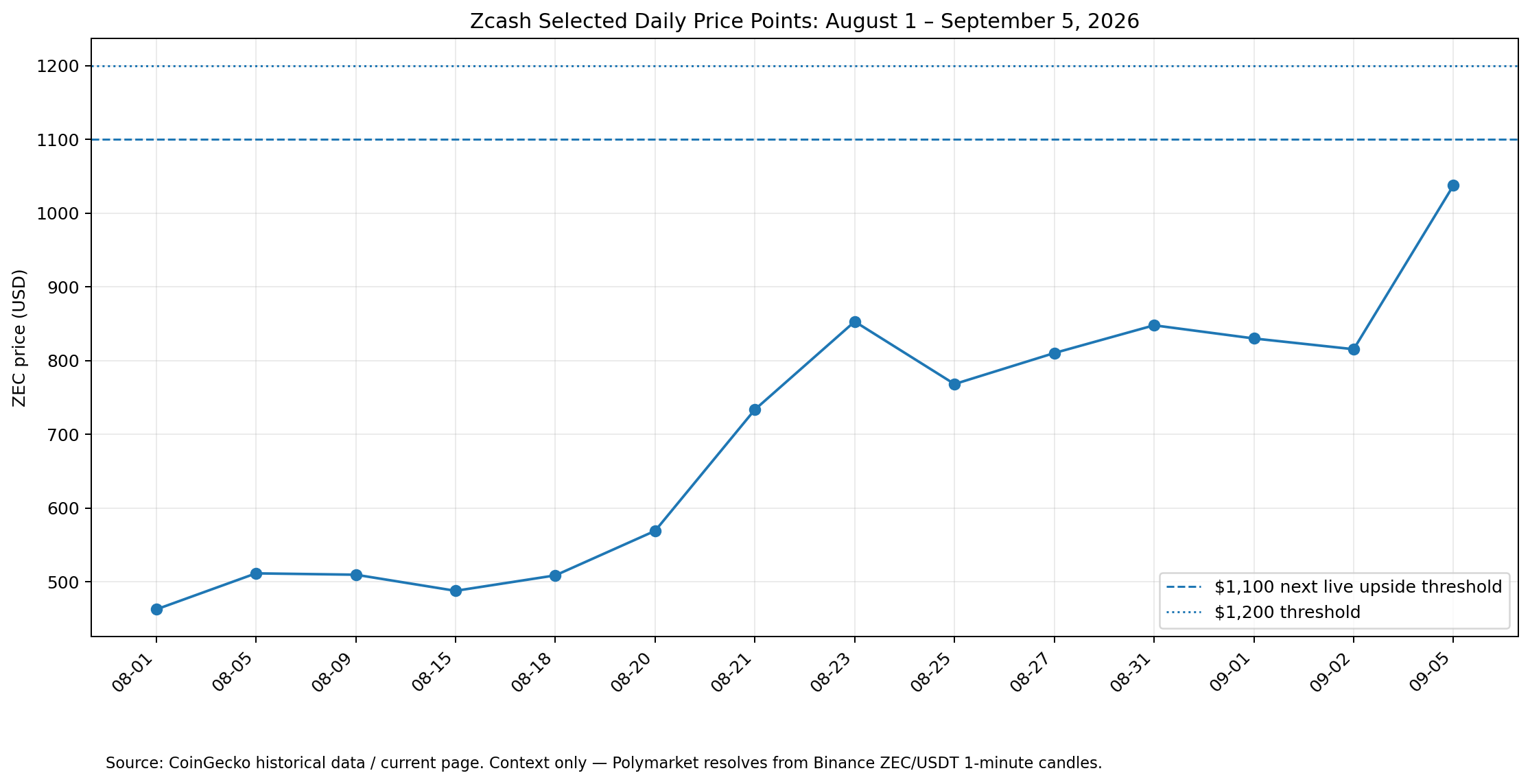
CoinGecko’s historical page shows ZEC around $462.37 on August 1, $568.97 on August 20, $733.47 on August 21, $852.82 on August 23, and $815.26 on September 2 before the break above $1,000. The magnitude of that move makes $1,100–$1,300 easier to imagine, but it also increases the risk of a sharp mean-reversion drawdown.
What the Market May Be Underestimating
Upside convexity: once a token enters a high-volatility, high-attention regime, threshold hits become more likely than a calm terminal-price model would imply. I am therefore somewhat more bullish than the market on $1,500 and $2,000.
Downside coherence: the downside quotes appear far less trustworthy than the upside ladder. A nested hit-price curve should be monotonic. When it is not, the first interpretation should be thin liquidity, stale trades, or wide spreads—not a bizarre probability law.
Short-squeeze decay: the market may also underestimate how quickly a technically-driven rally can cool once forced shorts have already covered. ETF flows are more durable than short liquidation, so separating those two drivers matters.
Bull/Bear Case for Major Outcomes
| Threshold | Bull Case | Bear Case |
|---|---|---|
| ↑ $1,100 | Only ~6% higher; strong momentum and ETF demand. | Immediate post-squeeze reversal before a qualifying Binance high. |
| ↑ $1,200 | ~16% higher; well inside recent monthly volatility. | ETF inflows slow and the short squeeze exhausts. |
| ↑ $1,500 | Another strong crypto leg or sustained ZCSH demand can extend the trend. | Requires ~45% additional upside from an already elevated level. |
| ↑ $2,000 | Privacy narrative plus broad crypto mania creates a second near-doubling. | Needs ~93% more upside; valuation and positioning become harder to sustain. |
| ↓ $700 | Crypto volatility, profit-taking or regulatory shock can produce a 30%+ correction. | ETF demand and renewed spot buying provide a higher floor. |
| ↓ $500 | Severe market-wide risk-off or privacy-coin shock. | Needs a >50% drawdown from the reference level. |
Risks and Uncertainties
- Resolution-source risk: only Binance ZEC/USDT 1-minute High/Low values count.
- Contract-window risk: newly added thresholds ignore price action before their own creation time.
- Market-liquidity risk: some Polymarket contracts have tiny volume and very wide spreads.
- Volatility risk: ZEC can hit both high and low thresholds in the same year.
- ETF-flow risk: net inflows can slow or reverse.
- Regulatory/listing risk: privacy assets remain sensitive to exchange access and policy decisions.
- Security/protocol risk: future vulnerabilities or network issues could rapidly reprice ZEC.
- Macro risk: crypto remains sensitive to global liquidity, rates, Bitcoin direction and risk appetite.
PredictBoy Probability Assessment
PredictBoy interpretation — analysis, not fact: because these are independent nested hit-price contracts, the probabilities below are not supposed to sum to 100%.
| Threshold | PredictBoy Probability | Reason |
|---|---|---|
| ↑ $1,100 | 90% | Only about 6% above the reference price in a high-volatility regime. |
| ↑ $1,200 | 72% | Base case: roughly +16% from reference, supported by current momentum but no longer trivial. |
| ↑ $1,300 | 57% | About +25%; still plausible if ETF demand and momentum persist. |
| ↑ $1,400 | 44% | About +35%; requires another strong leg higher. |
| ↑ $1,500 | 34% | About +45%; meaningful upside scenario, not the median path. |
| ↑ $2,000 | 14% | Nearly +93%; tail scenario even after the historic rally. |
| ↓ $700 | 32% | About -32.5%; large but entirely possible in crypto if the squeeze and ETF impulse reverse. |
| ↓ $600 | 22% | About -42%; possible in a sharp unwind, but lower than ↓$700 by logical nesting. |
| ↓ $500 | 14% | About -52%; severe retracement scenario. |
| ↓ $400 | 8% | Deep crash scenario. |
| ↓ $300 | 4% | Very deep drawdown scenario. |
| ↓ $200 | 1.5% | Extreme downside tail. |
| ↓ $100 | 0.5% | Near-collapse tail. |
| ↓ $50 | 0.2% | Extreme low-probability tail. |
Market Odds vs. PredictBoy
| Threshold | Polymarket Displayed | PredictBoy | Difference |
|---|---|---|---|
| ↑ $1,100 | 80% | 90% | +10.0 pts |
| ↑ $1,200 | 77% | 72% | -5.0 pts |
| ↑ $1,300 | 55% | 57% | +2.0 pts |
| ↑ $1,400 | 42% | 44% | +2.0 pts |
| ↑ $1,500 | 23% | 34% | +11.0 pts |
| ↑ $2,000 | 9% | 14% | +5.0 pts |
| ↓ $700 | 37% | 32% | -5.0 pts |
| ↓ $600 | 54% | 22% | -32.0 pts |
| ↓ $500 | 47% | 14% | -33.0 pts |
| ↓ $400 | 17% | 8% | -9.0 pts |
| ↓ $300 | 50% | 4% | -46.0 pts |
| ↓ $200 | 8% | 1.5% | -6.5 pts |
| ↓ $100 | 4% | 0.5% | -3.5 pts |
| ↓ $50 | 4% | 0.2% | -3.8 pts |
My largest practical disagreement is not a single price target—it is the quality of the downside ladder. The displayed downside percentages are not internally monotonic, so I give more weight to distance-to-price, realized volatility and a coherent nested probability structure than to those raw screen values.
What Could Change Before Resolution
- ZCSH ETF inflows accelerating or turning into outflows.
- Another short squeeze or, conversely, a leveraged-long liquidation cascade.
- Bitcoin and the broader crypto market entering a stronger risk-on or risk-off regime.
- A major privacy-coin regulatory or exchange-listing change.
- A Zcash network/security announcement.
- A new qualifying Binance high/low immediately resolving one or more threshold contracts.
Primary Factors
- Distance from the current price to each threshold.
- Realized volatility and momentum.
- ETF spot-demand persistence.
Secondary Factors
- Short positioning and forced-liquidation risk.
- Network/security confidence after Ironwood.
- Macro liquidity and privacy-coin regulation.
Overall Probability Outlook
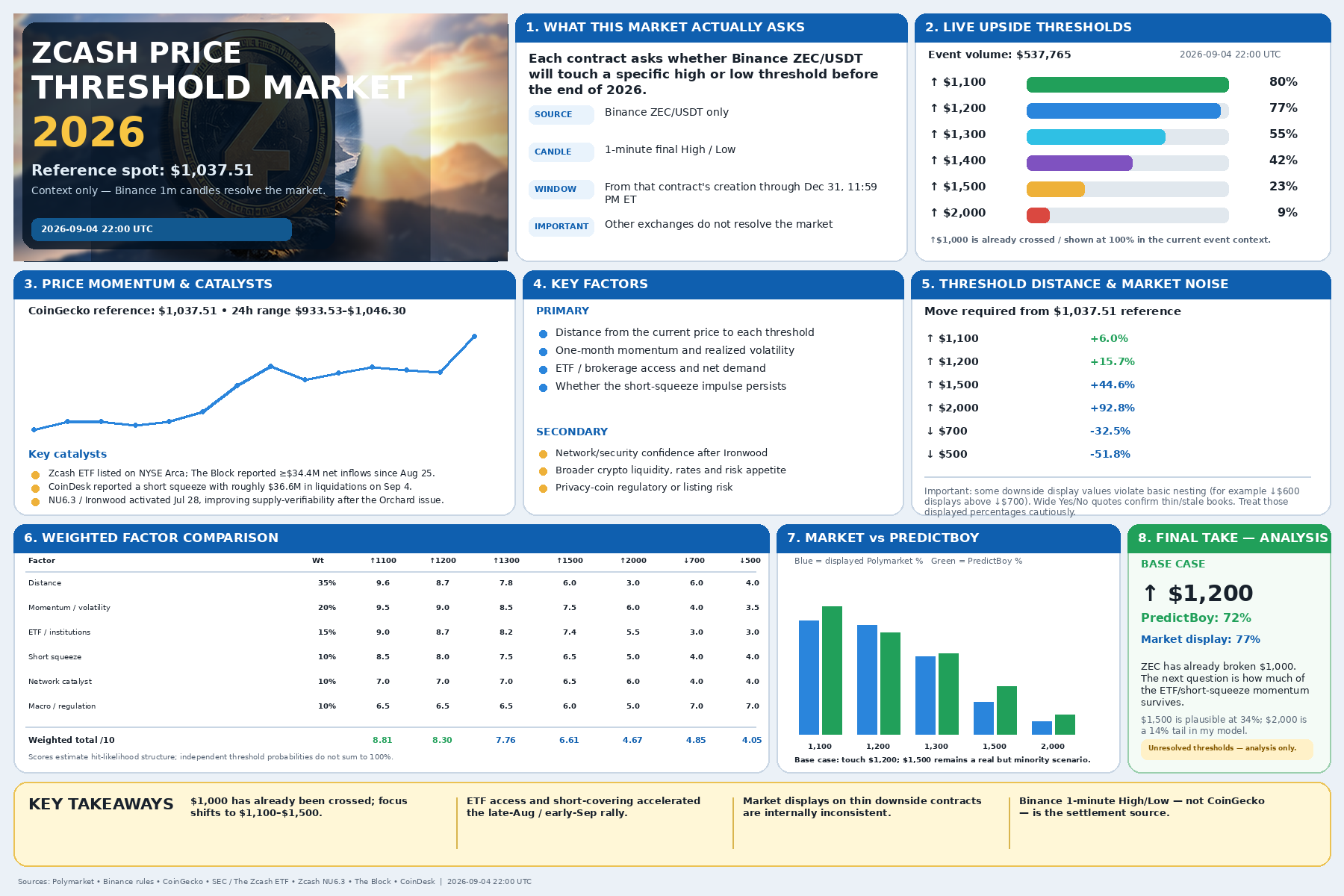
ZEC has already moved beyond $1,000, so the meaningful upside debate has shifted to $1,100–$1,500. I view $1,200 as the most useful base-case threshold, $1,500 as a meaningful but minority upside scenario, and $2,000 as a genuine tail rather than an impossibility. On the downside, $700 remains a credible correction level even in an overall bullish setup.
Final Take
PredictBoy analysis: my base case is that ZEC touches $1,200 before year-end (72%). I put 34% on a $1,500 touch and 14% on $2,000. The rally has real catalysts—new ETF access, reported inflows, renewed network-confidence signals—but part of the latest vertical move also came from forced short-covering, which is less durable.
For anyone tracking this market, the most important operational rule is simple: watch the Binance ZEC/USDT 1-minute High and Low during each contract’s active window. A CoinGecko or Coinbase print can be useful context, but it does not settle the contract.
Sources
- Polymarket — What price will Zcash hit in 2026?
- Binance — ZEC/USDT
- CoinGecko — Zcash current price
- CoinGecko — Zcash historical data
- SEC — The Zcash ETF prospectus
- SEC — NYSE Arca listing / name-change 8-K
- Zcash — NU6.3 / Ironwood
- Zcash — Security information
- The Block — ZEC above $1,000 / ETF inflows
- CoinDesk — ZEC short squeeze / liquidations
Disclosure: This article is informational analysis, not financial advice. Crypto assets and prediction-market prices can change rapidly, and the contracts resolve strictly according to their published rules.