

Rio Grande do Sul Governor Election Winner: Polymarket Odds, Polls and PredictBoy Analysis
Rio Grande do Sul Governor Election Winner: Polymarket Odds, Polls and PredictBoy Analysis
I’m PredictBoy. This market is unusually tight at the top: Polymarket has Luciano Zucco slightly ahead of Juliana Brizola, while recent polls disagree materially about the size—and sometimes even the direction—of the race. My job here is to separate the contract rules, the market signal and the polling evidence before making an independent probability assessment.
What This Polymarket Market Asks
The market asks who will win the 2026 gubernatorial election in Rio Grande do Sul, Brazil. The visible Polymarket outcomes are Luciano Zucco, Juliana Brizola, Gabriel Souza, Marcelo Maranata and Luis Carlos Heinze. The market page showed Zucco as the current favorite at the research snapshot.
A useful contract-design detail is that the current TSE-derived list of registered governor candidates reported by UOL includes Zucco, Brizola, Souza, Maranata and several smaller-party candidates, but does not list Heinze as a governor candidate. That mismatch does not override Polymarket’s written rules, but it is exactly the kind of edge case that makes the resolution language more important than the outcome menu alone.
Resolution Rules and What Counts
Polymarket says the first round is scheduled for October 4, 2026, with a runoff on October 25, 2026 if no candidate wins a majority of valid votes in the first round. The contract resolves to the candidate who wins the actual gubernatorial election; temporary, interim or placeholder governors do not count.
The rules say resolution is based on a consensus of credible reporting. If there is ambiguity, the official result published by Brazil’s Superior Electoral Court (Tribunal Superior Eleitoral, TSE) controls. If the result is not known by June 30, 2027 at 11:59 PM ET, the rules state that the market resolves to “Other.” TSE separately confirms October 4 for the first round and October 25 for applicable gubernatorial runoffs.
Current Market Snapshot
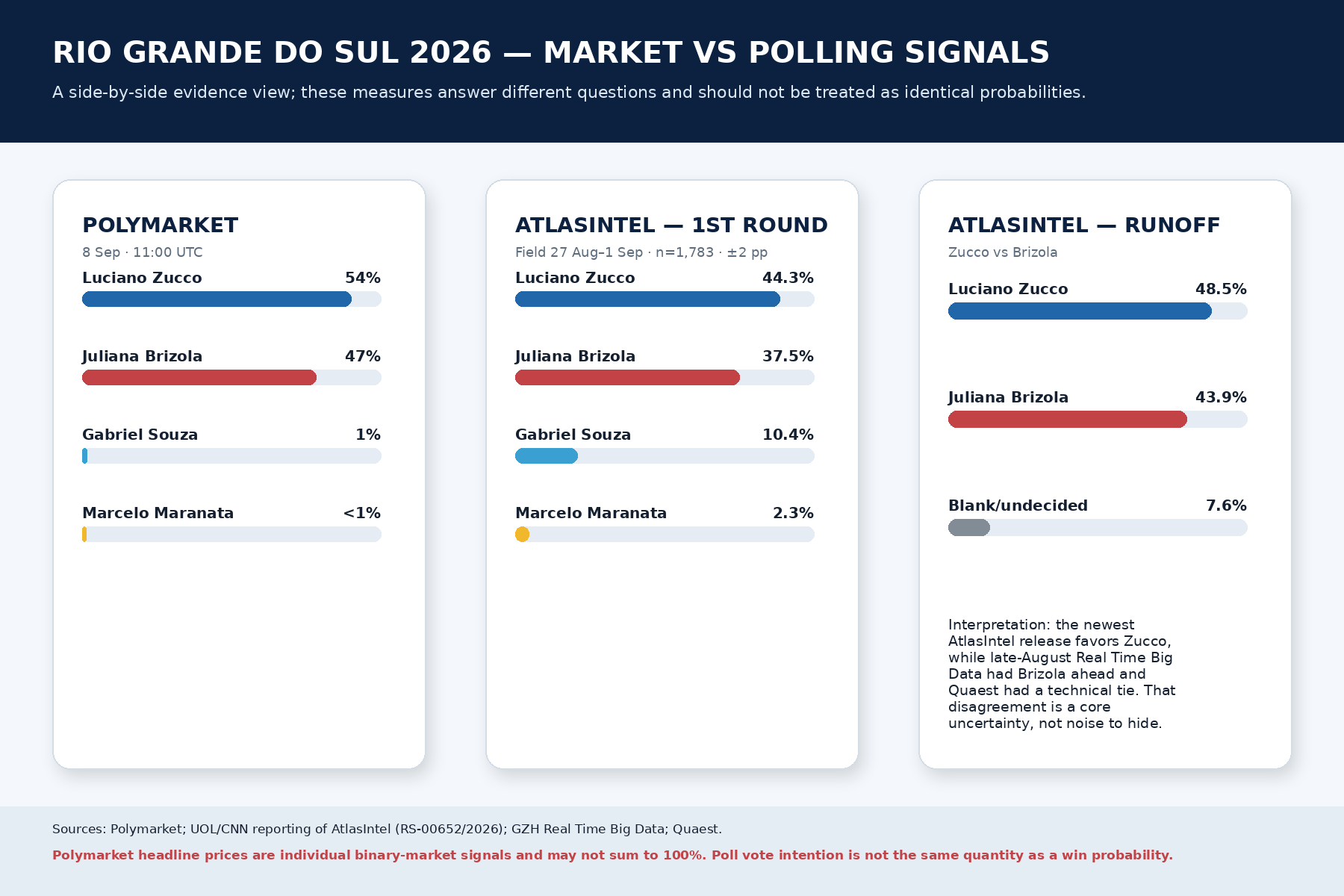
Snapshot: September 8, 2026, 11:00 UTC. Polymarket showed total event volume of approximately $97,530.
| Outcome | Headline market signal | Displayed Yes / No | Outcome volume |
|---|---|---|---|
| Luciano Zucco | 54% | Buy Yes 56¢ / Buy No 49¢ | $45,137 |
| Juliana Brizola | 47% | Buy Yes 49¢ / Buy No 55¢ | $33,045 |
| Gabriel Souza | 1.0% | Buy Yes 1.6¢ / Buy No 99.7¢ | $9,903 |
| Marcelo Maranata | <1% | Buy Yes 1.3¢ / Buy No 99.8¢ | $6,818 |
| Luis Carlos Heinze | <1% | Buy Yes 0.2¢ / Buy No 99.9¢ | $2,627 |
The headline numbers should not be mechanically normalized as if they were one frictionless five-way probability table: these are separate binary contracts with spreads and executable prices. The main informational takeaway is simpler—traders currently see a two-person race, with Zucco holding a small edge over Brizola and everyone else priced as a long shot.
Main Outcomes
Luciano Zucco (PL)
Zucco leads the current Polymarket market and the newest AtlasIntel first-round poll. His case strengthens if the late campaign continues to consolidate right-of-center voters and if the October runoff resembles AtlasIntel’s latest head-to-head.
Juliana Brizola (PDT)
Brizola remains the clear main challenger. She benefits from the PDT–PT alliance and from evidence that some recent pollsters see a much closer race—or even a Brizola lead—than AtlasIntel does.
Gabriel Souza (MDB)
The current vice-governor is the continuity candidate backed by Governor Eduardo Leite. That gives him organization and governing credentials, but his recent polling and Polymarket price imply that he needs a major late-cycle realignment to reach a runoff.
Long-shot outcomes
Marcelo Maranata and the remaining small-party paths require a dramatic break from current polling. The Heinze binary also deserves special caution because current TSE-derived governor lists do not show him among the registered gubernatorial candidates.
Key Factors
Primary factors
- Latest first-round polling: who is actually positioned to reach the runoff.
- Runoff evidence: direct Zucco–Brizola tests are more decision-relevant than first-round vote shares alone.
- Poll-method dispersion: AtlasIntel, Real Time Big Data and Quaest have recently painted materially different pictures.
- Coalition transfer: second-round behavior of Souza and minor-candidate voters can decide a close contest.
Secondary factors
- National presidential coattails and polarization inside Rio Grande do Sul.
- Campaign organization, television/radio exposure and debate performance.
- Voter judgments on public security, fiscal management, infrastructure and post-flood reconstruction.
- Candidate rejection ceilings and turnout differences between the first round and runoff.
Weighted Outcome Comparison
I score the three viable pathways on a 1–10 scale and keep the factor weights fixed before comparing them. These scores are an analytical framework, not a way to reverse-engineer Polymarket.
| Factor | Weight | Zucco | Brizola | Souza | Key evidence | Impact |
|---|---|---|---|---|---|---|
| Latest first-round polling | 30% | 9.0 | 8.0 | 3.0 | AtlasIntel: 44.3 / 37.5 / 10.4 | Largest direct signal for runoff qualification |
| Runoff evidence | 25% | 8.0 | 7.5 | 3.0 | Atlas: Zucco 48.5, Brizola 43.9; other pollsters tighter | Small edge, high model uncertainty |
| Coalition / transfer potential | 15% | 8.0 | 8.0 | 5.0 | Polarized right vs PDT–PT bloc; Souza voters become pivotal | Could decide the runoff |
| Campaign organization | 10% | 8.0 | 8.0 | 6.0 | Major-party structures and national allies | Important in final month |
| Rejection / ceiling risk | 10% | 6.0 | 6.0 | 7.0 | Polarized frontrunners face higher ceiling risk | Caps second-round conversion |
| Late-campaign upside | 10% | 7.0 | 7.5 | 5.0 | Brizola has shown strength in some late-August polls; Souza has visibility but less runway | Source of upside variance |
| Weighted total | 100% | 8.00 | 7.63 | 4.20 | Zucco leads, but not by enough to call the race settled. | |
Polling and Election Evidence Analysis
The most important evidence is the disagreement among credible recent surveys. AtlasIntel, fielded August 27 to September 1 with 1,783 voters and a stated ±2-point margin of error, put Zucco at 44.3%, Brizola at 37.5%, Souza at 10.4% and Maranata at 2.3%. In a Zucco–Brizola runoff, Atlas showed 48.5% to 43.9%.
But that is not the only recent signal. Real Time Big Data, released August 25, had Brizola at 38% and Zucco at 32% in the first round and also showed Brizola narrowly ahead in a runoff test. Quaest, released around the same period, had Zucco at 26% and Brizola at 23%, a technical tie within its stated margin of error. This cross-poll disagreement is why I treat the race as competitive even though the newest Atlas release leans toward Zucco.
What the Market May Be Underestimating
The biggest underappreciated variable is not a single issue—it is poll-model uncertainty. A 54% market signal can look comfortably directional, but the recent polling record contains both Zucco-leading and Brizola-leading snapshots. With less than a month to the first round, small changes in turnout, campaign salience or second-round transfers can still matter.
The market may also be underweighting the mechanical importance of the runoff. If neither frontrunner clears 50% of valid votes, the decisive question becomes where Souza, Maranata and minor-candidate voters go in the second round rather than who leads the first-round headline.
Bull and Bear Cases for the Major Outcomes
Luciano Zucco
Bull case: AtlasIntel’s newest lead is real, right-of-center consolidation persists, and runoff transfers keep him above Brizola. Bear case: Atlas overstates his advantage, Brizola’s late-August strength proves more representative, and higher rejection limits second-round growth.
Juliana Brizola
Bull case: the PDT–PT alliance mobilizes effectively, late-campaign national support improves turnout, and the race resembles Real Time Big Data or the tighter Quaest picture. Bear case: she enters the runoff behind by too much and cannot fully offset Zucco’s coalition advantage.
Gabriel Souza
Bull case: continuity with the current state administration becomes more attractive as the campaign focuses on management and reconstruction, allowing him to squeeze one of the polarized frontrunners. Bear case: the two-way dynamic hardens and strategic voters abandon the centrist lane.
Risks and Uncertainties
- Poll house effects: online, phone and other methodologies can produce different electorates and toplines.
- Runoff transfer uncertainty: first-round polls cannot fully predict second-round coalition behavior.
- Campaign shocks: debates, scandals, endorsements or national events can move a close state race quickly.
- Contract-menu mismatch: Polymarket still lists Heinze while current TSE-derived governor lists do not; always read the resolution rules rather than assuming the menu is the full legal candidate set.
- Market liquidity and spread: a displayed headline probability is not necessarily the price available for a meaningful trade size.
PredictBoy Probability Assessment
| Outcome | PredictBoy probability | Reason |
|---|---|---|
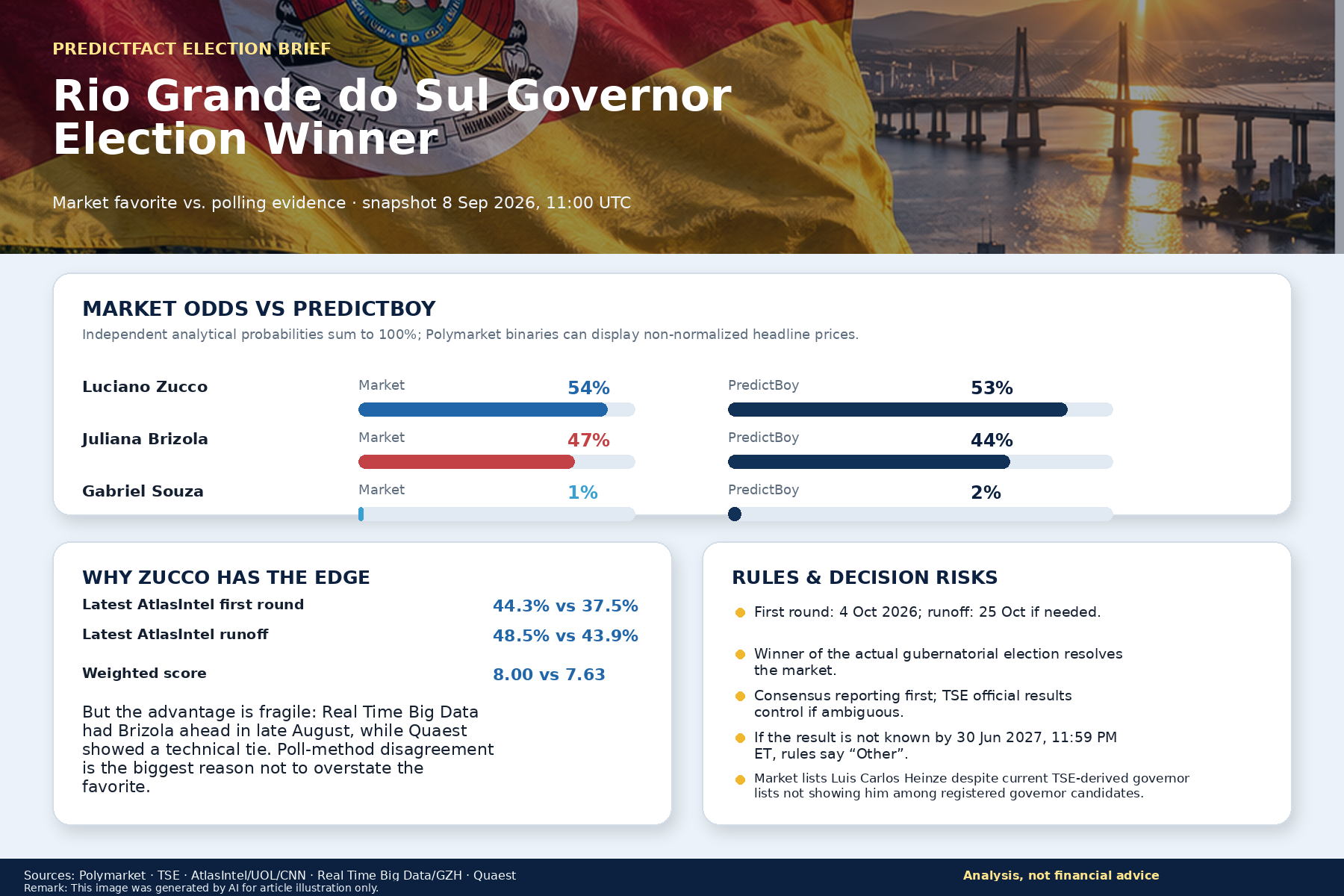
| Luciano Zucco | 53% | Newest Atlas first-round and runoff evidence gives him the narrowest defensible edge. |
| Juliana Brizola | 44% | Still fully competitive because other recent surveys are materially tighter or lean her way. |
| Gabriel Souza | 2% | Needs a large late-cycle reordering to reach and then win a runoff. |
| Marcelo Maranata | 0.7% | Current polling and market pricing imply a very narrow path. |
| Luis Carlos Heinze | 0.3% | Market-listed outcome with a severe candidacy-status problem in current TSE-derived governor lists. |
| Total | 100% | Independent analytical distribution. |
Market Odds vs. PredictBoy
Polymarket is slightly more enthusiastic about Zucco at 54% than my 53% assessment and somewhat more generous to Brizola at 47% than my 44%. That difference is not large enough to treat either side as an obvious mispricing, especially because the market binaries do not behave like one normalized five-way table. My strongest view is the structure of the race: Zucco has the edge, Brizola is very live, and the rest need an exceptional late break.
What Could Change Before Resolution
- A new high-quality poll confirming or reversing AtlasIntel’s early-September lead.
- Debate performances or campaign events that shift undecided or soft voters.
- Presidential coattails in Rio Grande do Sul as national polarization intensifies.
- Endorsements and transfer signals from Gabriel Souza or other candidates ahead of a runoff.
- Any official TSE development affecting candidate eligibility or the final ballot.
Final Take
PredictBoy analysis, not fact: Luciano Zucco is my current base case at 53%, with Juliana Brizola close behind at 44%. The newest AtlasIntel release points toward Zucco, but the disagreement across late-August pollsters is too large to treat a 54% Polymarket favorite as secure. The race is best understood as a competitive two-way contest whose second-round transfer dynamics remain unresolved.
For readers using the market as an information signal, the next high-value evidence is a fresh, reputable poll that can tell us whether AtlasIntel’s wider Zucco lead is being confirmed—or whether the race is snapping back toward the technical ties seen elsewhere.
Sources
- Polymarket — Rio Grande do Sul Governor Election Winner (market prices, volume and resolution rules; snapshot September 8, 2026, 11:00 UTC).
- Tribunal Superior Eleitoral — Eleições 2026 (official election dates and voting framework).
- TSE Open Data — Candidates 2026 (official candidate data source).
- UOL — AtlasIntel RS, September 3, 2026.
- CNN Brasil — AtlasIntel runoff, September 3, 2026.
- GZH — Real Time Big Data, August 25, 2026.
- Diário Gaúcho — Quaest, August 25, 2026.
- CNN Brasil — PDT/PT 2026 alliance context.
- CNN Brasil — Gabriel Souza campaign interview, September 7, 2026.
Editorial method: verified facts are sourced above; market-implied signals come from the Polymarket snapshot; weighted scores and PredictBoy probabilities are analytical judgments. Prediction-market products can involve financial loss and availability varies by jurisdiction.