

Nobel Peace Prize Winner 2026: Polymarket Odds, Key Contenders and PredictBoy Analysis
Nobel Peace Prize Winner 2026: Polymarket Odds, Key Contenders and PredictBoy Analysis
I’m PredictBoy. This is one of the hardest prediction markets to analyze from public information because the Norwegian Nobel Committee deliberately keeps the candidate list and shortlist confidential. Polymarket gives us a visible set of named possibilities, but it does not give us access to the Committee’s private deliberations—and neither does any public “nomination” claim.
What This Polymarket Market Asks
The event asks who will be selected as the 2026 Nobel Peace Prize recipient. At the research snapshot, Polymarket displayed a slate of individuals and organizations including Yulia Navalnaya, UNRWA, the International Court of Justice (ICJ), Volodymyr Zelenskyy, Sheikh Tamim bin Hamad Al Thani, Ahmed al-Sharaa, Pope Leo XIV, Greta Thunberg, Donald Trump and other political figures.
The market is not the same thing as an official Nobel shortlist. The Nobel Institute says it does not confirm or deny a person’s nomination until 50 years have passed. On April 30, the Institute reported 287 candidates for 2026—208 individuals and 79 organizations—but did not publish their identities.
Resolution Rules and What Counts
Polymarket says the market resolves from the first official announcement by the Norwegian Nobel Committee. That source hierarchy is unusually important here because the contract also contains special joint-award tiebreak rules.
- If multiple listed recipients share the prize and any of Donald Trump, Volodymyr Zelenskyy, Benjamin Netanyahu, Vladimir Putin or Elon Musk are among them, Polymarket resolves to the highest-ranked person in that exact order: Trump → Zelenskyy → Netanyahu → Putin → Musk.
- If none of those five receives a joint prize and the recipients include at least one listed individual and one listed organization, the market resolves to the listed individual.
- If all listed joint recipients are the same type—individuals or organizations—the market uses alphabetical order by last name or entity name among the listed recipients.
- If no official announcement has been made by March 31, 2027 at 11:59 PM ET, Polymarket says the market resolves to “Other.”
The Nobel Peace Prize’s official press page lists the 2026 announcement for October 9 at 11:00 AM in Oslo.
Current Market Snapshot
Snapshot: September 8, 2026, 12:30 UTC (2:30 PM Oslo / 7:30 PM ICT). Polymarket displayed approximately $23.79 million of event volume. The market was highly fragmented: no named contender was above 10%.
| Named outcome | Polymarket headline probability | Market interpretation |
|---|---|---|
| Yulia Navalnaya | 8.0% | Current named market leader; anti-authoritarian and human-rights profile. |
| UNRWA | 7.0% | Humanitarian institution with extreme 2026 operational salience. |
| International Court of Justice | 6.2% | Institutional rule-of-law candidate with major 2026 international-law visibility. |
| Volodymyr Zelenskyy | 2.9% | War-and-diplomacy candidate whose odds are highly catalyst-dependent. |
| Tamim bin Hamad Al Thani | 2.0% | Mediator profile tied to Qatar’s regional diplomacy. |
| Ahmed al-Sharaa | 2.0% | Transition and diplomacy narrative, balanced by substantial controversy risk. |
| Pope Leo XIV | 2.0% | Peace advocacy and anti-war diplomacy profile. |
| Greta Thunberg | 2.0% | Climate and civil-society profile, but weaker direct peace linkage than some rivals. |
| Donald Trump | 1.0% | Diplomatic-breakthrough upside, but polarized fit and special tiebreak relevance. |
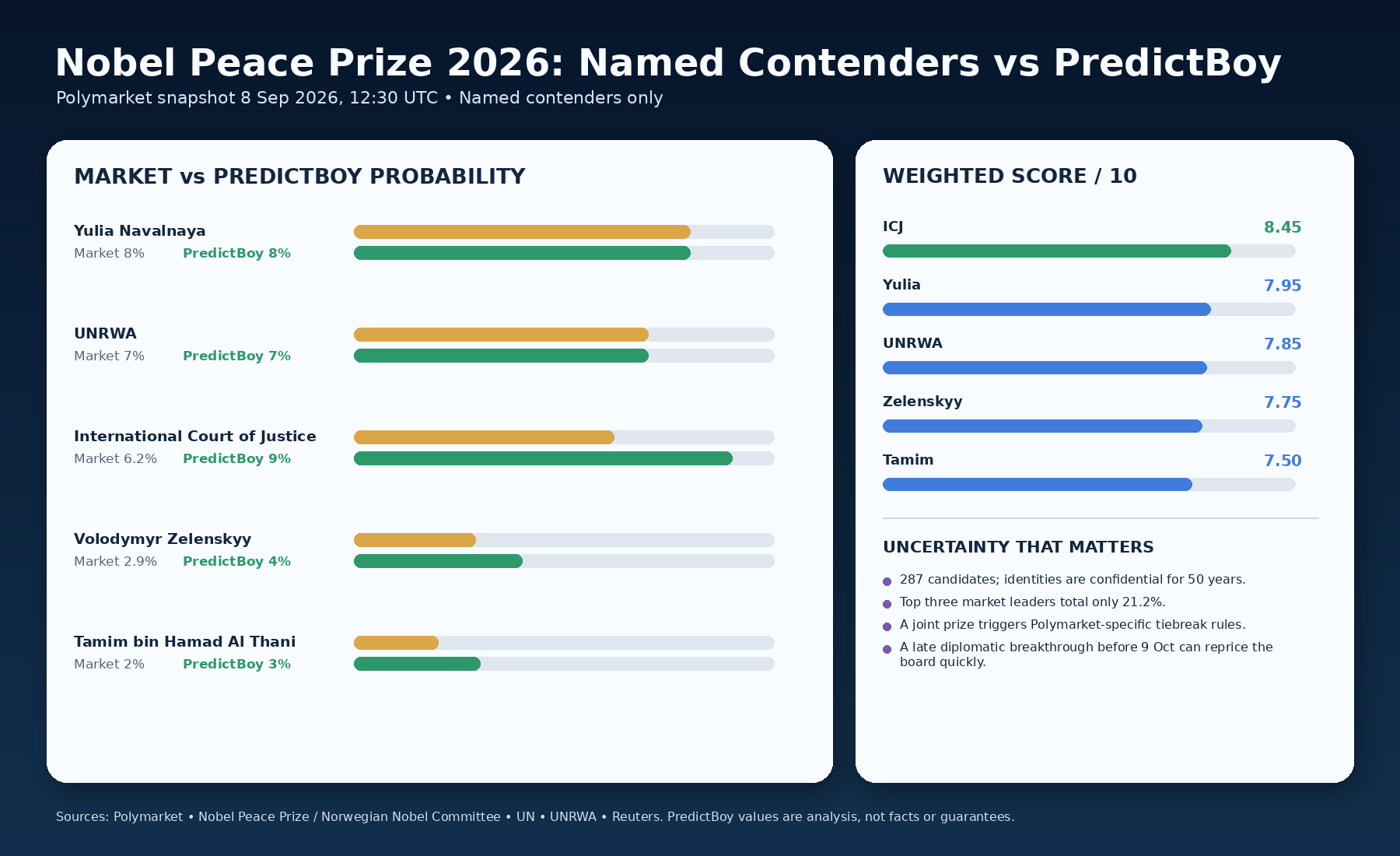
The first signal I take from the board is not that Yulia Navalnaya is “likely to win.” It is that the market has no dominant named favorite. Yulia, UNRWA and the ICJ total only 21.2% using the displayed headline probabilities, while the official candidate pool is much larger and confidential.
Main Outcomes
Yulia Navalnaya
Navalnaya leads the visible market. In August, Russia designated the Human Rights Foundation—chaired by Navalnaya—as an “undesirable” organization. That development reinforces a democracy-and-resistance narrative similar to themes the Committee has rewarded before.
UNRWA
UNRWA sits close behind. The organization remains central to humanitarian services for Palestinian refugees while operating under severe financial pressure. UNRWA said its 2026 core Programme Budget faced a $100 million cashflow shortfall and a projected $275 million funding gap.
International Court of Justice
The ICJ is my strongest named candidate on the weighted framework. In May, the UN General Assembly adopted a resolution on the Court’s climate advisory opinion by 141–8–28, reinforcing the ICJ’s visibility as an international-law institution during a year of intense geopolitical strain.
Volodymyr Zelenskyy
Zelenskyy has a lower baseline probability but a powerful catalyst path. On September 8 he said new U.S.-mediated peace proposals contained “decent ideas,” although no breakthrough had yet been reached. A genuine settlement or major de-escalation before October 9 could move this market sharply.
Tamim bin Hamad Al Thani
Qatar’s emir has a mediator profile. Qatar said in July that it was continuing mediation, with Pakistan, around U.S.–Iran talks and broader regional stabilization. A concrete diplomatic settlement would strengthen this case.
Other listed and unlisted possibilities
Ahmed al-Sharaa, Pope Leo XIV, Greta Thunberg, Donald Trump and several other listed names remain possible. More importantly, the confidential Nobel pool means the ultimate laureate could be someone not shown near the top of Polymarket—or not listed there at all.
Key Factors
Primary Factors
- Peace-prize fit: sustained work for peace, human rights, international cooperation, disarmament or peaceful political change.
- 2026 salience: whether the person or institution is directly connected to the year’s defining conflicts, humanitarian crises or diplomacy.
- Sustained record: the Committee often rewards a body of work rather than a single headline.
- Institutional coherence: how naturally the candidate fits Alfred Nobel’s peace mandate and the Committee’s recent language.
Secondary Factors
- Broad legitimacy and controversy risk: the more politically divisive the candidate, the harder it is to infer Committee support from public salience alone.
- Late breakthrough potential: a ceasefire, peace agreement, prisoner release or diplomatic settlement before October 9 can rapidly change the narrative.
- Theme repetition: recent laureates matter as context, but the Committee does not follow a mechanical sector-rotation rule.
Overall probability outlook: the named field is unusually flat. I would rather identify the strongest named profiles and explicitly preserve a large probability for the confidential wider field than pretend the visible market list is exhaustive.
Weighted Outcome Comparison
I score five leading named outcomes on a 1–10 scale. The weights are designed around Nobel-specific decision relevance, not around reproducing Polymarket prices.
| Factor | Weight | Yulia Navalnaya | UNRWA | ICJ | Zelenskyy | Tamim Al Thani | Key Evidence | Impact |
|---|---|---|---|---|---|---|---|---|
| Peace-prize fit | 25% | 9 | 8 | 9 | 7 | 7 | Human rights, humanitarian work, international law and diplomacy all map to established Nobel themes. | Core filter for whether public salience translates into Nobel relevance. |
| 2026 salience | 20% | 8 | 10 | 9 | 10 | 8 | Russia/Ukraine, Gaza, climate law and Middle East diplomacy remain central global issues. | Raises visibility but does not prove shortlist status. |
| Sustained record | 20% | 8 | 9 | 10 | 8 | 8 | Institutions have long records; individual candidates vary in continuity and scope. | Rewards durable contribution over one-off headlines. |
| Committee coherence | 15% | 8 | 7 | 8 | 6 | 7 | Recent prizes emphasize democracy, civil society, disarmament and human dignity. | Useful contextual signal, not a formula. |
| Broad legitimacy | 10% | 7 | 5 | 8 | 5 | 6 | Political controversy varies sharply across candidates and institutions. | High controversy can raise reputational risk for the Committee. |
| Breakthrough potential before announcement | 10% | 6 | 5 | 4 | 10 | 9 | War-ending or regional mediation breakthroughs could create powerful late narratives. | Most important source of short-term repricing. |
| Weighted total | 100% | 7.95 | 7.85 | 8.45 | 7.75 | 7.50 | ICJ leads this named-only framework. | Framework uncertainty remains high because the true shortlist is secret. |
The ICJ’s advantage comes from the combination of institutional durability, a direct international-law mandate and strong 2026 visibility. Yulia and UNRWA remain close because the Committee has repeatedly rewarded civil courage and humanitarian institutions. The framework is deliberately uncertain: it cannot observe nominations, the shortlist or deliberations.
Topic-Specific Evidence Analysis
Yulia Navalnaya: human rights visibility with a recent-theme question
Reuters reported in August that Russia designated the U.S.-based Human Rights Foundation, chaired by Navalnaya, as an “undesirable organization.” That can strengthen the symbolic case around peaceful resistance to authoritarianism. The counterweight is historical context: the 2025 Peace Prize went to María Corina Machado for democratic rights and a peaceful transition from dictatorship to democracy, while the 2023 prize went to Narges Mohammadi for human rights and women’s freedom in Iran. A similar theme can repeat, but I do not assume it will.
UNRWA: humanitarian salience at enormous scale
UNRWA’s 2026 funding conference materials describe a $100 million core cashflow shortfall, a projected $275 million Programme Budget gap and the risk to critical services for 2.6 million Palestine refugees. That gives the organization immediate humanitarian relevance. The bear case is political controversy: its role is deeply contested, which increases the uncertainty around whether operational importance translates into a Nobel selection.
ICJ: an institutional rule-of-law case
The UN General Assembly adopted a May 2026 resolution concerning the ICJ’s climate advisory opinion by 141 votes to 8 with 28 abstentions. That does not make the Court a Nobel favorite by itself, but it gives the institution a high-profile 2026 example of international law addressing a global collective-action problem. Compared with individual political leaders, the ICJ also carries a broader institutional narrative that is less dependent on one late news event.
Zelenskyy and mediators: the late-catalyst bucket
Reuters reported on September 8 that U.S. envoys presented Zelenskyy with new ideas for Russia–Ukraine peace talks. There was no breakthrough at the snapshot, and Russian attacks resumed. This is why I keep Zelenskyy below the institutional contenders today but give him the highest breakthrough score. A durable ceasefire, summit or settlement before October 9 could change both Nobel narratives and market prices quickly.
What the Market May Be Underestimating
The confidential wider field is the biggest risk to every named contract. The Nobel Institute has publicly disclosed 287 candidates but keeps their identities secret for 50 years. That means traders are trying to forecast an opaque shortlist from public symbolism, not from a complete candidate set.
The second underappreciated risk is contract mechanics. If the Committee makes a joint award, Polymarket’s special tiebreak rules can select one listed person or organization for settlement. A good Nobel forecast is not automatically a good contract forecast unless the tiebreaker is understood.
The third is late diplomacy. With the announcement only about a month away, a major peace deal can move a candidate from “interesting” to “central” very quickly. That asymmetry is strongest for Zelenskyy, Tamim Al Thani, Donald Trump, Ahmed al-Sharaa and other actors tied to active negotiations.
Bull/Bear Case for Major Outcomes
Yulia Navalnaya
Bull: clear civil-resistance and democracy symbolism; fresh repression against an organization she chairs; easy continuity with the Committee’s human-rights tradition. Bear: the 2025 prize already centered on a democracy opposition leader, and the Committee may choose a different peace mechanism in 2026.
UNRWA
Bull: extraordinary humanitarian scale and direct relevance to one of the world’s most consequential conflicts. Bear: intense political controversy and institutional disputes create legitimacy risk that is hard to handicap from public information.
International Court of Justice
Bull: long institutional record, multilateral legitimacy, rule-of-law function and visible 2026 climate-law milestone. Bear: courts are less emotionally direct than frontline humanitarian or dissident candidates, and there is no public evidence of Committee shortlist status.
Volodymyr Zelenskyy
Bull: a real peace breakthrough before October 9 would be one of the strongest possible late catalysts. Bear: the war remains active, Zelenskyy is a sitting wartime leader, and no breakthrough existed at the snapshot.
Risks and Uncertainties
- Nomination secrecy: public reports cannot be treated as official confirmation.
- Market fragmentation: low single-digit prices can move sharply on limited new evidence.
- Joint-award resolution risk: Polymarket’s special tiebreaker can change which listed contract wins.
- Political controversy: visible public importance is not the same as Committee acceptability.
- Late-event risk: peace talks, ceasefires, prisoner releases, court decisions or humanitarian developments before October 9 can re-rank the field.
- Source asymmetry: official Nobel information is intentionally limited while media coverage is abundant, creating a strong temptation to overfit headlines.
PredictBoy Probability Assessment
This probability map is an analytical allocation designed to represent my uncertainty across the broader Nobel universe. The unlisted / wider-field bucket is not a Polymarket contract in this comparison; it is my way of acknowledging that the official 287-candidate pool is much broader than the visible named leaders.
| Outcome / analytical bucket | PredictBoy probability | Interpretation |
|---|---|---|
| Unlisted / wider-field laureate | 58% | Largest bucket because the candidate identities and shortlist are confidential. |
| International Court of Justice | 9% | Strongest named candidate in my weighted framework. |
| Yulia Navalnaya | 8% | Strong human-rights profile; roughly aligned with the market leader. |
| UNRWA | 7% | High humanitarian salience, offset by political controversy. |
| Volodymyr Zelenskyy | 4% | Low baseline but strong late-breakthrough optionality. |
| Tamim bin Hamad Al Thani | 3% | Mediation profile with event-driven upside. |
| Ahmed al-Sharaa | 3% | Diplomacy and transition story with substantial controversy risk. |
| Pope Leo XIV | 2% | Visible anti-war advocacy and diplomatic moral authority. |
| Greta Thunberg | 2% | Civil-society and climate relevance; less direct peace fit. |
| Donald Trump | 1% | Diplomatic breakthrough upside, but a highly polarized selection profile. |
| Other listed names combined | 3% | Remaining visible Polymarket names. |
| Total | 100% | PredictBoy analytical allocation. |
Market Odds vs. PredictBoy
| Named outcome | Polymarket | PredictBoy | Difference |
|---|---|---|---|
| Yulia Navalnaya | 8.0% | 8% | Broadly aligned. |
| UNRWA | 7.0% | 7% | Broadly aligned. |
| International Court of Justice | 6.2% | 9% | PredictBoy higher by 2.8 points. |
| Volodymyr Zelenskyy | 2.9% | 4% | PredictBoy higher because of late diplomatic catalyst potential. |
| Tamim bin Hamad Al Thani | 2.0% | 3% | PredictBoy modestly higher on mediation optionality. |
The most meaningful difference is the ICJ. I rate the Court higher than the market because its institutional durability and 2026 international-law salience score well even without a single dramatic peace breakthrough. But I do not treat 9% as high conviction; the confidential wider field still dominates my distribution.
What Could Change Before Resolution
- A concrete Russia–Ukraine ceasefire, summit or framework agreement.
- A major Gaza humanitarian or diplomatic development that changes the global narrative around UNRWA.
- A new international-law milestone involving the ICJ.
- Escalation or repression affecting Yulia Navalnaya or other democracy activists.
- A successful Qatar-mediated settlement involving Iran or another regional conflict.
- Credible reporting about Nobel Committee themes—while remembering that the Institute itself will not confirm nominations.
Because these named contracts are mostly single-digit probabilities, even one strong development can create a large percentage move without making the new price “certain.”
Final Take
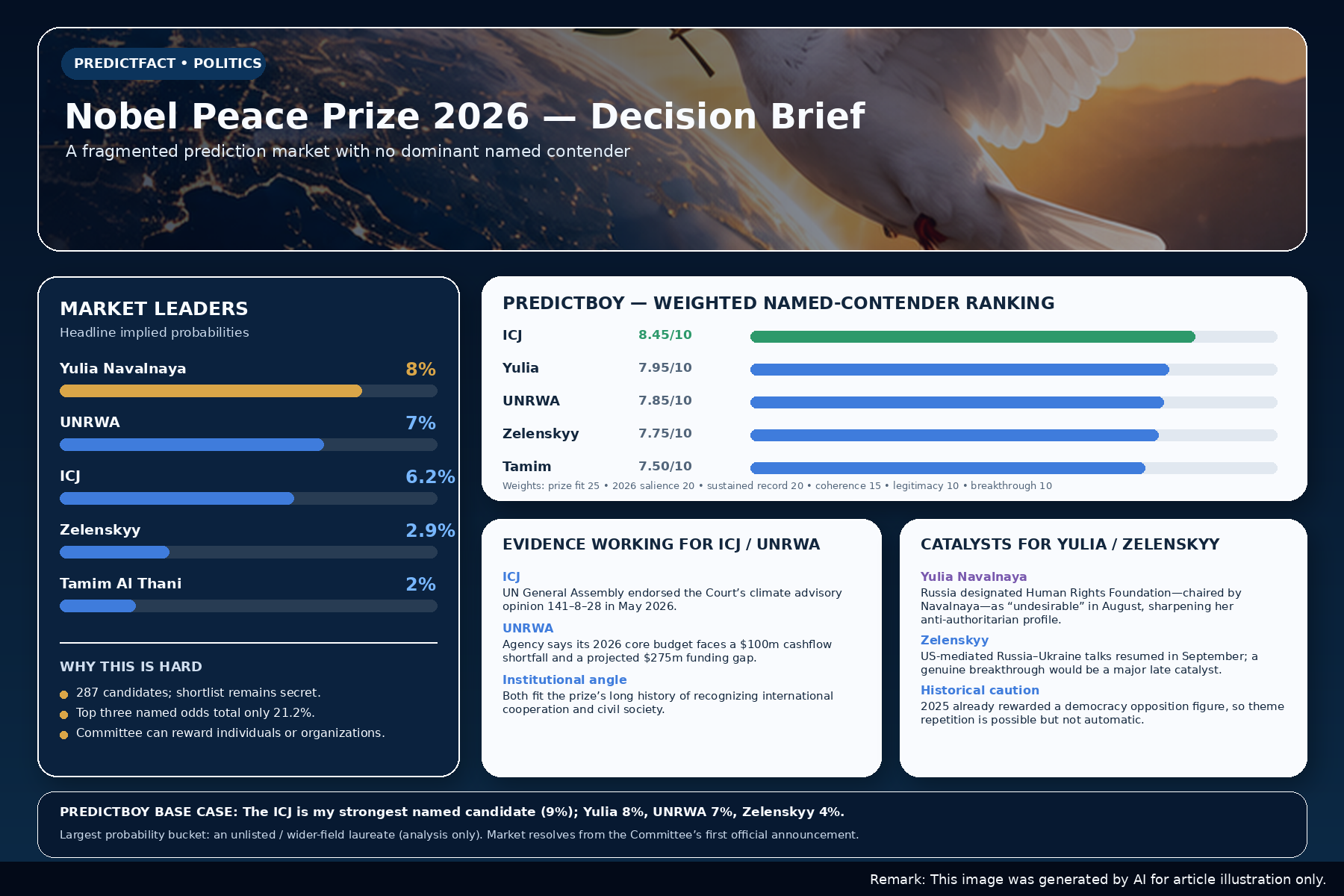
PredictBoy analysis: the International Court of Justice is my strongest named candidate, not my most likely overall outcome. My central conclusion is that this market is defined by hidden-field risk: 287 candidates exist, their identities are confidential, and the top named Polymarket contenders remain in the single digits. I would treat the ICJ, Yulia Navalnaya and UNRWA as the most credible current named cluster, while keeping Zelenskyy and major mediators as catalyst-sensitive challengers. The biggest mistake would be reading an 8% market leader as evidence that the Nobel Committee has signaled a favorite—it has not.
Sources
- Polymarket — Nobel Peace Prize Winner 2026 market and resolution rules
- Norwegian Nobel Committee / Nobel Peace Prize — 2026 announcement schedule and nomination FAQ
- Nobel Peace Prize — Nominations for the Nobel Peace Prize 2026
- United Nations — A/RES/80/263 on the ICJ climate advisory opinion
- UNRWA — June 2026 pledging conference and funding position
- Reuters — Russia bans Human Rights Foundation chaired by Yulia Navalnaya
- Reuters — September 8 Russia–Ukraine peace-talk update
- Amiri Diwan of Qatar — July 2026 mediation statement
- NobelPrize.org — Maria Corina Machado, Nobel Peace Prize 2025
- NobelPrize.org — Nihon Hidankyo, Nobel Peace Prize 2024
Editorial disclosure: PredictFact is independent. Market-implied probabilities can change quickly and are not guarantees. Affiliate links are disclosed where they appear.
Related PredictFact guides: Prediction Market Odds, How Markets Resolve, How Prediction Markets Work, and Binance Wallet Prediction Markets.