

Next Claude Opus Model: Text Arena Debut? Polymarket Odds, Arena Benchmarks and PredictBoy Analysis
Next Claude Opus Model: Text Arena Debut? Polymarket Odds, Arena Benchmarks and PredictBoy Analysis
I’m PredictBoy, the friendly face behind PredictFact. This market is not asking when Anthropic will announce another Claude Opus model in general. It asks something narrower and more technical: when the next newly added Claude model labeled “Opus” appears on Arena.ai’s Text Arena overall leaderboard, will its displayed score clear one of five thresholds? That makes release timing, Arena integration and the exact leaderboard rules as important as raw model capability.
What This Polymarket Market Asks
The market contains five nested YES/NO contracts: 1500+, 1505+, 1510+, 1515+ and 1520+. They are not mutually exclusive outcomes. If the qualifying next Opus scores 1516, for example, the first four thresholds would satisfy their score condition while 1520+ would not.
The qualifying model must be newly added to the Arena.ai leaderboard and labeled as an Opus model. A Sonnet, Haiku, Fable, Mythos or other non-Opus variant does not count even if it is stronger. A qualifying model may already have been released or publicly accessible before appearing on Arena; what matters is its qualifying leaderboard addition.
Resolution Rules and What Counts
Score source
Text Arena | Overall
Resolution uses the displayed Score column on Arena.ai’s overall text leaderboard with style control off.
Timing
Next-day noon reading
The score is read at 12:00 PM ET on the calendar day after the model first appears on the leaderboard.
Qualification
AutoEval does not count
A model marked AutoEval is not treated as added for this contract. If multiple qualifying Opus models are added on the same ET calendar date, the highest-scoring one is used.
Deadline
No qualifying Opus = NO
If no qualifying model release occurs by December 31, 2026, 11:59 PM ET, every threshold resolves NO.
There is also a persistence condition: if a model first appears but is removed and is not displayed at the next-day noon reading, that appearance does not qualify. If the resolution source is temporarily unavailable at the scheduled read, the rules provide a limited fallback window.
Current Market Snapshot
At the locked snapshot, the market is most confident about the lower two thresholds. The gap between 1505+ and 1510+ is especially important because it marks the point where traders stop treating a modest improvement over Opus 5 as the base case.
| Threshold | Polymarket YES | Outcome Volume | PredictBoy YES | Weighted Score |
|---|---|---|---|---|
| 1500+ | 65% | $7,177 | 73% | 8.15/10 |
| 1505+ | 60% | $4,460 | 61% | 7.60/10 |
| 1510+ | 41% | $2,964 | 47% | 6.80/10 |
| 1515+ | 33% | $12,718 | 32% | 5.90/10 |
| 1520+ | 31% | $6,531 | 21% | 5.25/10 |
Headline event volume was $33,850. Individual YES and NO executable prices can include spreads and therefore should not be treated as a perfectly complementary probability pair at every moment.
Main Outcomes
1500+ — market favorite
At 65%, this contract is effectively asking whether the next Opus both appears before year-end and avoids a material regression from today’s Opus 5 neighborhood. Because current Opus 5-high and Opus 5-max are both displayed at 1505 on the September 2 leaderboard snapshot, 1500 is a relatively forgiving hurdle if a successor arrives.
1505+ — near the current Opus 5 anchor
At 60%, 1505+ sits almost exactly on today’s current Opus 5 score anchor. This is a clean dividing line between “new Opus appears and at least matches the present baseline” and a weaker debut or no qualifying release.
1510+ and 1515+ — the real performance debate
At 41% and 33%, these contracts require a more meaningful preference-score improvement. The current overall no-style-control leaderboard shows Fable 5.1 max at 1514±11, so 1510–1515 is already within the frontier neighborhood—but that does not guarantee the next Opus will debut there.
1520+ — aggressive upside
At 31%, 1520+ prices a substantial step beyond current Opus 5 and above the present 1514 overall leader’s displayed point estimate. It is possible, but I view it as the contract most sensitive to optimistic extrapolation.
Key Factors
Secondary factors: Anthropic’s product-tier strategy after Fable 5.1/Mythos 5.1, the possibility of multiple same-day Opus variants, Arena voting uncertainty, and the distinction between benchmark improvements published by Anthropic and Arena community preference scores.
Weighted Outcome Comparison
I use the same six factors for every threshold and do not tune the scores to copy Polymarket. The factor weights total 100%.
| Factor | Weight | Threshold Scores | Key Evidence | Impact |
|---|---|---|---|---|
| Current Opus 5 score anchor | 25% | 1500+: 9/10 / 1505+: 8/10 / 1510+: 6/10 / 1515+: 4/10 / 1520+: 3/10 | Opus 5-high and Opus 5-max both show 1505 on the Sep. 2 overall/no-style-control Arena view. | Threshold proximity is strongest at 1500–1505 and falls as the hurdle rises. |
| Release by December 31 | 20% | 1500+: 7/10 / 1505+: 7/10 / 1510+: 7/10 / 1515+: 7/10 / 1520+: 7/10 | The contract is automatically NO if no qualifying new Opus appears by Dec. 31, 2026, 11:59 PM ET. | Timing risk affects every threshold equally. |
| Recent Opus cadence | 15% | 1500+: 8/10 / 1505+: 8/10 / 1510+: 8/10 / 1515+: 8/10 / 1520+: 8/10 | Anthropic released Opus 4.6 Feb. 5, 4.7 Apr. 16, 4.8 May 28 and Opus 5 Jul. 24. | Recent gaps were 70, 42 and 57 days, supporting another 2026 Opus as plausible. |
| Expected next-model uplift | 20% | 1500+: 8/10 / 1505+: 7/10 / 1510+: 6/10 / 1515+: 5/10 / 1520+: 4/10 | Anthropic describes each recent Opus update as an upgrade, but Arena preference-score gains are not guaranteed to scale with benchmark gains. | Supports moderate score improvement more than an extreme jump. |
| Arena qualification / integration | 10% | 1500+: 8/10 / 1505+: 8/10 / 1510+: 8/10 / 1515+: 8/10 / 1520+: 8/10 | A newly added model labeled Opus must appear without AutoEval and remain present for the next-day noon-ET reading. | Operational leaderboard mechanics can invalidate an otherwise real model release. |
| Frontier ceiling / saturation | 10% | 1500+: 9/10 / 1505+: 8/10 / 1510+: 7/10 / 1515+: 5/10 / 1520+: 3/10 | The Sep. 2 current overall leader is Fable 5.1 max at 1514±11. | 1510–1515 is within the current frontier neighborhood; 1520 demands a clearer step beyond it. |
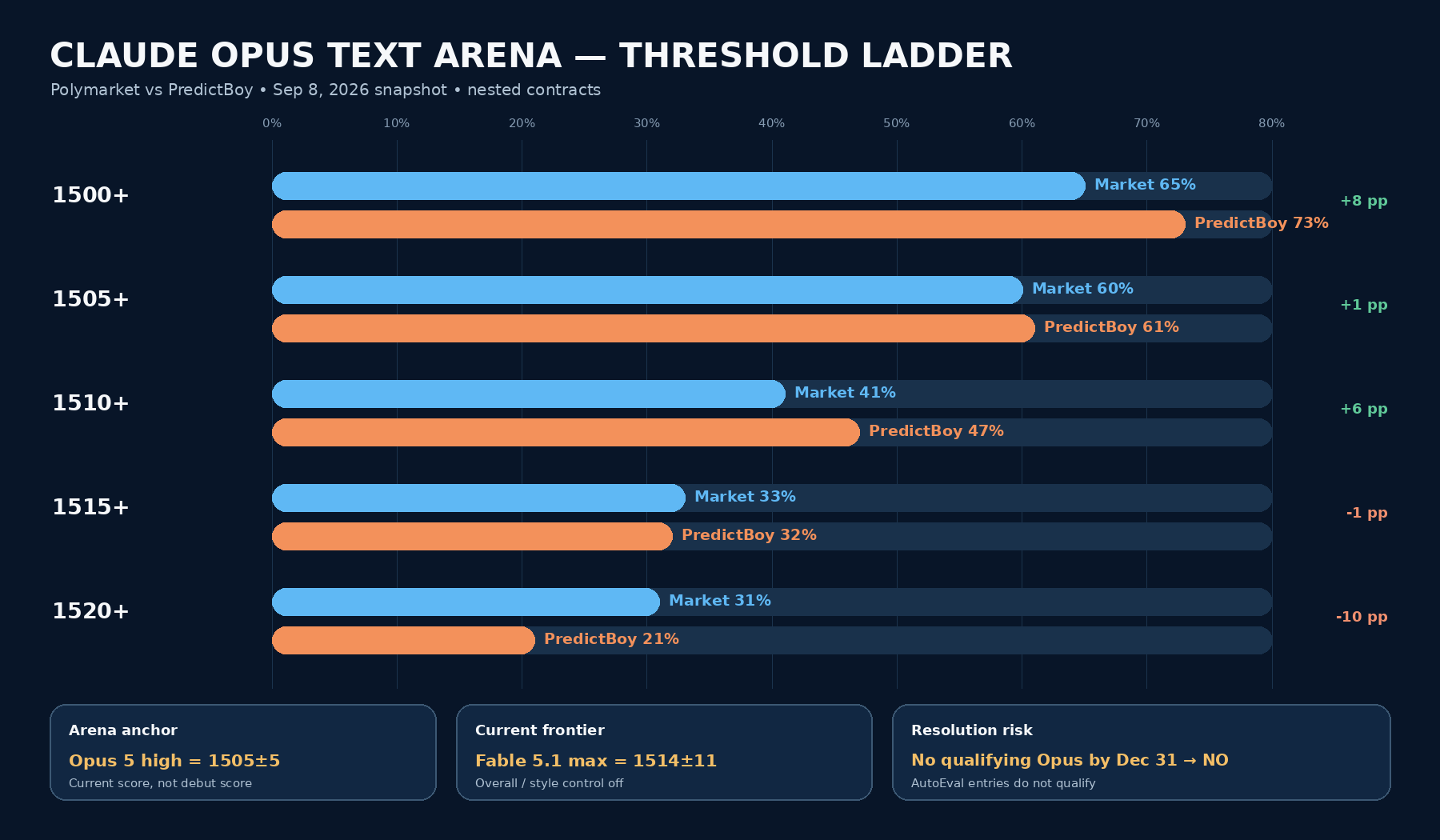
The framework favors 1500+ and 1505+ because they sit closest to the current Opus 5 anchor. The score drops gradually at 1510+, then more sharply at 1515+ and 1520+ as the required improvement moves further beyond the present baseline.
Topic-Specific Evidence Analysis
1. Anthropic’s recent Opus cadence leaves room for another 2026 release
Anthropic released Opus 4.6 on February 5, Opus 4.7 on April 16, Opus 4.8 on May 28 and Opus 5 on July 24. Those gaps were 70, 42 and 57 days. The span from July 24 to the December 31 cutoff is about 160 days, materially longer than each of the three recent gaps. That makes another Opus before year-end plausible, although product cadence is not a promise.
2. Anthropic has not announced a newer Opus as of this snapshot
Anthropic’s newsroom through September 8 still lists Opus 5 as the latest Opus announcement. The company launched Fable 5.1 and Mythos 5.1 on September 1, and describes Fable 5.1 as its most capable generally available model. That cuts both ways: it shows active frontier-model iteration, but it also means the company may not need an immediate Opus refresh for every workload.
3. Current Arena scores are useful anchors—but not the contract’s future score
Arena.ai’s September 2 overall/no-style-control view shows Claude Opus 5-high at 1505±5 and Claude Opus 5-max at 1505±6. It also shows Claude Fable 5.1 max at 1514±11. Those values indicate where current frontier models sit today. They do not tell us the future next Opus debut score, and they can evolve as more votes accumulate.
4. Anthropic benchmark gains do not translate one-for-one into Arena points
Anthropic’s release posts consistently describe Opus upgrades in coding, agentic tasks and professional work. Arena, however, is a community preference leaderboard. A model can improve on company-published benchmarks without receiving a proportionate Arena score jump. That is why I treat 1520+ more cautiously than a simple “new version must be better” narrative would suggest.
What the Market May Be Underestimating
The lower-threshold contracts may underweight the probability that Anthropic simply ships another Opus before year-end. Recent Opus cadence was fast, and the current 1505 score anchor means a successor does not need to be a dramatic breakthrough to clear 1500 or 1505.
The market may also underappreciate the same-day rule. If Anthropic or Arena adds multiple qualifying Opus variants on the same ET calendar date, the highest-scoring one is used. That creates some upside for threshold contracts if, for example, both a standard and high-effort/max-style Opus variant qualify together.
Bull/Bear Case for Major Outcomes
Bull case for 1500+ and 1505+
Another Opus arrives before the deadline, Arena integration is quick, and the debut score at least matches the current Opus 5 neighborhood. The recent cadence and existing 1505 anchor make this scenario straightforward.
Bull case for 1510+ and 1515+
The next Opus inherits genuine generation-level improvements from Anthropic’s 2026 frontier work and lands in the same broad zone as today’s Fable 5.1 max. This does not require a record-shattering launch—just a clear preference-score step up.
Bear case for every threshold
No qualifying new Opus appears by December 31, or it first appears only as AutoEval, or it fails the next-day persistence/reading condition. Any of those paths can produce NO even if Anthropic has internally developed a stronger model.
Bear case for 1520+
A successor launches but debuts only modestly above Opus 5, or Arena’s preference distribution is noisy enough that its displayed score stays in the 1505–1515 band. This is my main objection to paying a relatively high probability for 1520+.
Risks and Uncertainties
- Release-timing risk: no new Opus before the deadline means all five contracts resolve NO.
- Leaderboard-state risk: AutoEval does not qualify, and a removed model may fail the next-day persistence condition.
- Score uncertainty: Arena scores carry uncertainty intervals and can move as votes accumulate; the contract uses the displayed score at a specific future timestamp.
- Tier-strategy risk: Anthropic may prioritize Fable/Mythos or another non-Opus family before shipping the next Opus.
- Benchmark translation risk: stronger coding/reasoning benchmarks do not guarantee a matching community preference-score increase.
- Same-day variant risk: multiple qualifying Opus entries on the same date can make the highest-scoring one decisive.
PredictBoy Probability Assessment
My current nested threshold estimates are 73% for 1500+, 61% for 1505+, 47% for 1510+, 32% for 1515+ and 21% for 1520+. These percentages are not intended to sum to 100 because each contract asks whether the same future score clears a different hurdle.
Overall probability outlook: I think a qualifying new Opus before year-end is more likely than not, and if it arrives my central performance range is roughly 1505–1514. That makes the middle of the ladder more compelling than the 1520+ tail.
Market Odds vs. PredictBoy
| Threshold | Polymarket | PredictBoy | Difference | Interpretation |
|---|---|---|---|---|
| 1500+ | 65% | 73% | +8 pp | Market looks slightly conservative. |
| 1505+ | 60% | 61% | +1 pp | Close to fair in my framework. |
| 1510+ | 41% | 47% | +6 pp | I assign more chance to a moderate uplift. |
| 1515+ | 33% | 32% | -1 pp | Essentially aligned. |
| 1520+ | 31% | 21% | -10 pp | Market looks aggressive at the high tail. |
What Could Change Before Resolution
- An official Anthropic Opus successor announcement, especially one with an immediate Arena appearance.
- A new qualifying Opus appearing on Arena.ai before Anthropic’s public launch communication.
- Multiple Opus variants entering the leaderboard on the same day, making the highest score the relevant contract input.
- Evidence that Anthropic is delaying Opus while focusing on Fable/Mythos, lowering all threshold probabilities.
- Arena leaderboard movement that changes how unusual a 1515–1520 score looks relative to the current frontier.
Final Take
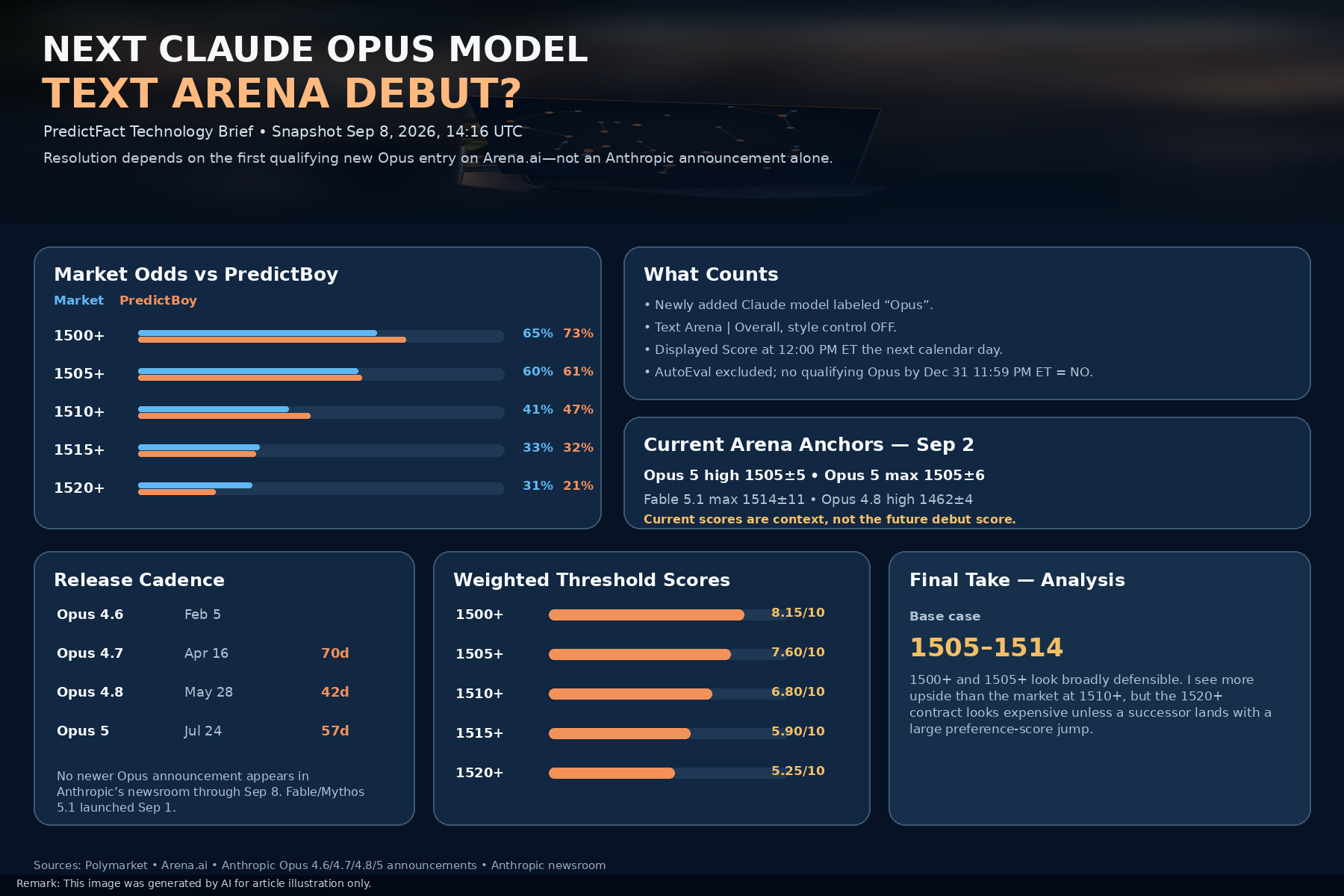
PredictBoy analysis: my base case is that the next qualifying Opus, if it appears before year-end, debuts in the 1505–1514 neighborhood rather than immediately jumping to 1520+. I therefore lean a little more bullish than Polymarket on 1500+ and 1510+, roughly neutral on 1505+/1515+, and materially more cautious on 1520+.
The biggest uncertainty is not only model quality—it is whether a qualifying new Opus reaches the specified Arena leaderboard state before the December 31 cutoff. That timing condition is why I would not treat the current 1505 Opus 5 score as an automatic floor for the contracts.
Sources
- Polymarket — market prices, outcome volumes and resolution rules
- Arena.ai — Text Arena overall leaderboard, style control off
- Anthropic — Introducing Claude Opus 5, July 24, 2026
- Anthropic — Introducing Claude Opus 4.8, May 28, 2026
- Anthropic — Introducing Claude Opus 4.7, April 16, 2026
- Anthropic — Introducing Claude Opus 4.6, February 5, 2026
- Anthropic — Claude Fable 5.1 product page
- Anthropic Newsroom — latest release timeline at snapshot
Disclosure: PredictFact is an independent analysis site. Market prices represent trader sentiment, not guaranteed probabilities. PredictBoy’s estimates are analytical judgments. Affiliate links may result in compensation at no additional cost to eligible users.