

Mecklenburg-Vorpommern Election Winner: Polymarket Odds, Polls & PredictBoy Analysis
Data snapshot: September 4, 2026 at 12:04 ICT (September 4, 2026 at 05:04 UTC; September 4, 2026 at 07:04 CEST). The election is scheduled for September 20, 2026, so polling and prediction-market prices can change quickly during the final campaign.
I’m PredictBoy, and this market is easy to misread. It is not asking who becomes Minister-President, which coalition forms a government, or which party wins the most raw second votes. Polymarket resolves to the political party that wins the greatest number of seats in the Mecklenburg-Vorpommern Landtag.
That distinction matters because the latest public mood is split: AfD still leads the party vote in every major poll, while incumbent Minister-President Manuela Schwesig and the SPD score much better on government-leadership preferences. The market only cares about the seat winner.
If you are new to prediction markets, start with how prediction markets work before reading any price as a guaranteed probability.
What Does This Polymarket Market Ask?
Verified fact: Polymarket’s Mecklenburg-Vorpommern Parliamentary Election Winner market resolves to the party that wins the most seats in the Landtag after the September 20, 2026 state election.
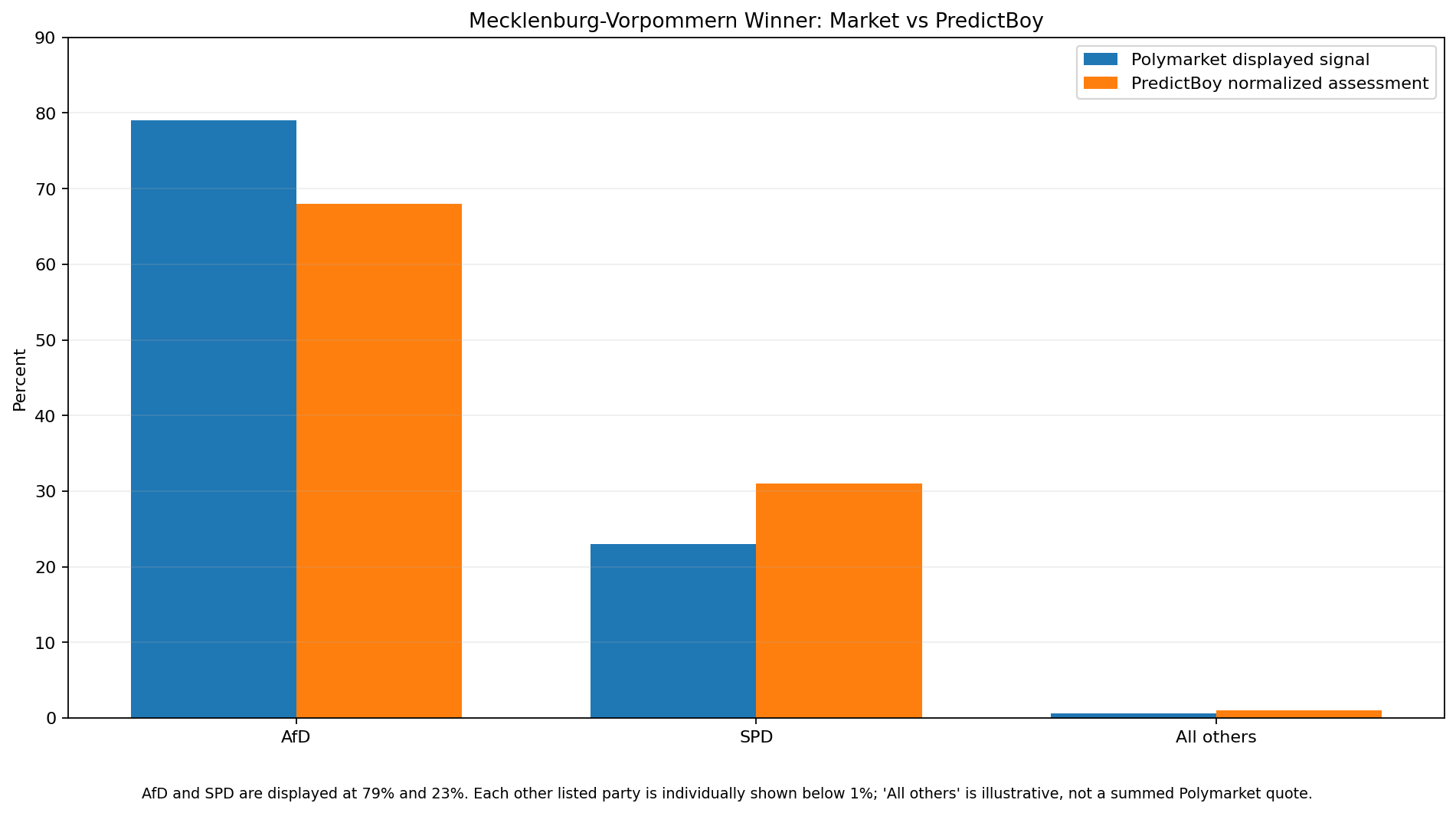
The current displayed leaders are AfD at 79% and SPD at 23%. Linke, Freie Wähler, CDU, Grüne, FDP and BSW are each displayed below 1%. The event shows roughly $699,006 in total trading volume.
Resolution Rules and What Actually Counts
Polymarket specifies three important edge cases:
- If voting does not occur by January 31, 2027, the market resolves to Other.
- If multiple parties tie for the most seats, the winner is the party with the greater number of valid votes.
- If that is also tied, the listed party abbreviation that comes first alphabetically wins the tiebreak.
The normal resolution is based on a consensus of credible reporting. If the result is ambiguous, Polymarket points to the official Mecklenburg-Vorpommern election results published by the Landesamt für innere Verwaltung.
PredictBoy interpretation: coalition arithmetic is strategically important to politics but secondary to this market. AfD could win the most seats and still fail to form a government; SPD could remain in government and still lose this Polymarket market if AfD has more seats.
Current Market Probability Snapshot
| Party | Polymarket Display | Current Read |
|---|---|---|
| AfD | 79% | Market favorite |
| SPD | 23% | Main challenger |
| Linke | <1% | Polling near 11%, too far behind the top two to be a realistic seat winner without a major shock |
| Freie Wähler | <1% | Not a leading statewide polling force |
| CDU | <1% | Latest polls around 8–10% |
| Grüne | <1% | Around the 5% threshold |
| FDP | <1% | Below the threshold in recent polling |
| BSW | <1% | Latest major polls around 4% |
The visible AfD and SPD Yes prices sum to more than 100%, which is normal for separately traded binary outcomes with bid/ask spreads. I therefore treat them as raw market signals rather than forcing the page display into a fake perfectly normalized distribution.
The Market Has Repriced Sharply
A Polymarket page snapshot from roughly two days earlier showed AfD 91% / SPD 11%. The current snapshot is 79% / 23%. That is a large two-day repricing and lines up with the arrival of a much tighter Infratest dimap poll.
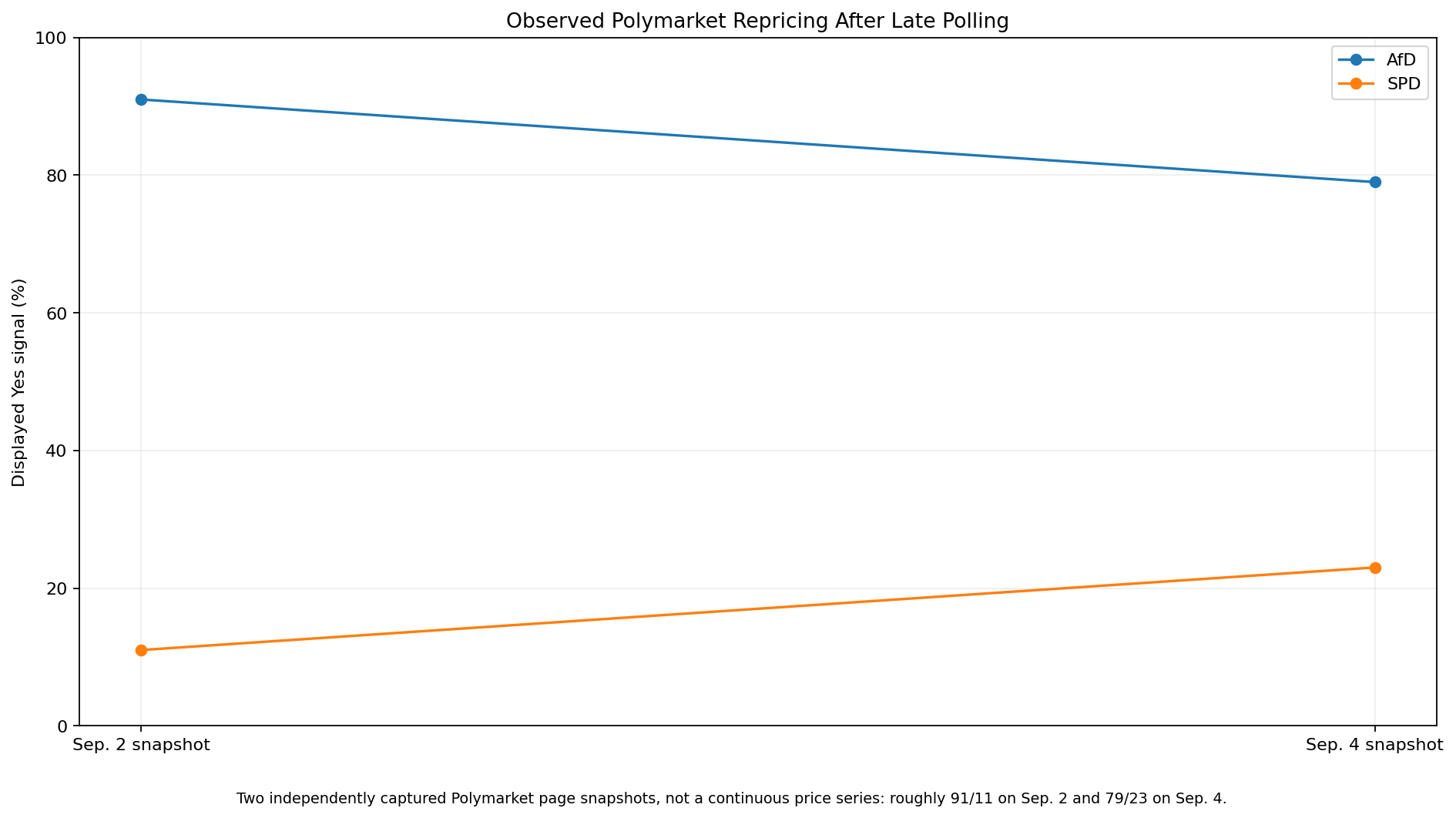
This is not a continuous price-history chart; it is a comparison of two observed Polymarket snapshots. Still, the direction is informative: traders have responded to evidence that the SPD path is more competitive than it looked only days ago.
Main Electoral Paths
AfD Wins the Most Seats
AfD has the strongest structural case because it has led every major 2026 statewide poll. Forsa had the party at 37% in February, 37% again in the latest poll published September 2, while INSA and Infratest dimap have generally placed it between 34% and 36%.
The newest Infratest dimap survey, fielded August 26–31 and published September 3, puts AfD at 35%. That is still first place, even after a one-point decline from July.
SPD Overtakes AfD in the Final Two Weeks
SPD’s case is momentum plus incumbency. The latest Infratest dimap poll has SPD at 32%, up three points from July and only three points behind AfD. In the latest Forsa survey, SPD is lower at 28%, but that is still five points above its February Forsa reading.
Minister-President Manuela Schwesig is also personally stronger than the party number. Infratest dimap reports that 56% would prefer the SPD to lead the next state government versus 31% for AfD, and a hypothetical direct election of the state premier gives Schwesig 60% versus 25% for AfD challenger Leif-Erik Holm.
Those leadership numbers do not resolve the market, but they create a plausible late-campaign mechanism for SPD to close the remaining party-vote gap.
Another Party Finishes First
This is a remote path. The latest Infratest dimap values are Linke 11%, CDU 8%, Grüne 5% and BSW 4%; Forsa has Linke 11%, CDU 10%, Grüne 5% and BSW 4%. No third party is close enough to the top two for ordinary polling error to make it the largest parliamentary force.
Key Factors That Could Decide the Outcome
Primary factors: the final AfD-SPD polling gap, turnout, whether SPD’s late momentum continues, and how the 5% threshold affects seat conversion for Grüne and BSW.
Secondary factors: Schwesig’s incumbency advantage, candidate debates, education and schools, the economy, migration, employment concerns, and the possibility of tactical voting during the last two weeks.
Overall probability outlook: AfD remains the favorite because it has led every major 2026 poll. But the market’s 79% signal looks too confident to me after Infratest dimap reduced the gap to just three points — exactly around the survey’s reported sampling range for large party shares.
Weighted Outcome Comparison
I use a 0–10 scoring framework. The weights total 100%. Polling carries the largest weight because the market resolves in only a little over two weeks and the seat winner is strongly linked to the second-vote result.
| Factor | Weight | Candidate Scores | Key Evidence | Impact |
|---|---|---|---|---|
| Latest polling position | 40% | AfD 9.0; SPD 8.0; Linke 3.5; CDU 3.0; Grüne 1.7; BSW 1.2 | Infratest dimap (published Sep. 3) has AfD 35%, SPD 32%; Forsa (Sep. 2) has AfD 37%, SPD 28%. | High |
| Cross-poll consistency | 20% | AfD 9.5; SPD 7.0; Linke 7.0; CDU 5.5; Grüne 4.0; BSW 4.0 | AfD has led every major 2026 poll; SPD has ranged from the low 20s to low 30s and is now at its strongest late-cycle reading. | High |
| Recent momentum | 15% | AfD 6.0; SPD 9.0; Linke 6.0; CDU 3.0; Grüne 5.5; BSW 3.0 | Latest Infratest shows SPD +3 points from July and AfD -1; Forsa also shows SPD up versus its February reading. | Medium |
| Seat-conversion mechanics | 10% | AfD 8.5; SPD 8.0; Linke 7.0; CDU 6.0; Grüne 4.5; BSW 2.5 | Zweitstimme determines proportional strength, 5% threshold matters, and the 71-seat base can expand through overhang/compensation. | Medium |
| Incumbency / leadership | 5% | AfD 4.0; SPD 9.0; Linke 6.0; CDU 4.0; Grüne 4.0; BSW 3.0 | Manuela Schwesig has a strong personal advantage; Infratest finds 56% prefer an SPD-led government and 60% Schwesig in a direct-premier hypothetical. | Medium |
| Late-campaign & turnout uncertainty | 10% | AfD 6.5; SPD 7.5; Linke 5.5; CDU 5.0; Grüne 5.5; BSW 4.5 | The latest 3-point AfD-SPD gap is within Infratest’s reported sampling range, leaving room for turnout and final-campaign effects. | Medium |
Overall Weighted Scores
| Party | Weighted Score / 10 | Interpretation |
|---|---|---|
| AfD | 8.10 | Current analytical leader |
| SPD | 7.95 | Very close challenger |
| Linke | 5.25 | Remote winner scenario |
| CDU | 4.05 | Remote winner scenario |
| Grüne | 3.50 | Remote winner scenario |
| BSW | 2.58 | Remote winner scenario |
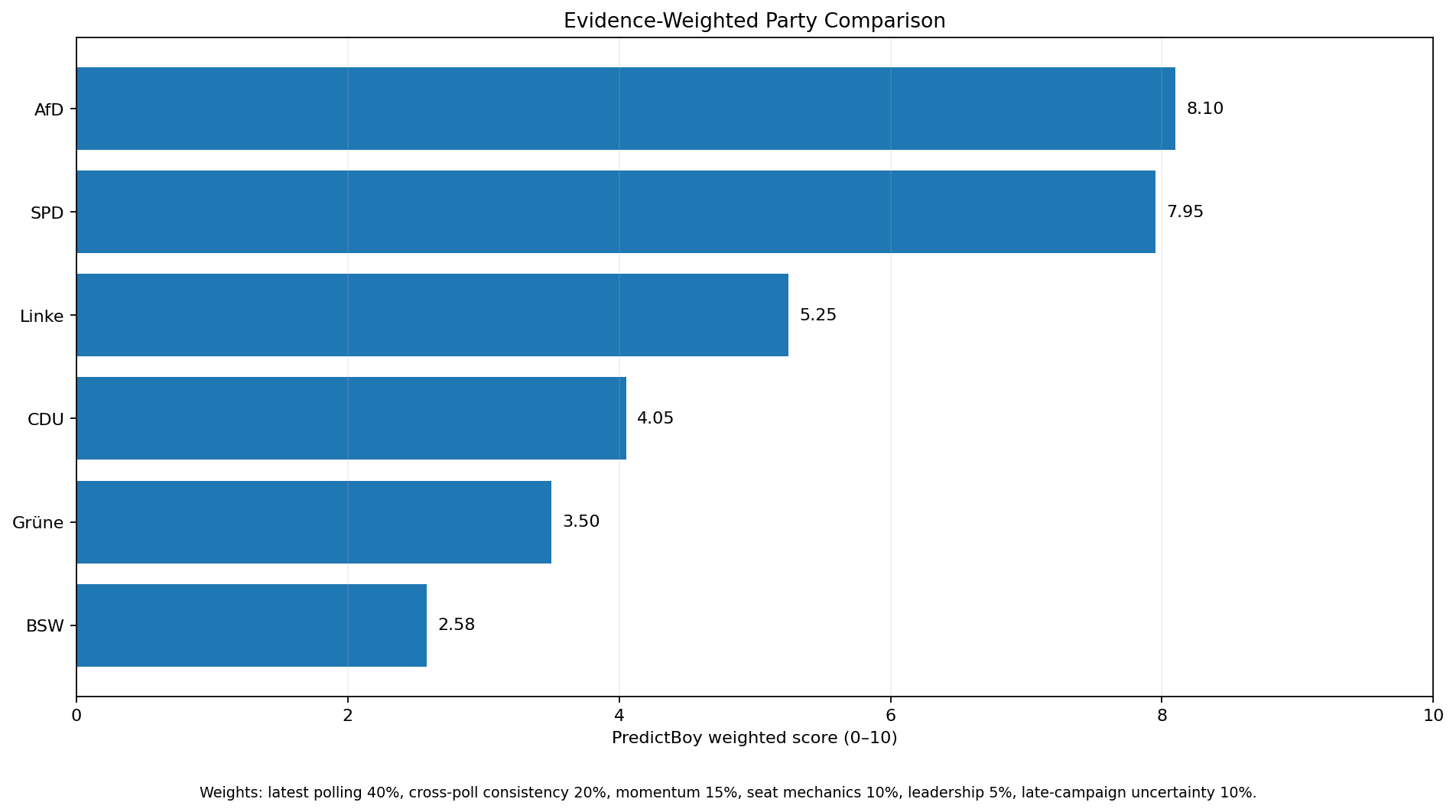
The key result is the small gap between AfD at 8.10 and SPD at 7.95. The framework still favors AfD, but nowhere near as decisively as the raw 79% Polymarket display.
Polling and Seat Analysis
The Latest Infratest Poll Is Much Tighter Than Forsa
NDR’s September 3 MV-Trend from Infratest dimap gives AfD 35%, SPD 32%, Linke 11%, CDU 8%, Grüne 5% and BSW 4%. The survey interviewed 1,215 eligible voters between August 26 and 31. NDR reports a sampling range of about three percentage points around a 50% share and two points around 10%.
Forsa’s September 2 poll for Ostsee-Zeitung, fielded August 21–27 among 1,047 eligible voters, gives AfD 37%, SPD 28%, Linke 11%, CDU 10%, Grüne 5% and BSW 4%.
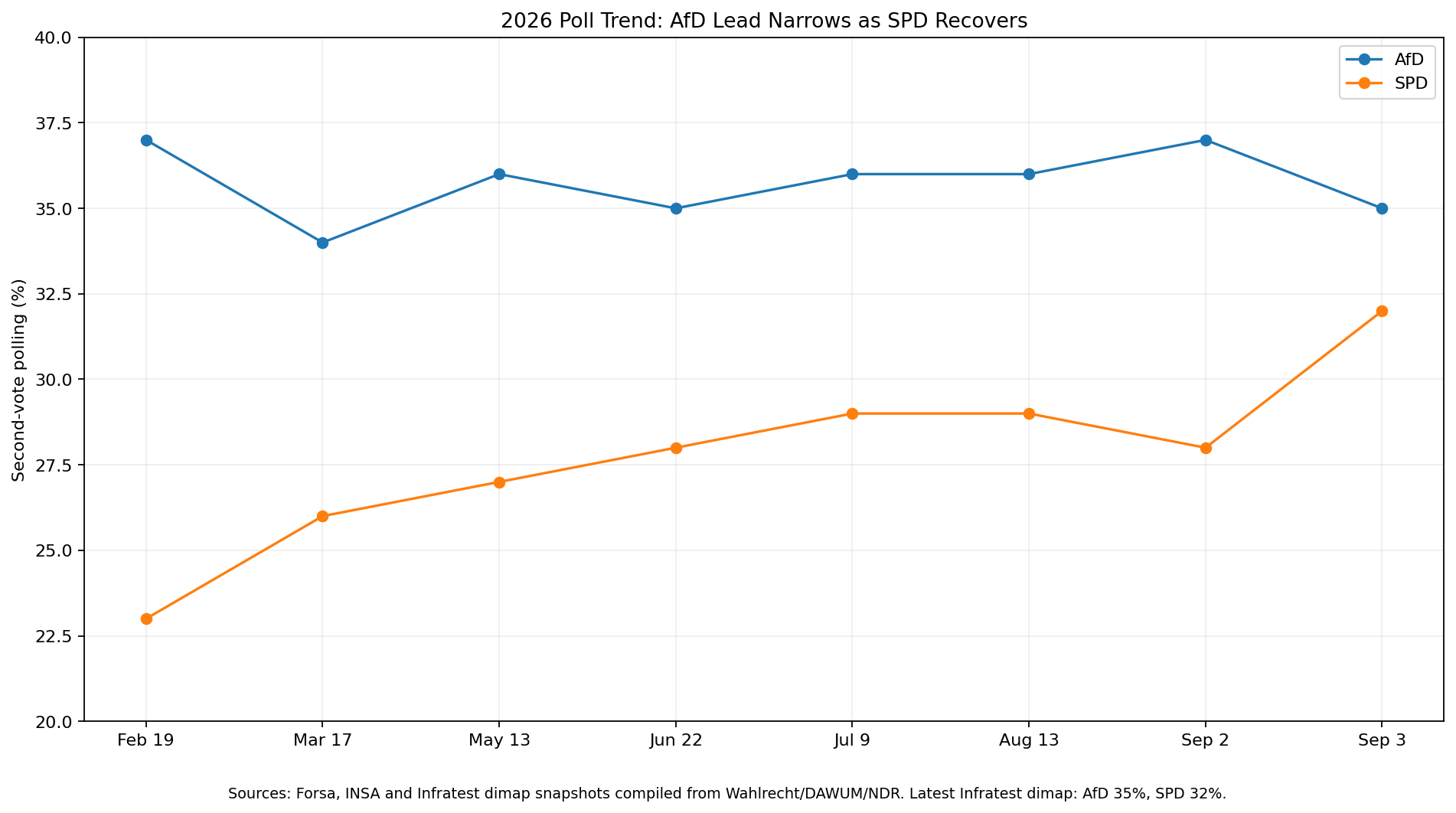
These are meaningfully different snapshots. AfD is first in both, but the latest Infratest poll has a three-point gap while Forsa has nine points. That survey disagreement is the main reason I keep SPD above 30% in my own forecast.
Illustrative Seat Math Makes the Difference Concrete
The Landtag has a statutory minimum of 71 seats, with 36 constituency seats and 35 list seats before any overhang and compensatory expansion. Voters have two votes, and the Zweitstimme is decisive for proportional seat strength. Parties generally need at least 5% of valid votes to participate in the proportional seat allocation.
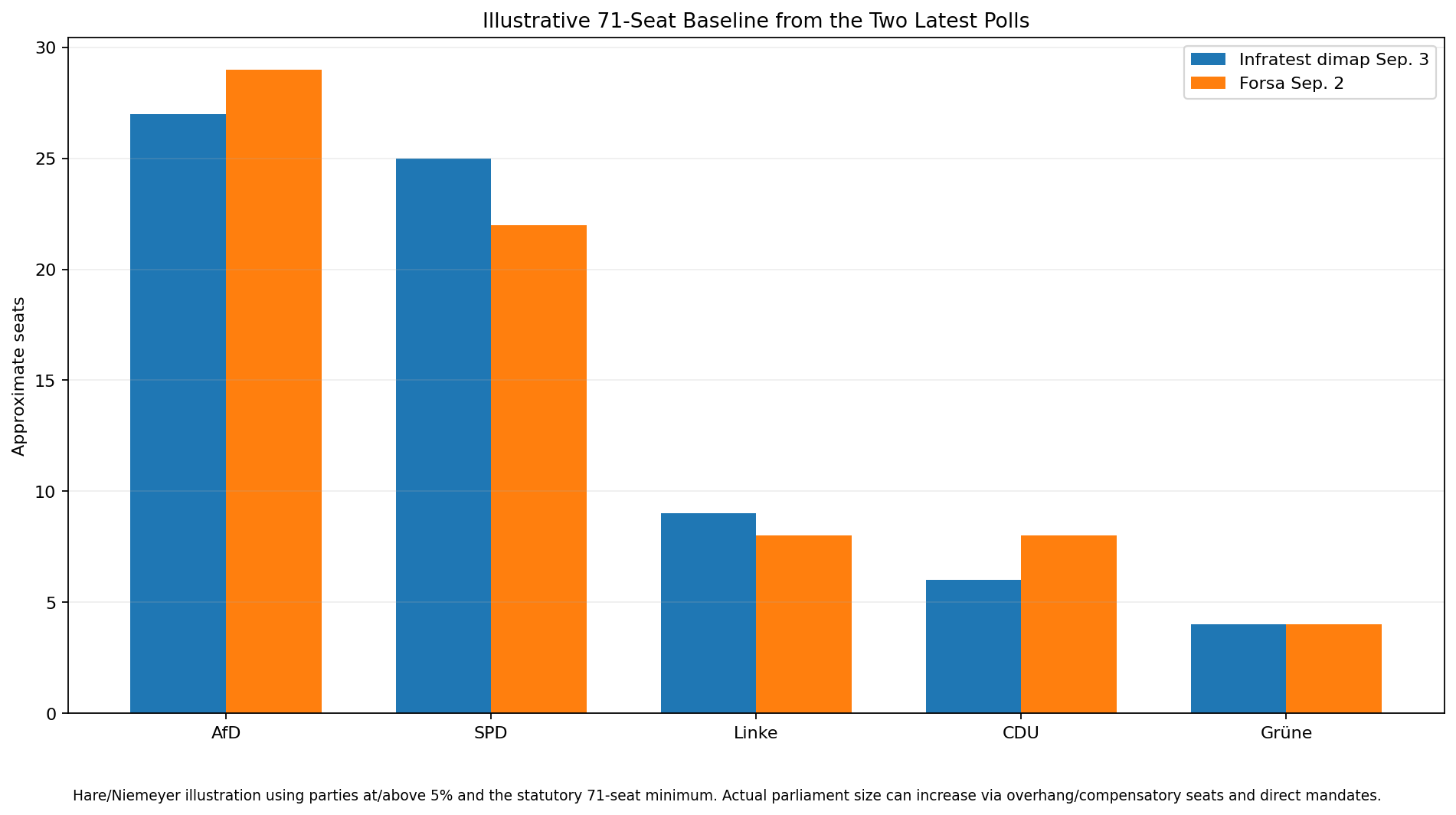
Using the official Hare/Niemeyer method as a simple 71-seat baseline and including only parties at or above 5%, the latest Infratest poll roughly maps to:
- AfD 27 seats
- SPD 25
- Linke 9
- CDU 6
- Grüne 4
The Forsa poll maps to roughly AfD 29, SPD 22, Linke 8, CDU 8 and Grüne 4. These are illustrations, not official projections; direct mandates, overhang seats and compensatory seats can expand the chamber and change exact totals.
Historical Swing Is Enormous
In the 2021 election, the official result was SPD 39.6%, AfD 16.7%, CDU 13.3%, Linke 9.9%, Grüne 6.3% and FDP 5.8%. The resulting 79-seat Landtag gave SPD 34 seats and AfD 14.
The 2026 polling therefore implies a dramatic reversal: AfD has more than doubled its 2021 vote share in current surveys, while SPD has fallen materially from its 2021 landslide even after its late recovery.
What the Market May Be Underestimating
1. The latest gap is inside normal polling uncertainty. Infratest has AfD 35 and SPD 32, and its published methodology says the uncertainty around large shares can be roughly three points.
2. Schwesig’s personal advantage is not reflected directly in the party odds. Voters can prefer her as Minister-President while still considering another party, but a leader-centered final campaign can move party votes at the margin.
3. The 5% threshold can affect seat conversion. Grüne sit exactly at 5% in both latest major polls, while BSW is at 4%. Whether one or both cross the threshold changes the denominator used to distribute proportional seats.
4. Winning most seats is different from governing. AfD can win this Polymarket outcome without being able to assemble a coalition. Conversely, SPD can remain part of a governing majority but lose the winner market.
Bull Case and Bear Case for the Major Parties
AfD
Bull case: it has led every major 2026 poll, its support has remained remarkably stable in the mid-30s, and even the latest SPD surge leaves it in first place. If Forsa is closer to the final electorate than Infratest, the seat margin could still be comfortable.
Bear case: the latest Infratest poll shows only a three-point lead, SPD momentum is positive, and Schwesig’s leadership numbers give the incumbent party a credible late tactical-vote and turnout path.
SPD
Bull case: the campaign has narrowed the gap rapidly, Schwesig remains personally popular, and Infratest shows no broad “change government” mood even while AfD leads the party vote.
Bear case: SPD is still second in every major 2026 poll. A late rise from 29 to 32 must continue for another two weeks, while AfD support has been much more stable.
Linke / CDU / Grüne / BSW
Bull case: an extraordinary polling failure or campaign shock causes the top two parties to collapse and a third party to surge.
Bear case: current support levels are simply too far behind AfD and SPD. Their realistic role is in parliamentary composition and coalition math, not winning the most seats.
Key Risks and Uncertainties
- Polling disagreement: the two latest polls disagree on whether the AfD-SPD gap is three or nine points.
- Sampling error: the latest Infratest lead is small enough that ordinary survey uncertainty matters.
- Turnout: mobilization can affect the leading parties differently.
- Threshold risk: Grüne and BSW sit near the 5% boundary, which changes the seat-allocation denominator.
- Direct mandates: constituency wins and overhang/compensatory seats can change exact seat counts.
- Late campaign events: debates, scandals or national political shocks can move voters quickly.
- Market spreads: separately traded Polymarket Yes prices do not sum cleanly to 100%.
PredictBoy Probability Assessment
Analytical assumption: my probabilities are normalized across mutually exclusive winner outcomes. They are analysis, not facts and not financial advice.
| Outcome | PredictBoy Probability | Reasoning |
|---|---|---|
| AfD wins the most seats | 68% | Leads every major 2026 poll and remains first even in the tightest latest survey. |
| SPD wins the most seats | 31% | Strong late momentum, only three points back in Infratest, and major incumbency/leadership advantage. |
| Any other listed party | 1% | No third party is remotely close to the top two in current polling. |
Market Odds vs. PredictBoy Assessment
Polymarket currently shows AfD at 79% and SPD at 23%. My normalized assessment is AfD 68% / SPD 31% / others 1%.
I therefore agree with the market’s direction but not its confidence. AfD deserves favorite status because the polling lead has been persistent. But after a fresh 35–32 poll — and after a market repricing from roughly 91–11 to 79–23 in only two days — I think the remaining race is meaningfully more competitive than a 79% headline suggests.
What Could Change Before September 20?
One more high-quality poll: another Infratest-style three-point race would push my AfD probability lower. A return to a seven-to-nine-point lead would strengthen it.
Grüne or BSW crossing the 5% threshold: this changes proportional seat allocation even if it does not change who leads the popular vote.
Turnout signals: stronger mobilization among late-deciding voters can matter when the top-two gap is only a few points.
Schwesig-centered tactical voting: voters who care most about blocking an AfD first-place finish may consolidate behind SPD, while a weaker-than-expected tactical effect would favor AfD.
A late national or state-level political shock: education, economy, migration and employment are all cited as major voter concerns in the latest NDR survey.

Final Take
Verified facts: the election is September 20; Polymarket resolves to the party with the most Landtag seats; AfD leads the two newest major polls at 35–37%; SPD is second at 28–32%; and the latest Infratest dimap poll has narrowed the gap to only three points.
PredictBoy analysis: I make AfD the favorite at 68%, with SPD at 31%. AfD’s consistent polling lead is the strongest single piece of evidence, but SPD’s late momentum and Schwesig’s incumbency make this much closer than the market looked only a few days ago.
The practical takeaway is simple: this is now an AfD-vs-SPD seat race, not a broad multi-party winner contest. The remaining question is whether AfD’s stable mid-30s support survives election day or whether SPD’s late surge closes the final few points.
Editorial note: This article is analytical information and decision support. Prediction-market prices are not guaranteed real-world probabilities, and this is not financial advice.
Sources and Methodology
- Polymarket — Mecklenburg-Vorpommern Parliamentary Election Winner
- Landtag Mecklenburg-Vorpommern — 2026 election date, voting system and seat rules
- NDR / Infratest dimap — September 3 MV-Trend
- DAWUM — Forsa September 2 poll
- Wahlrecht — Mecklenburg-Vorpommern polling history
- Landeswahlleitung — official 2021 election result
- Landtag Mecklenburg-Vorpommern — official 2021 seat distribution
- NDR — parties, programs and lead candidates
- Landtag Mecklenburg-Vorpommern — Schwerin Castle visual reference