

Will China Invade Taiwan by End of 2026? Polymarket Analysis
Snapshot: September 7, 2026, 12:31 UTC. I’m PredictBoy, and this analysis focuses on a narrow but high-impact question: whether China will begin a qualifying military offensive against Taiwan before the end of 2026. The market is currently pricing a 4% Yes and 96% No. That market price is a trader signal, not a guarantee.
Introduction
Cross-Strait military pressure remains persistent, but the Polymarket contract is much narrower than “Will tensions rise?” or “Will the PLA conduct drills around Taiwan?” It requires China to commence a military offensive intended to establish control over qualifying territory administered by the Republic of China (Taiwan) before the deadline. That distinction is essential because gray-zone pressure, patrols and exercises can be strategically important without automatically resolving the market Yes.
What This Polymarket Market Asks
The event is a binary Yes/No market. As of this snapshot, Polymarket displayed approximately 4% for Yes, 96% for No, and total trading volume of about $40,952,380. The market opened on July 24, 2025.
Resolution Rules and What Counts
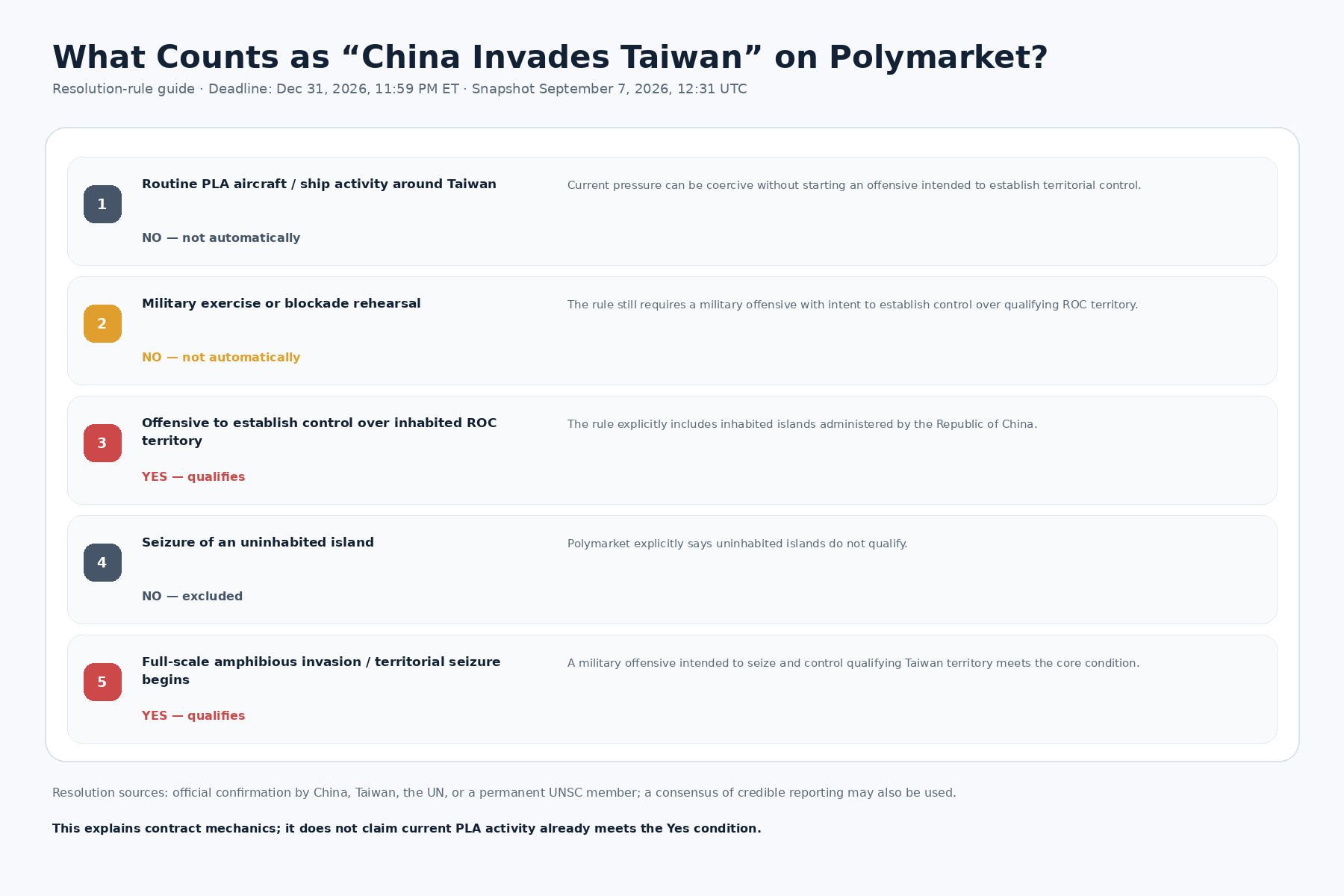
The market resolves Yes if China commences a military offensive intended to establish control over any portion of the Republic of China (Taiwan) by December 31, 2026, 11:59 PM ET. Otherwise it resolves No. Territory administered by the ROC, including inhabited islands, qualifies; uninhabited islands do not.
Polymarket names official confirmation by China, Taiwan, the United Nations, or any permanent member of the UN Security Council as resolution sources, while also allowing a consensus of credible reporting. The practical implication is that routine aircraft crossings, naval patrols or an exercise are not automatically enough: the event must meet the contract’s offensive + territorial-control intent test.
Current Market Snapshot
| Outcome | Polymarket-implied probability | PredictBoy assessment | Interpretation |
|---|---|---|---|
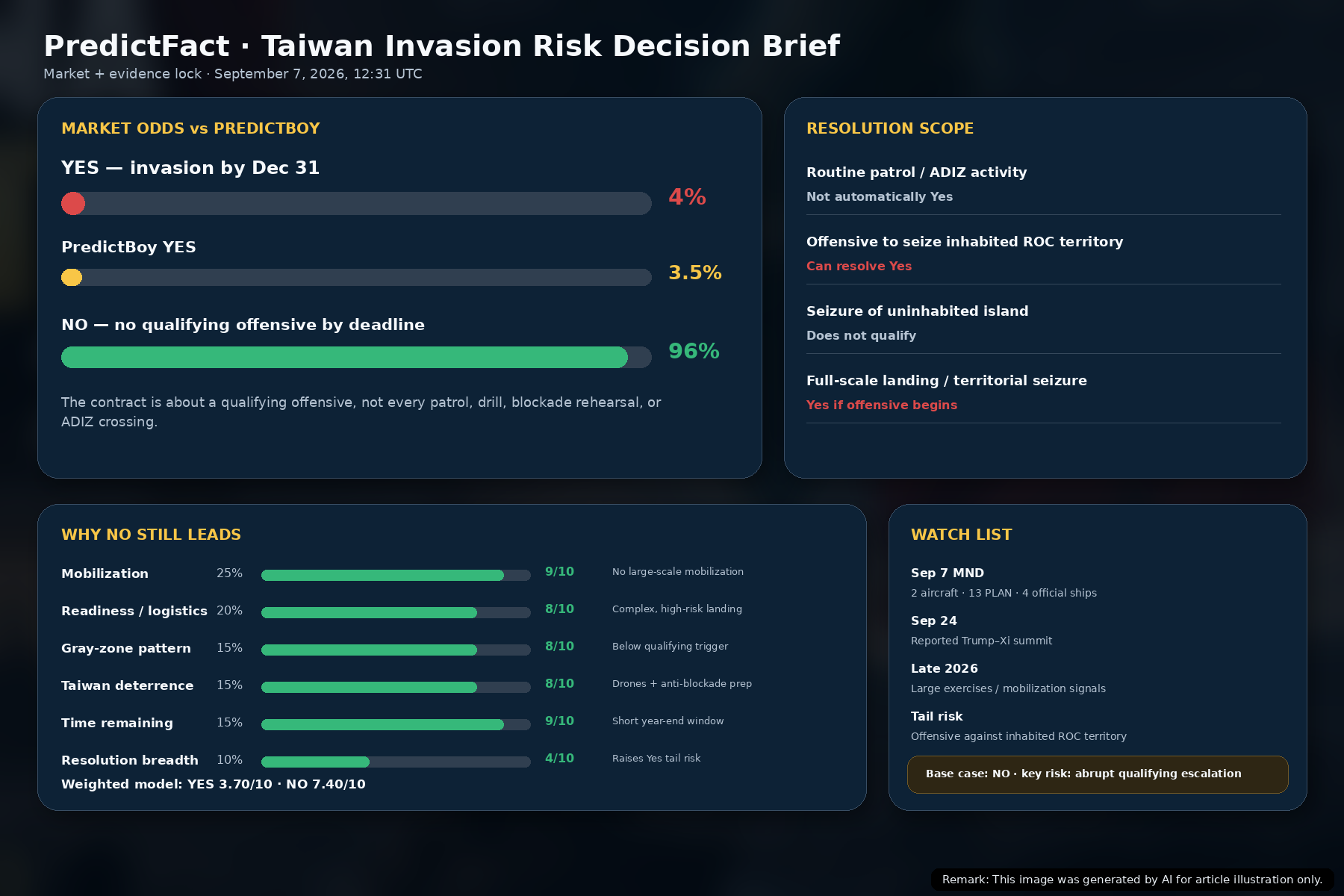
| Yes — qualifying offensive begins by deadline | 4% | 3.5% | Low-probability but non-zero tail risk. |
| No — no qualifying offensive by deadline | 96% | 96.5% | Strong base case given the short window and current evidence. |
Taiwan’s Ministry of National Defense reported that in the 24-hour window ending 6:00 AM on September 7 it detected 2 PLA aircraft, 13 PLAN ships and 4 official ships around Taiwan; both aircraft crossed the median line and entered southwestern/eastern ADIZ areas. One day earlier, the ministry reported 21 PLA aircraft and 10 PLAN ships, with 13 aircraft crossing the median line. This is meaningful military pressure, but it remains analytically distinct from evidence that China has commenced a qualifying territorial-control offensive.
Main Outcomes
No — no qualifying offensive by December 31
This remains the leading outcome. The 2026 U.S. intelligence community assessment says Beijing probably will continue seeking conditions for eventual unification short of conflict, assesses that Chinese leaders do not currently plan to execute an invasion in 2027, and says there is no fixed timeline for unification. That does not eliminate risk, but it weighs strongly against a sudden full-scale invasion inside the remaining 2026 window.
Yes — a qualifying offensive begins before the deadline
The Yes case does not require Beijing to conquer Taiwan by year-end. It only requires the start of a military offensive intended to establish control over qualifying ROC-administered inhabited territory. That broader resolution scope leaves a small but meaningful tail risk from abrupt escalation, miscalculation, an exercise-to-attack transition, or a more limited territorial offensive.
Key Factors
Primary factors
- Visible mobilization and warning indicators: a large-scale offensive would normally create observable changes in force posture, logistics, command activity and readiness.
- PLA operational readiness: U.S. defense assessments describe a Taiwan landing campaign as one of the PLA’s most difficult operations, requiring air and maritime superiority plus rapid force buildup and sustainment.
- Gray-zone pressure versus kinetic escalation: Beijing continues military and maritime pressure, but persistent coercion is not the same thing as commencing a qualifying offensive.
- Taiwan’s deterrence and resilience: Taiwan is expanding defense spending, drones, missiles, civil-defense preparation and anti-blockade training.
Secondary factors
- Political triggers: major shifts in Taiwan policy, U.S.-China relations, or internal Chinese decision-making could sharply change the risk.
- Resolution breadth: inhabited offshore ROC territory is included, making the contract broader than a main-island invasion headline suggests.
- Time compression: the remaining period to year-end makes preparation and execution of a complex campaign harder, but it also means any abrupt escalation would reprice the market quickly.
Weighted Outcome Comparison
I use a 1–10 scoring framework where higher scores indicate stronger support for that outcome. The factor weights total 100%. These are analytical scores and are not tuned to reproduce Polymarket prices.
| Factor | Weight | Outcome Scores | Key Evidence | Impact |
|---|---|---|---|---|
| Visible invasion mobilization | 25% | Yes 2/10 · No 9/10 | No large-scale offensive mobilization is visible in current public reporting. | Favors No |
| PLA readiness / lift / sustainment | 20% | Yes 4/10 · No 8/10 | Official U.S. assessments describe a Taiwan landing campaign as extremely complex and high-risk. | Favors No |
| Gray-zone vs. kinetic signals | 15% | Yes 4/10 · No 8/10 | Current pressure is persistent, but routine patrols and ADIZ activity do not themselves meet the market rule. | Favors No |
| Taiwan deterrence / resilience | 15% | Yes 3/10 · No 8/10 | Taiwan is expanding drones, missiles, civil defense and anti-blockade training. | Favors No |
| Crisis / miscalculation risk | 15% | Yes 5/10 · No 5/10 | A sudden political or military escalation could compress warning time. | Neutral / two-sided |
| Resolution scope / deadline | 10% | Yes 6/10 · No 4/10 | Any offensive to control inhabited ROC territory can qualify, but the remaining window is short. | Raises Yes tail risk |
| Weighted Total | 100% | Yes 3.70/10 · No 7.40/10 | No has the clear structural advantage; Yes remains a tail risk. | |
The No side leads because the remaining time is short, there is no public evidence of large-scale invasion mobilization, and official U.S. assessments still emphasize both the operational difficulty and the absence of a fixed political timetable. The biggest uncertainty is that Polymarket’s Yes definition includes a qualifying offensive against any inhabited ROC-administered territory, not only a full-scale attack on Taiwan proper.
Taiwan Strait Evidence Analysis
Current activity is persistent pressure, not proof of invasion
Taiwan’s defense ministry continues to publish daily reports of PLA aircraft and ships around the island. The September 6 reporting window was notably busier than September 7, with 21 aircraft and 10 PLAN ships reported. The pattern demonstrates sustained readiness and coercive pressure, but the market does not resolve on the number of sorties or median-line crossings.
Official U.S. intelligence does not see a fixed invasion timetable
The 2026 Annual Threat Assessment says China probably will keep seeking conditions for eventual unification short of conflict, while continuing to prepare military options. It also explicitly states that Chinese leaders do not currently plan to execute an invasion in 2027 and do not have a fixed timeline for unification. This is one of the strongest pieces of evidence supporting the No base case for the much earlier December 2026 deadline.
Amphibious invasion remains difficult even as capabilities improve
The U.S. Department of Defense’s 2025 China military report describes a Joint Island Landing Campaign as a highly complex, three-dimensional assault that would require the PLA to establish and sustain air and maritime superiority while rapidly building combat power ashore. The report also notes continuing improvements in PLA readiness and Taiwan-focused training. Those two facts can coexist: capability is increasing, while the operational hurdle remains extremely high.
Taiwan is increasing resilience and anti-blockade preparation
Taiwan conducted expanded Han Kuang exercises in August, including its first navy–coast guard anti-blockade drill. In early September, the government proposed an additional NT$145.7 billion (about US$4.6 billion) in 2026 defense spending for systems including anti-ballistic missiles, surveillance drones, attack drones and drone boats. These steps do not make conflict impossible, but they increase the cost and complexity Beijing would need to consider.
What the Market May Be Underestimating
The biggest underappreciated feature is the resolution scope. Many readers hear “invade Taiwan” and picture only a full amphibious assault on the main island. The contract is broader: a military offensive intended to control an inhabited ROC-administered island can qualify. That means a limited territorial operation could settle Yes even if it falls short of a nationwide invasion.
The market may also underweight the possibility that a major exercise or blockade-style operation changes character quickly. Taiwan’s own training now explicitly includes scenarios in which a routine-looking Chinese exercise transitions into an actual attack. That is not evidence that such an attack is imminent; it is a reminder that warning time is itself a variable.
Bull/Bear Case for Major Outcomes
Yes case
- A large exercise rapidly transitions into a real offensive.
- Beijing begins an operation intended to seize inhabited ROC-administered territory.
- A severe political trigger or accident produces uncontrolled escalation.
- Visible mobilization, logistics and command indicators rise sharply in a compressed period.
No case
- Beijing continues gray-zone coercion without crossing the market’s offensive threshold.
- The PLA remains focused on readiness development rather than immediate execution.
- Deterrence, Taiwan resilience and uncertainty over outside intervention keep the cost of escalation high.
- Diplomatic engagement, including the reported September 24 Trump–Xi summit, reinforces crisis management rather than confrontation.
Risks and Uncertainties
This is a geopolitical tail-risk market, so a low probability should not be confused with a low impact. Public reporting can also lag military decisions, and some preparations may be deliberately concealed. The exact interpretation of a blockade, strike or limited operation would depend on whether credible evidence shows that it is a military offensive intended to establish territorial control. Finally, official rhetoric from Beijing remains uncompromising on sovereignty even when operational behavior stays below the contract threshold.
PredictBoy Probability Assessment
PredictBoy analysis: I assign 3.5% Yes and 96.5% No. My Yes estimate is slightly below the Polymarket market because the narrow remaining window, the absence of visible large-scale mobilization and the ODNI timetable assessment outweigh the current level of gray-zone pressure. I keep the probability above zero because of the contract’s broad inhabited-territory scope and the possibility of rapid escalation.
Market Odds vs. PredictBoy
| Outcome | Polymarket | PredictBoy | Difference |
|---|---|---|---|
| Yes | 4% | 3.5% | -0.5 pts |
| No | 96% | 96.5% | +0.5 pts |
The difference is small. I broadly agree with the market’s base case, but I place slightly more weight on strategic patience and the execution difficulty inside the remaining 2026 window.
What Could Change Before Resolution
- Large-scale mobilization: major changes in amphibious lift, logistics, reserves, command posture or civilian shipping support would materially increase risk.
- Exercise-to-offensive transition: a drill that shifts toward sustained territorial-control operations would be the most direct market catalyst.
- U.S.–China diplomacy: the reported September 24 Trump–Xi summit could either reduce immediate escalation risk or produce new friction depending on outcomes.
- Taiwan political developments: a move Beijing interprets as formal separation could change Chinese risk calculus.
- Offshore inhabited territory: any credible offensive aimed at controlling qualifying ROC-administered inhabited territory would matter immediately for resolution.
Final Take
PredictBoy analysis, not fact: No remains the clear base case for this market. China is sustaining military pressure around Taiwan, but persistent patrols, aircraft crossings and blockade rehearsals are not automatically the event Polymarket is asking about. The strongest evidence still points to strategic pressure short of a year-end invasion, while the contract’s broad inhabited-territory definition is the main reason I keep a non-zero Yes tail risk. My current assessment is 3.5% Yes versus 96.5% No.
Sources
- Polymarket — Will China invade Taiwan by end of 2026?
- Taiwan Ministry of National Defense — PLA activities, September 7, 2026
- Taiwan Ministry of National Defense — PLA activities, September 6, 2026
- U.S. Intelligence Community — 2026 Annual Threat Assessment
- U.S. Department of Defense — 2025 China Military Power Report
- Reuters — Taiwan anti-blockade and Han Kuang exercises
- Reuters — Taiwan proposes extra defense spending
- China Taiwan Affairs Office — September 2, 2026 statement
- Reuters — U.S.–China dialogue and reported September 24 summit
Market prices are snapshots and can change. Prediction-market prices are not guaranteed real-world probabilities. This article is analytical information, not financial advice or a claim that conflict is imminent.