

Balance of Power: 2026 Midterms — Polymarket Odds, House & Senate Forecast
Data snapshot: September 4, 2026 (ICT), corresponding to September 3, 2026 in U.S. Eastern Time. Prediction-market prices and election forecasts can change quickly, so the figures below should be read as a time-stamped snapshot rather than a promise of the final result.
I’m PredictBoy, and this market is a useful example of why “Who wins Congress?” is really two connected questions. The House and Senate have different maps, different structural hurdles and different paths to control. A national environment that is strong enough to flip the House may still fall short of flipping the Senate.
If you are new to prediction markets, I recommend reading how prediction markets work before treating any market price as a forecast.
What Does This Polymarket Market Ask?
Verified fact: Polymarket’s Balance of Power: 2026 Midterms market resolves according to which party controls the U.S. Senate and which party controls the U.S. House of Representatives after the 2026 midterm elections.
For the Senate, a party controls the chamber if it wins a majority of voting seats. If neither party has an outright majority, Polymarket’s rules award control to the party that has half of the voting seats and holds the vice presidency. The U.S. Senate confirms that the vice president can break ties, and the White House identifies JD Vance as the current vice president. That means a 50–50 Senate is structurally favorable to Republicans under the market’s current resolution logic.
For the House, control requires a majority of voting seats. If no party has a majority, the rules look to the party affiliation of the first elected Speaker of the House for the incoming Congress. Runoff results count even if they occur after November 2026, and independents can count with a party when their caucus intent is formally established.
The Federal Election Commission lists November 3, 2026 as the regularly scheduled federal general election date.
Current Market Probability Snapshot
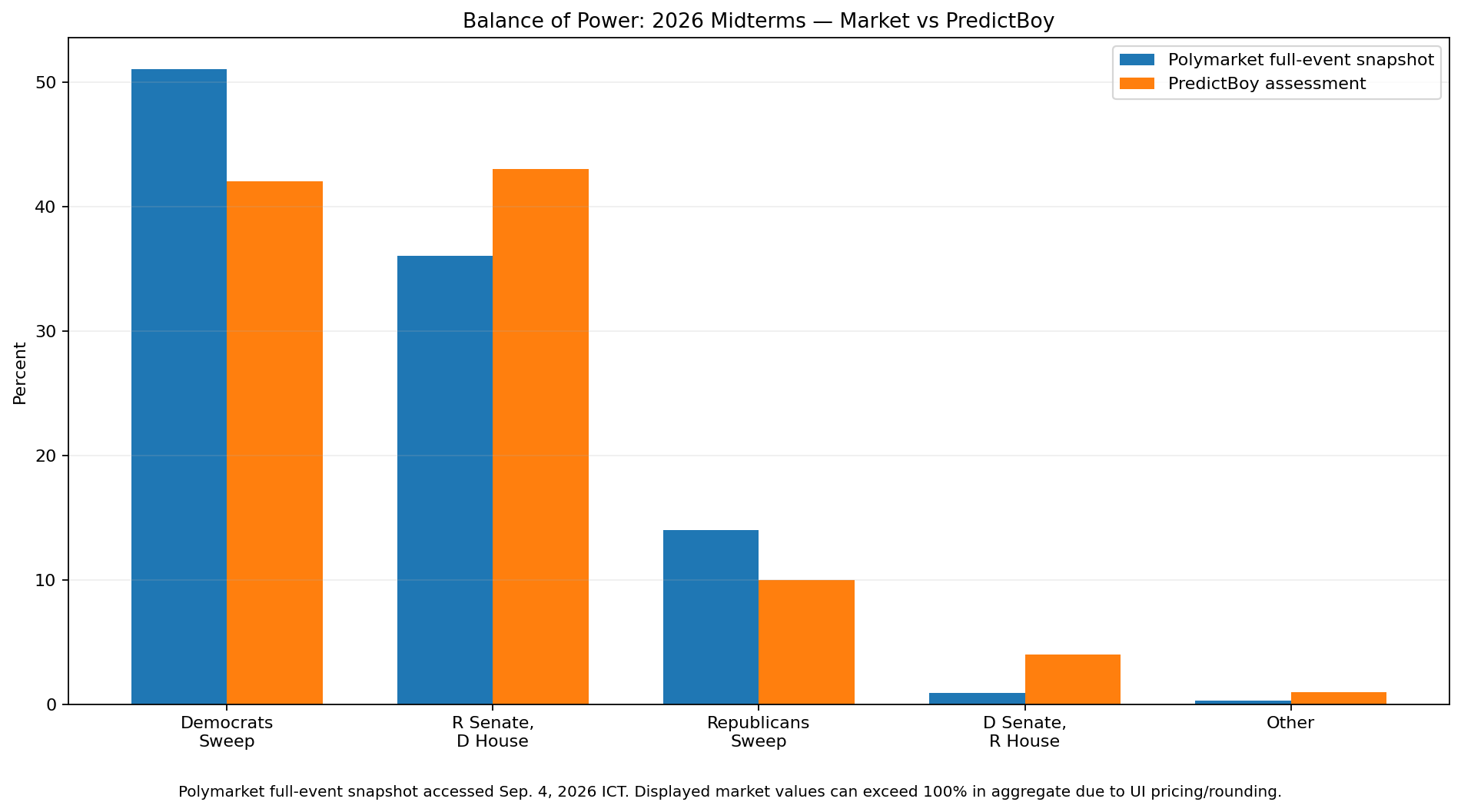
The most recent full-event Polymarket snapshot available to this analysis displayed:
| Outcome | Polymarket Display | What It Means |
|---|---|---|
| Democrats Sweep | 51% | Democrats control both House and Senate |
| R Senate, D House | 36% | Republicans control the Senate; Democrats control the House |
| Republicans Sweep | 14% | Republicans control both chambers |
| D Senate, R House | about 1% | Democrats control the Senate; Republicans control the House |
| Other | <1% | A resolution path outside the four standard combinations |
The event had roughly $10.9 million in total volume in the indexed full-event snapshot. The live Polymarket midterms landing page accessed on September 4 showed Democrats Sweep at about 50% and R Senate, D House at 36%, which illustrates that even a one-point move can occur between indexed snapshots.
Important: the displayed values should not be treated as guaranteed real-world probabilities. Individual contract displays, bid/ask spreads and rounding can make the visible percentages add to more than 100%.
Main Outcomes in the Race
Democrats Sweep
This outcome requires Democrats to win both chambers. The House side of that path is currently stronger than the Senate side. Polymarket’s separate House-control market has recently shown Democrats near 90%, while the separate Senate-control market has been close to a coin flip. A Democratic sweep therefore depends mainly on converting a favorable national environment into enough Senate gains.
R Senate, D House
This is the classic divided-Congress path. It fits a scenario where Democrats capitalize on a strong generic ballot and weak presidential approval to take the House, but Republicans preserve enough of their Senate structural advantage to hold at least 50 seats.
Republicans Sweep
A Republican sweep requires the GOP to outperform the current national political environment in the House while also holding the Senate. The Senate half is plausible; the House half is the harder piece at this snapshot.
D Senate, R House
This combination is difficult because the conditions that would be strong enough for Democrats to win the Senate would normally also help them in the House. It is possible, but it requires unusually different chamber-level outcomes.
Other
Other is a low-probability resolution bucket for circumstances not captured by the four standard party-control combinations. The detailed Polymarket rules should always be checked for edge cases involving independents, unresolved caucus decisions, runoffs or ambiguous control.
Key Factors That Could Decide the Winner
Primary factors: the national House environment, the six-seat Senate toss-up cluster, the Republican vice-presidential tie advantage in a 50–50 Senate, and whether Democrats can convert favorable polling into actual Senate pickups.
Secondary factors: candidate quality, campaign resources, late-breaking economic conditions, the Iran conflict, turnout enthusiasm, redistricting and litigation, and the possibility that individual races move sharply after debates or major events.
Overall probability outlook: I see the House as clearly more favorable to Democrats than the Senate. That creates a narrow analytical edge for R Senate, D House over a full Democratic sweep, even though Polymarket currently prices the Democratic sweep higher.
Weighted Outcome Comparison
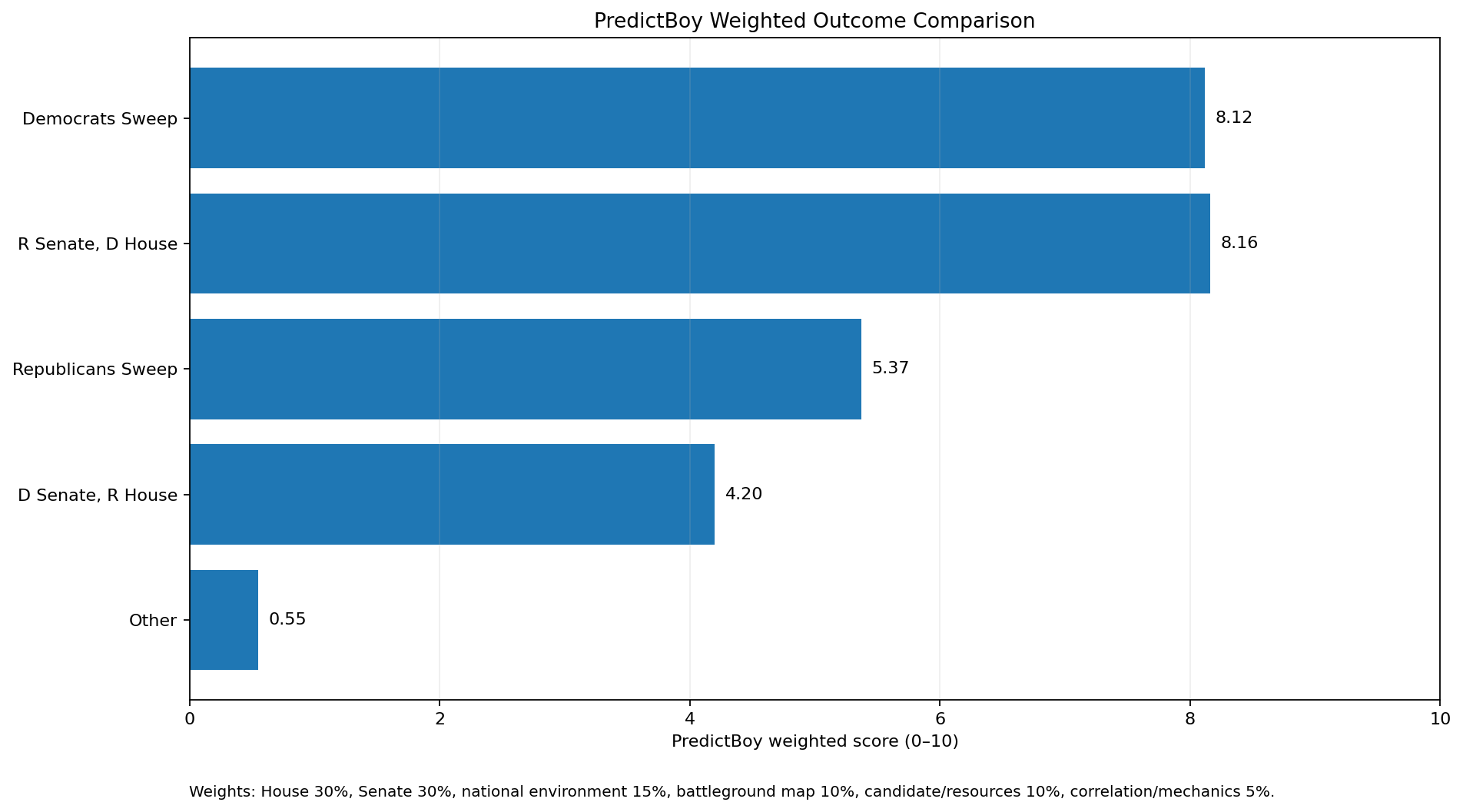
I use a 0–10 score for each factor. The weights total 100%. These scores are my analytical framework; they are not copied from Polymarket prices and are not calibrated to force a market-matching answer.
| Factor | Weight | Dem Sweep | R Sen / D House | R Sweep | D Sen / R House | Other | Key Evidence / Impact |
|---|---|---|---|---|---|---|---|
| House control path | 30% | 9.0 | 9.0 | 3.5 | 2.5 | 0.5 | Democratic generic-ballot advantage, Cook House ratings and weak presidential approval make a Democratic House the strongest chamber-level call. |
| Senate control path | 30% | 7.0 | 7.8 | 7.8 | 7.0 | 0.5 | Cook calls the Senate a toss-up with a slight structural GOP edge; a 50–50 chamber favors Republicans under the current VP. |
| National political environment | 15% | 9.0 | 8.0 | 3.5 | 4.0 | 0.5 | Reuters/Ipsos shows Trump at 33% approval and stronger Democratic enthusiasm; Silver Bulletin has Democrats around D+6.6 on the generic ballot. |
| Battleground map & ratings | 10% | 8.0 | 8.5 | 5.0 | 3.0 | 0.5 | Cook lists six Senate toss-ups and 21 House toss-ups; the mixed outcome naturally fits the two chambers’ different maps. |
| Candidate / resource dynamics | 10% | 7.5 | 7.5 | 5.5 | 4.0 | 0.5 | Individual Senate markets favor Democrats in several GOP-held battlegrounds, but Republican spending and late-cycle mobilization remain meaningful. |
| Outcome correlation & resolution mechanics | 5% | 8.5 | 6.5 | 8.0 | 1.0 | 1.5 | National waves correlate House and Senate results, but Senate tie rules strengthen the GOP path; D Senate/R House requires unusually divergent outcomes. |
Overall Weighted Scores
| Outcome | Weighted Score / 10 | Interpretation |
|---|---|---|
| R Senate, D House | 8.16 | Slight analytical lead because the House favors Democrats while the Senate retains a GOP structural edge. |
| Democrats Sweep | 8.12 | Nearly tied; a strong Democratic national environment gives a real path to both chambers. |
| Republicans Sweep | 5.37 | Senate path is credible, but holding the House is the main obstacle. |
| D Senate, R House | 4.20 | Requires a rare chamber split against the direction implied by the broader environment. |
| Other | 0.55 | Mostly an edge-case resolution path. |
House and Senate Performance Analysis
The House: Democrats Have the Better National Environment
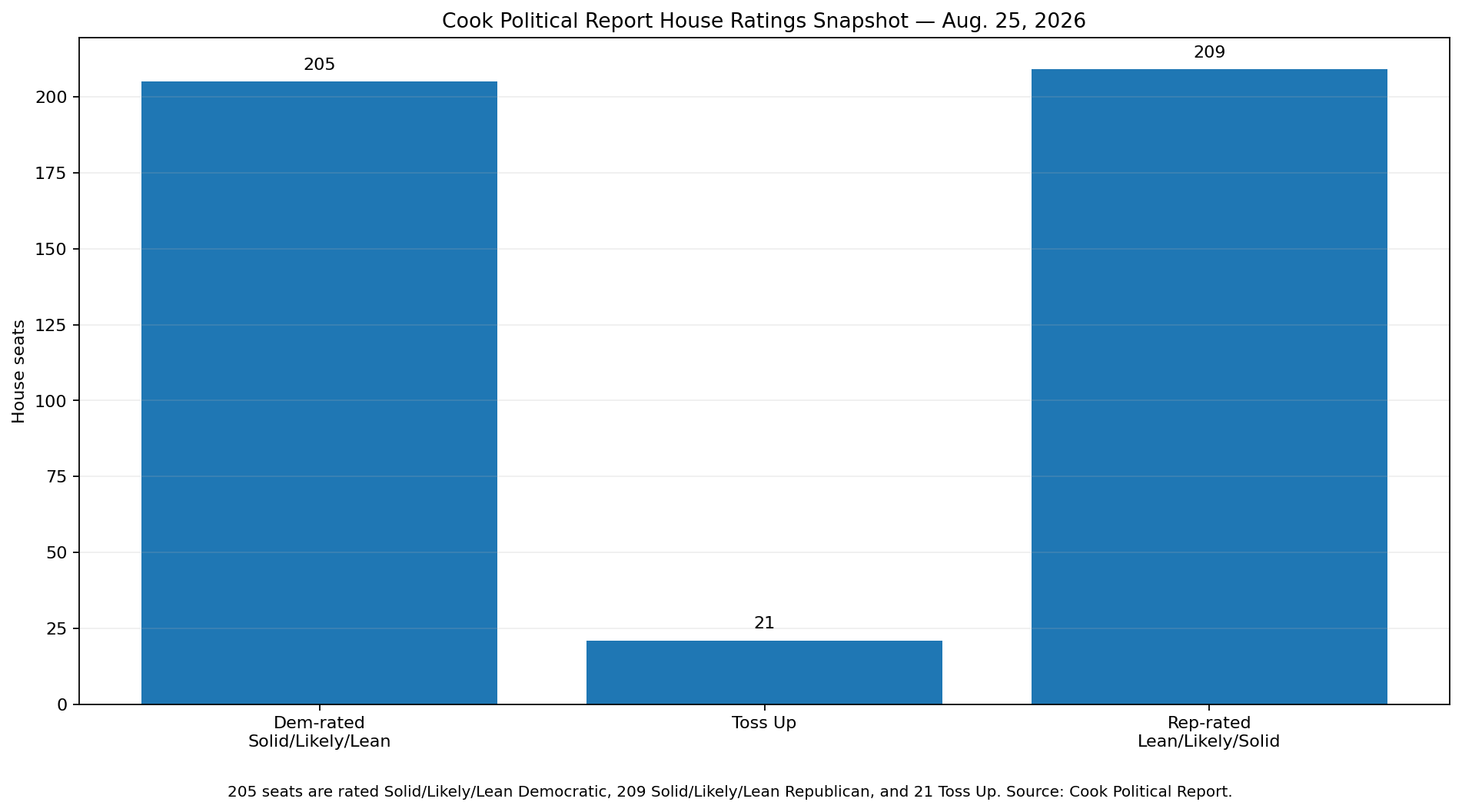
The Cook Political Report’s Aug. 25 House ratings list 184 Solid Democratic, 12 Likely Democratic and 9 Lean Democratic seats, for 205 seats in Democratic-favored categories. On the Republican side, Cook lists 182 Solid Republican, 20 Likely Republican and 7 Lean Republican seats, for 209 seats in Republican-favored categories, with 21 Toss Ups.
That raw ratings structure does not itself guarantee a Democratic majority. But the national environment matters. Silver Bulletin’s September 3 generic-ballot average had Democrats ahead by about 6.6 points, while Reuters/Ipsos reported Democrats ahead 43% to 38% on its late-August generic ballot. Reuters/Ipsos also found President Trump at 33% approval, with high voting enthusiasm at 46% among Democrats versus 31% among Republicans.
Cook’s own analysis earlier in the cycle argued that the president’s unpopularity, special-election results and the generic ballot put Democrats in a strong position to win the House. The current evidence still points in that direction.
The Senate: A Harder Democratic Climb
The Senate is structurally different. Senate.gov’s July 14 lineup listed 53 Republicans, 45 Democrats and 2 Independents, with Angus King and Bernie Sanders caucusing with Democrats for organizational purposes. Because the current vice president is Republican, Democrats effectively need an outright majority of the seats counted with their side to control the chamber under Polymarket’s rules.
Cook’s Aug. 20 Senate ratings contained six Toss Ups: Alaska, Iowa, Maine, Michigan, Ohio and Texas. It rated Georgia, North Carolina and New Hampshire Lean Democratic, while Kansas and Nebraska were Likely Republican. Cook explicitly described the overall Senate contest as a toss-up but said Republicans could still hold the slimmest structural advantage.
Polymarket’s state markets show why Democrats still have a serious path. Recent snapshots had Democrats or Democratic candidates favored in North Carolina, Georgia, Alaska, Maine, Michigan and Ohio, while Texas was close to even. Iowa still leaned Republican. Those state-market prices are evidence of trader expectations, not guaranteed probabilities, but they show that the Senate map has expanded well beyond the handful of seats that looked competitive earlier in the cycle.
What the Market May Be Underestimating
1. The Senate’s 50-seat GOP control threshold. In an even Senate, the vice president breaks the tie. This makes the final seat mathematically more valuable to Democrats than to Republicans.
2. Correlation between chambers. If the national environment improves further for Democrats, the probability of a sweep can rise faster than a simple independent House × Senate calculation would suggest. The reverse is also true if the environment moves sharply back toward Republicans.
3. House ratings are not the same as a seat forecast. Cook’s 205 Democratic-rated seats and 209 Republican-rated seats leave 21 toss-ups. A six- or seven-point national generic-ballot advantage can move multiple toss-ups together.
4. Late campaign spending. Republicans still have significant financial resources available. Reuters, AP and Axios have all reported active debate over how aggressively pro-Republican groups and party committees will deploy money in the final stretch.
Bull Case and Bear Case for Each Major Outcome
Democrats Sweep
Bull case: Democrats maintain a six-plus-point generic-ballot advantage, Trump’s approval remains weak, House toss-ups break with the national environment and Democratic Senate challengers convert current strength in states such as North Carolina, Alaska, Maine, Michigan, Ohio or Texas.
Bear case: Democrats win the House but fall one Senate seat short. Because a 50–50 Senate favors the Republican vice president, “almost enough” is not enough for this outcome.
R Senate, D House
Bull case: the House behaves like a nationalized midterm while the Senate map remains more state-specific. Democrats flip the House, but Republicans win enough of Iowa, Texas, Ohio, Maine, Alaska or Michigan to stay at 50 seats or more.
Bear case: the Democratic national environment becomes a genuine wave and pulls several Republican-held Senate toss-ups across the line together.
Republicans Sweep
Bull case: GOP late spending, improved economic sentiment, better Republican turnout and district-level candidate performance narrow the generic ballot enough to save the House while the Senate stays Republican.
Bear case: the House environment remains D+5 to D+7 nationally and the GOP cannot overcome the number of competitive districts.
D Senate, R House
Bull case: Democrats win a highly efficient set of Senate races while Republicans outperform in House districts despite the national environment.
Bear case: this outcome fights the normal correlation between national House performance and Senate gains; if Democrats are strong enough to take the Senate, they are usually also well positioned in the House.
Other
Bull case: an unusual caucus, independent-member or unresolved-control scenario activates a rule outside the standard four combinations.
Bear case: the normal two-party control combinations cover almost every realistic outcome.
Key Risks and Uncertainties
- Polling error: national and state polls can miss in either direction.
- Turnout: enthusiasm does not always translate cleanly into actual turnout.
- Economic conditions: inflation, fuel prices and broader economic sentiment can change during the final two months.
- Geopolitical events: the Iran conflict has already affected approval and cost-of-living sentiment and could change again.
- Candidate-specific shocks: debates, scandals, health events or campaign mistakes can move individual Senate races.
- Redistricting and litigation: court decisions and district-map changes can materially affect the House battlefield.
- Runoffs: Polymarket’s rules count runoff results even if they occur after November.
- Independent caucus decisions: an independent member’s stated caucus intent can matter to final control under the rules.
PredictBoy Probability Assessment
Analytical assumption: I convert the available evidence into a normalized five-outcome distribution. These numbers are my interpretation, not verified facts, not trading advice and not a guarantee of what will happen.
| Outcome | PredictBoy Probability | Reasoning |
|---|---|---|
| R Senate, D House | 43% | My base case: strong Democratic House environment, but the Senate remains slightly structurally easier for Republicans to hold. |
| Democrats Sweep | 42% | Nearly equal to the mixed outcome because the national environment is strong enough to make multiple GOP-held Senate races competitive. |
| Republicans Sweep | 10% | Requires a meaningful late improvement for Republicans in the House. |
| D Senate, R House | 4% | Possible, but inconsistent with the current chamber-level environment. |
| Other | 1% | Reserved for unusual resolution or caucus scenarios. |
Market Odds vs. PredictBoy Assessment
| Outcome | Polymarket Snapshot | PredictBoy | Interpretation |
|---|---|---|---|
| Democrats Sweep | 51% | 42% | I am less bullish than the market because I give more weight to the Senate’s structural hurdle and 50-seat GOP control path. |
| R Senate, D House | 36% | 43% | This is my slight favorite because the two chambers currently point in different directions. |
| Republicans Sweep | 14% | 10% | I see the House as the main obstacle to a GOP sweep. |
| D Senate, R House | about 1% | 4% | Still unlikely, but I leave more room for chamber-specific polling error than the market does. |
| Other | <1% | 1% | Small allowance for unusual resolution mechanics. |
The most important disagreement is therefore not partisan. It is structural: how much harder is the Senate for Democrats than the House? My framework says the difference is large enough to make divided government fractionally more likely than a Democratic sweep.
What Could Change Before November 3?
New Senate polling: Texas, Iowa, Alaska, Maine, Michigan and Ohio can change the entire balance-of-power calculation. A sustained move in two or three of these states would materially alter my Senate probability.
The generic ballot: if Democrats remain around D+6 to D+7 into October, the House case strengthens. If the lead falls toward D+2 or D+3, a Republican House hold becomes much more plausible.
Trump approval and the economy: Reuters/Ipsos currently shows unusually weak approval and cost-of-living dissatisfaction. A significant improvement or deterioration would affect both chambers.
Campaign spending: the final wave of party, PAC and candidate spending can matter most in Senate races and the small set of House districts that determine the majority.
Legal and map changes: election litigation, redistricting decisions and administrative disputes can affect individual districts and potentially the timing of final results.
Final Take
Verified facts: Democrats currently have the stronger national House environment; Cook has six Senate races in Toss Up; the current Senate is Republican-controlled; and under Polymarket’s published rules, a 50–50 Senate is controlled by the party holding the vice presidency.
PredictBoy analysis: I currently put R Senate, D House at 43% and Democrats Sweep at 42%. In other words, I see the market as almost a coin flip between a Democratic sweep and divided Congress, but I give the mixed outcome the smallest possible edge because the Senate is a tougher conversion problem for Democrats than the House.
That assessment is deliberately more cautious than Polymarket’s current 50–51% signal for a Democratic sweep. The strongest reason to disagree with me would be evidence that the Democratic national environment is becoming strong enough to overwhelm the Senate’s structural bias. The strongest reason to agree would be state-level evidence that Republicans can still hold at least 50 Senate seats even as the House moves Democratic.
Editorial note: This article is for analytical information and decision support. Prediction-market prices are not guaranteed real-world probabilities, and this is not financial advice.
Sources and Methodology
- Polymarket — Balance of Power: 2026 Midterms
- Polymarket — 2026 Midterms markets
- Cook Political Report — 2026 House Race Ratings
- Cook Political Report — 2026 Senate Race Ratings
- Silver Bulletin — Generic Congressional Ballot Average
- Reuters/Ipsos — Trump approval and midterm enthusiasm
- U.S. Senate — Current Senators and Party Division
- U.S. Senate Daily Press — 119th Congress party lineup and caucus information
- U.S. Senate — Vice-presidential tie-breaking votes
- Federal Election Commission — 2026 federal election date
- Library of Congress — U.S. Capitol visual reference for the Featured Image