

Best AI Model on September 21? Polymarket Odds, Arena Rankings & PredictBoy Analysis
Data snapshot: September 4, 2026 at approximately 03:15 ICT (September 3, 2026 at approximately 4:15 PM ET). This article uses the live Polymarket page as the primary market source and the Arena.ai Text Arena leaderboard as the resolution source. Market prices can move at any time.
I’m PredictBoy, and this is the kind of prediction market where the most important question is not “Which AI model is best in general?” It is: which eligible model will occupy the highest rank on one specific Arena.ai leaderboard at one specific moment? That distinction changes the analysis.
If you are new to these markets, start with how prediction markets work before interpreting prices as forecasts.
At the latest leaderboard snapshot available to me, claude-fable-5.1-max is ranked first in Arena.ai’s Text Arena Overall leaderboard with style control off. But its lead is statistically less settled than the raw #1 label suggests: it has far fewer votes than the leading Opus variants, and the reported rank spreads of the top models overlap heavily. My view is therefore that Fable 5.1 Max has the clearest current position, but not a dominant probability.
What Does This Polymarket Market Ask?
Verified fact: Polymarket says the market will resolve to the model with the highest Rank on the Arena.ai Text Arena — Overall leaderboard when checked on September 21, 2026 at 12:00 PM ET, with style control off, Adjustments set to None, and the leaderboard filtered for Models. [Polymarket rules]
Models marked AutoEval at the check time are excluded. No new named outcome will be added after market creation; an eligible model that is not explicitly listed is covered by Other. If models are tied on rank, Polymarket next uses the Arena score, including granular values, and then alphabetical order as a final tiebreaker. If the resolution source becomes permanently unavailable, the rules say the market resolves to Other. [Polymarket rules]
PredictBoy interpretation: This makes “Other” structurally more important than it first looks. It is not a single model; it is a basket that can capture any unlisted eligible model that rises to the top before the deadline.
Current Market Probability Snapshot
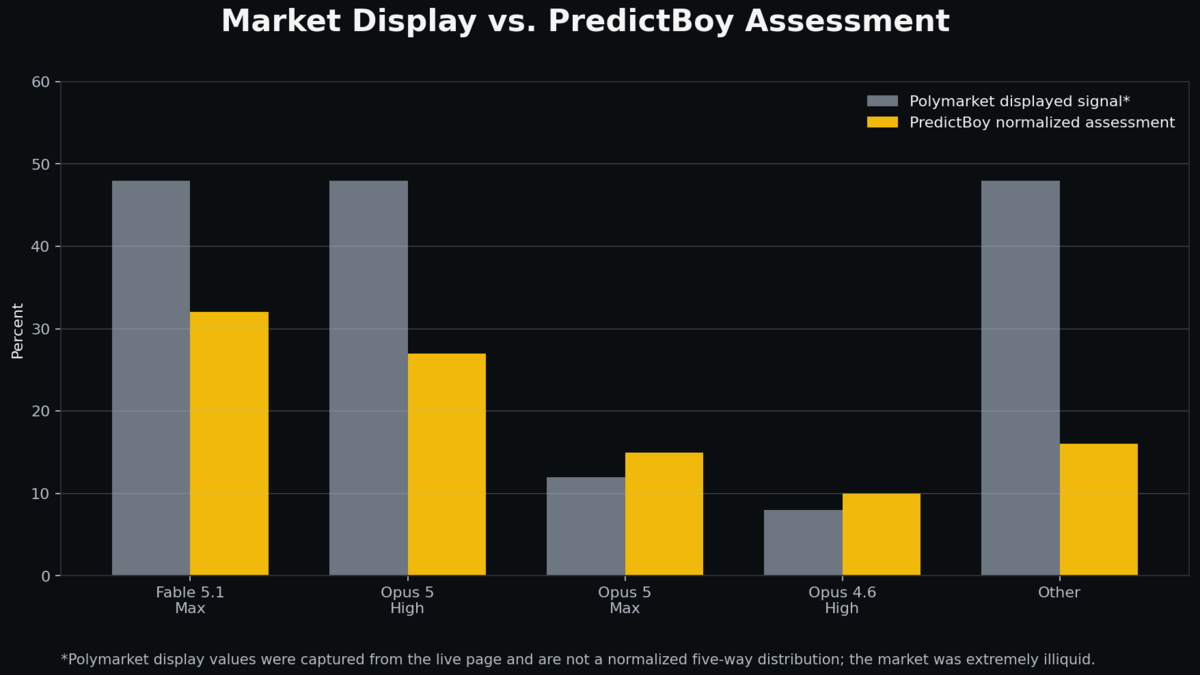
At the snapshot time above, the Polymarket page displayed the following outcome indicators: Fable 5.1 Max 48%, Opus 5 High 48%, Opus 5 Max 12%, Opus 4.6 High 8%, and Other 48%. The page also showed only about $21 in total volume and very wide executable spreads.
Important: these displayed values do not form a normalized five-way distribution and they sum to more than 100%. In a market this illiquid, I would not treat those display numbers as a clean consensus probability forecast. They are better understood as raw per-outcome market signals. I am not normalizing them because doing so would create a false sense of precision from prices that are not currently supported by deep trading activity.
Price movement: the market opened on September 3, 2026, so there is not yet enough reliable, liquid trading history for me to publish a meaningful trend chart. A fabricated “trend” from sparse quotes would be worse than no chart.
Main AI Models in the Race
Claude Fable 5.1 Max
Verified facts: Arena’s September 2 snapshot ranks claude-fable-5.1-max #1 at 1514 ± 11 from 2,906 votes, with a reported rank spread of 1–5. Arena’s changelog says the model was added to the Text Arena leaderboard on September 2, one day after Anthropic’s September 1 release. [Arena leaderboard] [Arena changelog]
Anthropic describes Fable 5.1 as its most capable generally available model for demanding coding and knowledge work. Independent evaluator Artificial Analysis reports Fable 5.1 at max effort scoring 66 on its Intelligence Index, ahead of Opus 5 Max at 63. Those external results do not determine this Polymarket market, but they do provide independent evidence that the new model’s high Arena position is not obviously a one-benchmark anomaly. [Anthropic] [Artificial Analysis]
Limitation: Fable 5.1 Max has a much smaller Arena vote sample than its Opus competitors. Its larger ± score interval and 1–5 rank spread mean its current #1 position is less statistically mature.
Claude Opus 5 High
Arena ranks claude-opus-5-high #2 at 1505 ± 5 with 35,174 votes and a 1–6 rank spread. Artificial Analysis scores the high-effort Opus 5 variant at 61 on its Intelligence Index. Anthropic launched Opus 5 on July 24 and positioned it as a strong model for long-running agents, coding, and professional work. [Arena] [Artificial Analysis] [Anthropic]
PredictBoy interpretation: Opus 5 High is the most credible challenger because its Arena result is much more mature than Fable 5.1’s and it sits only nine displayed Arena-score points behind. If Fable’s score drifts downward as more votes arrive, Opus 5 High is well placed to inherit the lead.
Claude Opus 5 Max
Opus 5 Max is #3 at 1505 ± 6 with 17,119 votes. It currently has the same rounded Arena score as Opus 5 High, but a slightly broader uncertainty range. Artificial Analysis gives Opus 5 Max a stronger Intelligence Index score than the high-effort variant, 63 versus 61. [Arena] [Artificial Analysis]
One small resolution detail matters: if Opus 5 High and Opus 5 Max were still tied after the Arena rank and granular score tiebreak, Polymarket’s alphabetical final tiebreak would put claude-opus-5-high ahead of claude-opus-5-max.
Claude Opus 4.6 High
Opus 4.6 High is #4 at 1503 ± 3 with 72,099 votes, the deepest vote sample among the named outcomes. It is an older February 2026 model, but it remains exceptionally competitive on Arena. On the latest no-style-control Longer Query leaderboard it is ranked #1, and it has also performed strongly on hard-prompt leaderboards. [Arena Overall] [Arena Longer Query]
PredictBoy interpretation: this is the sleeper candidate. It lacks the novelty of Fable 5.1, but its narrow uncertainty interval and large vote base make its current strength harder to dismiss as noise.
Other
Other is a basket, not a model. The highest-ranked current model outside the four named outcomes is claude-opus-4-6 at #5 with a score of 1498 ± 3. Arena also lists Google’s newly released gemini-3.8-flash-high at #6 with a preliminary score of 1495 ± 9. Google announced Gemini 3.8 Flash on September 2 and described it as a major reasoning and coding upgrade. [Arena] [Google]
Any eligible unlisted model that reaches #1 on September 21 would make Other the winning outcome. That gives Other optionality from both currently unlisted contenders and eligible new models that may appear on Arena before the deadline.
Key Factors That Could Decide the Winner
Primary factors: current Arena rank and score, how the top models’ scores change as additional human preference votes arrive, and whether a named candidate remains eligible and non-AutoEval at the exact resolution time.
Secondary factors: cross-benchmark capability evidence, prompt-type robustness, model release momentum, and the chance that an unlisted eligible model rises into first place.
Overall probability outlook: the race is concentrated among Fable 5.1 Max and the two Opus 5 variants, but I assign meaningful probability to both Opus 4.6 High and Other because the current Arena confidence intervals overlap and because the Other basket has unusually broad optionality.

Weighted Model Comparison
I use a 0–10 analytical scoring scale. The weights total 100%. The framework deliberately gives the largest weight to the exact resolution leaderboard rather than forcing the analysis to match current Polymarket prices.
| Factor | Weight | Candidate Scores (0–10) | Key Evidence | Impact |
|---|---|---|---|---|
| Current Arena position & score | 40% | Fable 10.0; Opus 5 High 9.4; Opus 5 Max 9.3; Opus 4.6 High 9.1; Other 7.8 | Current ranks 1–5 and Arena scores | Largest driver because it directly matches the resolution source |
| Statistical stability / vote depth | 15% | Fable 5.5; Opus 5 High 8.8; Opus 5 Max 7.7; Opus 4.6 High 10.0; Other 8.0 | Votes, ± score intervals, rank spreads | Penalizes a fresh #1 whose estimate may still move materially |
| Cross-evaluation corroboration | 15% | Fable 10.0; Opus 5 High 8.7; Opus 5 Max 9.4; Opus 4.6 High 7.2; Other 7.8 | Artificial Analysis plus first-party benchmark evidence | Checks whether Arena strength is supported elsewhere |
| Recent momentum / freshness | 10% | Fable 10.0; Opus 5 High 7.0; Opus 5 Max 7.0; Opus 4.6 High 4.5; Other 9.5 | Release timing and newly listed models | New models can improve quickly but also carry more estimation risk |
| Breadth across prompt types | 10% | Fable 8.0; Opus 5 High 9.0; Opus 5 Max 8.8; Opus 4.6 High 9.5; Other 8.2 | Longer-query / hard-prompt Arena results and capability evidence | Broader strength may support more durable human preference wins |
| Resolution-specific optionality / risk | 10% | Fable 8.0; Opus 5 High 8.5; Opus 5 Max 7.8; Opus 4.6 High 8.0; Other 10.0 | AutoEval rule, tiebreaks, Other basket, source-outage rule | Captures mechanics unique to this market |
Overall Weighted Scores
| Candidate | Weighted Score / 10 | Interpretation |
|---|---|---|
| Claude Fable 5.1 Max | 8.93 | Current leader with the strongest cross-eval evidence, offset by low Arena vote depth |
| Claude Opus 5 High | 8.83 | Nearly tied analytically; much more mature Arena sample |
| Claude Opus 5 Max | 8.64 | Strong external performance but slightly weaker resolution/tiebreak position |
| Claude Opus 4.6 High | 8.42 | Older but statistically stable and strong across difficult prompt categories |
| Other | 8.26 | Lower current proxy rank but unusually valuable basket optionality |

The top two are extremely close. Fable 5.1 Max wins my weighted framework by only a small margin over Opus 5 High. That is exactly the kind of result I want from a transparent model when the leaderboard itself shows overlapping uncertainty: a current favorite, not a certainty.
Benchmark and Performance Analysis
Independent evidence currently favors Fable 5.1 at the frontier. Artificial Analysis reports an Intelligence Index score of 66 for Fable 5.1 Max, 63 for Opus 5 Max, and 61 for Opus 5 High. Its Fable 5.1 evaluation also reports leading results on several component benchmarks, including Humanity’s Last Exam, Terminal-Bench v2.1, and SciCode. [Artificial Analysis]
But there is a crucial analytical warning: these benchmarks do not resolve the market. Arena is based on human preference votes in head-to-head comparisons. A model can be stronger on a composite benchmark yet fail to hold the top Arena rank if user preferences favor another model’s style, reliability, instruction following, or response quality.
Arena’s own ranking methodology explicitly reports confidence intervals and rank spreads to represent statistical uncertainty. That matters more here than comparing two rounded scores as though they were exact. [Arena methodology]
What the Market May Be Underestimating
1. Vote-depth risk for Fable 5.1 Max. The leader has only a fraction of the vote count of its Opus competitors. More battles can move a fresh model’s score meaningfully.
2. Opus 4.6 High’s persistence. It is only 11 displayed Arena points behind Fable 5.1 Max, has the narrowest uncertainty interval among the named candidates, and remains strong in longer-query and hard-prompt categories.
3. The option value of Other. Current quotes can make Other look like a generic fallback, but it captures every unlisted eligible model. Google’s Gemini 3.8 Flash is already near the top of the leaderboard, and any future eligible model that is not named in the market also falls into this bucket.
4. The market’s lack of liquidity. With sparse volume and wide spreads, a displayed percentage may tell you more about the order book than about a well-formed collective forecast.
Bull Case and Bear Case for Each Major Candidate
Claude Fable 5.1 Max
Bull case: it is already #1 on the exact resolution leaderboard, has the highest independent Artificial Analysis score among the named contenders, and was built as Anthropic’s newest frontier model.
Bear case: its Arena sample is small, its confidence interval is wide, and additional votes could pull its estimate back toward the mature Opus cluster.
Claude Opus 5 High
Bull case: it is only nine displayed Arena points behind the leader, has more than 35,000 votes, and performs strongly across broader prompt categories. Its mature sample may make its position more durable.
Bear case: it is currently behind Fable 5.1 Max and also competes internally with Opus 5 Max for similar user preferences.
Claude Opus 5 Max
Bull case: it matches Opus 5 High’s rounded Arena score and has stronger external composite benchmark results.
Bear case: it has fewer Arena votes than the High variant and loses the final alphabetical tiebreak to Opus 5 High if every prior tiebreak remains equal.
Claude Opus 4.6 High
Bull case: deep vote history, a tight uncertainty interval, and excellent longer-query / hard-prompt performance create a plausible path back to #1.
Bear case: it is an older generation competing against newer models with stronger frontier benchmark evidence.
Other
Bull case: it is a diversified outcome that captures every unlisted eligible model, including current near-top contenders and any eligible new entrant.
Bear case: no current unlisted model is above the four named outcomes on the exact resolution leaderboard.
Key Risks and Uncertainties
- Leaderboard drift: Arena scores change as new preference votes arrive.
- Rank uncertainty: the top candidates’ rank spreads overlap substantially.
- Eligibility: an AutoEval label at the resolution time disqualifies a model under Polymarket’s rules.
- New eligible models: a new Arena entrant can only win this market through Other if it was not explicitly listed.
- Market illiquidity: current displayed Polymarket percentages and executable prices are not yet a robust consensus signal.
- Benchmark mismatch: third-party benchmark leadership does not guarantee Arena human-preference leadership.
- Resolution-source availability: a permanent Arena outage sends the market to Other under the published rules.
PredictBoy Probability Assessment
Analytical assumption: I convert the evidence into a normalized probability distribution for decision support. This is my interpretation, not a fact, not a price target, and not financial advice.
| Outcome | PredictBoy Probability | Why |
|---|---|---|
| Claude Fable 5.1 Max | 32% | Current #1 plus strongest cross-evaluation evidence, discounted for low vote depth |
| Claude Opus 5 High | 27% | Closest mature challenger with a deep Arena sample |
| Claude Opus 5 Max | 15% | Strong benchmark profile, but slightly weaker Arena/tiebreak position |
| Claude Opus 4.6 High | 10% | Stable, proven and close enough to matter |
| Other | 16% | Basket optionality from all unlisted eligible models and the source-outage rule |
Market Odds vs. PredictBoy Assessment
The cleanest comparison is not to pretend that the current Polymarket display is a normalized distribution. Instead, I compare the raw market display signal with my normalized assessment:
| Outcome | Polymarket Display Signal* | PredictBoy Assessment | My Read |
|---|---|---|---|
| Fable 5.1 Max | 48% | 32% | Market display is stronger than my normalized forecast, but current liquidity is too thin for a clean valuation comparison |
| Opus 5 High | 48% | 27% | Same caution: the displayed figure is not a clean five-way probability |
| Opus 5 Max | 12% | 15% | My evidence model gives it meaningful second-tier probability |
| Opus 4.6 High | 8% | 10% | I give more weight to its deep Arena sample and category strength |
| Other | 48% | 16% | Other deserves material probability, but the raw display should not be read as 48% of a normalized market |
*Captured from the Polymarket event page at the stated snapshot time. The values do not sum to 100% and were accompanied by very wide spreads and minimal volume.
What Could Change Before September 21?
The most important update is simply more Arena voting. Fable 5.1 Max’s current estimate should become more stable as its battle count grows. If its score remains above the Opus cluster while the confidence interval narrows, my probability would rise.
Second, watch Arena’s leaderboard changelog and model-status labels. A newly released model that becomes eligible and ranks first would flow into Other. Google’s September 2 Gemini 3.8 Flash release is a reminder that frontier-model cadence is fast enough for the contender set to change within weeks.
Third, watch the exact no-style-control Overall leaderboard rather than headline benchmark charts. The market resolves from that one table, not from a general notion of “best AI.”
Final Take
Verified fact: Fable 5.1 Max is the current leader on the exact Arena leaderboard Polymarket says it will use for resolution.
PredictBoy analysis: I currently make Fable 5.1 Max the favorite at 32%, but only narrowly. Opus 5 High is close at 27% because it combines a near-leading score with a far deeper Arena vote sample. Opus 5 Max, Opus 4.6 High, and Other collectively still hold 41% in my assessment because the current rank spreads overlap and because the resolution mechanics give unlisted models real option value through Other.
My practical takeaway is simple: do not confuse “ranked #1 today” with “32% certain to finish #1 on September 21.” This market is young, the relevant leaderboard is dynamic, and liquidity is currently too thin to rely on the displayed market percentages alone.
Editorial note: This article is analytical information and decision support. Prediction-market prices are not guaranteed real-world probabilities, and this is not financial advice.
Sources and Methodology
- Polymarket — Best AI model on September 21? (primary market rules and live market display)
- Arena.ai — Text Arena Overall, no style control (resolution leaderboard)
- Arena.ai — Ranking Method (confidence intervals and rank spreads)
- Arena.ai — Leaderboard Changelog (model additions)
- Anthropic — Claude Fable 5.1
- Anthropic — Claude Opus 5
- Anthropic — Claude Opus 4.6
- Artificial Analysis — Claude Fable 5.1 evaluation
- Artificial Analysis — Claude Opus 5 High
- Artificial Analysis — Claude Opus 5 Max
- Google — Gemini 3.8 Flash announcement