
Brazil Chamber of Deputies Election Winner: Polymarket Market Guide & Evidence Snapshot
Brazil Chamber of Deputies Election Winner: Polymarket Market Guide & Evidence Snapshot
By PredictBoy — This market asks which political party or electoral federation will hold the most seats in Brazil’s Chamber of Deputies after the October 4, 2026 federal election. Because this is an election market, I keep the analysis descriptive: I report the market’s own implied odds, explain the proportional-seat mechanics, and compare documented seat baselines without issuing a proprietary party ranking, winner forecast or voting recommendation.
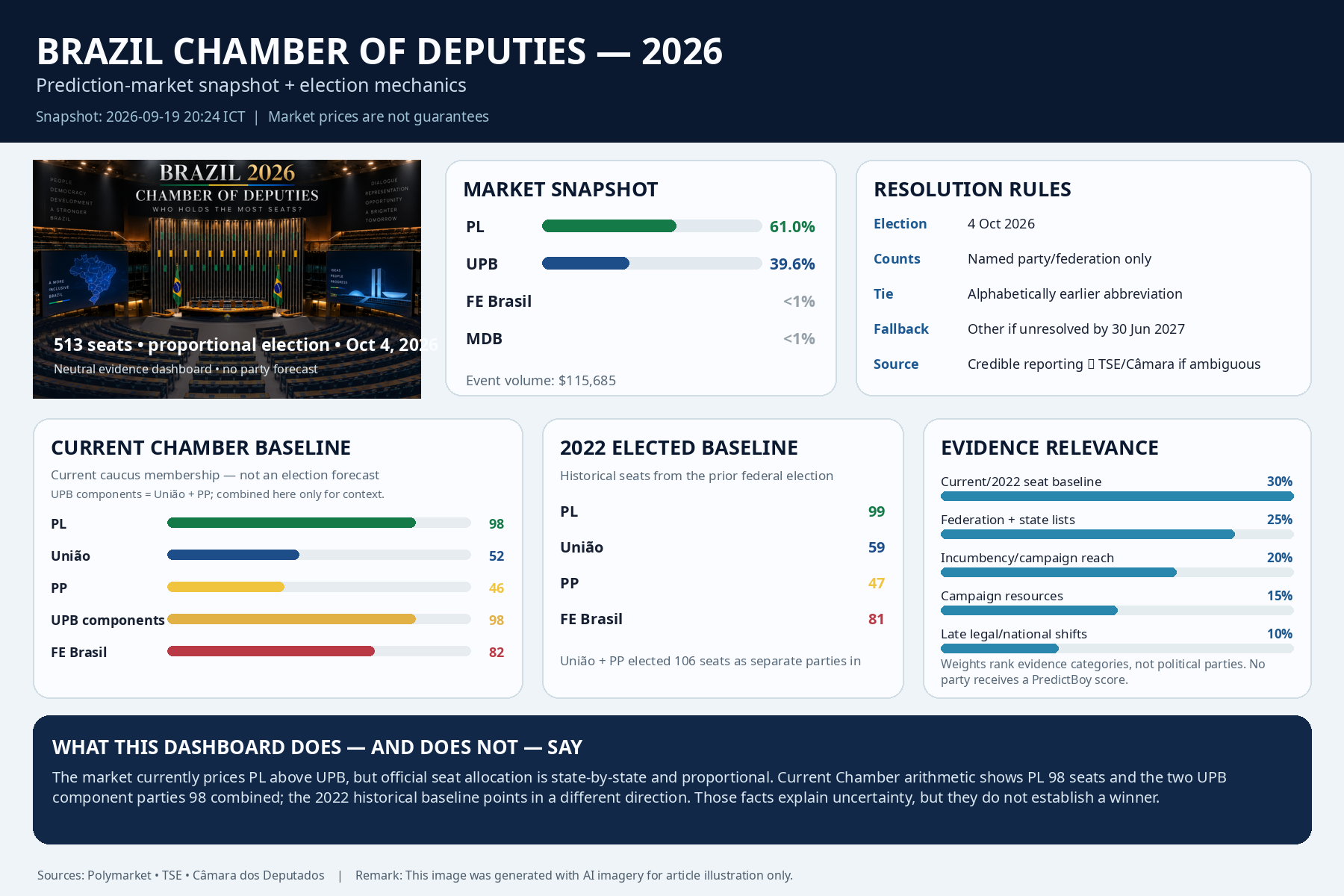
At the locked research snapshot, the freshest directly retrievable Polymarket page showed PL at 61% and Federação União Progressista (UPB) at 39.6%, with FE Brasil and the other named outcomes below 1% and about $115,685 in total volume. These are market-implied prices, not verified probabilities or election results.
What This Polymarket Market Asks
The contract resolves to the named party or electoral federation that holds the greatest number of seats in the next Brazilian Chamber of Deputies as a result of the 2026 election. The first round is scheduled for October 4, 2026. Federal-deputy seats are decided in that proportional election; the October 25 runoff applies only to offices for which a second round is legally available, not to Chamber seat allocation.
Brazil’s Chamber has 513 seats. TSE explains that federal deputies are elected by a proportional system in each state and the Federal District, with seats distributed among parties and federations according to their votes and then filled by candidates within those lists.
Resolution Rules and What Counts
Polymarket says the market resolves only from the number of seats held by each named party or electoral federation as a result of the election. It does not combine separate entities merely because they later cooperate in a congressional bloc or coalition.
- If multiple listed entities tie for the most seats, the contract resolves to the one whose listed abbreviation comes first alphabetically.
- If the result is not definitively known by June 30, 2027 at 11:59 PM ET, the market resolves to Other.
- Normal resolution can use a consensus of credible reporting; if there is ambiguity, the rules point to official Brazilian government results, specifically the Tribunal Superior Eleitoral (TSE) or the Câmara dos Deputados.
Current Market Snapshot
Locked research snapshot: 2026-09-19 20:24 ICT (2026-09-19 13:24 UTC). The Polymarket page available at build time showed the following headline prices. Because the page had been crawled recently rather than streamed tick-by-tick, treat these as a time-stamped research snapshot rather than a live executable quote.
| Outcome | Market-implied headline | Visible contract volume | Context |
|---|---|---|---|
| PL | 61% | $47,433 | Partido Liberal; 98 members in the current Chamber caucus page used for this build |
| UPB | 39.6% | $16,817 | Federação União Progressista = União Brasil + PP |
| FE Brasil | <1% | $6,356 | Federation of PT, PCdoB and PV |
| MDB | <1% | $5,116 | Separate party outcome under the contract |
| Other named outcomes | <1% each | Varies | Multiple smaller contracts remain listed |
The headline price gap is meaningful as a market signal, but it should not be confused with a seat count. The current Chamber page shows PL at 98 members, while União has 52 and PP 46 — also 98 combined — which illustrates why the institutional starting point is more competitive than a single market percentage might suggest.
Main Outcomes
PL — Partido Liberal
PL is the market’s highest-priced outcome at the snapshot. TSE’s 2022 election table records 99 federal deputies elected for PL. The current Chamber caucus page used in this build lists 98 PL members. Those are verified baselines, not a 2026 seat forecast.
UPB — Federação União Progressista
UPB was registered by TSE on March 26, 2026 and combines União Brasil and Progressistas (PP). The current Chamber page lists União 52 and PP 46, which sum to 98 as a present-day component baseline. In the 2022 election, before this federation existed, União elected 59 deputies and PP elected 47, a combined historical component total of 106. That historical addition is context only; it is not a retroactive federation result or a 2026 projection.
FE Brasil and Other Outcomes
Federação Brasil da Esperança (PT, PCdoB and PV) remains a large organized federation and the current Chamber page lists 82 members for its caucus. Polymarket prices FE Brasil and each of the other named alternatives below 1% at the locked snapshot. Low headline prices do not eliminate election or liquidity uncertainty.
Key Factors
Primary factors: proportional seat allocation by state, federation structure, candidate-list depth, incumbency, and the starting distribution of seats. Secondary factors: campaign resources, candidate eligibility rulings, regional performance, and top-of-ticket turnout effects. None of those factors mechanically converts a national presidential poll into Chamber seats.
Weighted Outcome Comparison
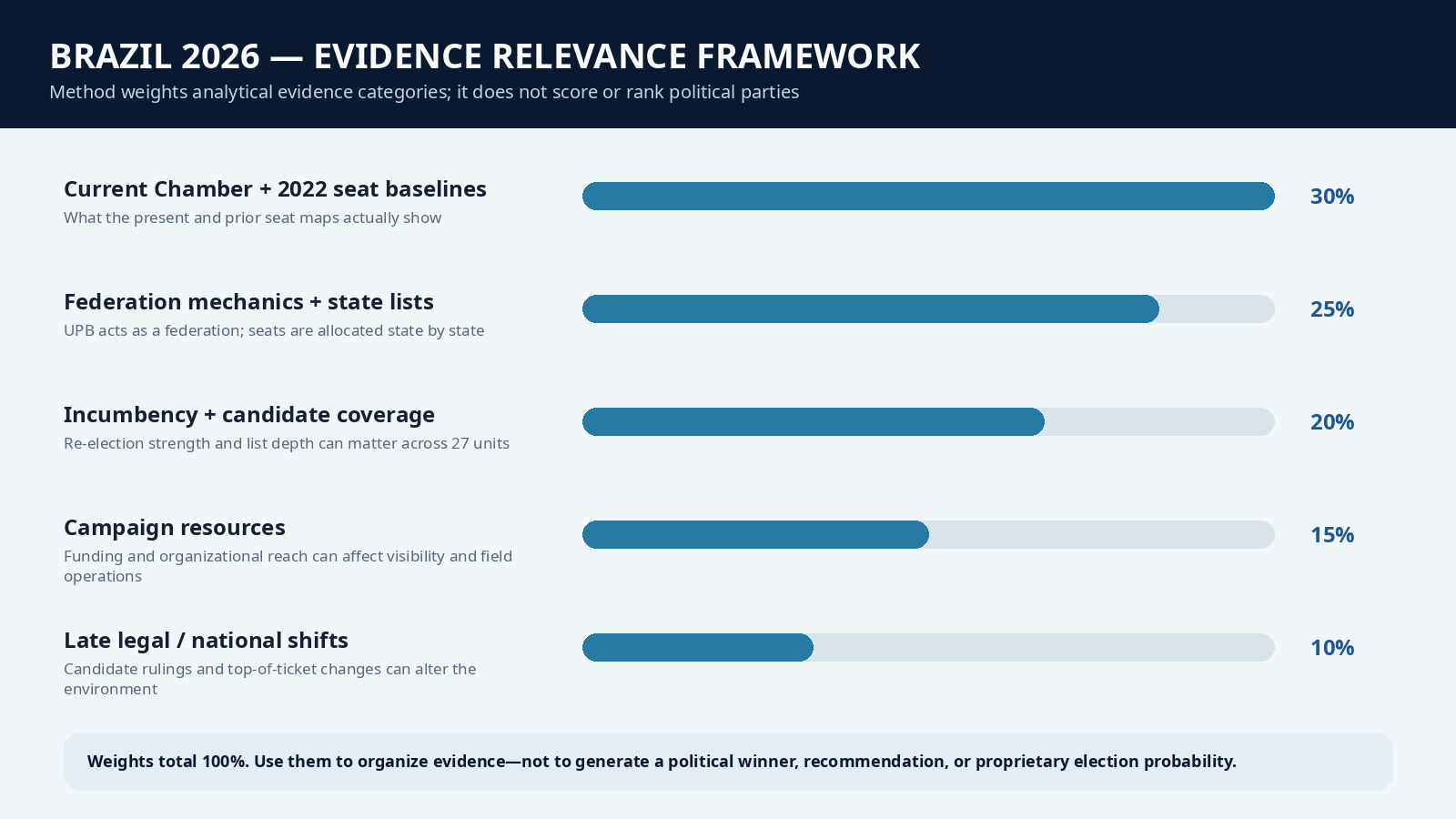
For a political election, I do not assign proprietary scores to parties or declare a criteria-specific winner. Instead, the framework below assigns relevance weights to evidence categories. The weights total 100% and help organize what deserves attention without turning the methodology into a political ranking.
| Factor | Weight | Neutral evidence by entity | Key evidence | Impact |
|---|---|---|---|---|
| Current Chamber + 2022 seat baselines | 30% | PL current 98; União 52 + PP 46; FE Brasil current 82. 2022 elected: PL 99, União 59, PP 47, FE Brasil 81. | Câmara + TSE | Shows scale and incumbency base; does not forecast 2026. |
| Federation mechanics + state lists | 25% | UPB combines União + PP as a registered federation; other federations also aggregate votes under electoral rules. | TSE federation registry + proportional-system rules | Can change vote-to-seat efficiency compared with parties running separately. |
| Incumbency + candidate coverage | 20% | Large parties and federations field broad slates across states; candidate-level strength is state-specific. | TSE candidate registry | Seat outcomes depend on district-level votes and list performance. |
| Campaign resources | 15% | Partial 2026 campaign-account data are now public; PL, PT and União are among major recipients in current reporting. | TSE partial accounts | Resources can affect visibility and organization but do not guarantee seats. |
| Late legal / national shifts | 10% | Candidate rulings, withdrawals and presidential-cycle turnout can change the environment before October 4. | TSE rulings + current reporting | Late shocks can matter, but there is no simple national-to-seat conversion. |
Topic-Specific Evidence Analysis
The proportional system makes state-level distribution decisive
Brazil does not award Chamber seats from one national winner-take-all vote. TSE states that federal deputies are chosen through proportional representation in each state and the Federal District. That means two entities can have similar national strength yet produce different seat totals depending on where votes and candidates are concentrated.
UPB changes the institutional comparison
In 2022, União and PP competed separately and elected 59 and 47 deputies respectively. In 2026, TSE has registered them together as Federação União Progressista. TSE also reported in August that its representation metric for free campaign broadcasting counted UPB 124 representatives, PL 107 and FE Brasil 89. That metric is used for campaign representation and should not be mistaken for a current Chamber seat count.
Current Chamber arithmetic is informative but not predictive
The Câmara’s current party page lists PL at 98, União at 52 and PP at 46. The two UPB component parties therefore also total 98 on that page. Party switching, federation rules, candidate recruitment and the actual October vote can all make the election result differ from today’s caucus arithmetic.
What the Market May Be Underestimating
The biggest structural risk is treating a national percentage as if it were a national popular-vote forecast. This contract resolves on seat totals. State-by-state proportional allocation, federation pooling and candidate-list performance matter more directly than a single nationwide narrative. A second risk is liquidity: PL and UPB have far more volume than the smaller outcomes, but even the leading contracts can move as orders, late polling and campaign information arrive.
Conditions That Could Strengthen or Weaken Major Outcomes
PL outcome
Evidence that would tend to support the PL contract includes stronger-than-expected PL list performance across high-seat states, successful incumbent retention and state-level vote shares that translate efficiently into seats. Evidence that would weaken the contract includes underperformance in large delegations or more efficient federation-level seat conversion elsewhere.
UPB outcome
Evidence that would tend to support the UPB contract includes effective pooling of União and PP votes under the new federation, strong incumbency retention and broad state-level candidate performance. Evidence that would weaken it includes state-level underperformance or internal candidate competition that fails to convert the federation’s broad base into the largest seat total.
Other outcomes
For FE Brasil or another listed outcome to become competitive with the two leading market prices, the observable evidence would need to show a much larger seat path than the market currently prices. That is a conditional statement about what data would have to change, not a forecast that it will or will not happen.
Risks and Uncertainties
- Candidate-status risk: regional courts continue to decide registration questions and candidacies can change before the vote.
- Seat-conversion risk: proportional formulas and state-level vote concentration can create results that differ from national narratives.
- Federation comparison risk: current Chamber counts and 2022 results are useful baselines but were produced under different organizational arrangements.
- Market-liquidity risk: displayed percentages can differ from executable prices and can move quickly.
- Resolution timing risk: Polymarket allows a long fallback window if the final result remains legally or officially unresolved.
PredictBoy Probability Assessment
Neutral-analysis note: I do not publish a proprietary winner probability for political parties in this election. The current market-implied prices are PL 61% and UPB 39.6% at the locked snapshot. My role here is to explain what those prices mean, show the documented institutional baselines and identify which evidence could change the market before official results are known.
Market Odds vs. Evidence Snapshot
| Measure | PL | UPB / components | What it means |
|---|---|---|---|
| Polymarket headline | 61% | 39.6% | Market-implied prices at the locked snapshot; not an official forecast |
| Current Chamber page | 98 | União 52 + PP 46 = 98 | Present-day caucus membership, not election result |
| 2022 elected baseline | 99 | União 59 + PP 47 = 106 | Historical component seats; UPB did not yet exist as a federation |
| 2026 TSE campaign-representation metric | 107 | 124 | Representation used for free campaign broadcasting, not Chamber seat count |
The four rows measure different things. They should not be collapsed into one homemade probability. Their value is in showing why the market question is genuinely about seat conversion rather than one national polling number.
What Could Change Before Resolution
- Final candidate-registration and legal rulings across the states.
- Partial and final campaign-finance disclosures from TSE.
- State-level polling or reporting focused on federal-deputy lists rather than only the presidential race.
- Late party/federation withdrawals or candidate substitutions.
- The official October 4 seat count and any subsequent recount or court decision affecting mandates.
Final Take
PredictBoy analysis — informational, not a political recommendation: Polymarket currently prices PL above UPB, but the factual baselines show why certainty would be misplaced. The current Chamber page has PL at 98 members and the two UPB component parties at 98 combined, while the 2022 election produced PL 99, União 59 and PP 47 before UPB existed as a federation. The decisive information will be the October 4 proportional seat allocation and, if needed, the official TSE or Câmara result. Readers should treat the market price as a trading signal about expectations, not as a substitute for the election result.
Sources
- Polymarket — Brazil Chamber of Deputies Election Winner
- TSE — Eleições 2026 overview
- TSE — Federação União Progressista
- TSE — 2026 party/federation representation for free campaign broadcasting
- Câmara dos Deputados — current party caucuses
- TSE — 2022 elected-party/federation baseline
- TSE — partial 2026 campaign accounts
Disclosure: Market prices can change after this snapshot. This article separates official facts and market-implied prices from analytical context. It does not endorse a party, recommend a vote, or provide financial advice.