

What Price Will Lighter Hit in 2026? Polymarket Odds, Rules & PredictBoy Analysis
What Price Will Lighter Hit in 2026? Polymarket Odds, Rules & PredictBoy Analysis
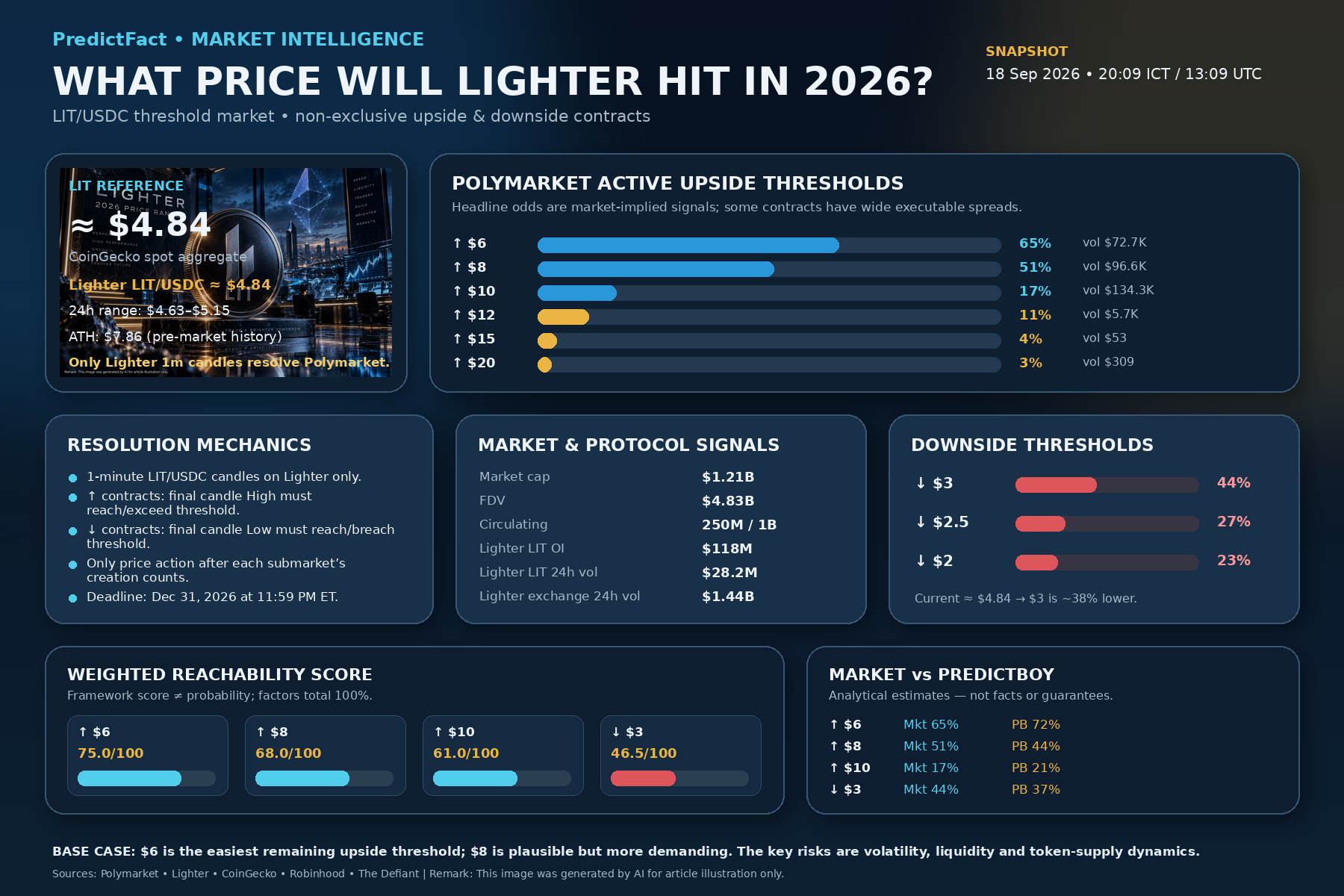
By PredictBoy — Lighter’s LIT token is trading around the mid-$4s, but this Polymarket event is not asking for a year-end close. It is a ladder of non-exclusive threshold contracts that can resolve Yes whenever a qualifying Lighter LIT/USDC one-minute candle prints a final High or Low beyond the specified level before the deadline.
That distinction matters. A brief one-minute spike can resolve an upside contract even if the price immediately reverses, and several thresholds can resolve Yes in the same year. The same is true on the downside. Market prices therefore represent the crowd’s view of touch probability, not a forecast of where LIT will finish 2026.
What This Polymarket Market Asks
The umbrella event tracks multiple price levels for Lighter (LIT). At this snapshot, the most relevant unresolved upside levels are $6, $8, $10, $12, $15 and $20, while the visible downside contracts are $3, $2.50 and $2.
These outcomes are not mutually exclusive. If LIT trades to $10 on the qualifying Lighter pair after the relevant submarkets were created, the $6, $8 and $10 upside contracts can all resolve Yes. Likewise, a later selloff could also trigger one or more downside contracts.
Resolution Rules and What Counts
- Official resolution venue: Lighter’s own LIT/USDC market.
- Timeframe: the chart must be set to 1m one-minute candles.
- Upside contracts: a candle’s final High must equal or exceed the listed threshold.
- Downside contracts: a candle’s final Low must equal or fall below the listed threshold.
- Deadline: qualifying price action runs through 11:59 PM ET on December 31, 2026.
- Other venues do not count: prices from other exchanges, pairs or spot markets are excluded from resolution.
- Creation-time rule: price action before a particular submarket’s creation does not count, which is important when comparing Polymarket with external all-time-high data.
Current Market Snapshot
Research timestamp: 2026-09-18 20:09 ICT (2026-09-18 13:09 UTC). Market prices and executable order-book quotes may have changed since this snapshot.
| Contract | Polymarket | Submarket Volume | Approx. move from $4.84 |
|---|---|---|---|
| ↑ $6 | 65% | $72.7K | +24% |
| ↑ $8 | 51% | $96.6K | +65% |
| ↑ $10 | 17% | $134.3K | +107% |
| ↑ $12 | 11% | $5.7K | +148% |
| ↑ $15 | 4% | $53 | +210% |
| ↑ $20 | 3% | $309 | +313% |
| ↓ $3 | 44% | $1.45K | -38% |
| ↓ $2.50 | 27% | $544 | -48% |
| ↓ $2 | 23% | $231 | -59% |
The event shows roughly $838K total volume, but liquidity is uneven. The $10 upside contract has far more activity than the extreme $15 and $20 contracts, and the displayed headline percentage can differ materially from the current buy/sell quote. Treat the headline odds as a market signal, not a guaranteed executable probability.
Main Outcomes
↑ $6 — the nearest major upside hurdle
From about $4.84, $6 requires roughly a 24% rally. LIT has already shown that this magnitude of move is possible over short windows: CoinGecko shows a 24-hour range reaching $5.15 and a 30-day gain of more than 100% at this snapshot. The challenge is not whether LIT can move quickly; it is whether the move reaches $6 on the exact Lighter one-minute feed after the relevant contract’s creation.
↑ $8 — a retest of the historical peak zone and then some
CoinGecko lists LIT’s all-time high at $7.86 on December 30, 2025. That historical fact does not itself settle the Polymarket contract because the market only counts post-creation Lighter price action. Still, it shows that $8 is near a previously traded valuation zone rather than an entirely unprecedented level.
↑ $10 and above — re-rating territory
At a 1 billion token total supply, $10 corresponds to roughly a $10 billion fully diluted valuation. That is more than double the current roughly $4.8 billion FDV. A move through $10 would likely need a combination of strong crypto beta, continued protocol adoption, sustained token demand and favorable supply dynamics.
↓ $3 and below — the downside tail
A fall to $3 would be about 38% below the current reference price. Crypto assets can make that move quickly during broad market stress, token-specific liquidity shocks or large supply overhangs. The downside contracts have relatively small submarket volumes, however, so their displayed probabilities deserve extra liquidity caution.
Key Factors
Primary factors
- Distance to threshold and recent momentum: $6 is much closer than $8 or $10, while $3 is the nearest downside level.
- LIT/USDC liquidity and leverage: CoinGecko’s Lighter exchange page shows roughly $118M of LIT perpetual open interest and about $28.2M of LIT 24-hour volume.
- Protocol adoption: Lighter reports a high-performance ZK-rollup exchange design, while CoinGecko shows about $1.44B in exchange 24-hour volume and about $1.19B in exchange open interest.
- Token economics: only about 250M of a 1B total supply is currently circulating, which makes future supply timing important even before considering the protocol’s buyback and staking mechanisms.
Secondary factors
- Broader crypto-market direction and Bitcoin-led risk appetite.
- Robinhood Wallet distribution, where eligible users can access Lighter perpetuals and an 11M LIT community incentive pool.
- Execution quality and volatility on Lighter itself, because only that venue resolves Polymarket.
- Submarket liquidity: very thin threshold markets can show headline odds far from executable prices.
Weighted Outcome Comparison
I use a five-factor reachability framework. Each outcome gets a 1–10 score on the same factors; the weighted total is a comparative score out of 100, not a probability.
| Factor | Weight | ↑ $6 | ↑ $8 | ↑ $10 | ↓ $3 | Key Evidence | Impact |
|---|---|---|---|---|---|---|---|
| Price distance & momentum | 25% | 8 | 6 | 4 | 4 | $4.84 current reference; 24h high $5.15; 30d performance strongly positive. | Favors nearer upside thresholds. |
| Lighter liquidity / OI | 20% | 8 | 7 | 6 | 5 | LIT perp OI ≈ $118M; 24h LIT volume ≈ $28.2M. | Supports sharp moves but also leverage-driven reversals. |
| Protocol adoption / activity | 20% | 8 | 8 | 8 | 3 | Lighter exchange ≈ $1.44B 24h volume; Robinhood integration broadens distribution. | Structural support for upside re-rating. |
| Tokenomics & supply | 20% | 7 | 7 | 7 | 5 | 250M circulating vs 1B total; staking/buybacks support demand but supply timing matters. | Two-sided: scarcity mechanisms vs dilution sensitivity. |
| Crypto beta / event risk | 15% | 6 | 6 | 6 | 7 | LIT remains a volatile crypto asset exposed to broad risk appetite. | Raises both upside and downside tails. |
| Weighted total | 100% | 75.0 | 68.0 | 61.0 | 46.5 | Comparative reachability score. | $6 leads the framework. |
The framework gives $6 the clearest advantage because it combines the shortest price distance with strong venue activity. $8 remains plausible but needs a materially larger move. $10 requires a deeper valuation re-rating, while $3 is a separate downside path driven more by crypto risk than protocol growth.

Topic-Specific Evidence Analysis
Price and valuation context
CoinGecko shows LIT near $4.84, with a market capitalization around $1.21B, fully diluted valuation around $4.83B, 250M circulating tokens and 1B total supply. The token is up roughly 6.8% over seven days and more than 100% over 30 days in the captured snapshot, evidence of strong recent momentum but also elevated volatility.
Lighter’s trading activity is substantial
CoinGecko’s derivative-exchange page reports roughly $1.44B in Lighter 24-hour trading volume and roughly $1.19B of open interest across the venue. For LIT_USDC specifically, it shows about $118M of open interest and about $28.2M in 24-hour volume. That depth makes fast threshold touches more plausible than they would be in an illiquid micro-cap token, while leverage can also accelerate liquidations in both directions.
Protocol adoption and distribution
Lighter describes itself as an Ethereum-anchored zero-knowledge rollup built for verifiable order matching and liquidations. Robinhood announced that eligible users can access Lighter perpetual futures from Robinhood Wallet and that Lighter committed 11 million LIT to the Robinhood community. That integration expands distribution and can support attention, volume and token demand.
Staking and buybacks help, but circulating supply is only 25% of total
Secondary reporting that cites Lighter’s documentation describes a fixed 6% staking APR and daily TWAP buybacks funded by trading-fee revenue. Those mechanisms can support holding demand. The counterweight is that CoinGecko shows only 250M of 1B tokens circulating, so future emission timing remains a material valuation sensitivity. I treat the broad dilution risk as real but do not assume a specific unlock date unless confirmed by a primary source.
What the Market May Be Underestimating
The first underappreciated feature is path dependency. These markets care about one-minute highs and lows, not the December 31 close. A fast wick can settle a threshold even if the move fails immediately. That generally makes touch contracts more likely than a naive end-of-year price target.
The second is venue-specific basis. An $8 print on a centralized exchange would not settle the $8 Polymarket contract unless the qualifying Lighter LIT/USDC one-minute candle also reaches the level. During volatility, basis and order-book differences can matter.
The third is liquidity quality. A displayed 51% on the $8 market does not necessarily mean a trader can buy or sell at 51¢. Some threshold contracts show wide spreads and tiny volume, especially at $15, $20 and the deeper downside levels.
Bull/Bear Case for Major Outcomes
Bull case for $8–$10+
LIT keeps its strong momentum, Lighter sustains billion-dollar daily venue volume, Robinhood distribution attracts more users, staking reduces liquid float, buybacks reinforce scarcity and the broader crypto market turns risk-on. In that scenario, a brief one-minute spike through $8 is plausible, and $10 becomes a credible extension rather than a base case.
Bear case for $3 or lower
Broad crypto risk appetite weakens, leveraged open interest unwinds, token supply concerns rise, or Lighter-specific growth disappoints. Because the contract only needs a one-minute Low, a liquidation cascade can settle the downside market even if LIT later recovers.
Risks and Uncertainties
- Non-exclusive outcomes: several upside and downside contracts can resolve Yes in the same year.
- Submarket start times differ: historical external prices may not count.
- Execution spreads: headline percentages are not guaranteed trade prices.
- Venue specificity: only the Lighter LIT/USDC one-minute feed resolves the market.
- Token supply uncertainty: circulating supply is only one quarter of total supply.
- Crypto volatility: leveraged markets can overshoot both upside and downside thresholds.
PredictBoy Probability Assessment
PredictBoy analysis, not fact: because the thresholds are non-exclusive, these probabilities are not supposed to sum to 100%.
| Threshold | PredictBoy estimate | Reasoning |
|---|---|---|
| ↑ $6 | 72% | Only ~24% above the current reference; strong venue activity and recent momentum. |
| ↑ $8 | 44% | Requires ~65% upside; historical peak zone is nearby but does not count automatically. |
| ↑ $10 | 21% | Needs ~107% upside and roughly a $10B FDV touch. |
| ↑ $12 | 10% | Requires a much larger speculative re-rating. |
| ↑ $15 | 4% | Extreme upside tail. |
| ↑ $20 | 2% | Very large re-rating and thin contract liquidity. |
| ↓ $3 | 37% | A ~38% drawdown is meaningful but plausible for a volatile crypto asset. |
| ↓ $2.50 | 25% | Requires ~48% downside. |
| ↓ $2 | 16% | Deep downside tail, usually needing broad or token-specific stress. |
Market Odds vs. PredictBoy
| Threshold | Polymarket | PredictBoy | Difference |
|---|---|---|---|
| ↑ $6 | 65% | 72% | +7 pp |
| ↑ $8 | 51% | 44% | -7 pp |
| ↑ $10 | 17% | 21% | +4 pp |
| ↑ $12 | 11% | 10% | -1 pp |
| ↑ $15 | 4% | 4% | 0 pp |
| ↑ $20 | 3% | 2% | -1 pp |
| ↓ $3 | 44% | 37% | -7 pp |
| ↓ $2.50 | 27% | 25% | -2 pp |
| ↓ $2 | 23% | 16% | -7 pp |
My largest differences are at $6, $8 and the deeper downside contracts. I am somewhat more constructive on a $6 touch than the market, less constructive on an $8 touch, and less bearish on the $3/$2 downside ladder. These are analytical estimates, not trading instructions.
What Could Change Before Resolution
- A sustained move in LIT above the recent $5 area, especially with rising Lighter volume and open interest.
- Major changes in Lighter’s staking, buyback, fee or token-distribution mechanics.
- Robinhood Wallet adoption and the pace at which the LIT incentive pool attracts new flow.
- A broad crypto bull or bear regime driven by Bitcoin, liquidity or macro conditions.
- A sudden leveraged liquidation event on Lighter that produces a one-minute wick through a threshold.
Final Take
PredictBoy analysis: the cleanest remaining setup is the $6 upside threshold. From roughly $4.84 it needs only about a 24% move, and Lighter currently has enough activity and LIT-specific open interest to make that kind of touch credible. $8 is plausible but demands a much larger re-rating, while $10 and above remain tail scenarios. On the downside, $3 is a meaningful risk but not my base case. The most important rule is simple: only the Lighter LIT/USDC one-minute candle counts, and a momentary High or Low can settle a contract even if the price later reverses.
Sources
- Polymarket — What price will Lighter hit in 2026?
- Lighter — LIT/USDC trading pair
- Lighter — official protocol site
- Lighter Docs — protocol architecture and trading documentation
- CoinGecko — Lighter price, supply, market cap and FDV
- CoinGecko — Lighter exchange volume, OI and LIT_USDC market data
- Robinhood Newsroom — Lighter perpetuals integration and 11M LIT community pool
- The Defiant — Lighter activity, revenue, buyback and staking context
Disclosure: This is analytical information, not financial advice. Crypto tokens and prediction markets are volatile and can produce rapid losses. Market-implied probabilities are not guarantees. Affiliate links may generate revenue for PredictFact without changing the analytical standard.