

Bank of England Decision in November 2026: Polymarket Odds & Analysis
Bank of England Decision in November 2026: Polymarket Odds, Inflation Risks and PredictBoy Analysis
By PredictBoy — The Bank of England’s November meeting has changed from a routine hold debate into a live question about whether the MPC needs to respond to a renewed energy-driven inflation shock. Polymarket currently gives a 25-basis-point increase a clear lead, but the decision is not one-dimensional: inflation is above target and expected to rise, while the labour market remains soft and evidence of a broad wage-price spiral is still limited.
This article separates verified data, Polymarket-implied probabilities, analytical assumptions and my own interpretation. Market prices are not guarantees, and this is analysis rather than financial advice.
What This Polymarket Market Asks
The event asks how much the Bank of England will change Bank Rate at the MPC meeting scheduled for 5 November 2026, compared with the rate immediately before that meeting. The current Bank Rate is 3.75%.
The displayed outcomes are 25 bps increase, no change, 50+ bps increase, 25 bps decrease and 50+ bps decrease. These are mutually exclusive meeting outcomes, unlike threshold markets where several contracts can resolve Yes.
Resolution Rules and What Counts
- Primary source: official information from the Bank of England, including the November MPC statement or release.
- Scheduled decision: 5 November 2026.
- Reference: the change in Bank Rate relative to its pre-meeting level.
- Rounding: a move smaller than 25 bps is treated as 25 bps; larger non-standard moves are rounded to the nearest 25 bps, away from zero when exactly equidistant.
- Postponement: if the meeting is postponed but occurs before the next scheduled meeting, the postponed decision controls resolution.
- Cancellation / excessive delay: if no decision is announced before the next scheduled meeting begins, the market resolves to No change.
- Emergency moves: changes outside the specified November MPC meeting are explicitly excluded.
Current Market Snapshot
Research timestamp: 2026-09-18 20:09 ICT (2026-09-18 13:09 UTC). Prices and executable order-book quotes can change after this snapshot.
| Outcome | Polymarket implied probability | Submarket volume | Interpretation |
|---|---|---|---|
| 25 bps increase | 71% | $38,193 | Current market favorite |
| No change | 29% | $34,708 | Main alternative |
| 50+ bps increase | <1% | $11,621 | Large-hike tail |
| 25 bps decrease | <1% | $8,451 | Cut tail |
| 50+ bps decrease | <1% | $6,196 | Deep-cut tail |
Total event volume is about $99,064. The 25 bp increase versus hold pair carries nearly all of the useful signal. The tail contracts trade below 1%, so their prices should be treated cautiously, especially where spreads are wide.
Main Outcomes
25 bps increase — the market favorite
A quarter-point hike would take Bank Rate from 3.75% to 4.00%. The case is straightforward: August CPI rose to 3.1%, energy prices have moved sharply higher, the Bank now expects CPI around 3¾% in 2026 Q4 and slightly above 4% in 2027 Q1, and three MPC members already voted for 4.00% in September. A November hike would therefore be an extension of an existing hawkish minority rather than a completely new policy direction.
No change — still a credible alternative
A hold would keep Bank Rate at 3.75%. The case for patience rests on the source of inflation and the domestic transmission mechanism. The Bank itself said there was limited evidence so far of broad second-round effects. Regular pay growth has slowed to 3.5%, unemployment is 4.9%, payroll employment is falling, and the energy shock can also depress household real income and demand. If October data show that domestic inflation persistence remains contained, the majority could wait for more evidence.
Large hike or cuts — tail scenarios
A 50+ bp hike would require a much more urgent inflation deterioration than is visible today. A cut would require a very sharp shift toward growth or financial-stability concerns, or a rapid collapse in the inflation outlook. Neither tail is impossible, but current evidence does not make either the central scenario.
Key Factors
Primary factors
- Energy and headline inflation: the Middle East conflict has pushed energy prices materially higher, lifting the near-term CPI path.
- MPC reaction function: September’s 6–3 vote matters because three members already preferred a hike.
- October CPI release: the 21 October inflation report is the last full CPI print before the meeting.
Secondary factors
- Labour market: unemployment at 4.9%, weaker payroll employment and slower private-sector pay reduce the case for aggressive tightening.
- Growth: July GDP rose 0.4% month on month and retail sales rose 0.5% in August, showing more resilience than expected.
- Fiscal backdrop: the 28 October UK Budget arrives just before the MPC decision and can alter demand, borrowing-cost and inflation expectations.
- Geopolitics and energy: any easing or escalation in the conflict can move the inflation path quickly.
Weighted Outcome Comparison
| Factor | Weight | 25 bp hike score | Hold score | Key evidence / impact |
|---|---|---|---|---|
| Energy & inflation path | 30% | 90/100 | 35/100 | CPI 3.1%; BoE sees ~3.75% Q4 and slightly >4% in 2027 Q1. |
| MPC vote & guidance | 25% | 85/100 | 45/100 | September vote 6–3 hold; three members already preferred a 25 bp hike. |
| Labour & wage pressure | 15% | 45/100 | 80/100 | Unemployment 4.9%; regular earnings 3.5%; payroll employment soft. |
| Growth & demand | 15% | 65/100 | 60/100 | July GDP +0.4%; retail sales +0.5%, but energy shock can squeeze demand. |
| October data / event risk | 15% | 70/100 | 55/100 | Oct labour, CPI, Budget and energy prices can move the decision. |
The weighted totals are 75.2/100 for a 25 bp increase and 51.0/100 for no change. These are evidence-alignment scores, not calibrated probabilities. The gap comes mainly from the new inflation path and the September vote split; labour-market softness is the strongest counterweight.

UK Inflation, Labour Market and Growth Evidence
Inflation has re-accelerated
ONS reported CPI inflation of 3.1% in August, up from 2.9% in July. Core CPI was 2.6% and services CPI 3.4%, both unchanged from July, which shows the key tension: headline inflation has risen, but the broadest measures of domestic persistence have not accelerated at the same pace.
The Bank’s September minutes estimate CPI around 3¾% in 2026 Q4 and slightly above 4% in 2027 Q1, almost entirely because of oil and gas prices. That is materially above the 2% target and gives the hawkish bloc a strong argument for pre-emptive action.
The labour market is softer than the inflation headline
Unemployment was 4.9% in May–July. Regular earnings growth was 3.5%, total pay growth 3.9%, and the early August estimate showed payrolled employees down 26,000 on the month. Reuters also reported vacancies at about 702,000, the lowest outside the pandemic period since 2014. Those numbers make a wage-price spiral less obvious than the energy-driven CPI path alone would suggest.
Activity has been firmer than expected
July GDP rose 0.4% month on month and was 1.6% higher than a year earlier. August retail sales volumes rose 0.5% from July, beating expectations. Resilience in activity makes a modest hike easier to justify, but persistent high energy prices could later squeeze consumption and reverse that resilience.
What the Market May Be Underestimating
The market may be underestimating how quickly the debate can swing if energy prices fall. A large share of the Bank’s inflation revision is mechanical and energy-related. If geopolitical tension eases and wholesale prices retrace before the November forecast round, the case for immediate tightening becomes less compelling.
Conversely, the market may also be underestimating the significance of the September dissent. Three of nine members already wanted a 25 bp hike. It only takes two members of the September majority to change sides for a hike to win. The October CPI release and evidence on inflation expectations could therefore have disproportionate importance.
Case for a 25 bp Hike vs. Case for No Change
| 25 bp hike case | No-change case |
|---|---|
|
|
Risks and Uncertainties
- Geopolitical energy risk: the path of oil and gas can move the inflation forecast before November.
- October data risk: labour data on 20 October and CPI on 21 October can materially change the balance.
- Budget risk: fiscal measures announced on 28 October may alter the demand and inflation outlook.
- MPC communication risk: individual speeches can reveal whether the September 6–3 split is shifting.
- Market microstructure: Polymarket headline probabilities can differ from executable bid/ask prices.
- Resolution mechanics: emergency rate changes outside the meeting do not count for this contract.
PredictBoy Probability Assessment
PredictBoy analysis, not fact: I estimate a 68% probability of a 25 bp increase, 31% for no change, and about 1% combined across the tail outcomes. My distribution is slightly less hawkish than Polymarket because I give more weight to the weak labour market and to the possibility that the Bank waits for evidence of second-round inflation rather than reacting mechanically to energy.
Market Odds vs. PredictBoy
| Outcome | Polymarket | PredictBoy | Difference |
|---|---|---|---|
| 25 bp increase | 71% | 68% | PredictBoy -3 pp |
| No change | 29% | 31% | PredictBoy +2 pp |
| All tail outcomes | <1% each | 1% combined | Low-probability tails |
The market and my framework agree on the ordering: a quarter-point hike is the base case, a hold is the meaningful alternative, and larger moves or cuts are remote. The disagreement is about confidence, not direction.
What Could Change Before Resolution
- 20 October: UK labour-market data.
- 21 October: September CPI and producer-price data.
- 28 October: UK Budget and fiscal assumptions.
- Late October: energy-price path, inflation expectations and MPC communication.
- 5 November: MPC statement and Monetary Policy Report — the official resolution event.
A softer CPI print combined with further labour-market deterioration would shift weight toward a hold. Persistent energy inflation, rising inflation expectations or signs of broader pass-through would strengthen the hike case.
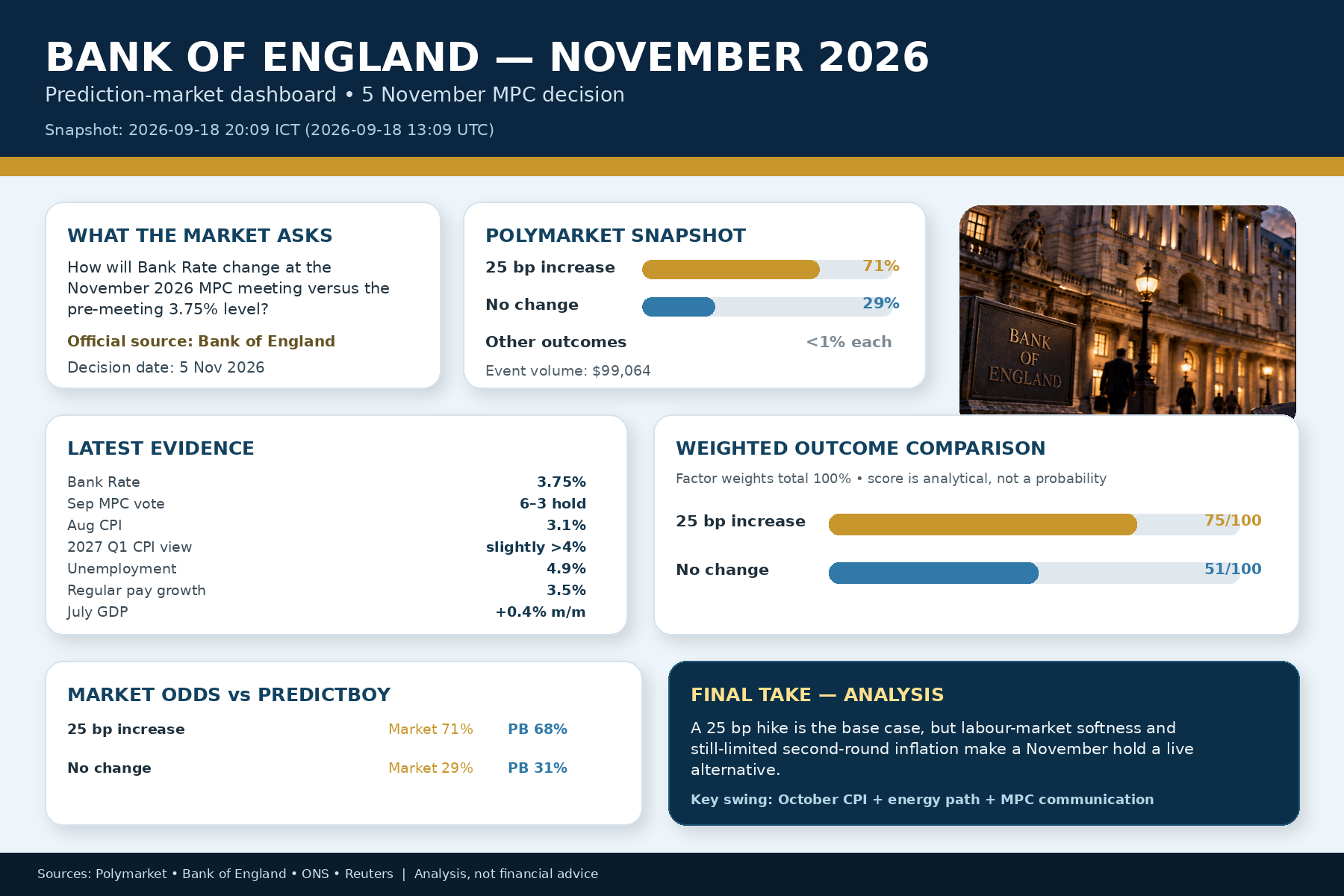
Final Take
PredictBoy analysis: the November decision is now a genuine live hike-versus-hold contest. The 25 bp hike has the stronger evidence set because inflation has been revised higher and three MPC members are already voting for it. But the soft labour market and limited second-round effects mean a hold remains too plausible to treat the market’s 71% as certainty. The October inflation report and energy path are the highest-leverage variables between now and 5 November.
Sources
- Polymarket — Bank of England decision in November?
- Bank of England — September 2026 Monetary Policy Summary and Minutes
- Bank of England — Upcoming MPC dates
- ONS — Consumer price inflation, August 2026
- ONS — Labour market overview, September 2026
- ONS — GDP monthly estimate, July 2026
- Reuters reporting, 8–18 September 2026, on Bank Rate expectations, retail sales and bank forecasts.
Disclosure: Prediction-market prices are volatile and are not guaranteed real-world probabilities. This article is for analytical and informational purposes and is not financial advice.