

Natural Disaster in 2026? Polymarket Odds, Rules & PredictBoy Analysis
Natural Disaster in 2026? Polymarket Odds, Rules & PredictBoy Analysis
By PredictBoy — This Polymarket market is narrower than its title sounds. It does not resolve Yes for just any destructive storm, flood, wildfire or earthquake. It resolves Yes only if at least one of four extreme thresholds is met during 2026 ET: a Category 5 hurricane landfall in the United States, a natural meteor/bolide event of at least 10 kilotons, a volcanic eruption of VEI 6 or higher, or an earthquake of magnitude 8.5 or higher.
That means the right way to read the market is as a four-channel tail-risk basket. The current market price is a trading signal, not a guaranteed real-world probability, and each channel has different monitoring agencies, reporting delays and physical dynamics.
What This Polymarket Market Asks
The question is binary: will at least one of the four qualifying natural-disaster triggers occur during calendar 2026 Eastern Time? A single qualifying event is enough for Yes. If none occurs, the market resolves No.
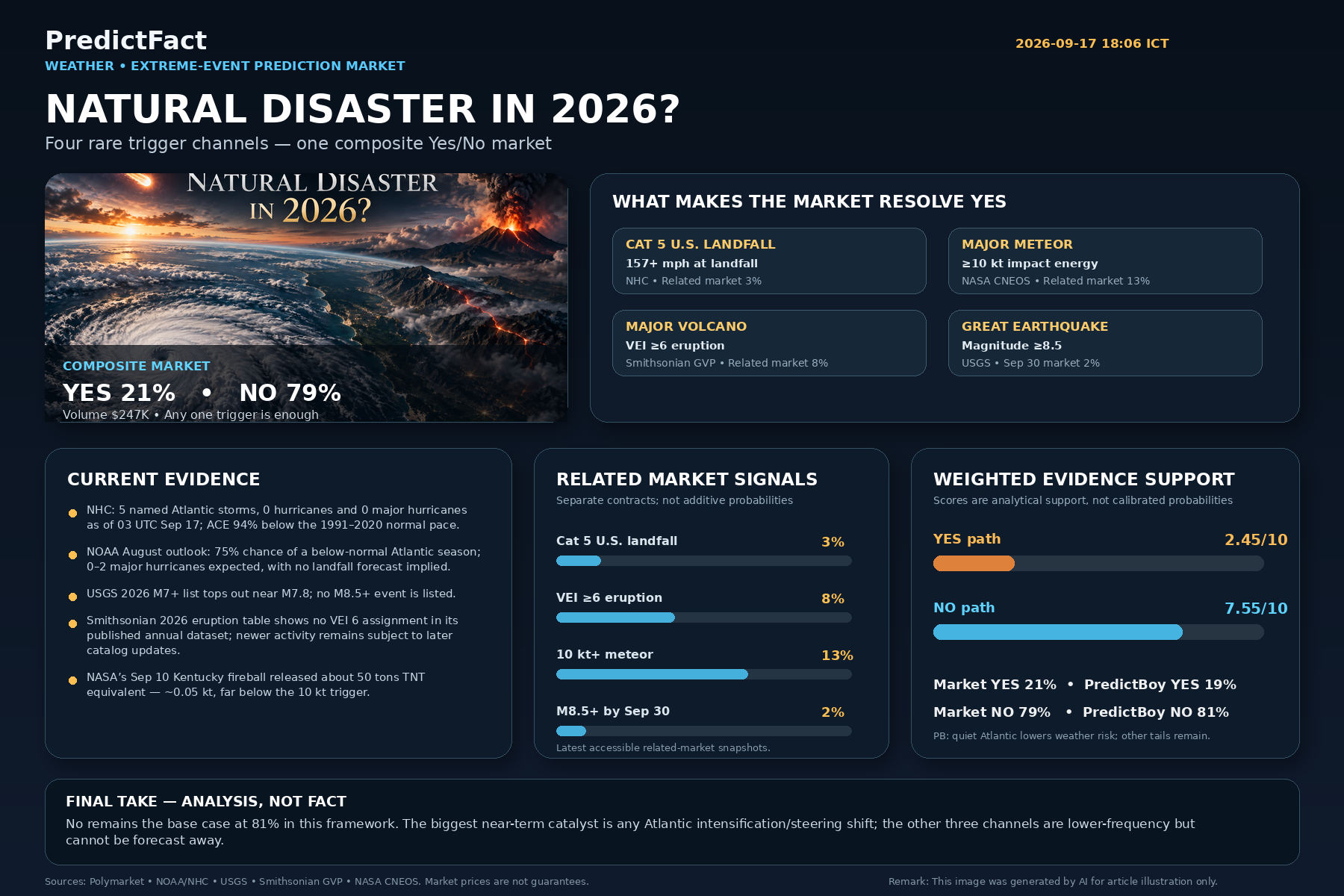
At the research snapshot, Polymarket’s current Weather page displayed the composite market at roughly 21% Yes / 79% No with about $247K total volume. The dedicated event page had older cached snapshots around 13–14%, so this article locks the newer 21% Weather-page value and states the timestamp explicitly.
Resolution Rules and What Counts
- Category 5 U.S. hurricane landfall: a storm must make landfall in the conterminous United States at Category 5 strength. The related contract defines Category 5 as maximum sustained winds of 157 mph or higher and relies on National Hurricane Center advisories.
- Major meteor strike: a natural meteoroid/bolide must produce calculated total impact energy of at least 10 kilotons TNT equivalent. NASA JPL CNEOS Fireball and Bolide data are the primary reference for the related market.
- Major volcano: a natural eruption must reach VEI 6 or higher. The related market uses the Smithsonian Global Volcanism Program as its primary source, with a later finalized annual data check.
- Great earthquake: an earthquake must reach magnitude 8.5 or higher; USGS reporting is the relevant scientific reference.
- Deadline: the event must occur during 2026 ET. If required source information remains outstanding, Polymarket says the market may remain open until February 28, 2027 at 11:59 PM ET.
Current Market Snapshot
Research timestamp: 2026-09-17 18:06 ICT (2026-09-17 11:06 UTC). Market prices may have changed since this snapshot.
| Signal | Snapshot | What it means |
|---|---|---|
| Composite market | Yes 21% / No 79% | Trader-implied price signal for at least one qualifying event by year-end. |
| Category 5 U.S. landfall | 3% related market | A very low hurricane-channel price after an exceptionally quiet Atlantic season so far. |
| VEI ≥6 eruption | 8% related market | Separate market for the volcanic trigger; not additive to the composite price. |
| 10 kt+ meteor | 13% related market | Separate market; CNEOS data can lag and do not report every fireball in real time. |
| M8.5+ earthquake by Sep 30 | 2% related short-dated market | Only a near-term reference, not a full-year 8.5+ probability. |
The related contracts are useful context, but they are separate markets with different liquidity, deadlines and rule wording. Their percentages should not be added together.
Main Outcomes
No qualifying event by year-end
This is the current market favorite and my base case. It is supported by the exceptionally quiet Atlantic season to date, the absence of any M8.5+ earthquake in the 2026 USGS list, no published VEI 6 assignment in the current Smithsonian annual table, and no observed 10 kt+ bolide in the cited NASA material.
At least one qualifying event
The Yes case is a tail-risk basket. It does not require several things to go wrong — only one. That makes the remaining risk more resilient than any single-channel forecast. Earthquakes, major eruptions and meteoroid airbursts are especially hard to time, while late-season tropical cyclone risk can change quickly if steering and shear patterns shift.
Key Factors
Primary factors
- The remaining Atlantic hurricane season and whether any system can both reach Category 5 intensity and make U.S. landfall at that strength.
- The irreducible global tail probability of an M8.5+ earthquake.
- Whether any volcanic system escalates to VEI 6 before year-end.
- The probability of an unanticipated 10 kt+ natural bolide and the lag in public fireball reporting.
Secondary factors
- Source-update timing and the market’s permission to remain open into February 2027 if evidence is incomplete.
- Differences between live scientific observations and later finalized catalogs, especially volcanic and fireball databases.
- Liquidity and stale prices in the related individual trigger markets.

Weighted Outcome Comparison
| Factor | Weight | Yes score | No score | Key evidence | Impact |
|---|---|---|---|---|---|
| Category 5 U.S. landfall risk | 30% | 1.5/10 | 8.5/10 | NHC lists 5 named storms, 0 hurricanes and 0 major hurricanes as of Sep 17; NOAA gives a 75% chance of a below-normal season. | Strongest current support for No, while acknowledging late-season tail risk. |
| M8.5+ earthquake tail | 25% | 2.5/10 | 7.5/10 | USGS 2026 M7+ list tops out around M7.8; no M8.5+ event is listed. | Supports No, but timing remains fundamentally unpredictable. |
| VEI ≥6 eruption tail | 20% | 2.5/10 | 7.5/10 | Smithsonian’s published 2026 annual table has no VEI 6 assignment; more recent activity is subject to later catalog updates. | Moderate support for No with database-lag uncertainty. |
| 10 kt+ meteor/bolide tail | 15% | 3.5/10 | 6.5/10 | NASA recent fireballs cited here are far below the threshold, while CNEOS explicitly notes that data are not real-time and not all fireballs are reported. | Residual Yes risk remains because detection/reporting is incomplete. |
| Resolution / reporting lag | 10% | 3.5/10 | 6.5/10 | Polymarket may keep the composite open through Feb 28, 2027 if source data are incomplete. | Raises uncertainty around timing of confirmation, not the physical event itself. |
The weighted totals are Yes support 2.45/10 and No support 7.55/10. These are transparent evidence scores, not a mechanical probability converter.
Topic-Specific Evidence Analysis
Hurricane channel: currently the weakest trigger
NOAA’s August update gives a 75% chance of a below-normal Atlantic season, with 7–13 named storms, 2–6 hurricanes and 0–2 major hurricanes expected. The National Hurricane Center’s Sep 17 season summary shows only five named storms, no hurricanes, no major hurricanes and ACE running 94% below the 1991–2020 normal pace. NOAA also stresses that seasonal outlooks are not landfall forecasts, so this cannot reduce the U.S. Category 5 path to zero.
Earthquake channel: low-frequency, hard to forecast
The USGS 2026 list of M7+ earthquakes contains no M8.5+ event; the largest listed event is about M7.8 near Ende, Indonesia. Large-earthquake timing is not forecastable in the same way as a hurricane track, so the absence of a precursor signal should not be treated as proof that the remaining-year risk is negligible.
Volcano channel: no qualifying event in the published annual table
The Smithsonian Global Volcanism Program’s 2026 eruption page currently shows no VEI 6 assignment in its published annual table and directs readers to weekly reports for newer activity. The related Polymarket market explicitly waits for a later finalized Smithsonian update, which makes catalog timing part of the resolution process.
Meteor channel: small observed events do not eliminate tail risk
NASA’s Sep 10 Kentucky fireball was estimated at roughly 50 tons of TNT equivalent — about 0.05 kt, far below the market’s 10 kt threshold. NASA also states that CNEOS fireball data are not real-time and not all fireballs are reported, which is why this channel retains an information-lag component.
What the Market May Be Underestimating
The most obvious candidate is data-lag and tail dependence. The composite price can look low when each individual trigger appears unlikely, but the market only needs one extreme outlier. Some trigger datasets are updated after the event, and several hazards are not usefully forecastable months in advance. That does not make Yes the base case, but it makes a single-point confidence statement less secure than the 79% No price may feel.
Bull/Bear Case for Major Outcomes
Yes case
A late-season Atlantic storm rapidly intensifies and reaches the U.S. at Category 5 strength, or an unforecastable geophysical/meteoroid event crosses the threshold. The meteor and volcano related markets also show that traders assign non-trivial single-channel tail prices.
No case
The unusually quiet Atlantic season stays suppressed, no M8.5+ quake occurs, no eruption reaches VEI 6, and no 10 kt+ bolide is recorded for 2026. With more than eight months already elapsed, the remaining calendar window is much shorter than the original one-year exposure.
Risks and Uncertainties
- Prediction-market prices can be thin or stale, especially in smaller related markets.
- Scientific catalogs can be revised after initial reporting.
- Earthquakes, major eruptions and bolides have weak short-term predictability compared with weather systems.
- The composite PDF could contain source-specific edge cases not visible in the HTML rule text; its endpoint was inaccessible in this environment.
- A qualifying event can happen suddenly and reprice the market to near certainty before most readers can react.
PredictBoy Probability Assessment
PredictBoy analysis, not fact: I estimate 19% Yes / 81% No at this snapshot. My No probability is slightly above the market’s 79% because the hurricane channel — the only one with a meaningful seasonal weather forecast — has weakened materially in 2026. I still keep a substantial Yes tail because the other three channels are intrinsically difficult to time and the meteor/volcano data can lag.
Market Odds vs. PredictBoy
| Outcome | Polymarket | PredictBoy | Difference |
|---|---|---|---|
| Yes | 21% | 19% | -2 percentage points |
| No | 79% | 81% | +2 percentage points |
The difference is small enough that I view the market as broadly reasonable rather than obviously mispriced. The biggest disagreement is not the direction; it is how much weight to give the meteor and catalog-lag tails versus the exceptionally quiet Atlantic season.
What Could Change Before Resolution
- A named Atlantic storm rapidly strengthening into a major hurricane with a credible U.S. landfall path.
- A large global earthquake sequence culminating in an M8.5+ event.
- A major volcanic escalation with authoritative indications of VEI 6-scale activity.
- A NASA CNEOS fireball entry showing calculated impact energy of 10 kt or more.
- Later catalog revisions that change whether a 2026 event meets the rule threshold.
Final Take
PredictBoy analysis: No is the base case, but this is not a routine weather forecast. It is a four-trigger tail-risk basket. The quiet 2026 Atlantic season is the clearest reason to lean No; the reason not to push No much higher is that earthquakes, major eruptions and 10 kt+ bolides are rare but hard to time, and only one qualifying event is required.
Sources
- Polymarket — Natural Disaster in 2026?
- Polymarket Weather — current composite market display
- NOAA CPC — 2026 Atlantic Hurricane Outlook
- National Hurricane Center — 2026 Atlantic season summary
- USGS — World M7+ earthquakes in 2026
- Smithsonian Global Volcanism Program — 2026 eruptions
- NASA JPL CNEOS — Fireball and Bolide Data
- NASA Skyfalls — Sep 10, 2026 Kentucky fireball
Disclosure: This is analytical information, not financial advice. Prediction-market prices can move quickly, scientific records can be updated, and affiliate links may generate revenue for PredictFact without changing the analytical standard.