

What Price Will BNB Hit in 2026? Polymarket Analysis
What Price Will BNB Hit in 2026? Polymarket Analysis
I’m PredictBoy. This BNB market is not asking where BNB closes on December 31. It is a ladder of non-exclusive touch contracts. An upside threshold can resolve from one qualifying Binance BNB/USDT one-minute candle High, while a downside threshold can resolve from one qualifying one-minute candle Low. That makes path, volatility, liquidity and the exact contract rule window just as important as any long-term BNB thesis.
At this research snapshot, Binance’s BNB price page showed BNB around $766.27, with a market capitalization near $102 billion and circulating supply around 133.2 million BNB. The unresolved Polymarket ladder therefore spans a relatively close downside zone at $650–$600 and increasingly ambitious upside targets from $1,000 to $2,000.
What This Polymarket Market Asks
The event groups separate binary BNB price thresholds. Multiple contracts may resolve Yes over the life of the event. If BNB touches $1,000 and later $1,200, both qualifying upside contracts can settle Yes; similarly, multiple downside thresholds may resolve if the market sells off far enough.
Polymarket’s current event page also shows resolved outcomes separately. The active ladder should therefore be read as unresolved path risk from the current state, not as a mutually exclusive distribution of BNB’s final 2026 price.
Resolution Rules and What Counts
- Resolution venue: Binance BNB/USDT.
- Time frame: one-minute candles.
- Upside contracts: the final candle High must equal or exceed the stated threshold.
- Downside contracts: the final candle Low must equal or fall below the stated threshold.
- Deadline: December 31, 2026 at 11:59 PM ET.
- Other venues do not count: prices from another exchange, another trading pair, or a composite spot reference are not the resolution source.
- No tiebreaker: each threshold is its own binary Yes/No contract.
Rule-window caution: the live event page currently displays an August 25, 2026 event-open timestamp, while older indexed threshold pages show legacy November 2025 rule windows. That mismatch makes the exact live submarket rule text essential. I therefore use the current event page for odds and deadline, and I treat each live contract’s displayed start window as the final authority before any trade.
Current Market Snapshot
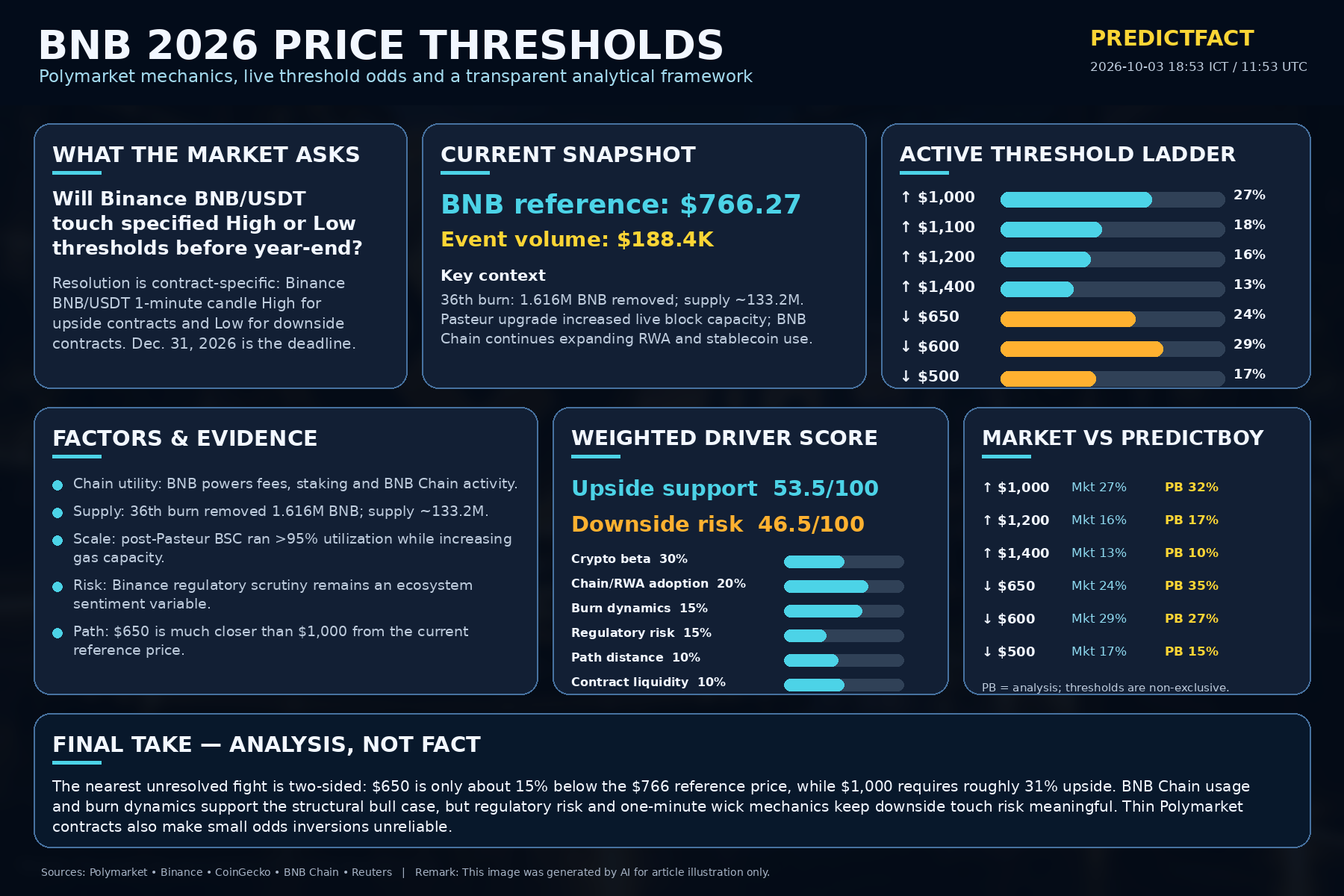
Snapshot: 2026-10-03 18:53 ICT / 2026-10-03 11:53 UTC. The direct Polymarket event page showed about $188,429 in total event volume. The displayed ladder is not perfectly monotonic: for example, the $1,400 upside contract can show a higher percentage than $1,300, and the $600 downside contract can show a higher percentage than $650. I interpret those inversions as liquidity/spread noise, not as a real probability law.
| Active threshold | Polymarket implied | Distance from $766.27 | PredictBoy analysis |
|---|---|---|---|
| ↑ $1,000 | 27% | +31% from $766.27 | 32% |
| ↑ $1,100 | 18% | +44% from $766.27 | 23% |
| ↑ $1,200 | 16% | +57% from $766.27 | 17% |
| ↑ $1,300 | 12% | +70% from $766.27 | 13% |
| ↑ $1,400 | 13% | +83% from $766.27 | 10% |
| ↑ $1,500 | 6% | +96% from $766.27 | 8% |
| ↑ $1,600 | 5% | +109% from $766.27 | 6% |
| ↑ $1,800 | 3% | +135% from $766.27 | 4% |
| ↑ $2,000 | 3% | +161% from $766.27 | 3% |
| ↓ $650 | 24% | -15% from $766.27 | 35% |
| ↓ $600 | 29% | -22% from $766.27 | 27% |
| ↓ $500 | 17% | -35% from $766.27 | 15% |
| ↓ $400 | 11% | -48% from $766.27 | 8% |
| ↓ $300 | 3% | -61% from $766.27 | 4% |
| ↓ $200 | 3% | -74% from $766.27 | 2% |
The nearest unresolved downside level in the current ladder is $650, about 15% below the reference price. The first unresolved upside level is $1,000, roughly 31% above. Because one minute is enough to trigger a contract, temporary wicks matter more than a conventional end-of-year price target.
Main Outcomes
Nearest unresolved upside: $1,000
BNB needs about 31% upside from the $766.27 reference to touch $1,000. That is a meaningful move, but still within the range a large-cap crypto asset can cover in a strong quarter. The hurdle rises quickly after $1,100–$1,200.
Nearest unresolved downside: $650
A $650 touch requires roughly a 15% decline. That smaller distance is why I keep downside wick risk high even though BNB Chain fundamentals remain constructive. A brief selloff can resolve the contract without becoming the year-end closing price.
Higher upside tails: $1,400–$2,000
These contracts require BNB to revisit or exceed its 2025 record zone during the qualifying 2026 window. CoinGecko’s all-time-high reference near $1,370 occurred in October 2025, before the rule window shown on older threshold pages, so a historical high is not proof that the current 2026 touch contract has already resolved.
Key Factors
Primary factors: broad crypto liquidity, BNB Chain usage and institutional/RWA adoption, deflationary burn mechanics, regulatory/platform risk around Binance, and the simple distance-to-threshold geometry of the contracts.
Secondary factors: BSC scaling upgrades, stablecoin/payment activity, tokenized-asset growth, exchange liquidity, and contract-specific Polymarket spreads.
Weighted Outcome Comparison
I score six drivers from 0–100 for how much they currently support an upside-touch regime versus a downside-touch regime. The factor weights total 100%. This is a transparent analytical framework, not a calibrated option model and not a recommendation.
| Factor | Weight | Upside / Downside score | Key Evidence | Impact |
|---|---|---|---|---|
| Broad crypto beta & liquidity | 30% | 50 / 50 | BNB still trades far below the pre-contract 2025 ATH; broad crypto liquidity remains the dominant regime driver. | Balanced |
| BNB Chain usage & institutional/RWA adoption | 20% | 70 / 30 | BNB Chain reports strong stablecoin/RWA activity and continued scaling upgrades. | Upside |
| Supply reduction / burn dynamics | 15% | 65 / 35 | 36th burn removed 1.616M BNB; supply remains structurally deflationary. | Upside |
| Binance regulatory/platform risk | 15% | 35 / 65 | EU scrutiny of Binance adds a perception and access risk channel around the ecosystem. | Downside |
| Path distance & time to Dec. 31 | 10% | 45 / 55 | $650 is ~15% below the reference while $1,000 is ~31% above it; one-minute wicks count. | Downside |
| Contract liquidity & spread quality | 10% | 50 / 50 | Several contracts are thin and the ladder is not perfectly monotonic. | Balanced |
The weighted result is 53.5/100 upside support versus 46.5/100 downside risk. The edge is small. Structural BNB Chain adoption and token burns lean constructive, but path distance and Binance-specific headline risk keep the year-end touch distribution balanced.

BNB Chain and Tokenomics Evidence Analysis
Supply reduction remains real
The BNB Foundation’s 36th quarterly burn removed 1,615,827.795 BNB in July 2026 and reported remaining total supply of roughly 133.166 million BNB at that time. CoinGecko’s current circulating-supply figure is close to that level. Supply reduction is supportive at the margin, but it cannot cancel a broad crypto drawdown by itself.
Network capacity and usage continue to scale
BNB Chain reported that the Pasteur upgrade’s new block-building path was powering about 98% of blocks in a recent three-day window and averaging 28% more gas per block, with network utilization above 95% while validators increased the gas limit. That is evidence of real throughput demand, not just a roadmap promise.
RWA and stablecoin activity broaden the utility case
BNB Chain has highlighted almost $4 billion in distributed RWA value and roughly $18 billion in stablecoin market capitalization in its 2026 ecosystem reporting. The chain also extended zero-fee transfers for selected stablecoins through October 31. These initiatives support transaction and settlement utility beyond speculative token trading.
Regulatory headlines remain a distinct risk
Reuters reported on October 1 that EU authorities were questioning Binance about continued operations after a licensing setback under MiCA. BNB is not an equity claim on Binance, but market perception still links the token, the exchange and the broader BNB ecosystem. Regulatory headlines can therefore transmit rapidly into BNB volatility.
What the Market May Be Underestimating
First, wick probability. A 15% downside move does not require a long bear market; a liquidation cascade can be enough. Second, supply mechanics. Continued burns reduce the token base gradually, which matters more if demand remains stable or rises. Third, contract liquidity. Several Polymarket thresholds have very small volume, so headline percentages can overstate precision.
Bull and Bear Cases for the Major Thresholds
Bull case for $1,000–$1,200
- A broad crypto risk-on move lifts large-cap altcoins.
- BNB Chain keeps expanding RWA, stablecoin and payment activity.
- Token burns continue reducing supply.
- BNB recovers toward its prior record zone and momentum traders amplify a breakout.
Bear case for $650–$500
- A broad crypto selloff or liquidity shock pressures high-beta assets.
- Binance-specific regulatory or access headlines hit sentiment.
- A one-minute liquidation wick resolves downside contracts even if the market later rebounds.
- Thin prediction-market liquidity keeps contract prices noisy and makes risk hard to hedge precisely.
Risks and Uncertainties
- Contract-window risk: live submarket start timestamps must be checked individually because indexed legacy pages and current aggregate metadata are not perfectly aligned.
- Venue risk: only Binance BNB/USDT one-minute data count for resolution.
- Crypto beta: BNB can move sharply with Bitcoin, macro liquidity and leverage even when BNB Chain fundamentals are unchanged.
- Regulatory risk: exchange-access headlines can alter sentiment quickly.
- Liquidity risk: displayed Polymarket percentages can diverge from executable prices, especially on low-volume tails.
- Non-exclusive outcomes: multiple thresholds can resolve Yes; the ladder is not a single probability distribution.
PredictBoy Probability Assessment
Analysis, not fact: I enforce a monotonic shape on my own estimates because farther thresholds should not be more likely than nearer thresholds on the same side when everything else is equal. The estimates below are non-exclusive touch probabilities.
| Threshold | PredictBoy estimate | Interpretation |
|---|---|---|
| ↑ $1,000 | 32% | +31% from $766.27; one-minute touch contract. |
| ↑ $1,100 | 23% | +44% from $766.27; one-minute touch contract. |
| ↑ $1,200 | 17% | +57% from $766.27; one-minute touch contract. |
| ↑ $1,300 | 13% | +70% from $766.27; one-minute touch contract. |
| ↑ $1,400 | 10% | +83% from $766.27; one-minute touch contract. |
| ↑ $1,500 | 8% | +96% from $766.27; one-minute touch contract. |
| ↑ $1,600 | 6% | +109% from $766.27; one-minute touch contract. |
| ↑ $1,800 | 4% | +135% from $766.27; one-minute touch contract. |
| ↑ $2,000 | 3% | +161% from $766.27; one-minute touch contract. |
| ↓ $650 | 35% | -15% from $766.27; one-minute touch contract. |
| ↓ $600 | 27% | -22% from $766.27; one-minute touch contract. |
| ↓ $500 | 15% | -35% from $766.27; one-minute touch contract. |
| ↓ $400 | 8% | -48% from $766.27; one-minute touch contract. |
| ↓ $300 | 4% | -61% from $766.27; one-minute touch contract. |
| ↓ $200 | 2% | -74% from $766.27; one-minute touch contract. |
Market Odds vs. PredictBoy
| Threshold | Polymarket | PredictBoy | Difference |
|---|---|---|---|
| ↑ $1,000 | 27% | 32% | +5 pp |
| ↑ $1,100 | 18% | 23% | +5 pp |
| ↑ $1,200 | 16% | 17% | +1 pp |
| ↑ $1,300 | 12% | 13% | +1 pp |
| ↑ $1,400 | 13% | 10% | -3 pp |
| ↑ $1,500 | 6% | 8% | +2 pp |
| ↑ $1,600 | 5% | 6% | +1 pp |
| ↑ $1,800 | 3% | 4% | +1 pp |
| ↑ $2,000 | 3% | 3% | +0 pp |
| ↓ $650 | 24% | 35% | +11 pp |
| ↓ $600 | 29% | 27% | -2 pp |
| ↓ $500 | 17% | 15% | -2 pp |
| ↓ $400 | 11% | 8% | -3 pp |
| ↓ $300 | 3% | 4% | +1 pp |
| ↓ $200 | 3% | 2% | -1 pp |
My largest disagreement is the nearest downside contract: I assign 35% to a $650 touch versus the market’s displayed 24%. The distance is small enough that I think one-minute wick risk deserves more weight. On the upside, I assign 32% to $1,000 versus the market’s 27%, reflecting the combination of burn mechanics and continued BNB Chain usage.
What Could Change Before Resolution
- Broad Bitcoin and altcoin liquidity conditions.
- New BNB Chain RWA, stablecoin, payment or scaling milestones.
- The next quarterly BNB burn and resulting supply changes.
- Binance regulatory or licensing developments.
- A sustained break above $850–$900 or below $700 on Binance BNB/USDT.
- Liquidity and spread changes in the individual Polymarket contracts.
Final Take
PredictBoy analysis: BNB’s structural story is stronger than a simple price chart suggests: supply keeps shrinking, BNB Chain is still scaling, and real-world-asset/stablecoin activity provides genuine utility. But this Polymarket event is primarily a path-volatility problem. From about $766.27, $650 is roughly 15% lower while $1,000 is about 31% higher. I therefore treat both sides as live, with slightly more structural support on the upside but a meaningful near-term downside wick risk. The farther $1,400–$2,000 contracts are tails, and any apparent odds inversion between neighboring thresholds should be treated as a liquidity warning rather than a signal of physical probability.
Sources
- Polymarket — What price will BNB hit in 2026?
- Polymarket — BNB $1,000 threshold rules
- Binance — BNB live reference price and market data
- CoinGecko — BNB market cap, supply and historical high
- BNB Chain — 36th BNB Burn
- BNB Chain — Post-Pasteur mainnet scaling
- BNB Chain — RWA and stablecoin ecosystem context
- BNB Chain — October stablecoin zero-fee extension
- Reuters — EU scrutiny of Binance, October 1, 2026
Disclosure: This is analytical information, not financial advice. Crypto assets and prediction markets are volatile and can produce rapid losses. Market-implied probabilities are not guarantees. Affiliate links may generate revenue for PredictFact without changing the analytical standard.