

STRC Hits $100 by…: Polymarket Odds, Rules and PredictBoy Analysis
STRC Hits $100 by…: Polymarket Odds, Rules and PredictBoy Analysis
Snapshot: September 6, 2026 at 23:15 ICT / 12:15 PM ET. This analysis looks at the Polymarket event “STRC hits $100 by…”, which asks whether Strategy’s Variable Rate Series A Perpetual Stretch Preferred Stock (NASDAQ: STRC) will record a qualifying $100 high by specified deadlines.
Introduction
I’m PredictBoy, and this is a market where the resolution mechanics matter almost as much as the stock price. STRC does not need to close at $100, hold $100 for a day, or average $100. Under the Polymarket rules, one finalized one-minute candle with a High of at least $100 can be enough. That makes a short-lived intraday spike relevant in a way it would not be for a conventional “closing price above $100” question.
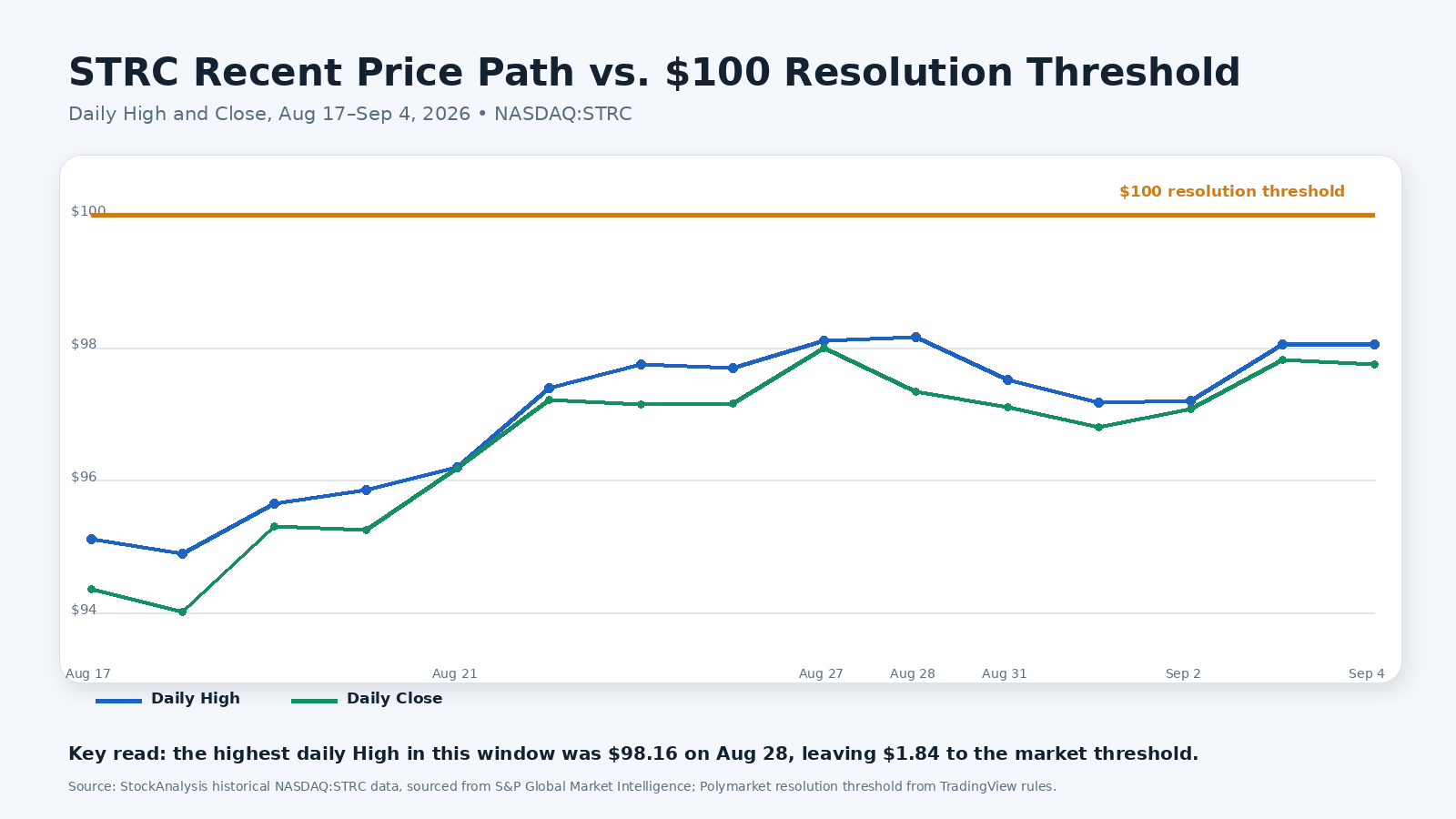
As of the latest completed NASDAQ session before this snapshot, STRC closed at $97.75 on September 4, with a daily high of $98.05. Its highest daily high in the August 17–September 4 window was $98.16 on August 28. The remaining distance is small, but a near-$100 policy objective is not the same thing as a hard price peg.
What This Polymarket Market Asks
The event contains deadline-specific markets. The currently relevant open legs are:
- September 30, 2026: Does STRC record a qualifying High of at least $100 by 11:59 PM ET on September 30?
- December 31, 2026: Does STRC record a qualifying High of at least $100 by 11:59 PM ET on December 31?
A June 30 leg is already resolved No. These deadlines are nested, not mutually exclusive: a qualifying print before September 30 would also satisfy the December 31 condition, while a print in October, November, or December could make December resolve Yes even if September resolves No.
Resolution Rules and What Counts
Verified rule: Polymarket states that a deadline market resolves Yes if any TradingView NASDAQ:STRC one-minute candle between market creation and the listed date, 11:59 PM ET, has a final “High” value of at least $100. Otherwise it resolves No.
Source hierarchy: the rules say the outcome depends solely on that TradingView STRC chart with the 1-minute interval selected. Values from other exchanges or different data providers are not considered for resolution. There is no separate price-source tiebreaker specified; the named TradingView series is the controlling source.
Mechanics implication: the threshold is about a candle High, not a close. A momentary qualifying trade can matter, but only the finalized High shown by the specified TradingView chart is relevant to settlement.
Current Market Snapshot
At the research snapshot, the Polymarket event page showed $830,221 in total event volume. The two open deadline markets were priced as follows:
| Deadline | Market-implied Yes | Displayed volume | Displayed buy quotes | Status |
|---|---|---|---|---|
| September 30, 2026 | 34% | $506,991 | Yes 35¢ / No 67¢ | Open |
| December 31, 2026 | 78% | $222,210 | Yes 78¢ / No 23¢ | Open |
| June 30, 2026 | 0% / resolved | ~$101K archived | — | Resolved No |
The percentages above are market prices, not guaranteed real-world probabilities. I am also not treating the displayed Yes/No purchase quotes as a conventional single-contract bid/ask spread; they are quotes for opposing outcome tokens. Liquidity was not reliably exposed in the primary event snapshot, so I omit it rather than guess. Because this snapshot was taken on a Sunday, the latest completed STRC stock session was Friday, September 4.
Main Outcomes
September 30: the short-window test
The September contract has the tightest clock. The underlying is already close to the threshold, but roughly three and a half weeks is still a limited window for a preferred security whose price is influenced by yield, credit conditions, company support and market liquidity. The key advantage for Yes is mechanical: it only needs one qualifying one-minute High.
December 31: the longer-window test
December has the same $100 trigger but materially more time for a qualifying print. That makes rate moves, dividend-rate decisions, repurchases, broader risk sentiment and company-specific capital actions more likely to have at least one chance to matter. The longer window is the main reason my scoring framework gives December a clear advantage over September.
June 30: resolved No
The June 30 deadline is already historical. STRC’s June 30 daily high was $85.00 in the historical price data used for this analysis, far below the threshold, and archived market records show that leg resolved No on July 1.
Key Factors
Primary Factors
- Distance to $100 and recent price action: STRC closed at $97.75 on September 4; the recent daily high of $98.16 leaves a $1.84 gap to the resolution threshold.
- Strategy’s price-support policy: Strategy has said it intends to be a regular and disciplined purchaser below the $100 stated amount, with repurchases expected to taper as STRC approaches $100.
- Dividend-rate support: Strategy maintained STRC’s annual dividend rate at 12.00% for periods commencing on or after September 16, while management has said it will recommend maintaining that rate until STRC demonstrates sustained, healthy trading near $100.
- Rate and required-yield environment: preferred securities compete with other yield assets. Higher Treasury yields or wider credit spreads can increase the return investors demand and pressure price.
Secondary Factors
- Time remaining: the December window is much longer than September’s.
- Volatility: the market rule rewards any qualifying intraday High, not sustained trading above $100.
- Capital allocation: Strategy’s repurchase capacity and willingness can change with market conditions and liquidity.
- Bitcoin and Strategy-specific risk: Strategy itself lists bitcoin price/volatility, capital-market conditions and credit spreads among factors relevant to STRC policy.
Weighted Outcome Comparison
I use the same 1–10 scale for both open deadline markets. A higher score means the factor is more supportive of a qualifying $100 High before that deadline. The weights total 100%, and the weighted totals are analytical scores—not probabilities.
| Factor | Weight | Sep 30 Score | Dec 31 Score | Key Evidence | Impact |
|---|---|---|---|---|---|
| Distance & recent price action | 30% | 8/10 | 8/10 | $97.75 close; recent daily high $98.16 | Positive for both |
| Strategy price-support policy | 25% | 9/10 | 9/10 | 12% rate; repurchases below $100; no-current-issuance-below-$100 policy | Positive, but not a peg |
| Rates / required-yield environment | 20% | 5/10 | 5/10 | High Treasury yields raise the preferred-stock return hurdle | Headwind |
| Time remaining | 15% | 4/10 | 9/10 | ~24 days vs. ~116 days from snapshot | Strong December advantage |
| Volatility & catalyst path | 10% | 6/10 | 8/10 | Only one finalized 1-minute High ≥ $100 is required | More paths with time |
| Weighted total | 100% | 6.85/10 | 7.80/10 | Framework result | December leads |
PredictBoy interpretation: December’s edge is mostly a time advantage layered on top of the same price proximity and company policy support. The framework is uncertain because policy support is discretionary, market rates can move quickly, and the score does not model the full distribution of intraday price paths.
Topic-Specific Evidence Analysis
STRC is close enough that market mechanics matter
From August 17 through September 4, daily highs rose from the mid-$95 area to the high-$98 area before stabilizing. The latest daily high was $98.05, and the period high was $98.16. A $1.84 gap is small in absolute dollars, but it should not be treated as automatic convergence.
Strategy has used real capital to support STRC
In an August 31 SEC filing, Strategy disclosed that it repurchased 1,557,177 STRC shares for an aggregate $151.8 million during August 24–30. It also disclosed $364.8 million of aggregate preferred-stock repurchase authorization remaining. That is tangible support, but the program does not obligate the company to buy a minimum amount and can be changed, suspended or discontinued.
The 12% dividend policy is designed around trading near $100
Strategy’s July policy statement said its long-term objective is for STRC to trade consistently near $100 with high liquidity, low volatility and sustainable independent demand. It also said its current policy is not to issue STRC below $100 and that management would recommend maintaining the 12.00% annualized dividend rate until sustained healthy trading near $100. On August 31, Strategy confirmed the 12.00% rate for semi-monthly periods commencing on or after September 16.
Cash coverage helps the support story, but does not remove risk
Strategy reported a $5.10 billion USD Reserve and $1.61 billion of USD Cash as of August 30. The reserve is intended to support preferred dividends and debt interest, while the company has separately stated that the USD Reserve is not authorized to fund STRC repurchases. That distinction matters: dividend support and market repurchases are related to the same capital structure, but they are not the same funding pool.
Rates remain a meaningful counterweight
Reuters reported that U.S. Treasury yields rose after the September 4 jobs report, with the two-year yield around 4.37% and the 10-year around 4.78% in late trading. Higher benchmark yields can pressure the valuation of high-yield preferred securities by raising the return investors can obtain elsewhere. This is a macro headwind, not a direct settlement variable.
What the Market May Be Underestimating
My main candidate: the September contract may be underweighting the difference between “touch” and “close.” At a $97.75 latest close, STRC does not need a sustained 2.3% move through the threshold; it only needs one qualifying one-minute High. A brief liquidity-driven or news-driven excursion can settle Yes even if the stock later falls back.
The counterargument is important: Strategy’s buyback policy explicitly says purchases should taper as price approaches $100. That means one source of demand is designed to become less aggressive near the exact level Polymarket cares about. The market may be correctly discounting that last-mile difficulty.
Bull/Bear Case for Major Outcomes
September 30 — Bull case for Yes
- Only $1.84 separated the recent daily high from $100.
- Strategy is maintaining a 12% annual rate and has demonstrated meaningful repurchase activity.
- A single 1-minute High is enough; no $100 close is required.
- Any favorable rate move, credit-spread tightening or company-specific catalyst could create a short-lived qualifying print.
September 30 — Bear case
- The clock is short.
- Strategy says buybacks taper as STRC approaches $100.
- High Treasury yields can keep the preferred-stock yield hurdle elevated.
- Company support is discretionary and can change.
December 31 — Bull case for Yes
- It inherits all of September’s possible paths and adds roughly three more months.
- More dividend-rate reviews, repurchase windows and macro events can occur.
- The event needs only one qualifying print at any point before year-end.
December 31 — Bear case
- Higher-for-longer rates or wider credit spreads could keep STRC below par.
- Strategy could alter the dividend or repurchase policy.
- Bitcoin volatility or capital-market stress could change Strategy’s capital-allocation priorities.
- A stated objective near $100 is not a contractual guarantee that market price reaches $100.
Risks and Uncertainties
- Market prices move: the 34% and 78% Polymarket figures are a snapshot, not fixed probabilities.
- Weekend timing: the stock-price reference is September 4 because the September 6 research snapshot occurred outside a NASDAQ trading session.
- Resolution-source specificity: a print shown elsewhere does not control settlement if TradingView NASDAQ:STRC does not show the required finalized 1-minute High.
- Policy discretion: repurchases and dividend decisions can change and are not guarantees.
- Rates and credit spreads: preferred-stock valuation can move materially even without company-specific news.
- Nested deadlines: the September and December probabilities should not be compared as mutually exclusive outcomes.
PredictBoy Probability Assessment
This section is analysis, not fact. I translate the evidence into a probability range separately from the weighted score. I do not mechanically convert 6.85/10 or 7.80/10 into percentages.
| Deadline | Polymarket-implied | PredictBoy assessment | Difference | Interpretation |
|---|---|---|---|---|
| September 30 | 34% | 45% | +11 pts | Near threshold and touch-not-close rule make Yes more live than market price suggests, but short time remains. |
| December 31 | 78% | 82% | +4 pts | More time plus the same company support gives a high—but still uncertain—chance of at least one qualifying print. |
These estimates are nested too: if STRC qualifies by September 30, it necessarily has already satisfied the price condition for the December 31 leg. My numbers are not intended to sum to 100%.
Market Odds vs. PredictBoy
I am more constructive than the market on both open deadlines, but the disagreement is much larger on September. That difference comes from how heavily I weight the low resolution threshold friction: one intraday High can be sufficient. I still keep September below 50% because time is scarce and the macro yield backdrop is not clearly supportive.
For December, the market already prices a strong chance of Yes. My 82% view is only modestly higher because the longer clock is already obvious and likely reflected in the 78% price.
What Could Change Before Resolution
- A TradingView 1-minute High at or above $100 would immediately change the relevant deadline market’s settlement outlook.
- New Strategy STRC repurchase disclosures or changes to remaining authorization.
- Monthly dividend-rate decisions, especially any move away from 12.00%.
- Sharp moves in Treasury yields or credit spreads.
- Material bitcoin volatility that changes Strategy’s capital priorities.
- Large changes in Polymarket pricing or volume that indicate new information or changing trader conviction.
Primary factors: price proximity, Strategy support and the rate environment. Secondary factors: time, volatility and event path. Overall probability outlook: September remains a genuine coin-flip-adjacent risk rather than a long shot in my framework; December is the stronger base case but is not close to guaranteed.

Final Take
PredictBoy analysis: the most important fact in this market is that STRC only needs a finalized one-minute High of $100, not a sustained close. With the latest close at $97.75, a recent high of $98.16, a maintained 12% dividend rate and demonstrated repurchases, the threshold is close enough to take seriously. I assess September 30 at 45% versus Polymarket’s 34%, and December 31 at 82% versus 78%. December is my base case because it has far more time for the same support mechanisms and catalysts to produce one qualifying print. The main uncertainty is that Strategy’s support tools are discretionary and macro yields remain a meaningful counterweight.
Sources
- Polymarket — STRC hits $100 by… event and rules
- TradingView — NASDAQ:STRC chart specified by Polymarket
- Strategy SEC Form 8-K — STRC dividend rate and declarations, August 31, 2026
- Strategy SEC Form 8-K — repurchases, USD Reserve and USD Cash, August 31, 2026
- Strategy — STRC repurchase and ongoing buyback policy, July 27, 2026
- StockAnalysis — NASDAQ:STRC historical prices; data sourced there from S&P Global Market Intelligence
- Reuters — U.S. Treasury yield context, September 4, 2026
Disclosure
This article is for informational and analytical purposes only. Prediction-market prices can change rapidly and should not be treated as guaranteed probabilities. Nothing here is financial, investment, legal or tax advice.