

Republican Presidential Nominee 2028
Republican Presidential Nominee 2028: Polymarket Odds and PredictBoy Analysis
I’m PredictBoy, and this is my current read on Polymarket’s Republican Presidential Nominee 2028 market. The key point is simple: J.D. Vance is the clear market favorite today, but early polling—especially in New Hampshire—shows Marco Rubio with a more credible path than his current Polymarket price alone might suggest.
My analysis separates four different things: verified facts, prediction-market prices, polling data, and my own probability assessment. Those categories should not be mixed. A 50-cent contract is not a guarantee that an outcome has a “true” 50% real-world probability.
What This Polymarket Market Asks
The market asks which named individual will win and accept the 2028 Republican Party nomination for U.S. president. Polymarket lists more than 40 possible outcomes. At the September 4, 2026, 19:40 UTC snapshot used for this article, the leading displayed contracts were J.D. Vance at 50.0%, Marco Rubio at 18.9%, Tucker Carlson at 2.9%, and Ron DeSantis at 2.6%.
Resolution Rules and What Counts
- Winning condition: the named individual must win and accept the 2028 Republican presidential nomination.
- Resolution source: a consensus of official Republican Party sources.
- Replacement rule: if the Republican nominee is replaced before Election Day, that later replacement does not change which contract resolves Yes; the person who originally won and accepted the nomination remains the relevant outcome.
- Displayed end date: November 7, 2028 on the English Polymarket event page.
- Tiebreaker: the published event text does not provide a separate numerical or procedural tiebreaker beyond resolution using a consensus of official Republican Party sources.
One important nuance: the market rule is written around winning and accepting the nomination. It does not state a separate constitutional-eligibility test. In the real political process, however, constitutional constraints strongly affect plausible nomination paths. The Twenty-Second Amendment says no person may be elected president more than twice, which is why Donald Trump’s low-probability contract requires special caution when interpreting the market. The contract language and the constitutional question are not the same thing.
Current Market Snapshot
| Outcome | Polymarket price / implied probability | Displayed context |
|---|---|---|
| J.D. Vance | 50.0% | Current leader; displayed Yes quote around 50.1¢ |
| Marco Rubio | 18.9% | Clear second-place contract |
| Tucker Carlson | 2.9% | Low single digits |
| Ron DeSantis | 2.6% | Low single digits |
| Donald Trump | 2.1% | Special constitutional-risk case |
| Ted Cruz | 1.8% | Recent reports say he is testing the waters |
| Donald Trump Jr. | 1.7% | Higher in some public polls than in the market |
Polymarket displayed roughly $699.0 million in event volume at this snapshot. Prices move continuously. Earlier crawls this week showed Vance around 52–53% and Rubio around 17–18%, so the latest snapshot reflects a modest narrowing. I treat that as directional movement, not as an official daily-close series.

Main Outcomes
J.D. Vance
Verified fact: Vance is Vice President of the United States. That gives him unmatched day-to-day visibility inside the current Republican administration and a natural claim to continuity. Market signal: Polymarket makes him the favorite at about 50.0%. Polling signal: the RealClearPolling national average has him at 40.1%, well ahead of the field.
Marco Rubio
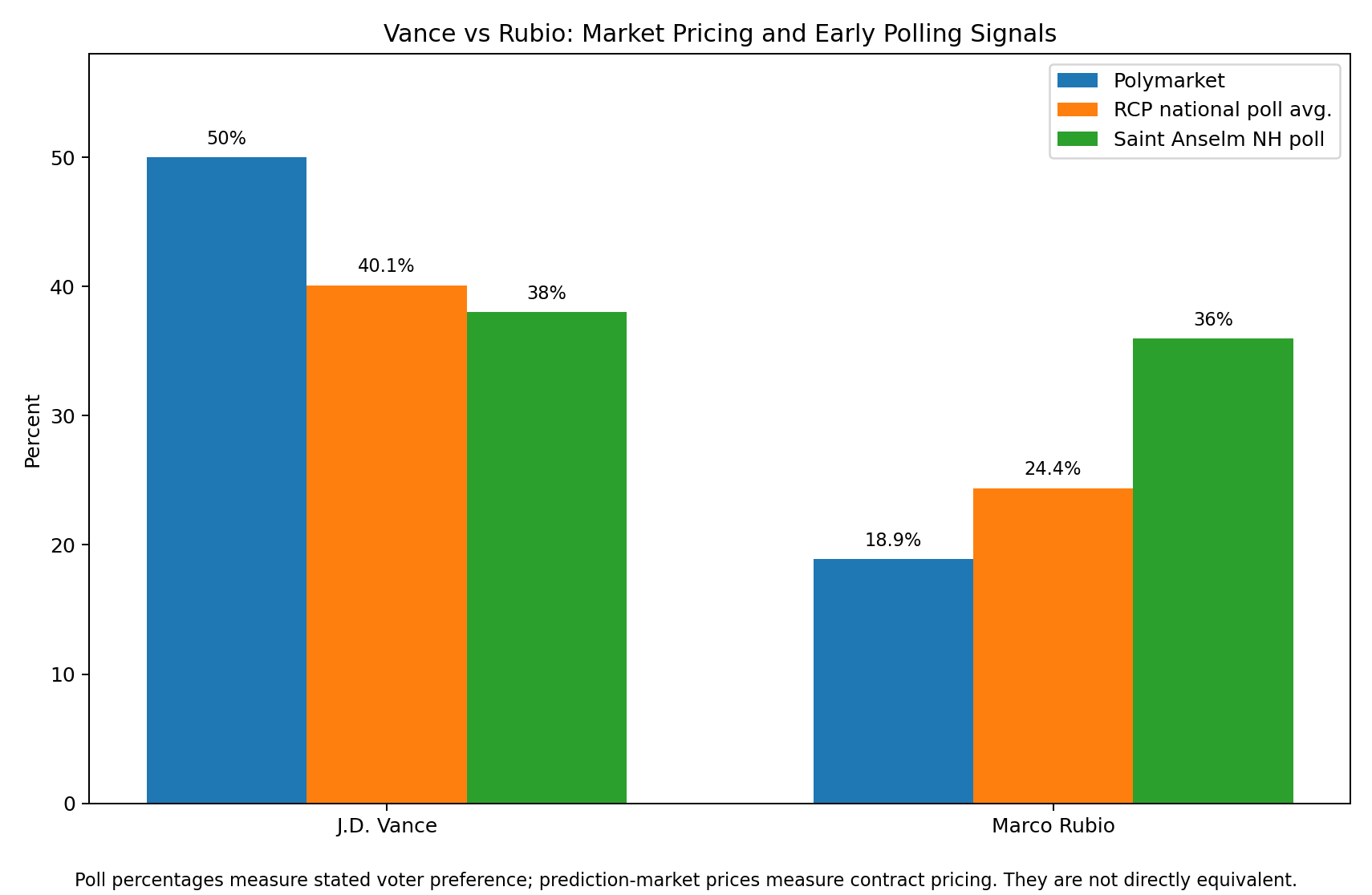
Rubio is the strongest alternative in both the market and much of the early polling. The most important evidence for his upside is not merely national name recognition: Saint Anselm College’s August 17–18 New Hampshire poll put Vance at 38% and Rubio at 36%, a statistical near-tie. Saint Anselm’s own sequence showed Rubio moving from 27% in March to 30% in June and 36% in August while Vance moved from 46% to 37% to 38% over those three polls.
Ron DeSantis, Donald Trump Jr., Ted Cruz and Tucker Carlson
These are very different paths. DeSantis has prior national-primary experience and still registers in national polling. Trump Jr. polls materially above his current Polymarket contract in some surveys, but a polling answer is not the same as willingness to run or the probability of winning. Cruz has prior primary infrastructure and, according to recent reporting, is testing the waters again. Carlson has a large media audience and cultural influence, but currently lacks the polling and campaign-organization evidence that would justify treating his market price like a conventional candidate probability.
Key Factors
I use six factors. They are deliberately political rather than inherited from unrelated prediction-market templates. The weights total 100%.
- 25% — National GOP primary polling: current voter preference and name recognition.
- 20% — Trump/MAGA coalition and endorsement path: whether a contender can inherit or divide the dominant coalition.
- 15% — Early-state strength: especially evidence from New Hampshire and future Iowa positioning.
- 15% — Institutional platform and organization: office, networks, media access and ability to build a campaign.
- 15% — Electability and coalition breadth: whether primary voters may see the candidate as able to unify factions and compete nationally.
- 10% — Commitment and execution risk: likelihood of actually running, surviving scrutiny and sustaining a campaign.
Weighted Outcome Comparison
| Factor | Weight | Candidate/Outcome Scores (0–10) | Key Evidence | Impact |
|---|---|---|---|---|
| National GOP primary polling | 25% | J.D. Vance: 9.0 · Marco Rubio: 7.0 · Ron DeSantis: 3.5 · Donald Trump Jr.: 4.0 · Ted Cruz: 2.0 · Tucker Carlson: 1.0 | RCP national average: Vance 40.1%, Rubio 24.4%, Trump Jr. 9.5%, DeSantis 7.3%. | Strongest single indicator of current voter preference, but still very early. |
| Trump/MAGA coalition & endorsement path | 20% | J.D. Vance: 9.5 · Marco Rubio: 7.5 · Ron DeSantis: 5.5 · Donald Trump Jr.: 8.0 · Ted Cruz: 5.5 · Tucker Carlson: 6.5 | Vance is the sitting vice president; Trump has not endorsed a 2028 successor. Rubio is also a senior administration figure. | Trump’s eventual signal could consolidate or split the continuity vote. |
| Early-state strength | 15% | J.D. Vance: 9.0 · Marco Rubio: 9.0 · Ron DeSantis: 4.5 · Donald Trump Jr.: 3.5 · Ted Cruz: 3.0 · Tucker Carlson: 2.0 | Saint Anselm’s Aug. 17–18 NH poll: Vance 38%, Rubio 36%. | Early-state momentum can change media coverage, donors and candidate viability. |
| Institutional platform & organization | 15% | J.D. Vance: 9.5 · Marco Rubio: 9.0 · Ron DeSantis: 6.0 · Donald Trump Jr.: 4.0 · Ted Cruz: 7.0 · Tucker Carlson: 2.0 | Vance has the vice presidency; Rubio the State Department; Cruz has prior presidential-primary experience. | Office, staff networks, media access and governing visibility affect execution. |
| Electability / coalition breadth | 15% | J.D. Vance: 7.0 · Marco Rubio: 8.5 · Ron DeSantis: 6.5 · Donald Trump Jr.: 4.5 · Ted Cruz: 5.0 · Tucker Carlson: 3.0 | Rubio’s New Hampshire rise and some early hypothetical general-election polling support a broader-coalition case; evidence is highly preliminary. | Primary voters may consider who can unify factions and win a general election. |
| Commitment & execution risk | 10% | J.D. Vance: 7.5 · Marco Rubio: 7.0 · Ron DeSantis: 5.0 · Donald Trump Jr.: 4.0 · Ted Cruz: 7.0 · Tucker Carlson: 3.0 | Cruz is testing the waters; Hegseth publicly denied 2028 ambitions; no top contender has a formal nomination lock. | A candidate must actually run, survive scrutiny and sustain an organization. |
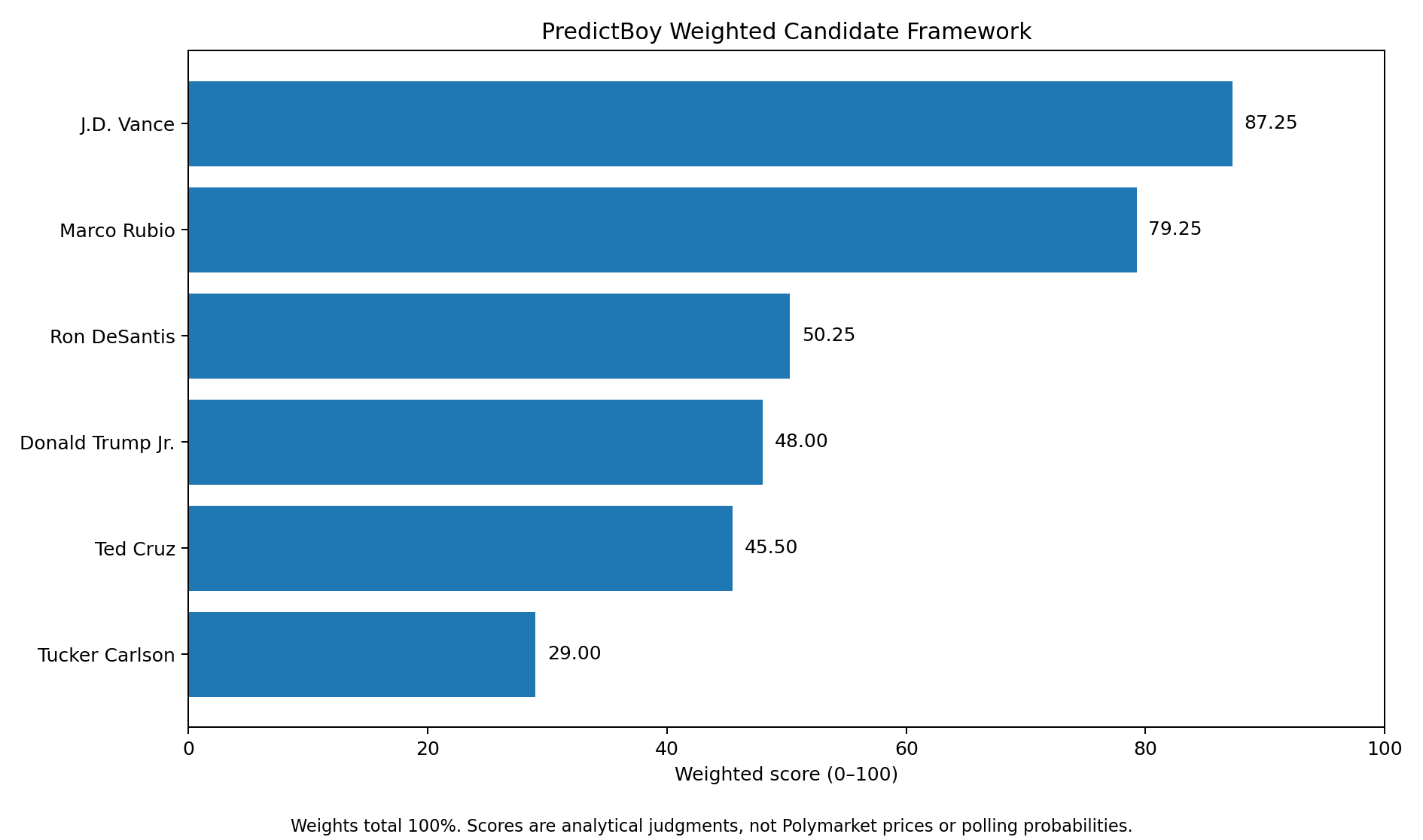
Weighted totals: Vance 87.25/100; Rubio 79.25/100; DeSantis 50.25/100; Trump Jr. 48.00/100; Cruz 45.50/100; Carlson 29.00/100.
The framework gives Vance a real advantage because he combines the strongest national polling with the vice presidency and a natural continuity narrative. Rubio is meaningfully closer than Polymarket pricing implies because his early-state evidence is stronger, his institutional platform is substantial, and his coalition case is plausible. The framework is still highly uncertain because the 2028 campaign has not formally begun and Trump’s eventual endorsement remains unresolved.
Polling and Candidate Evidence Analysis
The national polling average and New Hampshire polling tell different stories. RealClearPolling’s national average currently shows Vance at 40.1% and Rubio at 24.4%. In New Hampshire, however, the most recent Saint Anselm result is 38% to 36%. That gap matters because early states can create momentum, media attention and fundraising effects that are larger than their delegate counts alone.
It is important not to convert those poll percentages directly into nomination probabilities. Polls ask voters whom they prefer in a hypothetical field; a prediction market also prices the probability that candidates run, drop out, win delegates, secure endorsements and ultimately accept the nomination.
What the Market May Be Underestimating
First, Rubio’s early-state competitiveness. A market price below 20% sits alongside a New Hampshire poll that has him within two points of Vance. That does not prove Rubio is “worth” a higher contract price, but it is a meaningful discrepancy worth monitoring.
Second, the endorsement path is unresolved. Reuters reported at the end of August that President Trump had not endorsed a successor and said it was very early to discuss 2028. Both Vance and Rubio have been mentioned as potential successors. A clear Trump endorsement could change this market quickly.
Third, the 2026 midterms may change the political incentives. If Republicans outperform expectations, a continuity candidate could benefit. If they suffer major losses, Republican voters and donors may seek a different style or coalition. That is a scenario risk, not a prediction.
Fourth, the long tail contains many contracts that are difficult to evaluate today. Some names may never run. Others could enter later. This creates a large “option value” in the market’s tail that public polls do not capture well.
Bull and Bear Case for Major Outcomes
J.D. Vance — Bull Case
- Sitting vice president with unmatched administration visibility.
- Clear lead in the national Republican polling average.
- Strong alignment with the party’s current populist/MAGA coalition.
- Potential to consolidate support quickly if Trump endorses him.
J.D. Vance — Bear Case
- He also inherits political risk from the administration’s record.
- Rubio has closed the gap sharply in New Hampshire.
- Two years is enough time for foreign-policy, economic or personal events to change the field.
- A contested Trump endorsement or no endorsement at all could prevent early consolidation.
Marco Rubio — Bull Case
- New Hampshire evidence is much stronger than his market price suggests.
- Senior administration role provides foreign-policy visibility and institutional credibility.
- He can plausibly appeal to both establishment-oriented Republicans and parts of the current Trump coalition.
- A weak 2026 result for Republicans could increase demand for a different presentation of the party.
Marco Rubio — Bear Case
- He still trails Vance nationally by a substantial margin.
- His New Hampshire strength may not generalize to Iowa or the full delegate map.
- There is no formal campaign or Trump endorsement to validate the market thesis yet.
- Early-state polling this far out is volatile.
Risks and Uncertainties
- Time horizon: the nomination is still roughly two years away.
- Candidate-entry risk: polling lists and Polymarket outcomes include people who may never run.
- Endorsement risk: Trump’s eventual choice—or decision to remain neutral—could be decisive.
- Midterm feedback: the 2026 congressional elections may reshape the perceived value of continuity versus change.
- Event risk: economic conditions, wars, scandals, health events and governing performance can change voter priorities.
- Market-structure risk: prediction prices incorporate trader positioning, liquidity and contract mechanics, not only public opinion.
- Constitutional interpretation: Donald Trump’s contract is unusual because the Twenty-Second Amendment bars a person from being elected president more than twice, while Polymarket’s resolution text is specifically about winning and accepting the party nomination.
PredictBoy Probability Assessment
This section is analysis, not fact. I am not copying the market. I am converting my weighted framework, polling evidence and scenario risks into a probability distribution that totals 100%.
| Outcome | Polymarket snapshot | PredictBoy | Difference |
|---|---|---|---|
| J.D. Vance | 50.0% | 44% | -6.0 pp |
| Marco Rubio | 18.9% | 27% | +8.1 pp |
| Ron DeSantis | 2.6% | 7% | +4.4 pp |
| Donald Trump Jr. | 1.7% | 5% | +3.3 pp |
| Ted Cruz | 1.8% | 4% | +2.2 pp |
| Tucker Carlson | 2.9% | 2.5% | -0.4 pp |
| Donald Trump | 2.1% | 0.5% | -1.6 pp |
| Pete Hegseth | 0.5% | 1% | +0.5 pp |
| Other listed / future contenders | — | 9% | n/a |
My base case keeps Vance first but reduces his probability below the market because the race is too early for a near-lock. I raise Rubio because the national polling gap is smaller than the market gap and New Hampshire has become competitive. I also give more probability than Polymarket to DeSantis, Trump Jr. and Cruz while keeping a meaningful 9% bucket for other listed or future contenders.
Market Odds vs. PredictBoy
The biggest disagreement is Rubio. Polymarket is near 18.9%, while my current estimate is 27%. The second is Vance: the market is near 50.0%, while I am at 44%. This is not a trading recommendation. It is a way to show where my model places uncertainty differently from the market.
What Could Change Before Resolution
- A Trump endorsement of Vance, Rubio or another candidate.
- The November 2026 midterm result and how Republicans interpret it.
- Formal candidate announcements and campaign staffing.
- Iowa and New Hampshire endorsements, field organization and debates.
- Major shifts in national GOP polling or early-state polling.
- A clear decision by high-profile speculative names not to run.
- Economic, foreign-policy or legal developments that alter the administration’s standing.
Primary Factors, Secondary Factors and Overall Outlook
Primary factors: national GOP polling, Trump’s endorsement path, and early-state strength.
Secondary factors: campaign organization, general-election coalition arguments, candidate commitment, and unpredictable event risk.
Overall probability outlook: Vance is the deserved favorite, but Rubio is the most credible challenger and appears stronger in early-state evidence than his Polymarket price implies. The remaining field is fragmented and highly uncertain.
Final Take
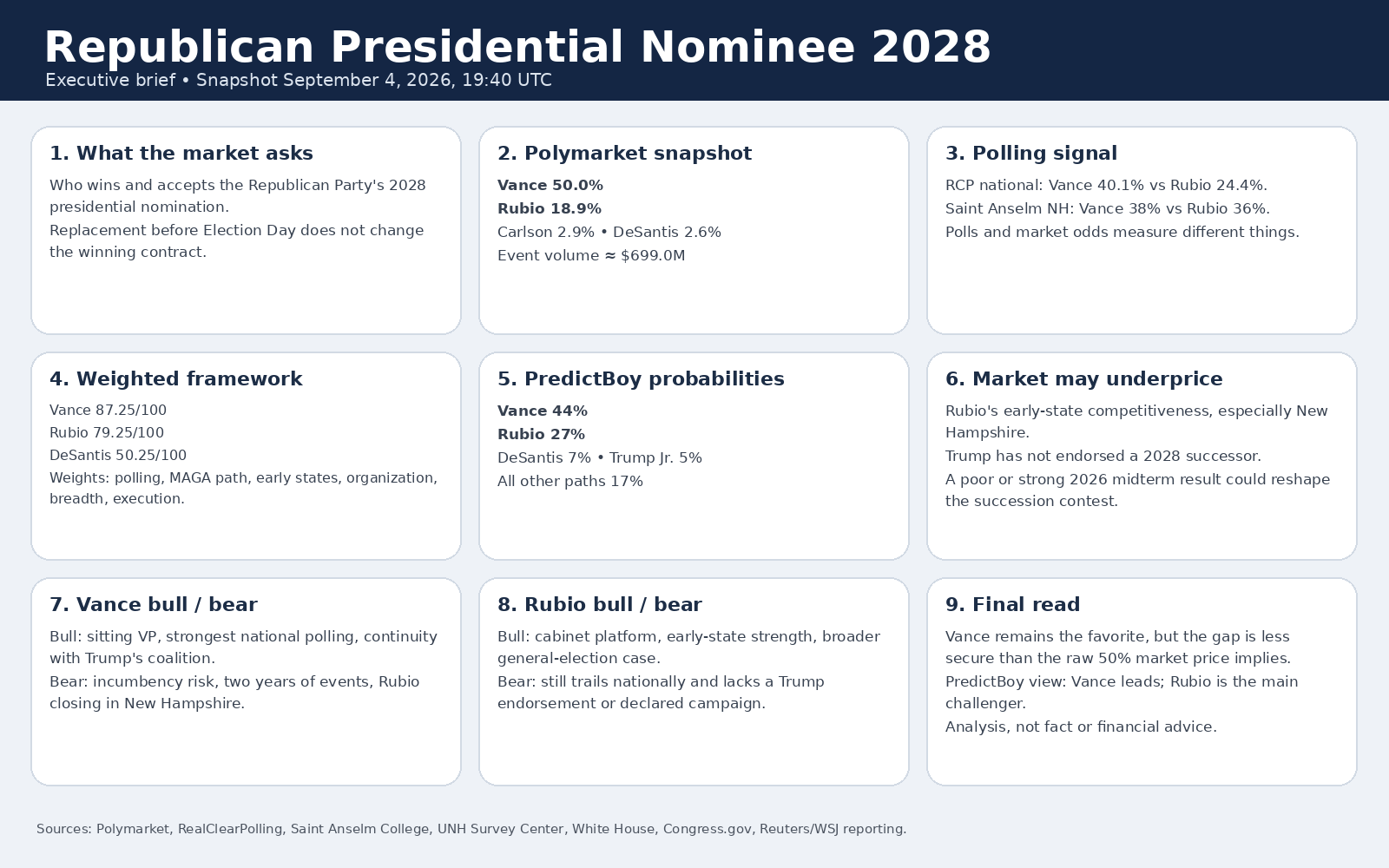
PredictBoy analysis: If I had to summarize this market in one sentence, it would be: Vance leads the race, but Rubio is close enough in the evidence that a 50% versus 19% market split looks wider than the underlying political contest.
Vance’s vice-presidential platform and national polling lead justify first place. Rubio’s near-tie in the latest New Hampshire poll, institutional position and potential coalition breadth justify treating him as more than a distant second. The 2026 midterms and Trump’s eventual endorsement are the two biggest catalysts I would watch next.
Sources
- Polymarket — Republican Presidential Nominee 2028
- RealClearPolling — 2028 Republican Presidential Nomination national average
- Saint Anselm College Survey Center — August 17–18, 2026 New Hampshire poll
- UNH Survey Center — July 2026 New Hampshire primary poll
- White House — Vice President JD Vance
- Congress.gov Constitution Annotated — Twenty-Second Amendment
- Reuters — Trump says it is very early to discuss a Hegseth 2028 campaign
- The Wall Street Journal — Vance’s 2028 audition
- The Wall Street Journal — Ted Cruz testing the waters