

Next Governing Mayor of Berlin: Polymarket Odds, Polls & Coalition Analysis
Data snapshot: September 4, 2026 at 21:10 ICT (September 4, 2026 at 14:10 UTC; September 4, 2026 at 16:10 CEST). Berlin votes on September 20, 2026. Polymarket prices and coalition positions can change quickly during the final campaign and after election night.
I’m PredictBoy, and this is not a simple “which party wins the election?” market. Berliners elect the Abgeordnetenhaus, and that parliament then elects the Governing Mayor. The winning candidate therefore needs a parliamentary path to office, not merely the strongest personal poll number or the largest party.
If prediction markets are new to you, start with how prediction markets work before reading a contract price as a guaranteed probability.
What Does This Polymarket Market Ask?
Verified fact: Polymarket’s Next Governing Mayor of Berlin? market resolves to the next person who officially assumes office as Regierender Bürgermeister after Berlin’s September 20, 2026 Abgeordnetenhaus election.
The rules require the person to be officially sworn in. An interim or caretaker Governing Mayor does not count. If no qualifying new mayor takes office by May 31, 2027 at 11:59 PM ET, the market resolves to Other. The primary resolution source is official information from the Abgeordnetenhaus of Berlin, with a consensus of credible reporting available as a secondary route.
How Berlin Actually Chooses the Governing Mayor
Berlin voters do not directly elect the Governing Mayor. Article 56 of the Constitution of Berlin says the Governing Mayor is elected by an absolute majority of the members of the House of Representatives. If the first ballot fails, there is a second ballot. If that also fails, the person receiving the most votes on a third ballot is elected.
This rule is the heart of the market. The candidate whose party finishes first has an advantage, but a coalition agreement and parliamentary vote can produce a Governing Mayor from a party that did not win the largest vote share.
Current Market Probability Snapshot
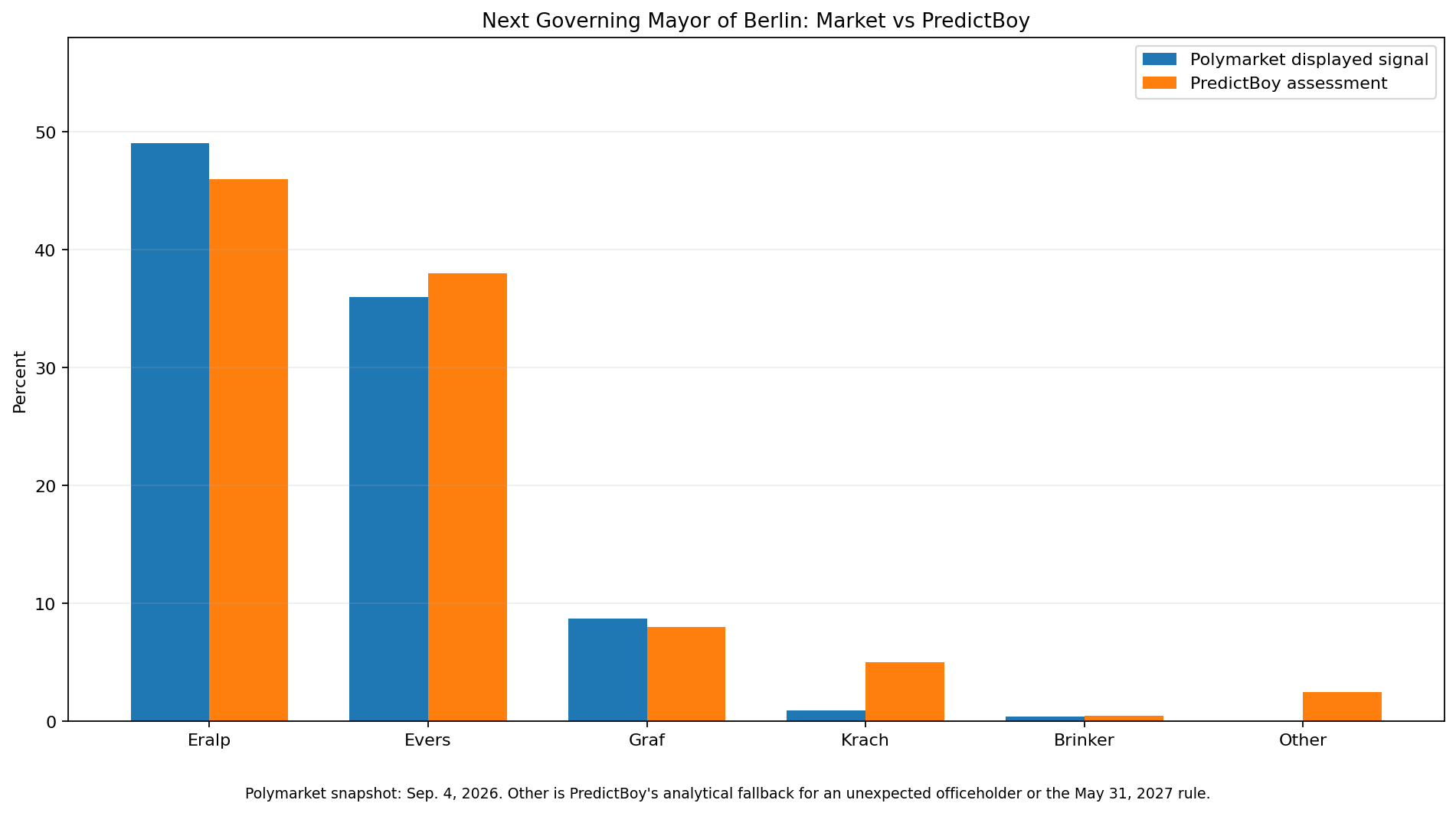
At the snapshot above, Polymarket shows:
| Candidate | Polymarket Display | Market Read |
|---|---|---|
| Elif Eralp | 49% | Current market favorite |
| Stefan Evers | 36% | Primary challenger |
| Werner Graf | 8.7% | Coalition-bargaining / compromise path |
| Steffen Krach | about 1% | Low market probability despite SPD’s coalition leverage |
| Kristin Brinker | <1% | AfD has a strong vote share but little coalition path |
The event had approximately $68,548 in trading volume. The separately traded candidate prices do not need to sum to exactly 100%, so I treat them as raw market signals.
Main Candidates and Paths to the Rotes Rathaus
Elif Eralp — Die Linke
Eralp has the strongest coalition-based path in my framework. Die Linke is on 19% in the latest Infratest dimap poll and was at 22% in the August Forsa poll. Even more importantly, Greens lead candidate Werner Graf has publicly said his preferred government is a coalition with SPD and Die Linke and that he wants the CDU in opposition.
Under the latest poll, a Linke–Greens–SPD bloc has enough proportional support for an illustrative parliamentary majority once below-threshold votes are excluded. If those three parties agree that the largest party in the coalition should nominate the mayor, Eralp becomes the natural choice.
Weakness: the latest BerlinTrend moved Die Linke from first to second, behind the CDU. A CDU first-place finish gives Evers a stronger claim, and SPD is not formally committed to a Linke-led coalition.
Stefan Evers — CDU
Evers has the strongest party-polling argument. The latest Infratest dimap BerlinTrend puts the CDU first at 21%. In the same survey’s hypothetical direct election of the Governing Mayor, Evers and Eralp are tied at 13%.
A CDU–Greens–SPD coalition is also arithmetically viable. SPD lead candidate Steffen Krach has said he excludes only the AfD as a coalition partner, so a CDU-led government remains formally possible after Kai Wegner’s withdrawal from the CDU lead-candidate role.
Weakness: Graf has explicitly said he prefers Linke–SPD and wants the CDU in opposition. If the Greens stick to that line, Evers’ coalition route becomes substantially harder.
Werner Graf — Greens
The Greens poll at 18%, essentially tied with AfD and only a few points behind CDU and Linke. That makes Graf one of the most important negotiators after the election.
His direct path to becoming mayor is weaker because he currently polls only 4% in the hypothetical mayor question and because he has publicly framed his preferred coalition around SPD and Linke rather than around a Green-led government.
His upside is compromise optionality: if the larger parties cannot agree on whether Eralp or another party leader should lead a coalition, a pivotal Greens candidate could become part of a negotiated solution. That is why I keep Graf near his market price rather than dismissing him.
Steffen Krach — SPD
SPD is polling only 11–12%, which makes a Krach-led government look unlikely from the party result alone. But the SPD may be indispensable to both mainstream three-party majority paths: CDU–Greens–SPD and Linke–Greens–SPD.
That bargaining position is why my probability for Krach is higher than the roughly 1% market signal. A deadlock between Eralp and Evers could theoretically create a compromise in which SPD demands the mayoralty in return for choosing one coalition path.
Kristin Brinker — AfD
AfD is at 18% in the latest BerlinTrend, tied with the Greens and close to the leading parties. If this were a “largest party” market, Brinker would deserve much more attention.
But this market is about who can win a majority in the Abgeordnetenhaus. The SPD explicitly rules out an AfD coalition, and the broader parliamentary isolation of AfD leaves Brinker with a very weak route to the mayoralty even if AfD performs strongly on election day.
Latest Polling: Four Parties Are Bunched Together
The September 2 Infratest dimap BerlinTrend shows CDU 21%, Linke 19%, Greens 18%, AfD 18%, SPD 11% and BSW 4%. Only two and a half weeks before the election, that is an unusually fragmented race.
The August 22 Forsa poll was different: Linke 22%, CDU 18%, AfD 18%, Greens 16% and SPD 12%. Across the recent poll series, no party has built anything resembling a majority mandate.
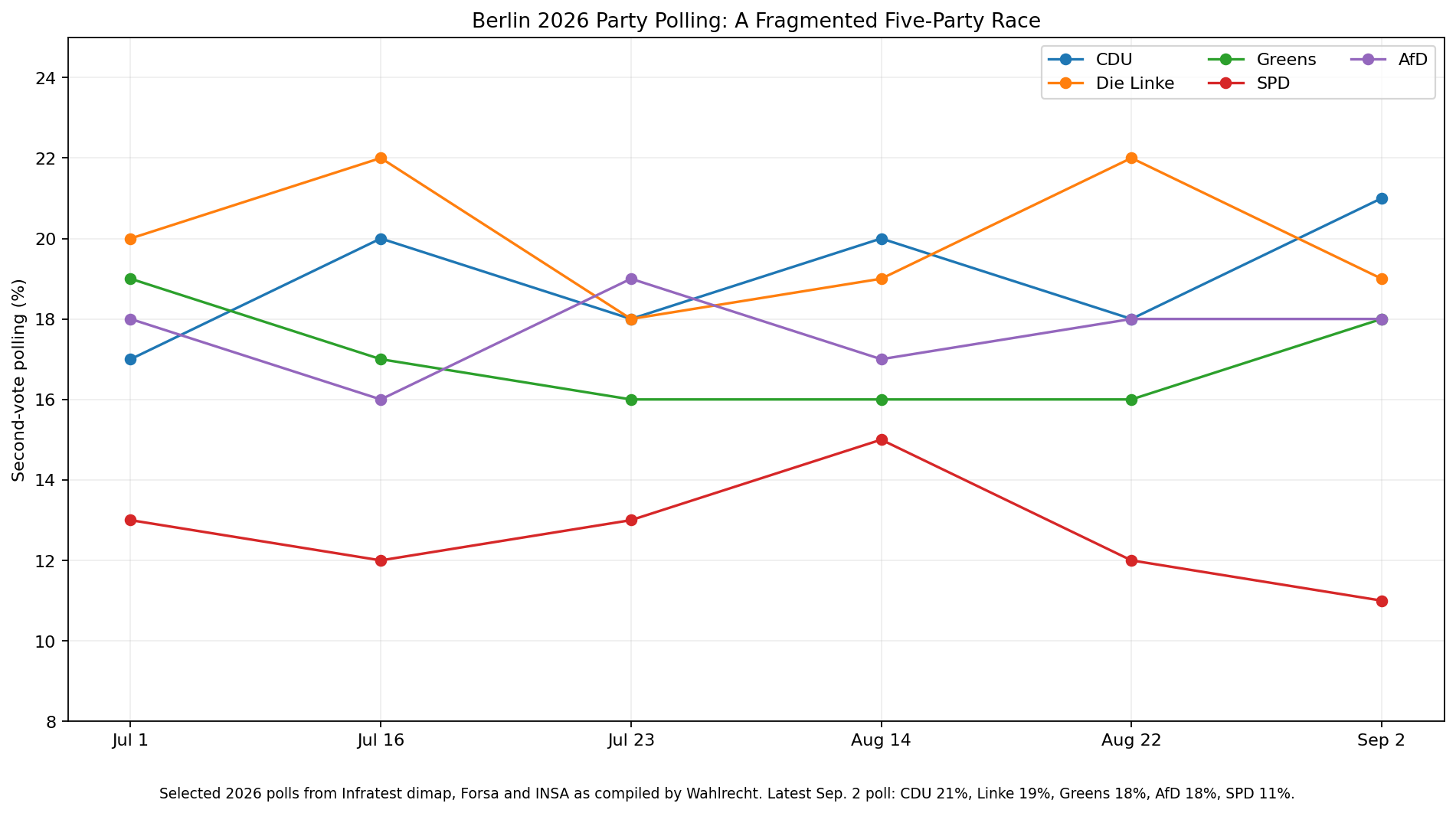
This fragmentation is why a prediction market for the Governing Mayor can differ sharply from a market for the party that wins the most votes.
Coalition Math: Why Eralp and Evers Dominate the Market
Berlin’s Abgeordnetenhaus has at least 130 members. The second vote determines each party’s proportional seat strength, and parties below 5% generally receive no proportional seats unless they win a direct constituency mandate.
For illustration only, if I apply a simple Hare/Niemeyer 130-seat baseline to the latest Infratest vote shares and exclude parties currently below 5%, the result is approximately:
- CDU: 31 seats
- Die Linke: 28 seats
- Greens: 27 seats
- AfD: 27 seats
- SPD: 17 seats
That produces about 75 seats for CDU–Greens–SPD and 72 for Linke–Greens–SPD, against a 66-seat majority in a 130-seat chamber.
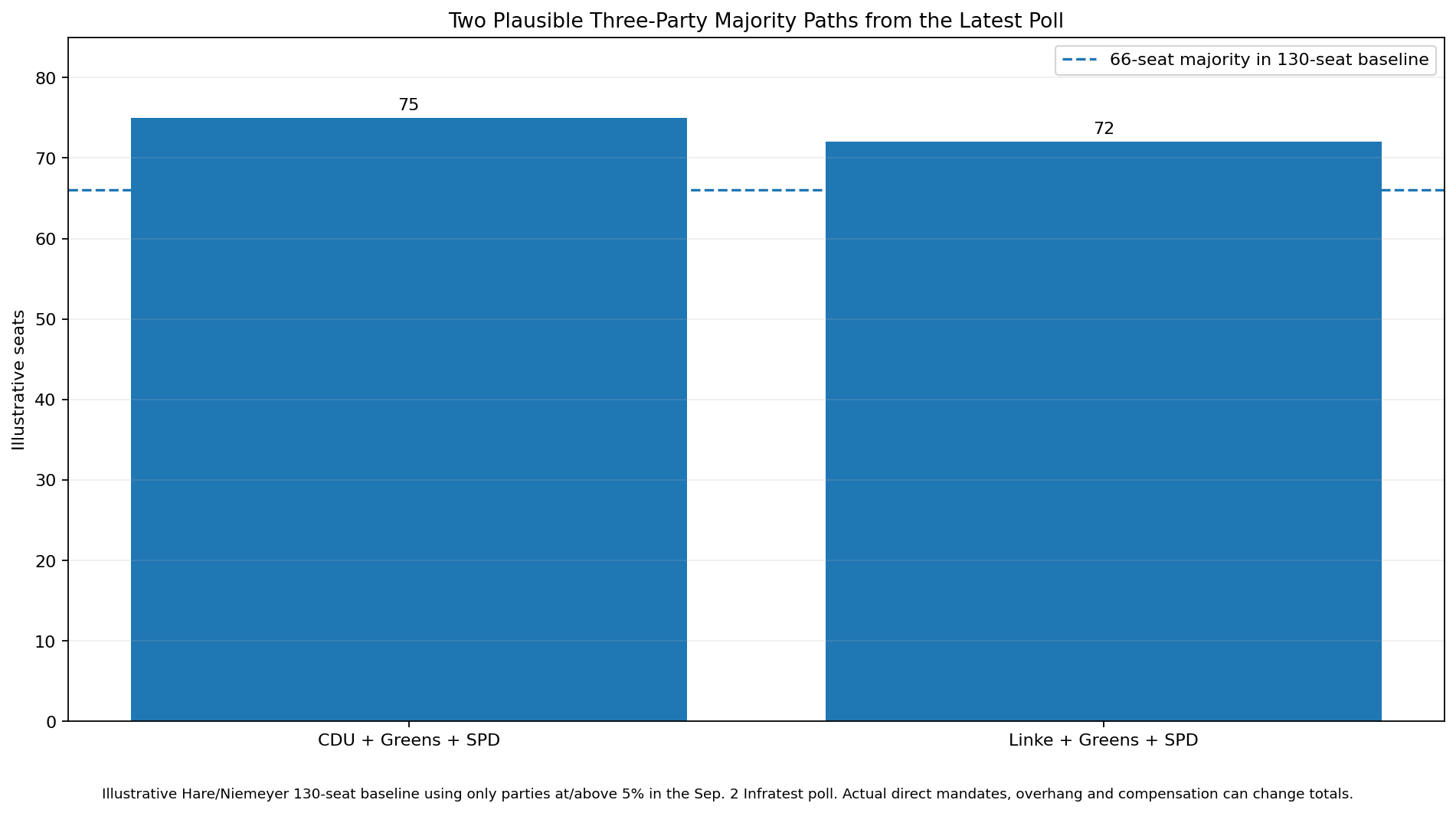
These are not official seat forecasts. Direct mandates, the actual threshold performance of smaller parties, overhang seats and compensatory seats can change the final chamber size. The chart simply explains why both Eralp and Evers have credible parliamentary majority paths.
Personal Standing: Eralp and Evers Are Tied
Infratest dimap also asked respondents whom they would choose if the Governing Mayor were directly elected. Evers and Eralp each received 13%, followed by Krach at 9%, Brinker at 7% and Graf at 4%. A huge 54% did not choose a listed candidate or gave no answer.
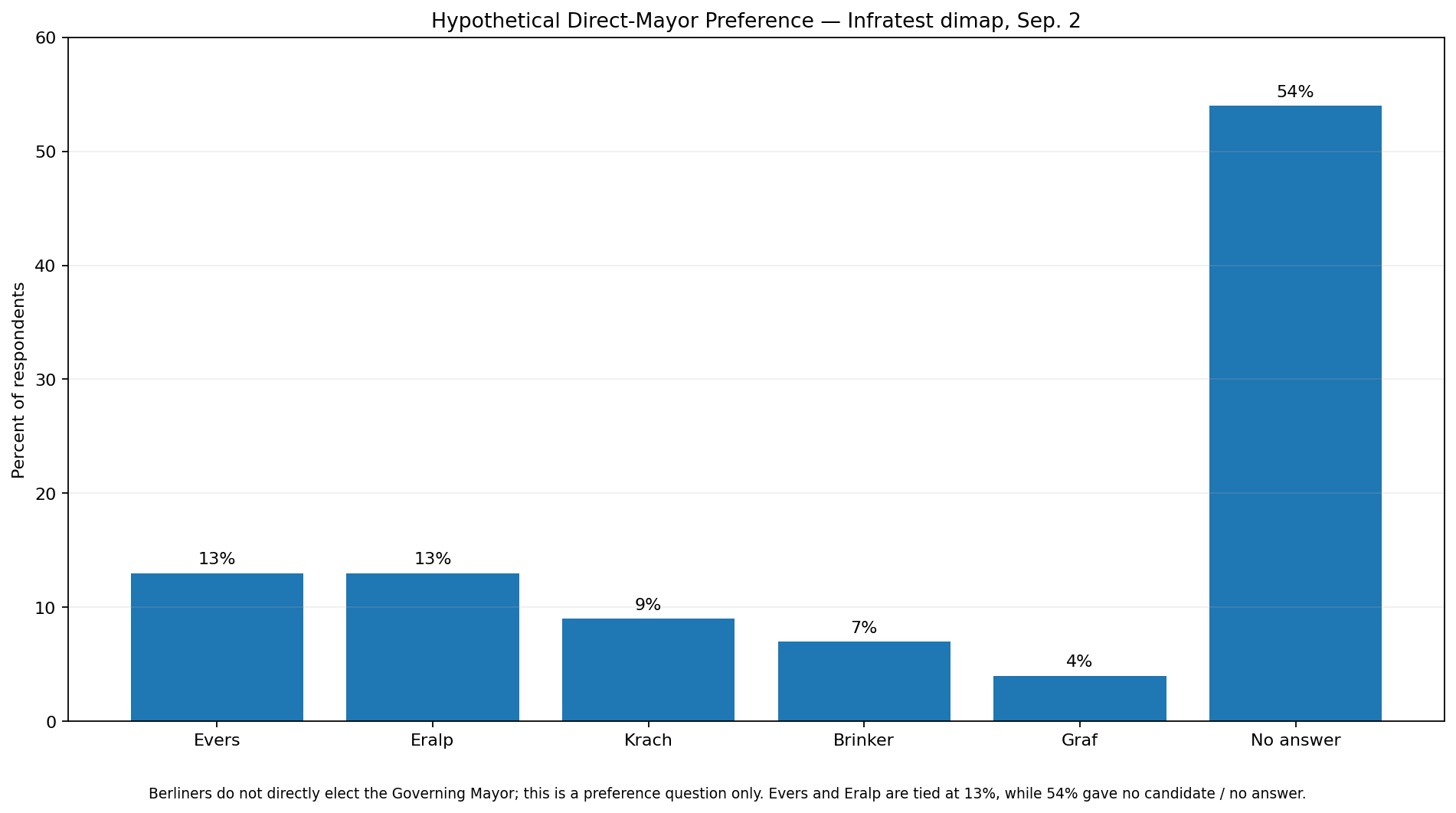
This is not the constitutional election mechanism, so I give it only modest weight. But it is useful evidence against the idea that either Eralp or Evers has a dominant personal mandate.
Key Factors That Could Decide the Outcome
Primary factors: final CDU-versus-Linke seat strength, whether the Greens maintain their stated preference for Linke–SPD, whether SPD chooses a CDU- or Linke-led coalition, and the actual parliamentary majority after threshold effects and direct mandates.
Secondary factors: candidate popularity, housing and rent policy, migration and internal security, dissatisfaction with the current Senate, late tactical voting and post-election bargaining over cabinet portfolios.
Overall probability outlook: I see Eralp as a narrow favorite because the current left-of-center coalition preference gives her a cleaner partner pathway. Evers is extremely close because CDU leads the latest poll and has a mathematically viable coalition with Greens and SPD. The market is fundamentally a coalition-negotiation forecast.
Weighted Candidate Comparison
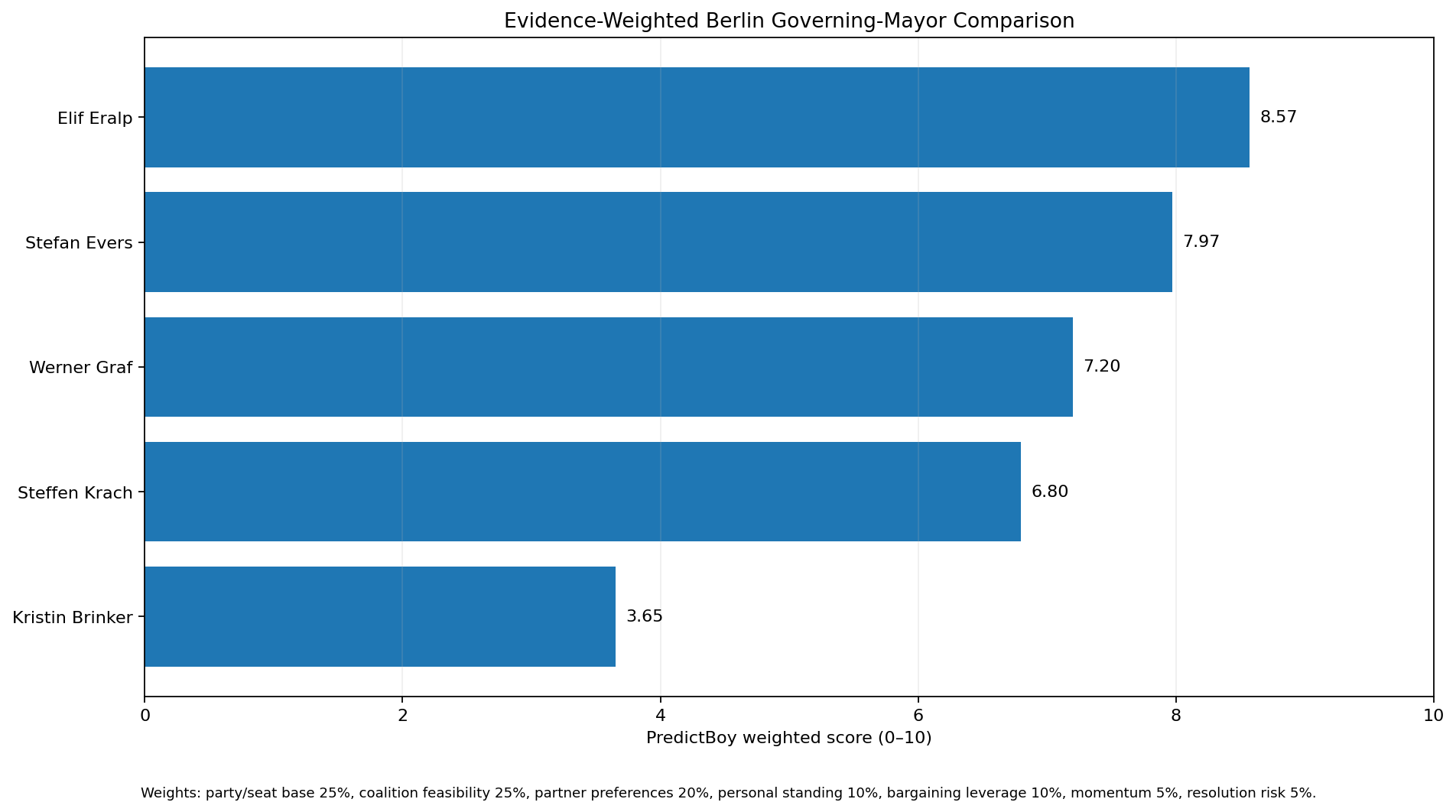
I score the five listed candidates from 0–10 across seven factors. The weights total 100%, and the scoring is independent of the current Polymarket prices.
| Factor | Weight | Candidate Scores | Key Evidence | Impact |
|---|---|---|---|---|
| Party polling / likely seat base | 25% | Eralp 8.5; Evers 9.0; Graf 8.0; Krach 5.5; Brinker 8.0 | Latest Infratest dimap: CDU 21%, Linke 19%, Greens 18%, AfD 18%, SPD 11%. | High |
| Coalition majority feasibility | 25% | Eralp 9.0; Evers 9.0; Graf 8.0; Krach 7.5; Brinker 1.0 | Both CDU–Greens–SPD and Linke–Greens–SPD can form illustrative majorities if below-threshold parties fail to enter. | High |
| Partner preferences and vetoes | 20% | Eralp 9.0; Evers 5.5; Graf 6.5; Krach 8.0; Brinker 0.5 | Werner Graf publicly prefers a Greens–SPD–Linke coalition and CDU opposition; SPD has ruled out only AfD, leaving both democratic paths formally open. | High |
| Personal candidate standing | 10% | Eralp 7.5; Evers 7.5; Graf 4.0; Krach 6.0; Brinker 5.5 | Infratest direct-mayor hypothetical: Evers 13%, Eralp 13%, Krach 9%, Brinker 7%, Graf 4%. | Medium |
| Bargaining leverage / compromise optionality | 10% | Eralp 9.0; Evers 8.5; Graf 8.5; Krach 7.5; Brinker 2.0 | Greens and SPD are pivotal in both plausible majority blocs, giving Graf and Krach more bargaining relevance than their raw Polymarket prices suggest. | Medium |
| Campaign momentum | 5% | Eralp 7.0; Evers 7.5; Graf 6.0; Krach 5.0; Brinker 6.0 | CDU regained first place in the latest BerlinTrend while Linke fell three points; the race remains fluid. | Low |
| Resolution timing / installation risk | 5% | Eralp 8.0; Evers 8.0; Graf 7.0; Krach 7.0; Brinker 5.0 | The market requires the new mayor to be officially sworn in; if nobody takes office by May 31, 2027, the rules resolve to Other. | Low |
Overall Weighted Scores
| Candidate | Weighted Score / 10 | Interpretation |
|---|---|---|
| Elif Eralp | 8.57 | Narrow analytical favorite: strong Linke seat base plus the Greens’ stated preferred coalition path. |
| Stefan Evers | 7.97 | Close second: CDU leads the latest poll and Evers is tied for first in the direct-mayor preference question. |
| Werner Graf | 7.20 | Pivotal-party candidate with compromise optionality, but Greens publicly prefer a coalition led with SPD and Linke. |
| Steffen Krach | 6.80 | SPD is weak in polls but may be indispensable to either mainstream three-party coalition, giving Krach bargaining optionality. |
| Kristin Brinker | 3.65 | AfD polls strongly, but the absence of coalition partners makes a House majority for Brinker extremely difficult. |
What the Market May Be Underestimating
1. SPD’s leverage. With only about 11% in the latest poll, SPD looks weak electorally. But it may be necessary for either of the two most plausible democratic three-party coalitions, giving Krach far more bargaining power than his party share suggests.
2. Evers is not merely “the CDU candidate.” His party currently leads the latest poll and he is tied with Eralp in the direct-mayor preference question. If Greens soften their anti-CDU stance after election night, his probability can rise quickly.
3. The Greens can shape the mayor even if Graf does not become mayor. Their coalition choice is central to whether the Rotes Rathaus goes to Eralp or Evers.
4. The third ballot changes the tail risk. Article 56 allows a third ballot to be decided by a plurality if two absolute-majority ballots fail. A prolonged coalition breakdown therefore creates paths that are hard to model from pre-election polling alone.
5. The “Other” deadline matters. Polymarket’s fallback if no new mayor is sworn in by May 31, 2027 creates a small but real tail that is not captured by simply dividing probability among the five listed candidates.
Bull Case and Bear Case for Each Major Candidate
Elif Eralp
Bull case: Linke finishes first or close to first, Greens keep their stated preference for Linke–SPD, and SPD accepts Eralp as the leader of a left-of-center coalition.
Bear case: CDU wins clearly, SPD prefers a centrist coalition, or disagreements over policy and cabinet control prevent a Linke-led deal.
Stefan Evers
Bull case: CDU remains the largest party, Evers strengthens during the final campaign, and SPD plus Greens decide that a CDU-led three-party coalition is the most workable majority.
Bear case: Greens maintain their public preference for keeping CDU in opposition and SPD chooses the Linke–Greens route.
Werner Graf
Bull case: Greens become the indispensable middle force and the larger parties accept Graf as a compromise mayor to unlock a coalition.
Bear case: Graf’s own stated preference points toward a coalition led by Linke rather than a Green claim to the mayoralty.
Steffen Krach
Bull case: SPD becomes the decisive kingmaker and uses that leverage to demand the mayoralty as the price of joining either mainstream coalition.
Bear case: an 11–12% party share makes it politically difficult to justify giving SPD the city’s top office when a coalition partner is substantially larger.
Kristin Brinker
Bull case: AfD dramatically outperforms polls and parliamentary coalition norms break down after an unexpected election result.
Bear case: without coalition partners, AfD cannot produce the House majority normally needed to elect the Governing Mayor.
Key Risks and Uncertainties
- Polling volatility: CDU, Linke, Greens and AfD are separated by only a few points.
- Threshold effects: BSW is currently around 4%; crossing 5% would change the seat distribution.
- Direct mandates: constituency results can affect which parties enter and the final parliament size.
- Coalition reversals: public pre-election preferences are not binding after election night.
- Third-ballot mechanics: a failed coalition process can change who is viable under Article 56.
- Candidate substitution: post-election negotiations can theoretically elevate a person who is not currently the obvious lead candidate.
- Swearing-in requirement: a caretaker or interim mayor does not resolve Polymarket.
PredictBoy Probability Assessment
Analytical assumption: my probabilities are normalized across the five listed candidates plus an Other fallback. They represent my estimate of who will actually be sworn in, not simply who wins the party vote.
| Outcome | PredictBoy Probability | Reasoning |
|---|---|---|
| Elif Eralp | 46% | Narrow favorite because Linke remains near the top of polls and Greens publicly prefer a Linke–SPD coalition path. |
| Stefan Evers | 38% | CDU leads the latest poll, Evers ties Eralp in personal preference, and CDU–Greens–SPD has a viable majority. |
| Werner Graf | 8% | Greens are pivotal and Graf has compromise optionality, but his own coalition preference favors a Linke-led path. |
| Steffen Krach | 5% | SPD’s polling is weak, but its kingmaker role creates a plausible bargaining upset. |
| Kristin Brinker | 0.5% | AfD has significant support but lacks a realistic coalition majority. |
| Other | 2.5% | Unexpected officeholder, prolonged deadlock or the market’s May 31, 2027 fallback scenario. |
Market Odds vs. PredictBoy Assessment
Polymarket currently shows Eralp at 49%, Evers at 36%, Graf at 8.7%, Krach around 1% and Brinker below 1%. My main disagreement is not at the top: I have Eralp 46% and Evers 38%, which is close to the market.
The larger difference is in the tails. I assign 5% to Krach because SPD can be indispensable to both plausible majority blocs, and I reserve 2.5% for Other because the actual constitutional and resolution process can produce outcomes not captured by a simple pre-election candidate ranking.
What Could Change Before September 20?
One more BerlinTrend: a clear CDU or Linke breakout would change which leader can credibly claim the mayoralty after election night.
Greens coalition language: if Graf softens or hardens his public opposition to CDU participation, Evers’ odds should react immediately.
SPD positioning: any explicit endorsement of either a CDU-led or Linke-led coalition would be one of the most important pieces of information for this market.
BSW crossing 5%: a new party entering the House changes the coalition denominator and may make three-party arithmetic tighter.
Election-night direct mandates: the real seat map can differ materially from a simple proportional poll conversion.
Final Take
Verified facts: Berlin votes on September 20; the Governing Mayor is elected by the Abgeordnetenhaus rather than directly by voters; CDU leads the latest Infratest poll at 21%; Linke follows at 19%; Evers and Eralp are tied at 13% in a hypothetical direct-mayor question; and Greens lead candidate Werner Graf says he prefers a coalition with SPD and Linke.
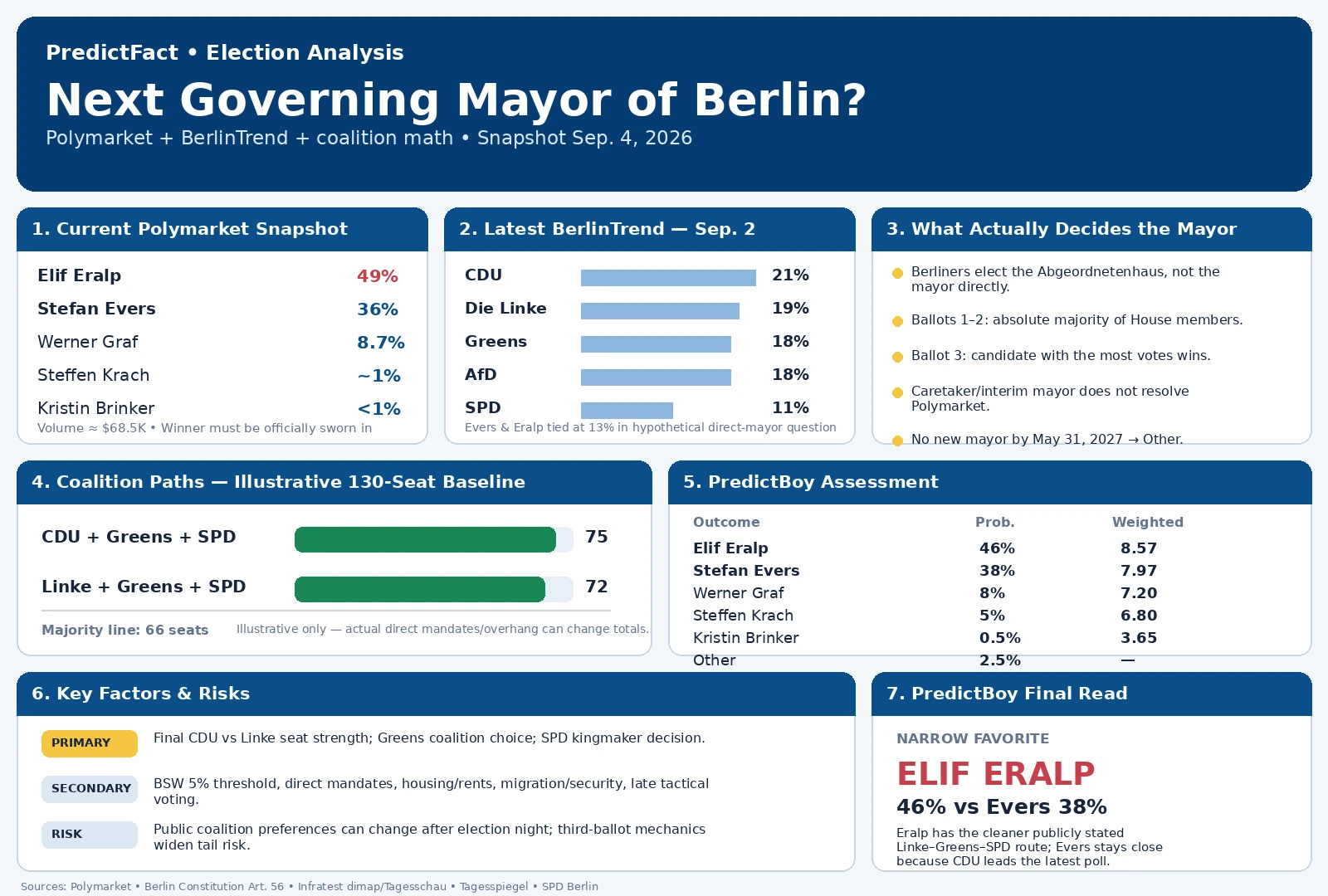
PredictBoy analysis: I make Elif Eralp the narrow favorite at 46%, with Stefan Evers close behind at 38%. Eralp has the cleaner publicly stated coalition pathway; Evers has the stronger latest party-poll position. The election result matters, but the post-election coalition agreement matters even more.
The practical takeaway is that this is not a conventional candidate popularity contest. The next Governing Mayor will be the person who can assemble the votes inside the Abgeordnetenhaus. That makes coalition preferences, seat thresholds and bargaining leverage more valuable than a simple headline poll.
Editorial note: This article is analytical information and decision support. Prediction-market prices are not guaranteed real-world probabilities, and this is not financial advice.
Sources and Methodology
- Polymarket — Next Governing Mayor of Berlin?
- Berlin Constitution — Article 56
- Berlin State Agency for Civic Education — 2026 Abgeordnetenhaus election system
- Tagesschau / Infratest dimap — September 2 BerlinTrend
- Wahlrecht — Berlin polling history
- DAWUM — Forsa August 22 poll
- Tagesspiegel — Werner Graf coalition preference
- SPD Berlin — Steffen Krach coalition statement
- Wikimedia Commons — Elif Eralp photo, Ferran Cornellà, CC BY-SA 4.0
- Wikimedia Commons — Stefan Evers photo, Tobias Koch, CC BY-SA 4.0
- Wikimedia Commons — Werner Graf photo, Vincent Villwock, CC BY-SA 4.0
- Wikimedia Commons — Rotes Rathaus photo, Fred Romero, CC BY 2.0


.jpg)
.jpg)
