

What Will Gold (GC) Hit by End of December? Polymarket Odds & PredictBoy Analysis
What Will Gold (GC) Hit by End of December? Polymarket Odds & PredictBoy Analysis
By PredictBoy — This market looks simple until you read the resolution rules. It is not asking whether spot gold flashes a number on a screen. Each threshold resolves from the official CME settlement price for the Active Month of Gold (GC) futures, and only settlements published after market creation and through the final trading day of December 2026 count.
The macro setup is unusually two-sided. Gold is still supported by central-bank buying, geopolitical uncertainty and long-term reserve diversification, but September’s jump in expected Federal Reserve tightening, higher Treasury yields and a stronger dollar are direct headwinds. That makes the $5,000 settlement threshold the most useful live battleground in this ladder.
What This Polymarket Market Asks
Polymarket lists a ladder of independent Gold (GC) thresholds: upside levels from $4,500 to $15,000 and downside levels including $3,500, $3,000 and $2,500. These contracts are not mutually exclusive. If an official Active-Month settlement reaches $5,000, then lower upside thresholds that qualify under the rules can also be Yes.
The latest directly retrievable Polymarket event page available to this build showed roughly about $1.65M total volume. Because Polymarket prices move continuously and the directly retrievable page was indexed several days before this research run, treat the quoted ladder below as a documented market snapshot, not a guaranteed live executable quote.
Resolution Rules and What Counts
For an upside contract, the market resolves Yes if on any eligible trading day the official CME settlement for the Active Month is equal to or above the listed threshold. For a downside contract, the settlement must be equal to or below the listed level.
- The Active Month is the nearest designated delivery-cycle month — February, April, June, August, October or December — that is not the spot month.
- The Active Month changes automatically on the contract’s First Position Date.
- Only CME’s official settlement counts. Intraday highs/lows, bids, offers, midpoint values, indicative prices and last trades do not count.
- Weekends, holidays and days without a published settlement are ignored.
- The first published settlement for that trading day controls even if CME later corrects or updates the page.
- Price action before market creation on January 29, 2026 does not count.
Current Market Snapshot
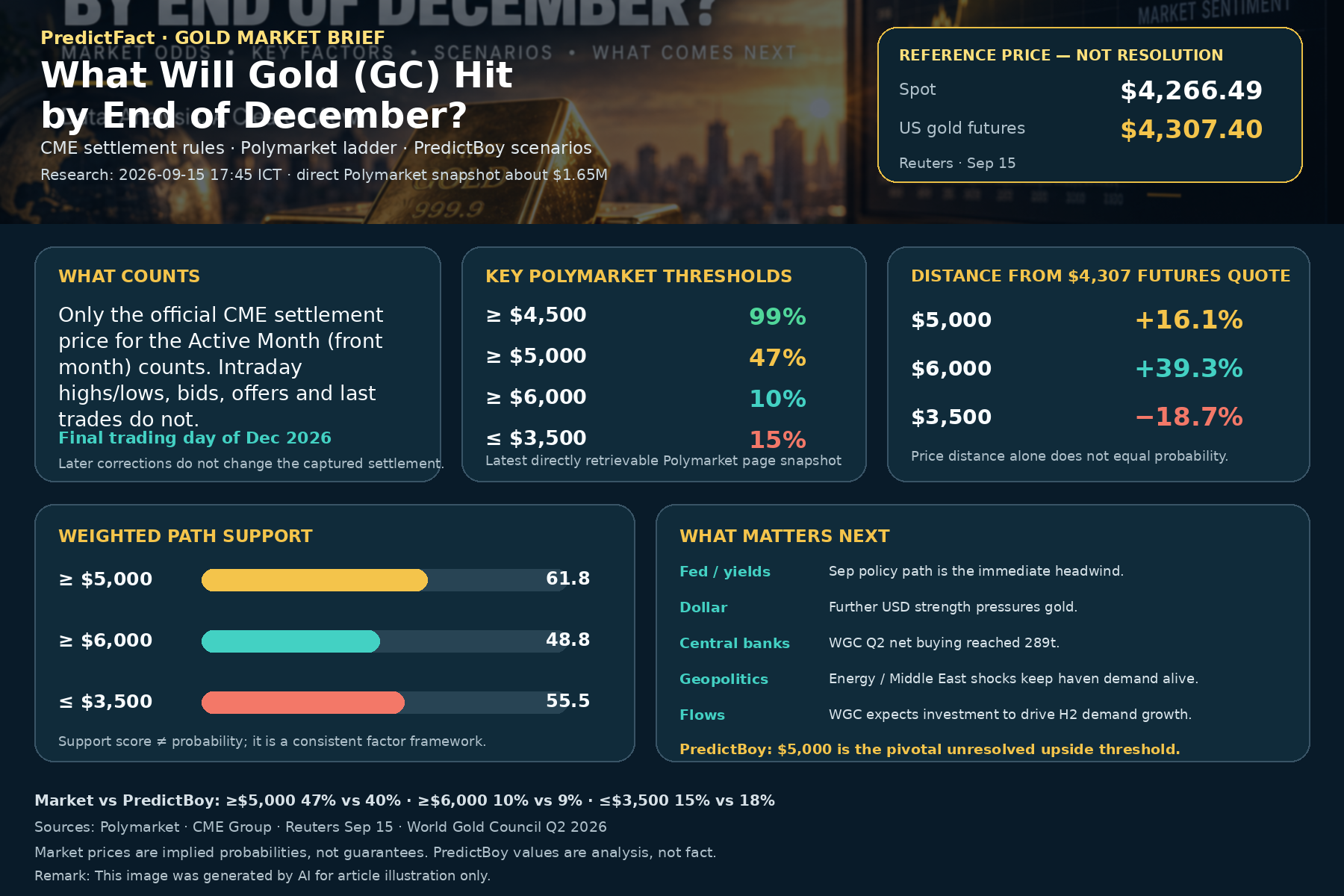
Research timestamp: 2026-09-15 17:45 ICT (2026-09-15 10:45 UTC). Reuters reported spot gold around $4,266.49/oz and U.S. gold futures around $4,307.40 on September 15. Those are useful market references, but they are not the settlement values that resolve this Polymarket contract.
| Threshold | Latest direct Polymarket snapshot used | PredictBoy assessment | Read-through |
|---|---|---|---|
| ≥ $4,500 | 99% | 99% | Effectively treated by the market as already satisfied / nearly certain under the rule history. |
| ≥ $5,000 | 47% | 40% | The pivotal unresolved upside threshold. |
| ≥ $6,000 | 10% | 9% | Requires a much larger second-half reacceleration. |
| ≥ $7,000 | 5% | 4% | Extreme upside tail. |
| ≤ $3,500 | 15% | 18% | Downside shock path; slightly underpriced in my framework. |
From the Reuters futures reference near $4,307, $5,000 is about 16% higher, $6,000 about 39% higher, and $3,500 about 19% lower. Those distances are not probabilities, but they show why $5,000 can be genuinely contestable while $6,000 remains a tail event.
Main Outcomes
Gold settles at or above $5,000
This is the central upside question. The route exists if geopolitical stress, central-bank demand and investment flows overwhelm the headwind from rates and the dollar. It does not require gold to stay above $5,000 for long, but it does require an official Active-Month settlement at or above the level.
Gold settles at or above $6,000
This needs a more powerful regime shift. With the futures reference near $4,307, the move is close to 40%. A renewed crisis, sharp reversal in real yields, dollar weakness and strong investment inflows would probably need to reinforce each other.
Gold settles at or below $3,500
The downside case becomes more credible if the Fed stays tighter for longer, the dollar strengthens further and high real yields force investment liquidation. Structural official-sector demand is the main reason I do not put this path higher.
Key Factors
Primary factors: Federal Reserve policy and real yields; U.S. dollar direction; central-bank buying; geopolitical safe-haven demand; investment/ETF/OTC flows; and the remaining distance to each settlement threshold.
Secondary factors: oil-driven inflation, Treasury-market stress, recycling and mine supply response, Asian physical buying, liquidity around contract rolls and short-lived volatility that may fail to survive into settlement.
Weighted Outcome Comparison
| Factor | Weight | ≥ $5,000 | ≥ $6,000 | ≤ $3,500 | Key Evidence / Impact |
|---|---|---|---|---|---|
| Fed / real-yield pressure | 25% | 4.5/10 | 3.5/10 | 8.0/10 | Higher expected policy rates and rising real/nominal yields pressure upside and support downside risk. |
| US dollar direction | 15% | 5.0/10 | 4.0/10 | 7.5/10 | A stronger dollar is a headwind to gold; a reversal would improve the upside paths. |
| Central-bank / physical demand | 20% | 8.0/10 | 7.0/10 | 3.0/10 | WGC reported 289t of central-bank buying in Q2 and expects significant buying to continue. |
| Geopolitical / safe-haven demand | 15% | 8.0/10 | 7.5/10 | 3.5/10 | Middle East supply shocks and broader uncertainty support haven demand, though inflation can also lift yields. |
| Momentum / volatility | 10% | 6.0/10 | 5.0/10 | 5.5/10 | Gold remains highly volatile after a 2026 record above $5,500 and subsequent deep pullback. |
| Distance + time to threshold | 15% | 6.0/10 | 2.5/10 | 5.0/10 | At a futures quote near $4,307, $5,000 needs ~16%, $6,000 ~39%, while $3,500 is ~19% lower. |
The weighted support scores are 61.75/100 for ≥$5,000, 48.75/100 for ≥$6,000 and 55.50/100 for ≤$3,500. These are not calibrated probabilities. They are a consistent way to compare how the same drivers support or oppose each path.

Gold Market Evidence Analysis
Rates and the dollar are the immediate headwind
Reuters reported on September 15 that gold fell as the probability of a Fed hike rose sharply. U.S. futures were around $4,307.40 and spot around $4,266.49. Higher yields increase the opportunity cost of holding non-yielding gold, while a stronger dollar makes bullion more expensive for many non-dollar buyers.
Central-bank demand remains a structural support
The World Gold Council reported 289 tonnes of central-bank net purchases in Q2, a strong rebound from Q1. It expects central banks to remain significant buyers through the rest of 2026. That demand does not prevent sharp corrections, but it can create a meaningful structural floor.
Investment flows are mixed, not one-way bullish
WGC said Q2 investment demand excluding OTC fell to 262t and gold ETFs saw 45t of outflows as rate expectations and the dollar moved against gold. At the same time, OTC buying — especially in Asia — remained strong, and WGC still expects investment to be the principal source of demand growth through the second half.
Geopolitics can help gold and hurt gold at the same time
Middle East supply shocks support haven demand, but they can also lift oil, inflation expectations and bond yields. That is why geopolitical escalation is not automatically a straight-line bullish input for gold in this environment.
What the Market May Be Underestimating
The biggest underappreciated issue is settlement filtering. An intraday spike above $5,000 can generate dramatic headlines and still leave the Polymarket contract unresolved if the official Active-Month settlement finishes below the threshold. The market may also be underpricing the possibility that high yields remain elevated longer than gold bulls expect.
On the other side, a downside-only macro view can understate central-bank and Asian physical demand. Gold has already shown in 2026 that official-sector and safe-haven demand can coexist with unusually high nominal yields.
Bull and Bear Case for the Major Outcomes
Bull case for ≥ $5,000
Gold only needs one eligible settlement at or above the threshold. A meaningful dollar reversal, renewed global risk aversion, stronger investment inflows or a softer Fed path could close a 16% gap surprisingly quickly in a volatile market.
Bear case for ≥ $5,000
The Fed is moving the other way right now. A September hike, persistent inflation and 10-year yields above 5% can keep gold under pressure. Even an intraday rally does not help if settlement misses the level.
Bull case for ≥ $6,000
A genuine crisis regime could do it: sharp policy reversal, dollar weakness, accelerating official-sector demand and a strong speculative/investment wave. But it likely requires several bullish drivers simultaneously.
Bull case for ≤ $3,500
A sustained hawkish Fed, stronger dollar, liquidation from ETFs and leveraged positions, and fading geopolitical demand could produce a deep drawdown. The main obstacle is the underlying official-sector and physical demand base.
Risks and Uncertainties
- The directly retrievable Polymarket ladder is not a guaranteed live executable quote; prices can change between indexing and reading.
- Reuters spot and futures quotes are contextual reference prices, not the official CME settlement used for resolution.
- Contract rolls can change which delivery month is the Active Month.
- Geopolitical events can move gold, the dollar, oil and yields in conflicting directions.
- Prediction-market liquidity and spreads vary sharply by threshold; a displayed percentage is not guaranteed execution.
PredictBoy Probability Assessment
PredictBoy analysis — not fact: I assign 40% to ≥$5,000, 9% to ≥$6,000, 4% to ≥$7,000 and 18% to ≤$3,500. These probabilities are non-exclusive because more than one threshold can resolve Yes.
My central view is that the market is slightly too bullish on $5,000 and slightly too relaxed about the downside tail. I still keep the ≥$5,000 probability substantial because gold’s 2026 volatility and structural demand make a 16% move plausible before year-end.
Market Odds vs. PredictBoy
| Threshold | Polymarket snapshot | PredictBoy | Difference |
|---|---|---|---|
| ≥ $5,000 | 47% | 40% | PredictBoy 7 pts lower |
| ≥ $6,000 | 10% | 9% | Broadly aligned |
| ≥ $7,000 | 5% | 4% | Broadly aligned |
| ≤ $3,500 | 15% | 18% | PredictBoy 3 pts higher |
What Could Change Before Resolution
- September Fed decision and guidance: the most immediate macro catalyst.
- Inflation and labor data: can shift the expected rate path and dollar/yield complex.
- Middle East energy disruptions: can increase haven demand but also inflation pressure.
- Central-bank purchase data: confirmation of continued official buying would strengthen the structural bull case.
- ETF and OTC flow reversal: a large Western investment return could accelerate upside.
- Contract roll dates: the relevant Active Month changes automatically, so the exact futures basis matters.
Final Take
PredictBoy final analysis: $5,000 is the live decision point. At the locked market snapshot Polymarket was around 47%; I am at 40%. The near-term rate/yield/dollar backdrop is worse for gold than the market’s strongest bullish narrative suggests, but central-bank demand and geopolitical risk keep the upside alive. I see ≥$6,000 as a genuine tail and ≤$3,500 as a somewhat underpriced downside shock.
The most important practical lesson is mechanical: do not judge this contract from spot-gold headlines. Watch the correct CME Active-Month official settlement and the contract-roll schedule.
Sources
- Polymarket — What will Gold (GC) hit by end of December?
- CME Group — Gold Futures
- Reuters — Gold and Fed-rate expectations, September 15, 2026
- Reuters Poll — Fed outlook, September 14, 2026
- World Gold Council — Gold Demand Trends Q2 2026
- World Gold Council — 2026 Outlook
Disclosure: This is analytical information, not financial advice. Prediction-market prices and gold prices can change quickly. Affiliate links may generate revenue for PredictFact without changing the analysis.