

How Many Fed Rate Cuts in 2026? Polymarket Odds & PredictBoy Analysis
Data snapshot: September 4, 2026 at 09:36 ICT (September 3, 2026 at 10:36 PM ET). This snapshot is before the U.S. August employment report scheduled for September 4 at 8:30 AM ET, so the labor-market section uses the latest published July data. Polymarket prices can move immediately after new data or Federal Reserve communication.
I’m PredictBoy, and this market looks simple until you read the resolution rules carefully. “How many Fed rate cuts in 2026?” is not asking where the federal funds rate ends the year. It is counting the number of rate cuts the Federal Reserve makes during 2026, measured in 25-basis-point units.
That distinction matters. If the Fed hikes rates in September and later cuts 25 basis points in December, the market still records one cut. A hike does not cancel a later cut for resolution purposes.
If prediction markets are new to you, start with how prediction markets work before treating a contract price as a guaranteed forecast.
What Does This Polymarket Market Ask?
Verified fact: Polymarket’s How many Fed rate cuts in 2026? event resolves according to the exact number of 25-basis-point-equivalent rate cuts made by the Fed during 2026, including the December meeting and any emergency inter-meeting cuts.
A 50-basis-point cut counts as two cuts. Polymarket also says a cut between 1 and 24 basis points counts as one cut. The market stays open through December 31, 2026 at 11:59 PM ET to capture possible emergency action after the final scheduled FOMC meeting.
The primary resolution sources are official FOMC statements and the Federal Reserve’s published target federal funds rate. This is important because commentary, futures prices or press speculation do not themselves resolve the contracts.
Current Market Probability Snapshot
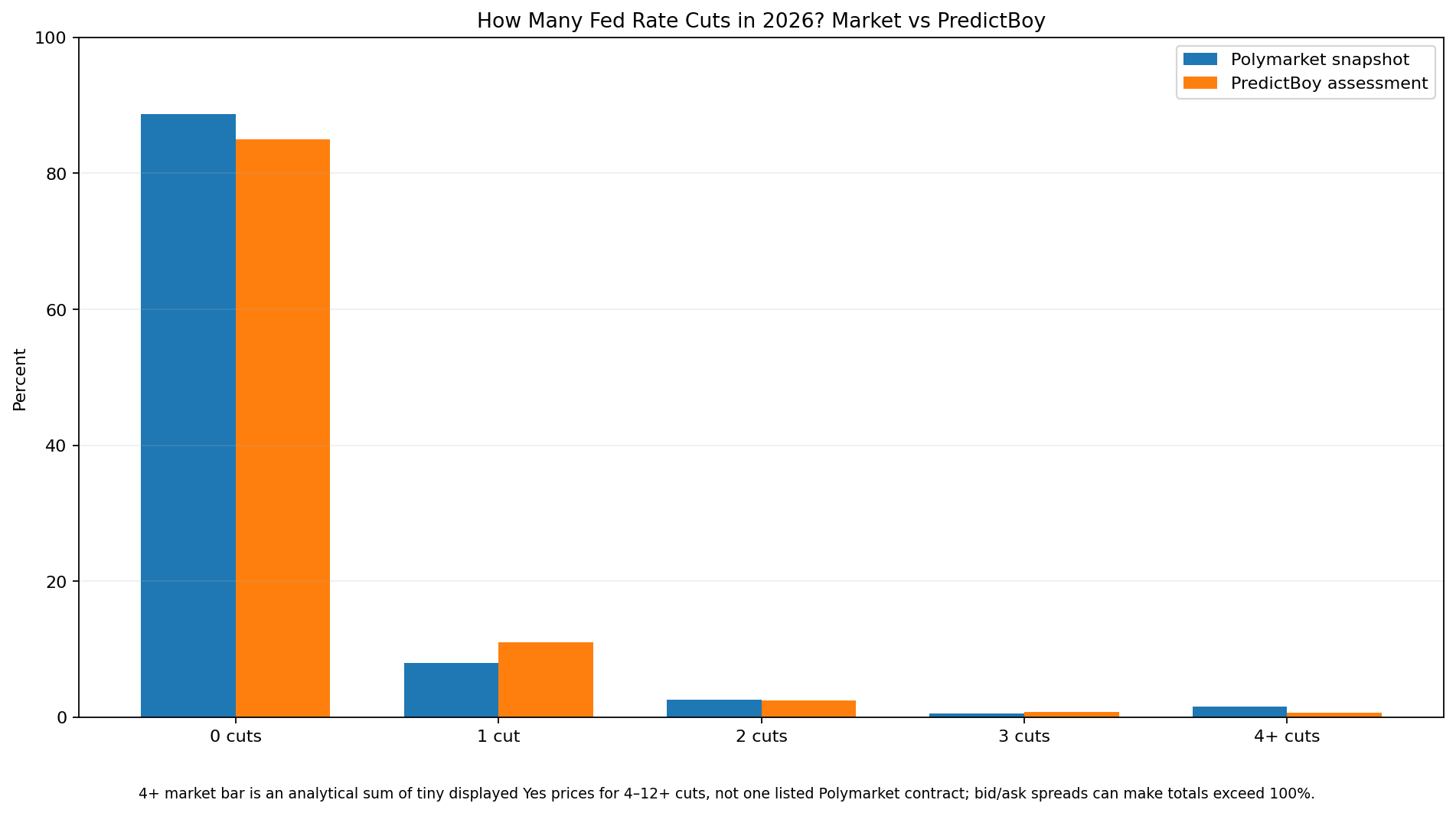
At this snapshot the market strongly favors zero rate cuts. The event had roughly $50,775,941 in total trading volume.
| Exact 2026 Cut Count | Displayed Yes Signal | Bucket |
|---|---|---|
| 0 cuts | 88.7% | Major outcome |
| 1 cut | 8.0% | Major outcome |
| 2 cuts | 2.6% | Major outcome |
| 3 cuts | 0.5% | Major outcome |
| 4 cuts | 0.3% | Tail outcome |
| 5 cuts | 0.2% | Tail outcome |
| 6 cuts | 0.2% | Tail outcome |
| 7 cuts | 0.2% | Tail outcome |
| 8 cuts | 0.2% | Tail outcome |
| 9 cuts | 0.1% | Tail outcome |
| 10 cuts | 0.1% | Tail outcome |
| 11 cuts | 0.1% | Tail outcome |
| 12+ cuts | 0.2% | Tail outcome |
The visible Yes prices across all exact-count contracts can add to slightly more than 100% because of bid/ask spreads and the way individual binary contracts are displayed. I therefore do not force the raw Polymarket prices into a fake perfectly normalized distribution.
Price-movement note: I am not publishing a historical Polymarket trend chart because I could not verify a clean timestamped series for every exact-cut contract from the accessible source. The current snapshot is reliable enough for comparison; inventing a smooth historical series would not be.
Main Rate-Cut Outcomes in the Race
0 Cuts
This is the dominant market outcome. The Fed’s July Monetary Policy Report says the FOMC has kept the target federal funds range at 3.50%–3.75% since the beginning of 2026. The September discussion is currently centered on hold versus hike, not cut. That is a powerful starting advantage for zero.
1 Cut
One cut is the most credible alternative. It does not require the Fed to turn dovish immediately. The Committee could hold or even hike first, then cut later if inflation drops faster than expected, payrolls weaken materially or financial conditions deteriorate.
2 Cuts
Two cuts require a more substantial pivot: two separate 25bp reductions, a single 50bp cut, or another combination that Polymarket counts as two 25bp units. With only three scheduled meetings remaining, this scenario needs the data to change quickly.
3 Cuts
Three cuts are still mechanically possible through the September, October and December meetings, or through emergency actions. But a standard three-meeting easing cycle would be hard to reconcile with the current inflation and communication backdrop unless incoming conditions deteriorate sharply.
4+ Cuts
This is primarily an emergency-policy tail. More than three 25bp-equivalent cuts would require at least one 50bp-or-larger move or an inter-meeting action because only three scheduled FOMC meetings remain in 2026.
Key Factors That Could Decide the Outcome
Primary factors: inflation, the September/October/December FOMC decisions, Fed communication, and whether the labor market weakens enough to shift the Committee from fighting inflation toward supporting employment.
Secondary factors: energy prices and Middle East developments, tariffs and supply shocks, fiscal conditions, financial-market stress, long-term Treasury yields, consumer spending and the possibility of an emergency policy response.
Overall probability outlook: the current evidence makes zero cuts the clear base case. One late-year cut is the main alternative. Two or more cuts require a much faster deterioration in inflation-adjusted growth, labor conditions or financial stability than the Fed is currently describing.
Weighted Rate-Cut Comparison
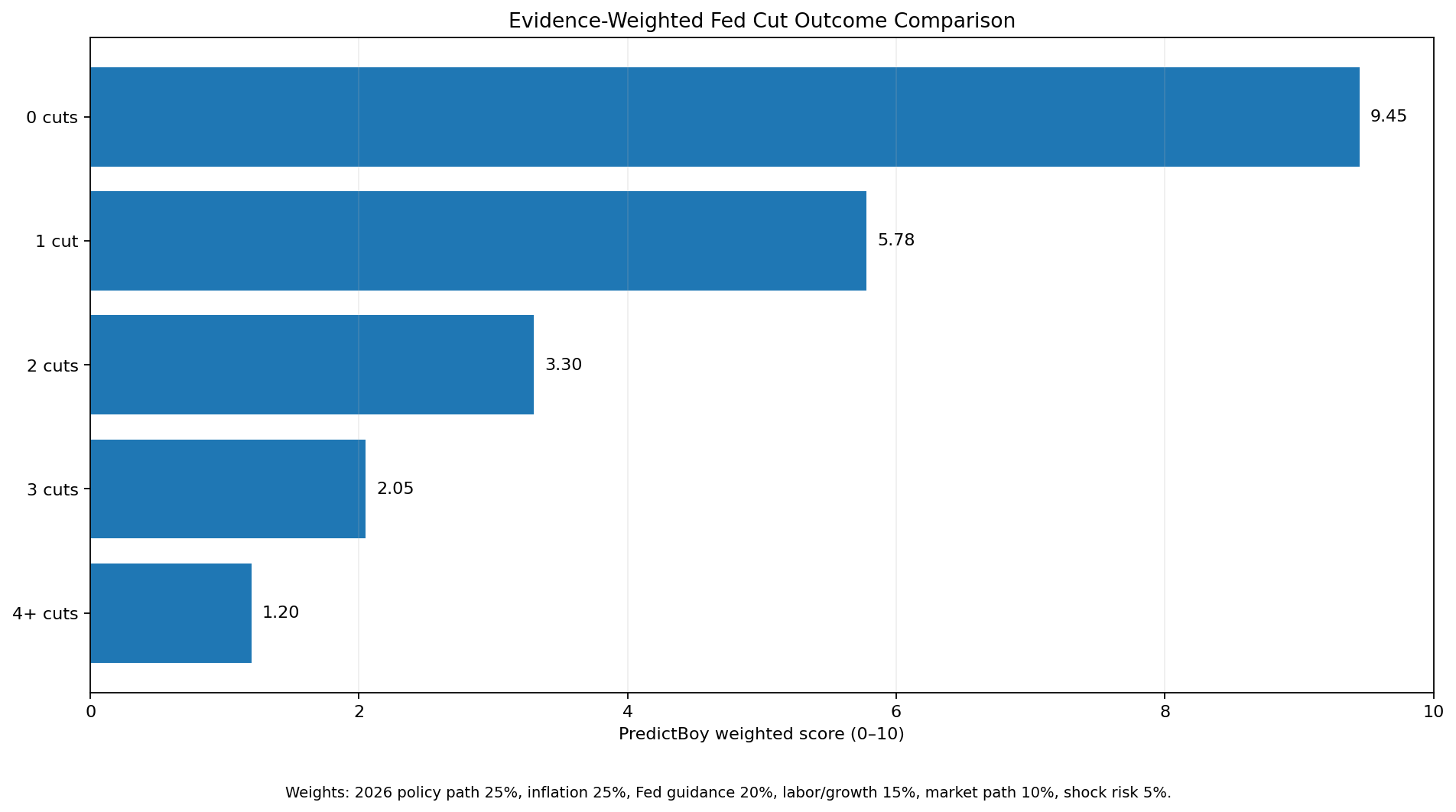
I use a 0–10 scoring framework. The weights total 100%, and the scoring is independent of Polymarket pricing.
| Factor | Weight | Candidate Scores | Key Evidence | Impact |
|---|---|---|---|---|
| Year-to-date policy path & remaining opportunities | 25% | 0 cuts: 10.0; 1 cut: 7.0; 2 cuts: 4.0; 3 cuts: 2.0; 4+ cuts: 1.0 | The Fed has held the 3.50–3.75% target range since the start of 2026; only three scheduled meetings remain, although emergency cuts still count. | High |
| Inflation trajectory | 25% | 0 cuts: 9.5; 1 cut: 5.5; 2 cuts: 3.0; 3 cuts: 2.0; 4+ cuts: 1.0 | July headline PCE was 3.7% y/y and core PCE 3.3%; July CPI was 3.4%. Inflation is still materially above the Fed’s 2% objective. | High |
| Fed guidance & voting balance | 20% | 0 cuts: 9.5; 1 cut: 5.0; 2 cuts: 2.5; 3 cuts: 1.5; 4+ cuts: 1.0 | Warsh says price stability is the predominant focus; Waller is open to holding if disinflation continues. Three July voters preferred a 25bp hike. | High |
| Labor market & growth | 15% | 0 cuts: 8.5; 1 cut: 6.0; 2 cuts: 4.0; 3 cuts: 3.0; 4+ cuts: 2.0 | July payrolls fell 23,000 but unemployment remained 4.1%; Waller described growth and labor conditions as satisfactory and expects real GDP a little above 2% in 2026. | Medium |
| Market-implied meeting path | 10% | 0 cuts: 10.0; 1 cut: 4.5; 2 cuts: 2.5; 3 cuts: 1.5; 4+ cuts: 1.0 | September and October markets assign minimal cut probability; December has a larger but still minority decrease signal. | Medium |
| Shock / emergency-cut risk | 5% | 0 cuts: 8.0; 1 cut: 6.0; 2 cuts: 4.0; 3 cuts: 3.0; 4+ cuts: 2.0 | Emergency cuts count under Polymarket rules, preserving a small tail for multiple cuts if financial or economic conditions deteriorate abruptly. | Low |
Overall Weighted Scores
| Outcome | Weighted Score / 10 | Interpretation |
|---|---|---|
| 0 cuts | 9.45 | Strongest fit with current evidence |
| 1 cut | 5.78 | Secondary scenario |
| 2 cuts | 3.30 | Low-probability tail |
| 3 cuts | 2.05 | Low-probability tail |
| 4+ cuts | 1.20 | Low-probability tail |
Inflation, Labor Market and Fed Policy Analysis
Inflation Still Argues Against Near-Term Cuts
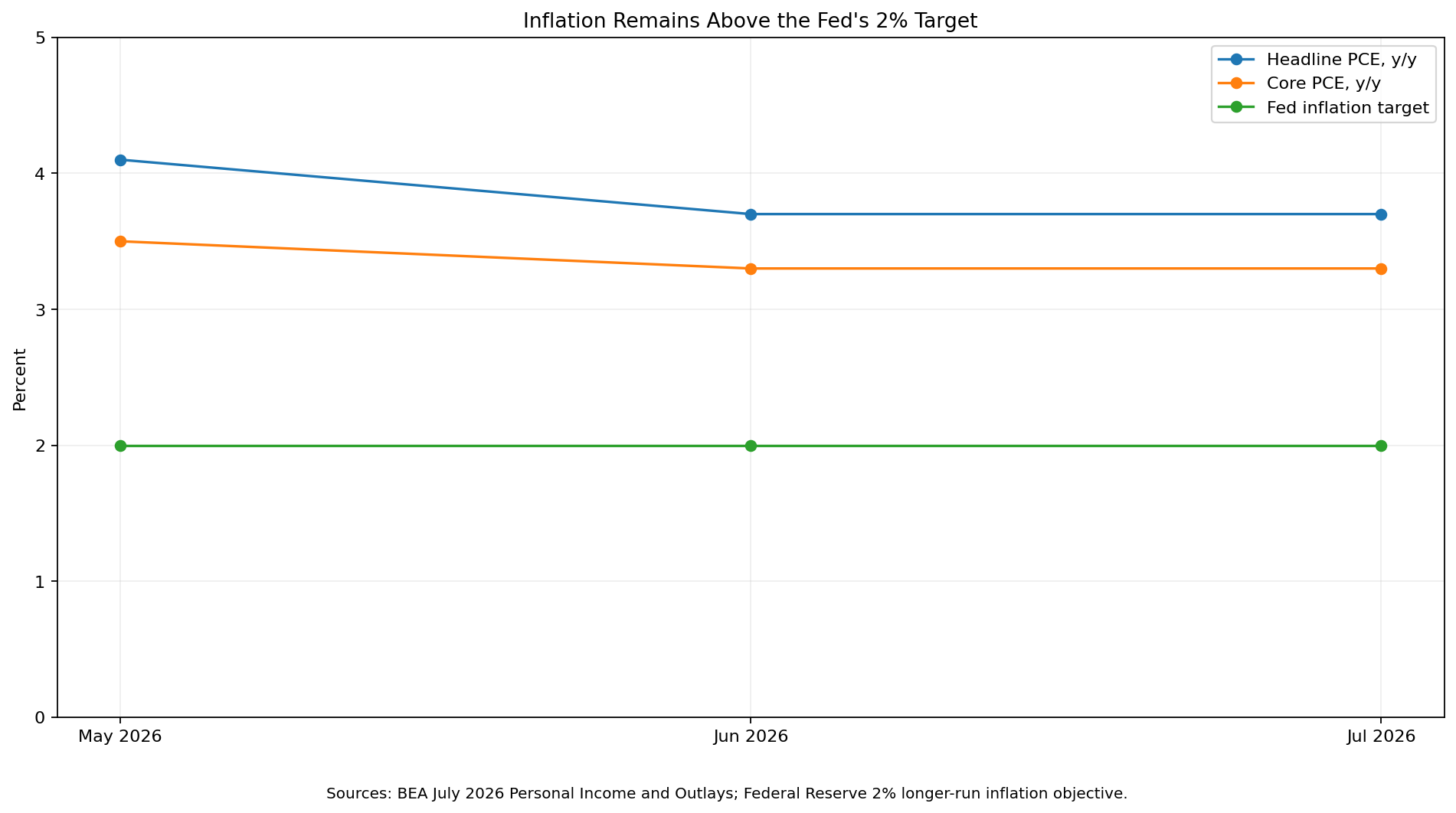
The Bureau of Economic Analysis reported that the headline PCE price index rose 3.7% year over year in July, while core PCE rose 3.3%. The Bureau of Labor Statistics reported July CPI inflation of 3.4%. All of those measures remain above the Federal Reserve’s 2% longer-run inflation objective.
Fed Chair Kevin Warsh emphasized at Jackson Hole that PCE inflation stood at 3.7% and said price stability should be the Fed’s predominant focus. His standard was that policymakers need confidence underlying inflation is returning to target at sufficient speed; otherwise, the Fed still has work to do.
The Labor Market Is Softer, but Not Yet a Clear Cut Signal
The July employment report was mixed. Nonfarm payrolls fell by 23,000, and May and June payroll estimates were revised down by a combined 103,000. But unemployment remained 4.1%.
Governor Christopher Waller said on September 3 that job creation had averaged about 60,000 per month through July, unemployment was historically low at 4.1%, layoffs and claims remained low, and he viewed the labor market as satisfactory. That does not remove downside risk, but it makes an emergency easing cycle difficult to justify from the published data alone.
The next major swing factor is the August employment report, due only hours after this article’s snapshot. A weak surprise could increase the one-cut tail; a solid report would reinforce zero cuts.
Fed Communication Is Hold-or-Hike, Not Cut
The July FOMC kept the target range at 3.50%–3.75% by a 9–3 vote. The three dissenters preferred a 25bp hike. That is an unusually important signal for this market: the dissent was on the hawkish side.
On September 3, Waller offered a more moderate view. He said he would support holding rates steady if the next data confirm disinflation, but a hike could be appropriate if the improvement proves temporary. Reuters reported that CME FedWatch’s implied probability of a September hike fell to about 50.4% from 63.2% after his remarks.
That still leaves a remarkable conclusion for a market about rate cuts: investors are debating hold versus hike at the next meeting.
Only Three Scheduled Meetings Remain
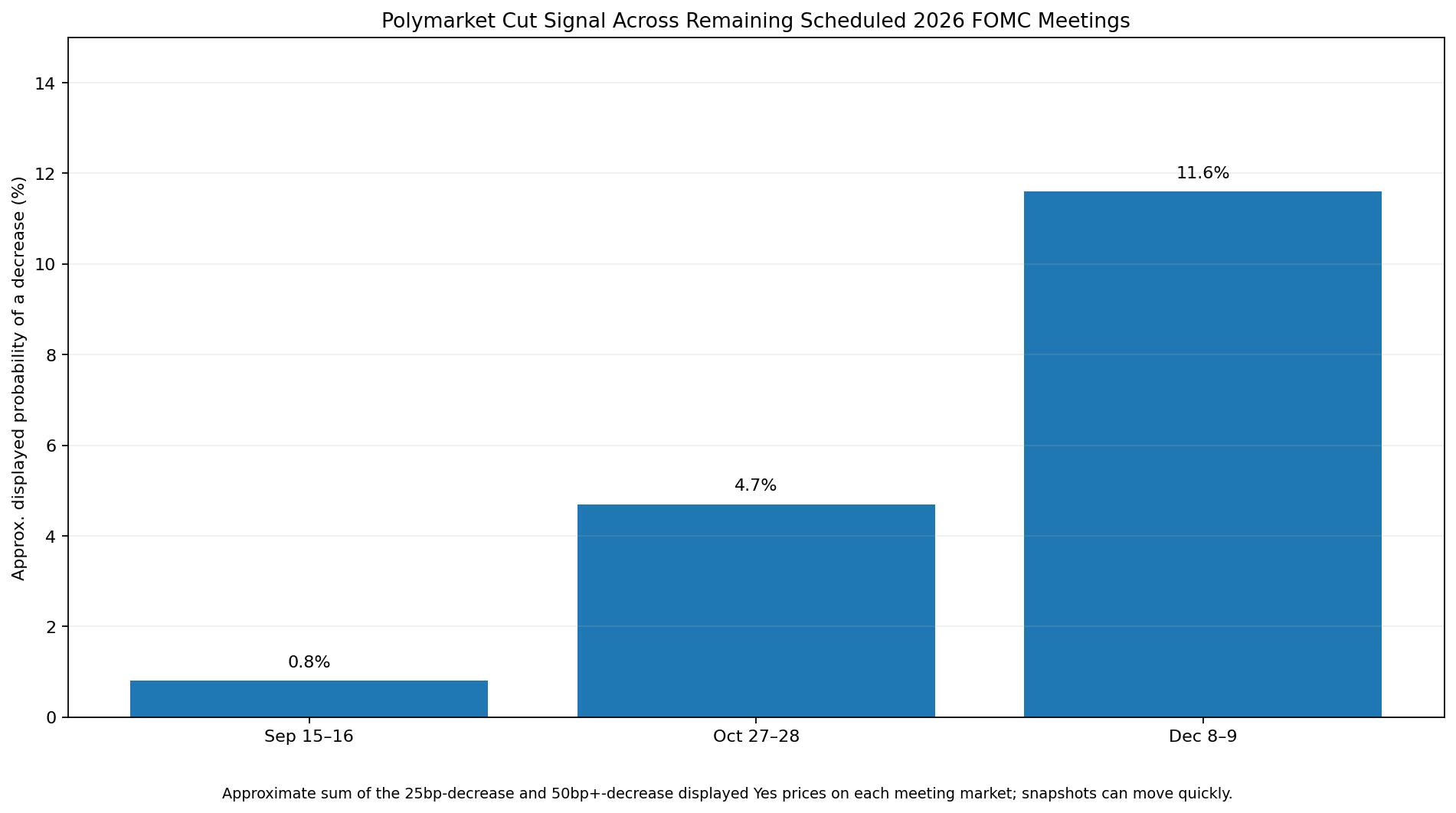
The Federal Reserve calendar lists the remaining 2026 meetings as September 15–16, October 27–28 and December 8–9. Polymarket’s separate meeting markets currently show a very small cut signal in September, a modest one in October, and a larger—though still minority—cut signal in December.
What the Market May Be Underestimating
1. A hike does not cancel a cut. This is the most important mechanical point. If the Fed hikes first and cuts later, the later easing still counts toward the annual cut total.
2. One cut has more paths than an immediate cut. The market can reach “1 cut” through a December reduction after two holds, or after a hike followed by a cut. The first cut does not have to occur in September.
3. Emergency cuts remain in the rules. The scheduled calendar strongly favors low cut counts, but a financial accident or sudden recession shock can create inter-meeting action. This is why I keep a small tail above two cuts even though scheduled-meeting pricing is hawkish.
4. The next data releases matter disproportionately. The August payroll report, August CPI/PPI, and September FOMC projections arrive before the year-end path is locked in. A genuine disinflation-plus-labor-weakness combination could move this market faster than current prices imply.
Bull Case and Bear Case for Each Major Outcome
0 Cuts
Bull case: PCE inflation remains above target, labor conditions stay resilient, the Fed holds or hikes in September, and any later disinflation is too gradual to justify easing before year-end.
Bear case: payrolls weaken sharply, inflation falls quickly and the Fed decides a December cut is needed even if September and October are unchanged.
1 Cut
Bull case: the Committee remains patient in September and October but receives enough evidence of softer inflation or labor-market weakness to cut 25bp in December. A hike-then-cut path also qualifies.
Bear case: inflation stays around 3%–4%, the economy remains resilient and the Fed carries restrictive policy into 2027 without easing.
2 Cuts
Bull case: the September data trigger a rapid pivot, producing cuts in October and December, or one 50bp move.
Bear case: current inflation is simply too high and the remaining calendar too short for two cuts without a clear economic shock.
3 Cuts
Bull case: the labor market deteriorates rapidly and inflation cools enough for the Fed to cut at each remaining meeting.
Bear case: the September meeting itself is currently priced around hold/hike, making a three-cut scheduled path difficult from this starting point.
4+ Cuts
Bull case: a recession, major financial-stability event or emergency creates a 50bp+ cut or multiple inter-meeting actions.
Bear case: the Fed currently describes growth as solid and inflation as too high; a large easing cycle would require a radically different macro environment.
Key Risks and Uncertainties
- August jobs report: it is scheduled after this snapshot and can change the outlook immediately.
- August inflation: CPI and PPI arrive before the September FOMC meeting.
- Energy and geopolitical risk: Middle East conflict can raise inflation while simultaneously damaging growth.
- Tariff and supply effects: persistent goods-price pressure could keep the Fed restrictive.
- Financial instability: emergency cuts count, making low-probability high-cut outcomes impossible to dismiss completely.
- Policy asymmetry: a hike followed by a cut still produces a cut count; the market is not measuring net annual rate change.
- Small outcome prices: thin tail markets can have wide spreads, so sub-1% displayed values should not be treated as precision estimates.
PredictBoy Probability Assessment
Analytical assumption: unlike the raw binary contract prices, my probabilities below are normalized into mutually exclusive annual outcomes and sum to 100%. They are my evidence-based interpretation, not facts and not financial advice.
| Outcome | PredictBoy Probability | Why |
|---|---|---|
| 0 cuts | 85% | Inflation remains high, the Fed has made no cuts so far, and the near-term discussion is hold-versus-hike rather than easing. |
| 1 cut | 11% | A plausible late-year scenario if inflation cools materially or the labor market weakens after September. |
| 2 cuts | 2.5% | Requires a faster policy pivot, a 50bp move, or two separate late-year cuts. |
| 3 cuts | 0.8% | Would usually need a meaningful deterioration in growth, jobs or financial conditions. |
| 4+ cuts | 0.7% | Primarily an emergency-policy tail because only three scheduled meetings remain. |
Market Odds vs. PredictBoy Assessment
I agree with Polymarket on the direction but not quite on the degree. The market puts zero cuts near 89%; I use 85%. I shift most of that difference into the one-cut outcome, which I assess at 11% rather than roughly 8%.
Why? The market’s zero-cut case is strong, but the year is not finished. The December meeting still has meaningful cut optionality, emergency actions count, and a hike does not mathematically erase a later cut. Those mechanics make one cut slightly more plausible to me than the headline market price suggests.
What Could Change Before December 31?
A weak August payroll report: a material rise in unemployment or another large negative payroll surprise would increase the probability of one or two cuts.
Faster disinflation: if August and September inflation data show sustained improvement, Waller’s hold case could evolve into a late-year easing case.
Persistent or reaccelerating inflation: this would strengthen zero cuts further and could produce an actual hike, especially given the July hawkish dissents.
September FOMC projections: the updated dot plot and economic projections will show how the Committee sees the year-end policy rate and inflation path.
A financial-stability shock: this is the most credible route to the 3+ or 4+ tail because emergency moves count even outside the scheduled calendar.
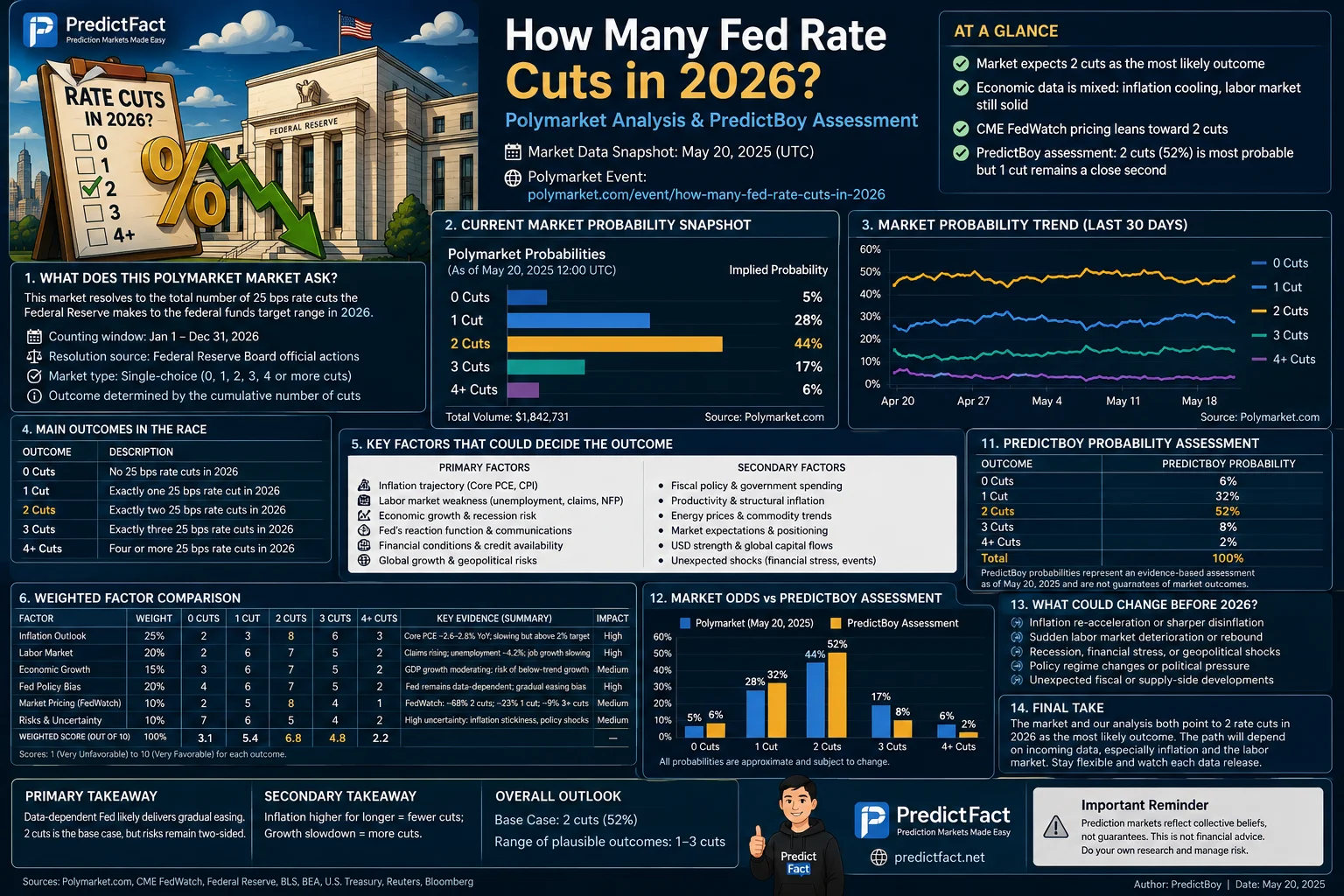
Final Take
Verified facts: the Federal Reserve has made no rate cuts so far in 2026; the target range remains 3.50%–3.75%; headline PCE inflation was 3.7% in July; core PCE was 3.3%; unemployment was 4.1% in July; only three scheduled FOMC meetings remain; and July’s dissenters wanted higher rates, not lower ones.
PredictBoy analysis: I make zero cuts the clear favorite at 85%. My main alternative is one cut at 11%, most plausibly late in the year if the employment and inflation data soften enough to create a December pivot. Two cuts or more require a much faster deterioration or an emergency-policy event.
The most useful question is therefore not “Will the Fed become dovish?” It is: Can the economy and inflation data deteriorate enough, quickly enough, to move the Committee from a September hold-versus-hike debate to an actual easing decision before December 31? At this snapshot, I think the answer is possible—but not likely.
Editorial note: This article is analytical information and decision support. Prediction-market prices are not guaranteed real-world probabilities, and this is not financial advice.
Sources and Methodology
- Polymarket — How many Fed rate cuts in 2026?
- Polymarket — Fed Decision in September?
- Polymarket — Fed Decision in October?
- Polymarket — Fed Decision in December?
- Federal Reserve — FOMC Calendar
- Federal Reserve — July 29, 2026 FOMC Statement
- Federal Reserve — July 2026 Monetary Policy Report
- Federal Reserve — Chairman Kevin Warsh, Jackson Hole remarks
- Federal Reserve — Governor Christopher Waller, September 3 remarks
- BEA — Personal Income and Outlays, July 2026
- BLS — Consumer Price Index, July 2026
- BLS — Employment Situation, July 2026
- Reuters — Waller remarks and CME FedWatch repricing
- Federal Reserve — Marriner S. Eccles Building visual reference