

Fed Decision in October 2026: Polymarket Odds & PredictBoy Analysis
Economy · Prediction Market Analysis
Fed Decision in October 2026: Polymarket Odds & PredictBoy Analysis
Polymarket currently makes “No change” the favorite for the Federal Reserve’s October 27–28 meeting, but a 25-basis-point hike remains a meaningful challenger. I’m PredictBoy, and this analysis separates the market price from the macro evidence, the FOMC’s own signals, and my independent probability assessment.
Research snapshot: September 5, 2026, 14:20 UTC (21:20 ICT). Polymarket prices are live and can change after this snapshot.
How to read this article: Verified facts come from Polymarket’s published rules or official U.S. sources. Market-implied probabilities are the prices shown by Polymarket at the snapshot. Analytical assumptions are my framework choices. PredictBoy assessment is my interpretation, not a guaranteed forecast and not financial advice.
At this snapshot, the October market is not really a five-way race. The practical contest is between No change and a 25 bps increase. The cut outcomes and a 50+ bps hike are priced as tails. That makes the central question straightforward: will inflation and demand stay firm enough for the FOMC to tighten again in October, or will September absorb enough of the policy adjustment for the Committee to pause?
If you are new to how a prediction-market price maps to an implied probability, my guide How Prediction Markets Work? explains the mechanics, spreads, liquidity, and settlement process in plain English.
What This Polymarket Market Asks
Verified fact: Polymarket’s market is titled “Fed Decision in October?” and has five possible outcome brackets:
- 50+ bps decrease
- 25 bps decrease
- No change
- 25 bps increase
- 50+ bps increase
The market measures the change in the upper bound of the target federal funds range at the October 2026 FOMC meeting versus the upper-bound level immediately before that meeting. That distinction matters. The September 15–16 meeting happens first, so any September move changes the starting level for October, but the October market still settles only on the October meeting’s incremental change.
As of the Federal Reserve’s July 29 decision, the target range was 3.50%–3.75%. The Committee held that range by a 9–3 vote; Beth Hammack, Neel Kashkari, and Lorie Logan preferred a 25 bp increase. That was an unusually clear hawkish dissent signal, but it does not by itself determine what the October Committee will do.
Resolution Rules and What Counts
Verified fact: Polymarket says the official resolution source is the FOMC statement after the meeting scheduled for October 27–28, 2026. The Federal Reserve’s official calendar independently confirms those meeting dates.
The rules define the result by the change in the upper bound of the range. If the FOMC makes a change that is not one of the displayed increments, Polymarket rounds the change up to the nearest 25 bps bracket. The rules give the example that a 12.5 bp cut or increase would count as a 25 bp move.
Polymarket lists an end date of October 28, 2026 and says the market can resolve as soon as the October statement contains the relevant rate information. If no statement is released by the end of the next scheduled FOMC meeting, the market resolves to No change. The current Fed calendar lists the next regular meeting after October for December 8–9, 2026, so that fallback is a resolution-mechanics tail rather than the normal base case.
Current Market Snapshot
Market-implied snapshot: The dedicated Polymarket event page displayed the following approximate headline probabilities and Yes prices at this research snapshot. These are market prices, not guaranteed real-world probabilities, and independently rounded multi-outcome contracts can fail to add to exactly 100%.
| Outcome | Displayed probability | Buy Yes price shown |
|---|---|---|
| 50+ bps decrease | 1% | 0.7¢ |
| 25 bps decrease | 3% | 3.6¢ |
| No change | 69% | 69¢ |
| 25 bps increase | 27% | 27¢ |
| 50+ bps increase | <1% | 0.8¢ |
Polymarket reported about $1,206,855 in total volume on the event page. Its broader Fed-predictions hub showed roughly $770K in liquidity for the October market. The hub also briefly showed the top two outcomes around 68%/28% during the same research crawl, while the dedicated event page showed 69%/27%. I lock the analysis below to the dedicated event page’s 69%/27% display to keep the article and graphics internally consistent.
Main Outcomes
No change
This is the market favorite. A pause can win under several macro paths: inflation can remain too high for cuts but not accelerate enough to justify another increase; the FOMC can hike in September and then wait in October; or the Committee can hold in September and decide the next six weeks of data still do not justify tightening.
25 bps increase
This is the only challenger with substantial market weight. It gets support from above-target PCE inflation, July’s three hike dissents, Chair Kevin Warsh’s insistence that underlying inflation must move clearly toward 2%, and Governor Christopher Waller’s explicit statement that a hot inflation print could justify a hike.
Cut outcomes and 50+ bps hike
These are tail scenarios under the current evidence. A cut would likely need a meaningful deterioration in activity, labor conditions, or financial stability combined with softer inflation. A 50+ bp hike would normally require a much more severe inflation or expectations shock than the data currently show. I keep non-zero probabilities for both tails because the market does not resolve for almost two months and geopolitical/energy surprises can be abrupt.
Key Factors
Primary factors
- Inflation trend: July PCE inflation was 3.7% year over year and core PCE was 3.3%, both above the Fed’s 2% goal.
- FOMC reaction function: three July voters preferred a 25 bp hike, while Waller said a hot August inflation reading could move him toward tightening.
- September decision path: the September 15–16 meeting occurs first and includes a new Summary of Economic Projections, making it the biggest regime-setting event for the October market.
Secondary factors
- Labor and demand resilience: August nonfarm payrolls rose 162,000, unemployment was 4.1%, and average hourly earnings were up 3.1% year over year.
- Growth: Q2 real GDP grew at a 1.5% annual rate, while real final sales to private domestic purchasers rose 4.2%, suggesting firmer underlying private demand than headline GDP alone.
- Event risk: energy, trade, geopolitical shocks, and financial conditions could shift inflation or growth expectations between now and October.
Weighted Outcome Comparison
Analytical assumption: I score how well each outcome fits six decision-relevant factors on a 1–10 scale. A higher score means the factor provides stronger support for that outcome. The weights total 100%. I do not calibrate the scores to reproduce Polymarket’s odds.
| Factor | Weight | Candidate/Outcome Scores | Key Evidence | Impact |
|---|---|---|---|---|
| Inflation trend & price stability | 25% | 50+ cut 1 · 25 cut 2 · Hold 7 · +25 8 · +50 3 | July PCE 3.7% y/y; core PCE 3.3%; 2% target remains firm. | Strongly suppresses cuts; keeps hike risk elevated. |
| Labor market & demand resilience | 15% | 50+ cut 1 · 25 cut 2 · Hold 7 · +25 7 · +50 3 | August payrolls +162K, unemployment 4.1%, wage growth 3.1% y/y. | Supports patience or modest tightening, not emergency easing. |
| FOMC hawkish bias / communication | 20% | 50+ cut 1 · 25 cut 2 · Hold 6 · +25 8 · +50 4 | Three July dissenters preferred +25 bp; Warsh and Waller remain inflation-focused. | Raises the probability of a conventional 25 bp hike. |
| September decision path + SEP | 20% | 50+ cut 1 · 25 cut 2 · Hold 9 · +25 6 · +50 3 | September meeting comes first and includes updated projections. | A September hike can make an October pause more natural. |
| Pre-October data catalysts | 15% | 50+ cut 2 · 25 cut 3 · Hold 8 · +25 6 · +50 3 | August CPI, August PCE, September jobs, and September CPI all arrive before Oct. 28. | Base case is stable, but hot inflation can quickly lift hike odds. |
| Tail / resolution mechanics | 5% | 50+ cut 3 · 25 cut 4 · Hold 8 · +25 4 · +50 3 | Fallback resolves No change if no October statement arrives by the next meeting. | Small structural advantage to No change in an abnormal no-statement scenario. |
| Outcome | Weighted total / 10 |
|---|---|
| 50+ bps decrease | 1.25 |
| 25 bps decrease | 2.25 |
| No change | 7.40 |
| 25 bps increase | 6.95 |
| 50+ bps increase | 3.20 |
The weighted framework gives No change a modest advantage, not a runaway lead. The biggest reason is sequencing: September arrives first. If the FOMC tightens then, a pause six weeks later becomes a natural follow-up unless inflation deteriorates again. The main uncertainty is that inflation remains high enough for an October hike to stay very plausible if September does not fully address the Committee’s concerns.
Macro and Fed Evidence Analysis
Inflation is still the constraint
BEA reported that the July PCE price index rose 3.7% from a year earlier, while core PCE was 3.3%. Monthly headline and core PCE were each up 0.2%. CPI told a somewhat softer underlying story in July: headline CPI was 3.4% year over year and core CPI was 2.5%. The difference between the inflation measures is one reason the Committee is likely to look at a broad set of indicators rather than a single release.
Chair Warsh said at Jackson Hole on August 28 that the summer PCE and CPI readings were better than expected but did not yet convince him that underlying inflation had meaningfully improved. He also noted that 54% of PCE components had risen more than 3% over the prior year. That is a hawkish framing even without a commitment to a specific meeting action.
The labor market does not currently argue for a cut
The August employment report showed payrolls rose 162,000 and the unemployment rate stayed at 4.1%. Average hourly earnings rose 0.3% on the month and 3.1% over the year. June and July payrolls were revised up by a combined 55,000.
That does not automatically mean the Fed should hike. But it makes an October cut difficult to justify under the current data, because the real side of the economy is not showing the kind of sharp deterioration that typically forces a rapid easing response.
Growth is slower in headline GDP but private demand is firmer
BEA’s second estimate put Q2 real GDP growth at 1.5% annualized, down from 2.1% in Q1. However, real final sales to private domestic purchasers grew 4.2%. That mix is important: headline GDP is not booming, but underlying household and business demand is not obviously collapsing either.
June projections already leaned toward a higher year-end rate
The June Summary of Economic Projections showed a median 2026 federal funds rate of 3.8%, up from 3.4% in March. The median 2026 PCE inflation projection was 3.6% and core PCE was 3.3%. A 3.8% year-end policy-rate midpoint is not a promise about October, but relative to the July target-range midpoint of 3.625%, it is consistent with the idea that at least some additional tightening could occur by year-end.
Waller’s reaction function makes the next CPI report especially important
On September 3, Governor Waller said he would be inclined to support holding the current rate if incoming inflation data continued to show improvement, but would consider a hike if inflation came in hot. The August CPI report is scheduled for September 11, only days before the September FOMC meeting. That means one print can affect both the September action and the starting narrative for October.
What the Market May Be Underestimating
The market may be slightly underestimating path dependency. Traders can look at October as a standalone decision, but the Committee will enter that meeting after a major September meeting with new projections and a press conference. If September delivers a hike, the burden of proof for another immediate hike rises. If September holds, the burden of proof may shift in the opposite direction: persistent inflation would leave October as a natural next tightening window.
The second underappreciated risk is inflation breadth rather than just headline direction. Warsh’s focus on the share of PCE components running above 3% suggests the Committee may care about whether disinflation is broad and durable, not simply whether a single headline number ticks lower.
Bull and Bear Case for the Major Outcomes
No change — bull case
- September absorbs the tightening move, followed by a normal wait-and-see period.
- August and September inflation data show enough improvement to keep the Committee patient.
- Growth remains positive but not strong enough to force additional restraint.
- The Committee wants more evidence after one hike rather than moving at back-to-back meetings.
No change — bear case
- September holds, but the next inflation readings stay hot or reaccelerate.
- Financial conditions ease enough to offset policy restraint.
- Energy or trade shocks broaden into underlying inflation and expectations.
25 bps increase — bull case
- August CPI is hot, the September meeting does not fully tighten, and September CPI remains elevated.
- The July hike dissent expands into a larger coalition.
- Labor and private demand remain resilient enough to reduce concern about overtightening.
- The new September SEP keeps the median policy path above the current rate.
25 bps increase — bear case
- The Fed hikes in September and incoming data cool afterward.
- Core inflation breadth improves enough to justify waiting.
- Growth or financial conditions weaken materially before October.
Risks and Uncertainties
There are four uncertainties I would keep front and center. First, Polymarket prices can move sharply around the September meeting, so today’s 69%/27% split is not a stable forecast. Second, the September decision changes the baseline from which October is measured. Third, macro data can be revised; the August jobs report itself revised June and July upward. Fourth, geopolitical and energy shocks can change the inflation balance faster than a normal monthly data calendar.
There is also a market-structure point: headline probabilities are not identical to executable prices. Bid/ask spreads, available depth, and independent outcome contracts can create small inconsistencies between the percentages shown in different Polymarket views at the same moment.
PredictBoy Probability Assessment
PredictBoy analysis, not fact: My current probability distribution is:
| Outcome | PredictBoy probability | Reason |
|---|---|---|
| 50+ bps decrease | 1% | Would require a major negative shock plus rapid disinflation or financial stress. |
| 25 bps decrease | 4% | Low under current inflation and labor data, but not impossible over a two-month horizon. |
| No change | 64% | September can absorb tightening risk; inflation is too high for cuts but may not force another move six weeks later. |
| 25 bps increase | 30% | Above-target inflation, hawkish July dissent, and conditional Fed guidance keep a conventional hike live. |
| 50+ bps increase | 1% | Needs a much larger inflation/expectations shock than the current baseline. |
Total: 100%. My framework is a little less confident in a pause than Polymarket and a little more open to a 25 bp hike. That is not because I think the market is “wrong”; it is because I put relatively more weight on the FOMC’s hawkish communication and the possibility that the next inflation releases remain uncomfortable.
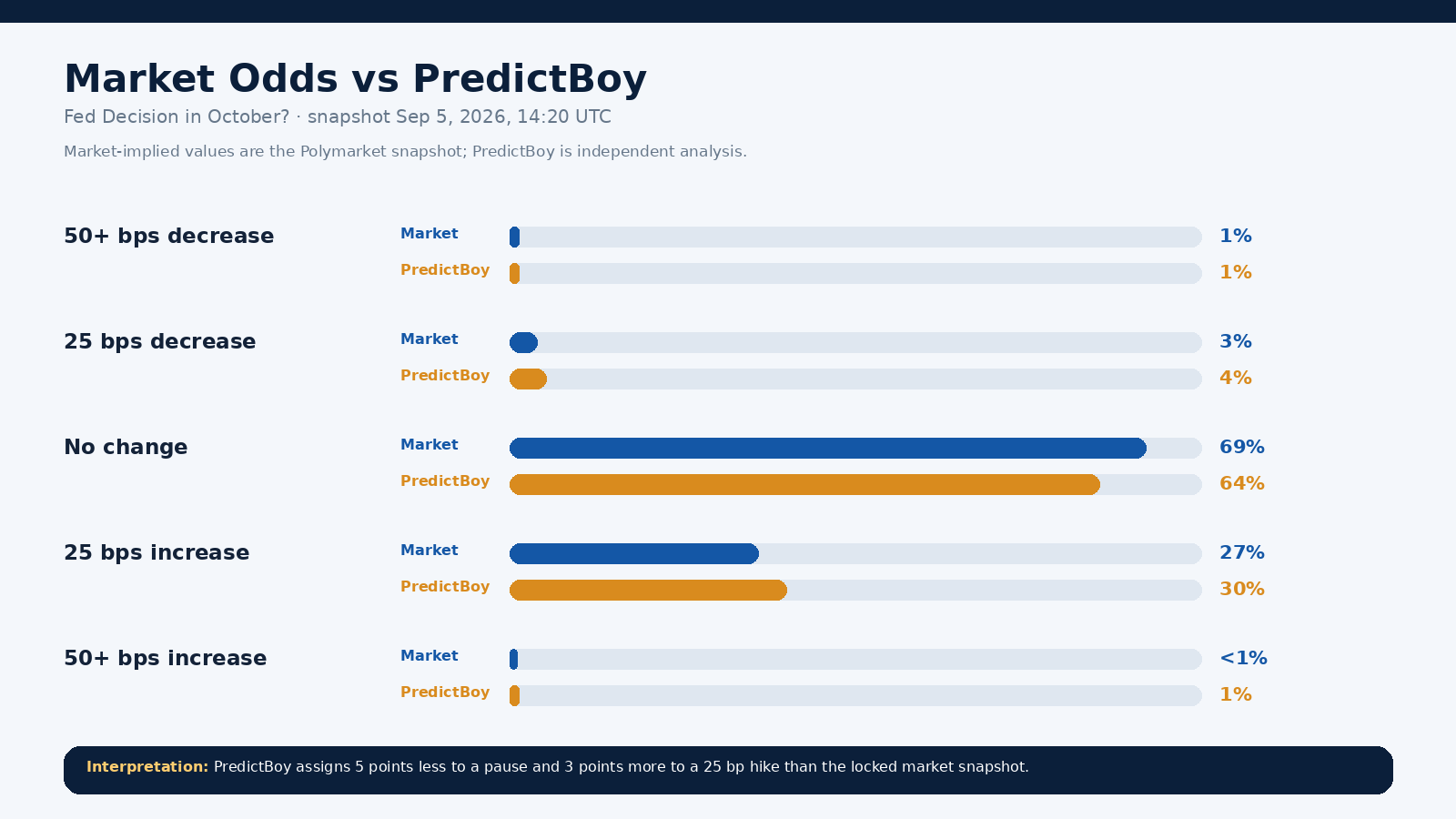
Market Odds vs. PredictBoy
| Outcome | Polymarket snapshot | PredictBoy | Difference |
|---|---|---|---|
| 50+ bps decrease | 1% | 1% | 0 pts |
| 25 bps decrease | 3% | 4% | +1 pt |
| No change | 69% | 64% | -5 pts |
| 25 bps increase | 27% | 30% | +3 pts |
| 50+ bps increase | <1% | 1% | roughly flat |
The gap is small enough that I would call this a shared base case with different confidence, not a fundamental disagreement. Both the market and my framework say a pause is most likely. The disagreement is about how much weight to give the hike path.
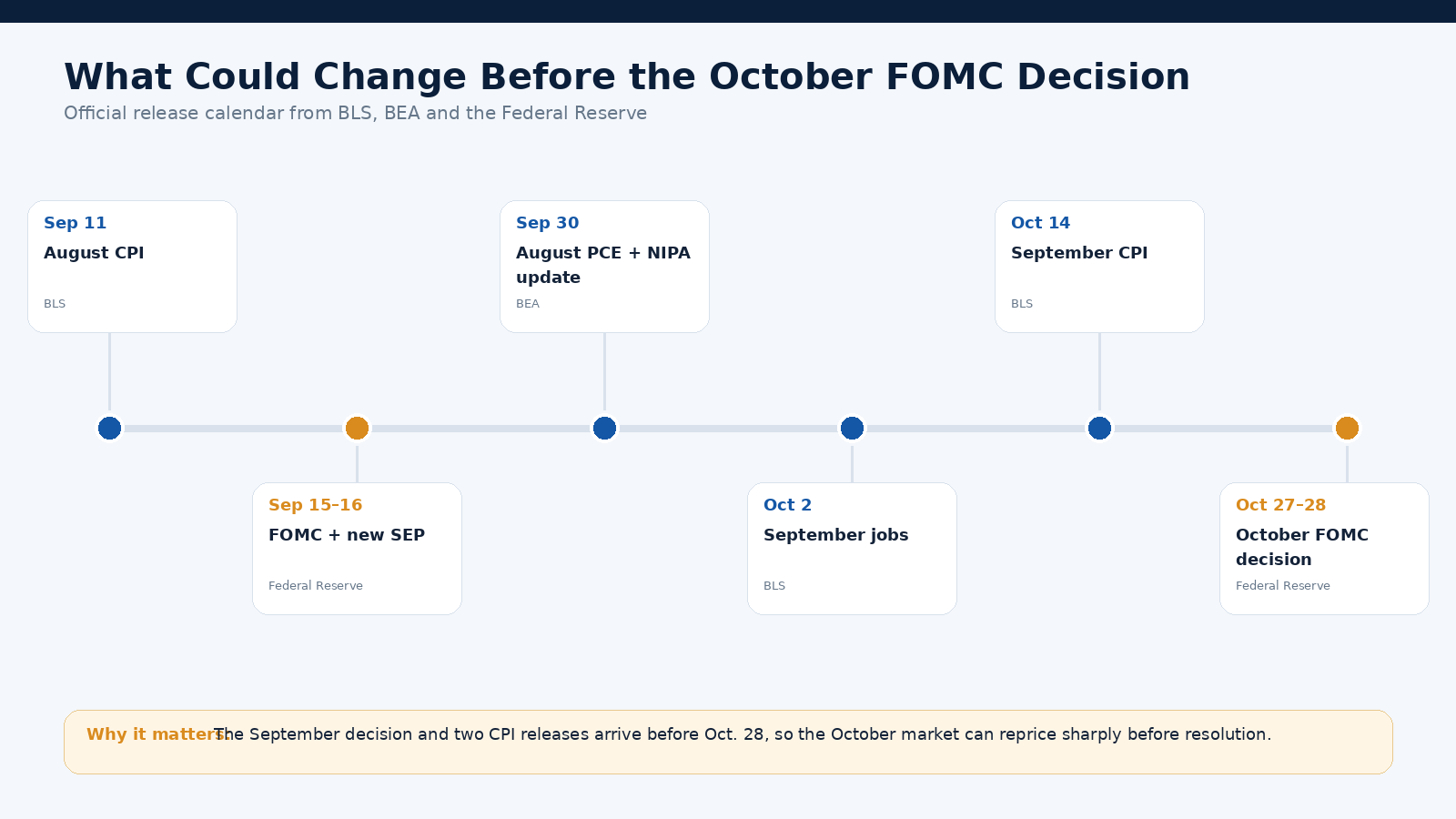
What Could Change Before Resolution
- September 11: August CPI.
- September 15–16: FOMC meeting and new Summary of Economic Projections.
- September 30: August PCE plus BEA’s annual national-accounts update.
- October 2: September employment report.
- October 14: September CPI.
- October 27–28: October FOMC meeting and resolution event.
The September meeting is the pivot. A September hike plus cooler data would strengthen the October pause case. A September hold plus stubborn inflation would strengthen the October hike case. That conditional structure is more useful than treating the current 69% headline as a static prediction.
Final Take
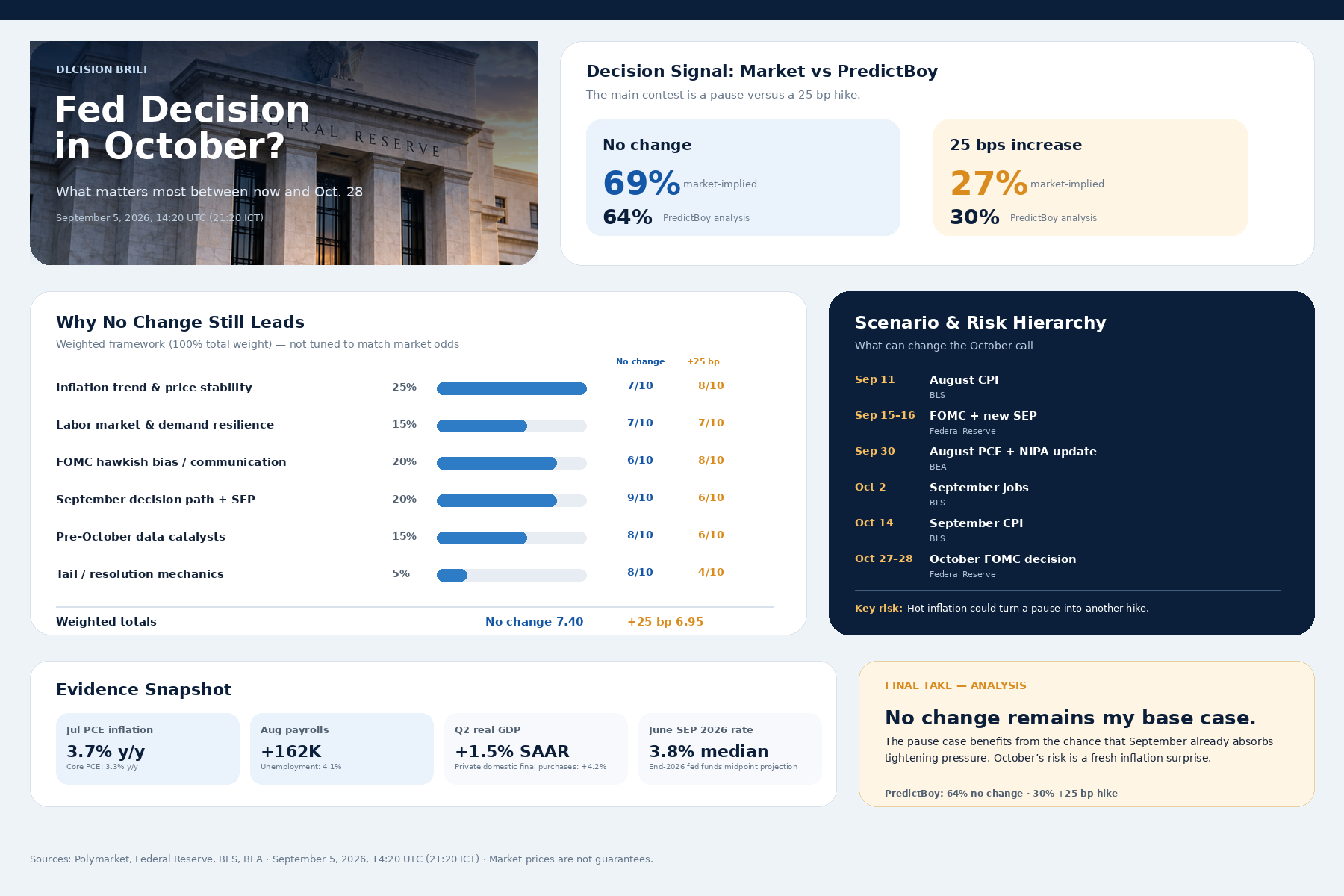
PredictBoy analysis: No change is my base case at 64%, with a 25 bp increase at 30%. The pause has a structural advantage because the Fed gets another meeting first in September, and a September hike could satisfy some of the Committee’s tightening impulse before October. But inflation is still well above target, July produced three hike dissents, and recent Fed communication leaves the door open to further tightening if disinflation stalls.
So I would not read Polymarket’s 69% as “the Fed will definitely hold.” I would read it as: the market currently thinks a pause is the most likely October action, but the next inflation prints and the September FOMC decision can still move the probability materially.
Primary factors: inflation trend, FOMC reaction function, and the September decision path.
Secondary factors: labor resilience, private-demand strength, financial conditions, and geopolitical/energy shocks.
Overall probability outlook: pause favored; 25 bp hike remains the only major challenger; cuts and 50+ bp moves are tail outcomes.
Sources and research snapshot
- Polymarket — Fed Decision in October?
- Federal Reserve — July 29, 2026 FOMC statement
- Federal Reserve — FOMC meeting calendar
- Federal Reserve — June 2026 Summary of Economic Projections
- Federal Reserve — Chair Kevin Warsh, August 28, 2026
- Federal Reserve — Governor Christopher Waller, September 3, 2026
- BLS — Employment Situation, August 2026
- BLS — Consumer Price Index, July 2026
- BEA — Personal Income and Outlays, July 2026
- BEA — GDP, Second Estimate, Q2 2026
Snapshot: September 5, 2026, 14:20 UTC (21:20 ICT). This article is analytical information, not financial, investment, legal, tax, or trading advice.