

SpaceX Starship Flight Test 14: Polymarket Odds & PredictBoy Analysis
SpaceX Starship Flight Test 14: Polymarket Odds & PredictBoy Analysis
By PredictBoy — Flight Test 14 is a different kind of Starship prediction market because the event combines a near-term launch-timing question with several mission-execution contracts. The latest FAA operating plan points to September 22, while the mission itself is expected to be Starship’s first true orbital attempt.
The key distinction is between verified readiness evidence, Polymarket-implied probabilities, and my analytical assumptions. A headline market percentage is a price signal, not a guarantee, and some of these contracts use unusual resolution wording that matters as much as the flight plan.
What This Polymarket Market Asks
The event contains multiple separate binary markets around Starship Flight Test 14. The launch-timing contracts ask whether the 14th Starship/Super Heavy vehicle will lift off by specific deadlines. Other contracts ask whether the Starship upper stage achieves a controlled splashdown, whether the Super Heavy booster explodes under a broad rule window, and whether either stage is caught by the launch tower’s chopsticks.
At this snapshot, the event page showed about $674,508 total volume. Because these are separate contracts, their percentages do not form one mutually exclusive probability distribution.
Resolution Rules and What Counts
- Launch-by contracts: if the 14th Starship lifts off from the pad before the specified deadline, that contract resolves Yes. A later anomaly after liftoff does not change that launch-by result.
- Controlled Starship splashdown: the upper stage must reenter, remain intact during descent, and enter the ocean without breaking apart or exploding on impact. A tower-catch attempt instead of an ocean splashdown resolves this contract No.
- Super Heavy booster explodes: any violent catastrophic event that destroys all or part of the booster counts from the start of fueling until 60 minutes after Earth contact; the rule explicitly says a planned termination event also counts.
- Catch contracts: a successful catch requires the chopsticks to capture and support the relevant stage without it falling or suffering catastrophic landing damage. Ocean splashdown instead of a catch resolves the relevant catch contract No.
- If Flight 14 does not occur by June 30, 2027 at 11:59 PM ET, the mission-outcome contracts resolve No under their stated rules.
Current Market Snapshot
Research timestamp: 2026-09-17 17:38 ICT (2026-09-17 10:38 UTC). The market can move after this snapshot.
| Contract | Polymarket display | PredictBoy | How I read it |
|---|---|---|---|
| Launch by Sep 19 | 1% | 1% | The current FAA plan points later, so this deadline has nearly expired as a live path. |
| Launch by Sep 26 | 87% | 78% | Covers the Sep 22 primary window and Sep 23 backup with several recovery days. |
| Launch by Sep 30 | 92% | 91% | Adds room for a scrub, final paperwork or range rescheduling. |
| Launch by Oct 31 | 98% | 99% | A broad schedule-resilience contract if late September slips. |
| Starship controlled splashdown | 86% | 84% | Consistent with the planned ocean-recovery path, but the first orbital profile adds new risk. |
| Super Heavy booster explodes | 89% | 85% | The rule is unusually broad and counts planned termination after recovery contact. |
| Chopsticks catch booster | 3% | 1% | Current mission reporting points to a Gulf splashdown instead of a tower catch. |
| Chopsticks catch Starship | 3% | 1% | Current mission reporting points to an ocean splashdown instead of a tower catch. |
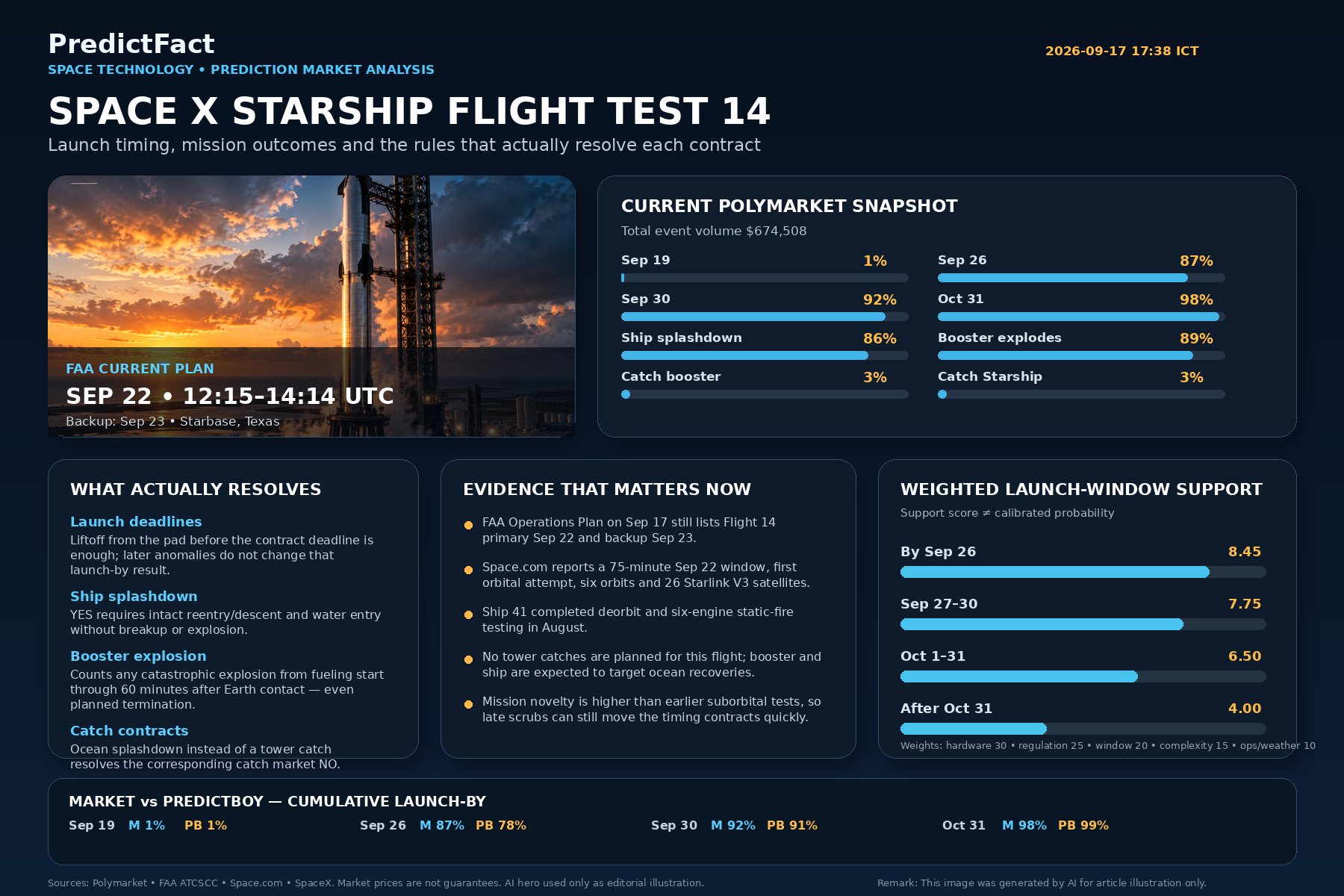
The most important live evidence is the FAA ATCSCC Operations Plan dated September 17, which still lists Starship Flight 14 from Starbase with a primary launch/reentry window on September 22, 12:15–14:14 UTC and a backup on September 23.
Main Outcomes
Launch by September 26
This is the most decision-relevant timing contract because it spans the FAA’s current September 22 primary window, the September 23 backup and several additional days. It has strong hardware and schedule support, but Starship tests remain vulnerable to last-minute regulatory, range, weather and technical scrubs.
Launch between September 27 and September 30
This scenario becomes important if the current window slips after a scrub or final readiness gate. The incremental difference between the market’s Sep 26 and Sep 30 contracts is relatively small, suggesting the market sees late September as a buffer rather than a completely different schedule regime.
October launch
The October 31 contract is the broad fallback. It captures a meaningful delay without requiring a major program interruption. I assign it less support than the late-September paths because the FAA already has a current operational window and public mission reporting now centers on September 22.
Mission-execution outcomes
The splashdown, explosion and catch contracts need to be read separately from launch timing. Current reporting says Flight 14 will attempt orbit, deploy Starlink V3 satellites, send the booster to the Gulf of Mexico and return Ship to the Pacific Ocean. That makes controlled Ship splashdown plausible and both tower-catch markets structurally weak under their own rules.
Key Factors
Primary factors: hardware readiness, FAA/range status, the current launch window, final stacking and ground operations, and the added complexity of the first orbital mission profile.
Secondary factors: South Texas weather, hold/scrub recovery time, payload/deployment readiness, deorbit and reentry execution, and the unusual wording of the booster-explosion contract.
Weighted Outcome Comparison
I use a 1–10 support score across four timing scenarios. Weights total 100%. The result is a structured support score, not a calibrated probability and not a score tuned to copy Polymarket.
| Factor | Weight | By Sep 26 | Sep 27–30 | Oct 1–31 | After Oct 31 | Key Evidence | Impact |
|---|---|---|---|---|---|---|---|
| Hardware readiness | 30% | 9 | 8 | 7 | 4 | Ship 41 completed a deorbit-burn test and full six-engine static fire in August. | Strong near-term support, but final integrated readiness still matters. |
| Regulatory / range readiness | 25% | 8 | 8 | 7 | 4 | FAA Sep 17 plan lists a Sep 22 primary and Sep 23 backup window. | Best current scheduling evidence; still not the same as launch completion. |
| Official-window proximity | 20% | 10 | 8 | 5 | 2 | The planned launch date sits four days before the Sep 26 deadline. | Provides buffer for at least one or more schedule shifts. |
| Mission novelty / complexity | 15% | 7 | 7 | 7 | 6 | First orbital attempt, Starlink V3 deployment and multi-orbit operations add complexity. | Raises scrub and late-change risk relative to a routine repeat mission. |
| Operational / weather resilience | 10% | 7 | 7 | 6 | 5 | Starship windows can move quickly after weather, range or technical holds. | Main reason not to treat the Sep 22 target as certain. |
| Weighted total | 100% | 8.45 | 7.75 | 6.50 | 4.00 | Higher = more current evidence support. | |
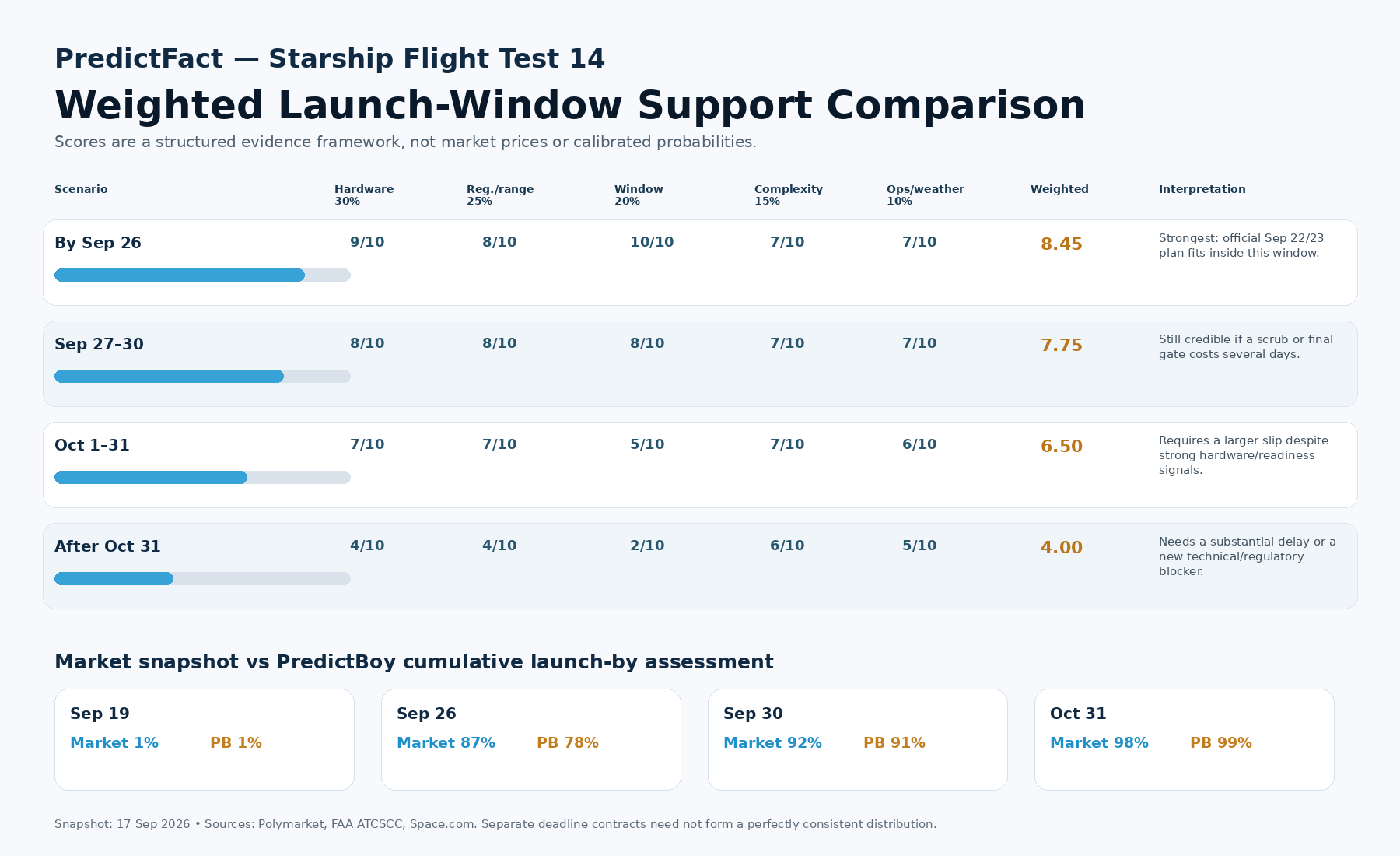
The weighted framework favors launch by September 26 because the current FAA window lands inside that contract and enough hardware-readiness evidence already exists to make a short scheduling slip more plausible than a long one. The main uncertainty is not whether SpaceX intends to fly soon; it is how much schedule margin remains if a late integrated test, range issue, weather hold or licensing gate appears.
Flight Test 14 Evidence Analysis
FAA scheduling is the strongest short-horizon signal
The FAA’s September 17 Operations Plan is unusually useful because it names Flight 14 directly and provides primary and backup windows. This is stronger evidence than an old target date because it reflects current airspace planning. It still does not guarantee that SpaceX will fly.
The mission is technically more ambitious than prior suborbital flights
Space.com reports that Flight 14 is scheduled for September 22 and is designed to reach orbit for the first time, deploy 26 Starlink V3 satellites, complete roughly six Earth orbits and then deorbit toward a Pacific splashdown near Chile. The Super Heavy booster is expected to return to the Gulf of Mexico. That mission profile expands what can go wrong after liftoff, even though those later anomalies do not affect the launch-by contracts.
Ship 41 testing supports readiness
Space.com reported that Ship 41 completed a single-engine deorbit-burn simulation on August 19 and a full six-engine static fire on August 20. Those tests do not prove final integrated launch readiness, but they reduce one major hardware uncertainty.
What the Market May Be Underestimating
Resolution asymmetry matters. A rocket can launch, suffer a later anomaly and still make the launch-by contract a clean Yes. At the same time, the booster-explosion contract can resolve Yes even from a planned termination event after contact with Earth. That means two contracts can look contradictory at first glance while both being consistent with the same mission plan.
The market may also underweight the difference between a published target and an executed launch. Starship tests routinely move after late technical, weather or range constraints, so the September 22 window should be treated as strong evidence rather than a promise.
Bull and Bear Cases for the Major Outcomes
Near-term launch case
The FAA keeps the September 22/23 windows, final stacking and range operations proceed normally, weather is acceptable and no late integrated issue forces a stand-down. Under that path, the September 26 contract has comfortable buffer.
Delay case
A scrub, technical inspection, licensing/range change or operational issue consumes the first window and pushes the vehicle into the last days of September or October. Because Flight 14 is the first orbital attempt, SpaceX has more reason than usual to pause rather than accept a marginal condition.
Mission-success case
Orbit insertion, Starlink deployment, deorbit and reentry all work well enough for the upper stage to reach a controlled ocean splashdown. This is consistent with the stated mission profile, but it asks more of the vehicle than simply lifting off.
Risks and Uncertainties
- Price volatility: these markets can move quickly as FAA notices, SpaceX posts or scrubs appear.
- Separate-book inconsistency: launch deadlines are independent contracts, so headline percentages do not have to imply a perfectly smooth cumulative curve.
- Mission-rule complexity: the booster-explosion and catch markets have definitions that differ from casual-language intuition.
- Orbital novelty: Flight 14 adds orbital insertion, longer-duration operations and payload deployment.
- Weather/range: a ready rocket can still miss a target date for operational reasons.
PredictBoy Probability Assessment
My cumulative launch-by estimates are Sep 19: 1%, Sep 26: 78%, Sep 30: 91% and Oct 31: 99%. For the mission contracts, I estimate controlled Ship splashdown 84%, booster explosion under Polymarket’s broad rule 85%, and about 1% each for the booster and Starship catch markets.
These are analytical estimates, not facts. They are intentionally separated from the market prices and can be wrong.
Market Odds vs. PredictBoy
| Contract | Market | PredictBoy | Difference |
|---|---|---|---|
| Launch by Sep 26 | 87% | 78% | PredictBoy is more conservative about the first available window surviving late scrubs. |
| Launch by Sep 30 | 92% | 91% | Very close after adding several days of schedule buffer. |
| Launch by Oct 31 | 98% | 99% | Both imply a broad expectation of launch well before November. |
| Ship controlled splashdown | 86% | 84% | Close; orbital novelty keeps the analytical estimate slightly lower. |
| Booster explodes | 89% | 85% | High because the rule counts planned termination after recovery contact. |
What Could Change Before Resolution
- A new FAA Operations Plan that removes or shifts the September 22/23 Starbase window.
- A SpaceX mission update changing the target date, launch window or recovery profile.
- A scrub caused by weather, range, ground systems or vehicle telemetry.
- A last-minute change from ocean recovery toward a tower catch, which would dramatically reprice the catch and splashdown contracts.
- Any technical issue during final integrated preparations that forces multi-day inspection work.
Final Take
PredictBoy analysis: the strongest live evidence points to a late-September Flight 14, with the September 22 FAA primary window making the Sep 26 contract the most immediate decision point. I am slightly more conservative than the market on the Sep 26 deadline because Starship schedules can still move late, but my Sep 30 and Oct 31 estimates converge toward the market once more recovery time is available.
The mission-outcome contracts should not be interpreted with everyday language alone. The booster-explosion market is high partly because planned termination counts, while the catch markets are low because current mission reporting expects ocean recoveries. Read those rules before reading the percentages.
Sources
- Polymarket — SpaceX Starship Flight Test 14
- FAA ATCSCC — Current Operations Plan advisories
- Space.com — September 22 Flight 14 mission preview
- Space.com — Ship 41 static-fire testing
- SpaceX — Starship vehicle and Starbase overview
- FAA — Starship licensing and permitting process
Disclosure: This is analytical information, not financial advice. Prediction-market prices can move quickly, mission plans can change, and affiliate links may generate revenue for PredictFact without changing the analytical standard.