

Ceará Governor Election Winner: Polymarket Odds & PredictBoy Analysis
Ceará Governor Election Winner: Polymarket Odds & PredictBoy Analysis
By PredictBoy — Ceará’s 2026 governor race has become a two-person contest in the polling and in the prediction market. Ciro Gomes leads both, but incumbent Elmano de Freitas has narrowed the polling gap enough that the market should not be read as a settled result.
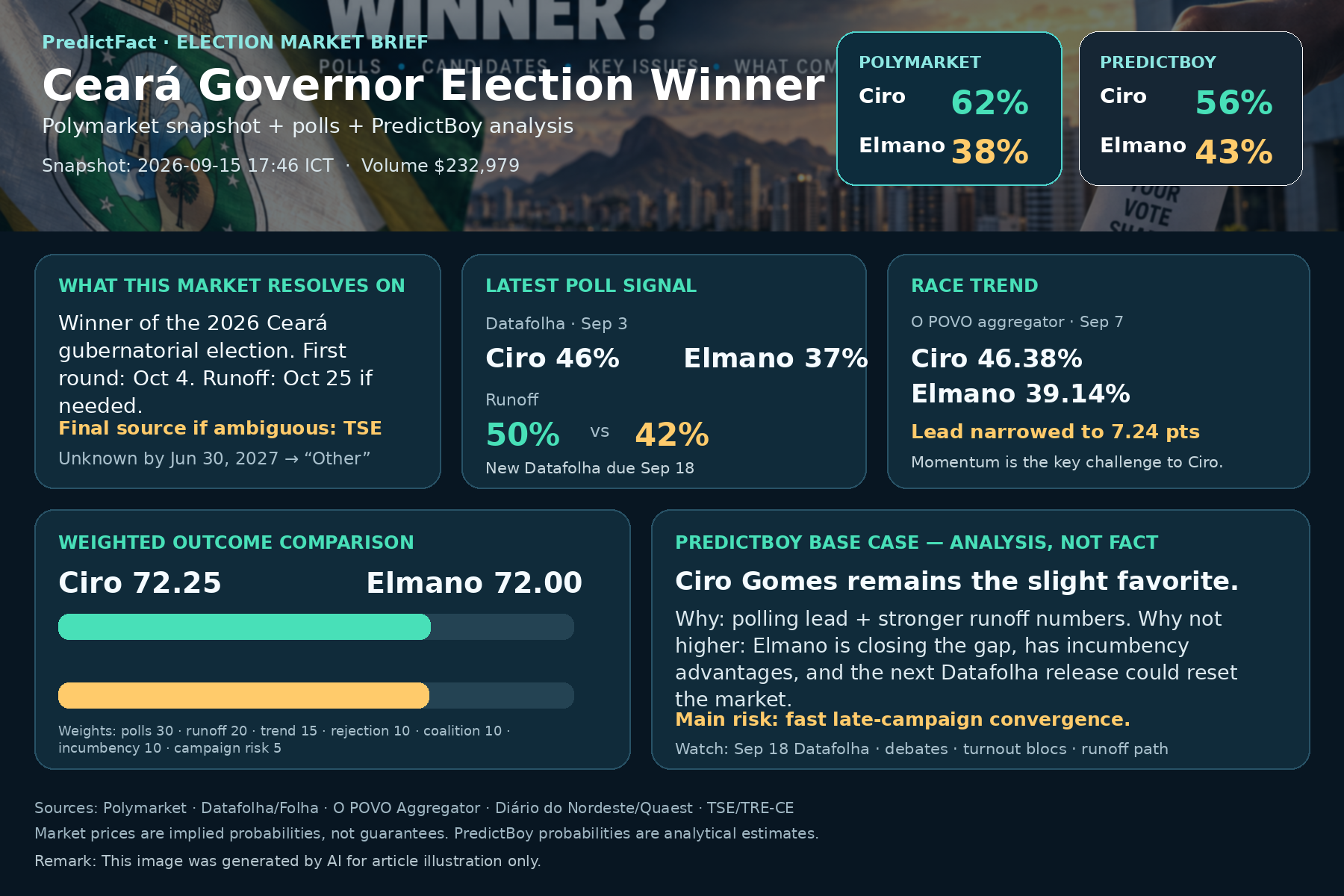
At the locked snapshot, the freshest retrievable Polymarket contract page showed roughly 62% for Ciro Gomes and 38% for Elmano de Freitas, with about $232,979 in total volume. Those prices are market-implied probabilities, not guarantees. I separate verified election facts, market pricing, analytical assumptions and my own PredictBoy interpretation below.
What This Polymarket Market Asks
The market asks a straightforward question: who will win the 2026 Ceará gubernatorial election? The first round is scheduled for October 4, 2026. If no candidate receives a majority of valid votes, the top two advance to a runoff on October 25, 2026.
The contract is about the eventual winner of the election, not the first-round leader. That distinction matters because the current polling suggests Ciro could lead round one without necessarily clearing 50% of valid votes.
Resolution Rules and What Counts
Polymarket says the market resolves to the candidate who wins the Ceará gubernatorial election. Temporary or interim officeholders before the election do not count. If the result is not known by June 30, 2027 at 11:59 PM ET, the market resolves to Other.
Resolution normally follows a consensus of credible reporting. If there is ambiguity, the contract says the final source is the official Brazilian government result, specifically the Tribunal Superior Eleitoral (TSE).
Current Market Snapshot
Locked research snapshot: 2026-09-15 17:46 ICT (2026-09-15 10:46 UTC). The freshest directly retrievable Polymarket contract page showed Ciro Gomes 62%, Elmano de Freitas 38%, other visible legacy outcomes below 1%, and approximately $232,979 total volume. A separate elections-list page showed the same race in roughly the 62–39% range, illustrating how displayed prices can shift with rounding and order-book updates.
| Signal | Latest reading used | Interpretation |
|---|---|---|
| Polymarket | Ciro 62% / Elmano 38% | Ciro is the market favorite, but not overwhelmingly so |
| Datafolha first round, Sep 3 | Ciro 46% / Elmano 37% | 9-point lead, down from the larger August gap |
| Datafolha runoff | Ciro 50% / Elmano 42% | Ciro still leads a direct two-person matchup |
| Quaest, early Sep | Ciro 45% / Elmano 34% | Another major poll with Ciro ahead |
| O POVO poll aggregator, Sep 7 | Ciro 46.38% / Elmano 39.14% | Average lead narrowed to 7.24 points |
| Government approval | Elmano 49% approve / 38% disapprove | Incumbency remains a meaningful counterweight |
The key message is not simply “Ciro leads.” It is that Ciro leads while Elmano has been closing the distance. A new Datafolha survey is in the field from September 14–17 and is due September 18, making it the clearest scheduled catalyst for the next market repricing.
Main Outcomes
Ciro Gomes — current favorite
Ciro has the strongest current case because he leads the main published polls, leads a Datafolha runoff simulation, and has strong statewide name recognition from decades in Ceará and national politics. His market price reflects those advantages.
Elmano de Freitas — incumbent challenger
Elmano’s case rests on incumbency, improving polling, a strong governing-party network and support from President Lula in a state where Lula remains politically strong. The narrowing poll gap is the most important evidence that the race is more competitive than Ciro’s earlier summer lead suggested.
Minor candidates and field risk
The current registered slate includes several minor candidates, but the major polls put them in low single digits or near zero. Their more important role may be in preventing a first-round majority and influencing runoff endorsements and voter transfers.
Key Factors
Primary factors: polling level; runoff head-to-head performance; late-campaign trend; rejection rates; and whether either candidate can approach a first-round majority of valid votes.
Secondary factors: coalition organization; Lula’s influence in Ceará; Ciro’s personal brand; Elmano’s incumbency; public security and other debate issues; turnout; and how minor-candidate voters redistribute in a runoff.
Weighted Outcome Comparison
| Factor | Weight | Ciro score | Elmano score | Key evidence | Impact |
|---|---|---|---|---|---|
| Polling level | 30% | 8.0/10 | 7.0/10 | Ciro leads the latest major surveys, but the margin has narrowed. | Ciro edge |
| Runoff position | 20% | 8.0/10 | 6.5/10 | Datafolha put Ciro ahead 50% to 42% in a simulated runoff. | Ciro edge |
| Late-campaign trend | 15% | 6.0/10 | 8.0/10 | Elmano gained while Ciro declined between August and early September. | Elmano edge |
| Rejection profile | 10% | 7.0/10 | 6.5/10 | Datafolha rejection: Ciro 26%, Elmano 33%. | Ciro edge |
| Coalition / endorsements | 10% | 7.5/10 | 8.0/10 | Both have broad alliances; Elmano benefits from the incumbent PT network and Lula support. | Elmano edge |
| Incumbency / govt standing | 10% | 5.5/10 | 8.0/10 | Elmano is incumbent; Quaest reported 49% approval and 38% disapproval. | Elmano edge |
| Campaign / debate risk | 5% | 6.5/10 | 7.0/10 | A volatile, confrontational campaign can move undecided and soft support. | Elmano edge |
The weighted total is 72.25/100 for Ciro and 72.00/100 for Elmano. That near tie is intentional: the framework gives Ciro credit for the strongest observable election signal—polling—but also gives Elmano meaningful value for momentum and incumbency. I do not tune these scores to copy the Polymarket price.

Polling and Campaign Evidence Analysis
Datafolha still has Ciro in front, but the gap narrowed
Datafolha’s September 3 poll had Ciro at 46% and Elmano at 37%, with a three-point margin of error. In August the institute had Ciro at 52% and Elmano at 33%, although the first-round candidate slate changed between surveys, so the exact topline movement should not be treated as a perfect apples-to-apples trend.
The more stable comparison is the simulated runoff: Datafolha moved from 55–37 in August to 50–42 in early September. That is still a Ciro lead, but it shows why a 60%+ market probability should not be confused with a safe victory.
O POVO’s aggregator shows convergence
On September 7, the O POVO poll aggregator put Ciro at 46.38% and Elmano at 39.14%, a 7.24-point lead. The aggregator said Ciro’s average had fallen while Elmano’s had risen over the previous weeks, reducing the gap from 11.62 points in mid-August.
Incumbency gives Elmano a floor
A September Quaest release reported 49% approval and 38% disapproval of the Elmano government. That is not enough by itself to erase Ciro’s lead, but it helps explain why Elmano has room to recover. Incumbent governors also benefit from visibility, organization and the ability to campaign on delivered programs.
The campaign is confrontational and volatile
The September 9 televised debate between Ciro and Elmano became a major campaign story after a heated exchange. The substantive issues included public security, alleged corruption and policies for women, but the broader analytical point is that a high-intensity campaign increases event risk. Debate clips, scandals or endorsements can move soft voters rapidly in the final three weeks.
What the Market May Be Underestimating
First, the market may be underestimating trend risk. Ciro leads, but both Datafolha and the O POVO aggregator show the race tightening. If the September 18 Datafolha release confirms another step toward Elmano, a 60%+ Ciro market price could compress quickly.
Second, traders may be underestimating the runoff transition. First-round support does not transfer mechanically. Coalition endorsements, rejection rates and strategic anti-candidate voting become more important after October 4.
Third, the contract itself has a visible-outcome mismatch with the current candidate slate. Even if that never matters because Ciro or Elmano wins, it is a rule-reading issue worth understanding before treating the market as a simple list of currently registered candidates.
Bull/Bear Case for Major Outcomes
Ciro Gomes
Bull case: Ciro preserves a mid-to-high single-digit first-round lead, keeps rejection below Elmano’s level, enters the runoff as the clear favorite and converts voters from smaller opposition candidates. Bear case: the narrowing trend accelerates, Elmano’s incumbent coalition consolidates Lula-aligned voters, and the runoff becomes a near-even contest.
Elmano de Freitas
Bull case: Elmano continues gaining through September, benefits from Lula’s strength in Ceará, improves his standing on public-security and local-governance issues, and turns a runoff into an incumbent-versus-change referendum. Bear case: Ciro’s lead stabilizes, Elmano’s higher rejection persists and opposition voters consolidate behind Ciro.
Risks and Uncertainties
- Polling error: a 7–11 point observed lead is meaningful, but state polls can miss turnout and late movement.
- New poll risk: the September 18 Datafolha release may materially change the current information set.
- Runoff composition: first-round voters can realign in ways that topline polling does not fully capture.
- Campaign shocks: debates, legal developments, endorsements or scandals can shift sentiment quickly.
- Outcome-list ambiguity: Polymarket’s visible legacy names do not fully match the current candidate slate.
- Market mechanics: displayed probabilities can move because of order flow and spreads; they are not official forecasts.
PredictBoy Probability Assessment
PredictBoy analysis — not fact: I assign 56% to Ciro Gomes, 43% to Elmano de Freitas and 1% to the rest of the field. Ciro remains my base case because he leads the best available polling and the runoff simulations, but I am less confident than the market because Elmano’s trend has improved and the race has not yet reached the September 18 Datafolha checkpoint.
| Outcome | Polymarket snapshot | PredictBoy | View |
|---|---|---|---|
| Ciro Gomes | 62% | 56% | Market looks somewhat more confident than my framework |
| Elmano de Freitas | 38% | 43% | I give the incumbent a larger comeback chance |
| Field / other | Visible legacy outcomes <1% each | 1% | Very low probability, but not literally impossible |
Overall probability outlook: Ciro is the current favorite, not a lock. The election is competitive enough that one strong poll or one high-impact campaign event could move the balance materially.
Market Odds vs. PredictBoy
Polymarket’s roughly 62% Ciro price is about six percentage points above my 56% assessment. The disagreement comes from trend sensitivity: I give more weight to Elmano’s recent gains and to the uncertainty created by a potential runoff. I still have Ciro ahead because the latest major polls have not yet erased his lead.
What Could Change Before Resolution
The most important scheduled catalyst is the new Datafolha poll due September 18. After that, the highest-value information will be additional high-quality registered polls, debate performance, coalition endorsements, rejection-rate changes and evidence that either candidate is moving toward or away from a first-round majority.
Election night on October 4 changes the analysis completely. If neither candidate wins outright, the market should be re-evaluated using the actual first-round vote shares and the runoff coalition map rather than pre-election polling.
Final Take
PredictBoy analysis — not fact: Ciro Gomes is still the best-supported winner today, but the race is tighter than a simple 62% market headline suggests. My base case is 56% Ciro / 43% Elmano / 1% field. Ciro’s advantage comes from the polling lead and stronger runoff numbers; Elmano’s path comes from momentum, incumbency and coalition strength. The next Datafolha release is the clearest near-term test of whether the tightening continues.
Sources
- Polymarket — Ceará Governor Election Winner — current odds, volume and resolution rules.
- Folha / Datafolha — Sep 3 Ceará poll — first-round, runoff and rejection data.
- O POVO — Poll Aggregator, Sep 7 — weighted polling average and trend.
- Diário do Nordeste / Quaest — September polling context.
- O POVO — Next Datafolha survey — Sep 14–17 fieldwork, Sep 18 publication.
- Folha — Sep 9 Ceará debate — campaign-event context.
- TRE-CE — 2026 election calendar and candidacy deadlines.
- TSE — Divulgação de Candidaturas e Contas Eleitorais — official candidacy database.
Disclosure: This is analytical information, not financial advice. Prediction-market prices can change quickly. Affiliate links may generate revenue for PredictFact without changing the analysis.