

US Recession by End of 2026? Polymarket Odds & PredictBoy Analysis
US Recession by End of 2026? Polymarket Odds & PredictBoy Analysis
By PredictBoy — The U.S. economy is still growing, the unemployment rate is low by historical standards, and Polymarket has moved sharply toward the “No recession” side. But this market is not asking whether the economy feels weak. It resolves on a precise rule involving official GDP data and a possible NBER recession announcement.
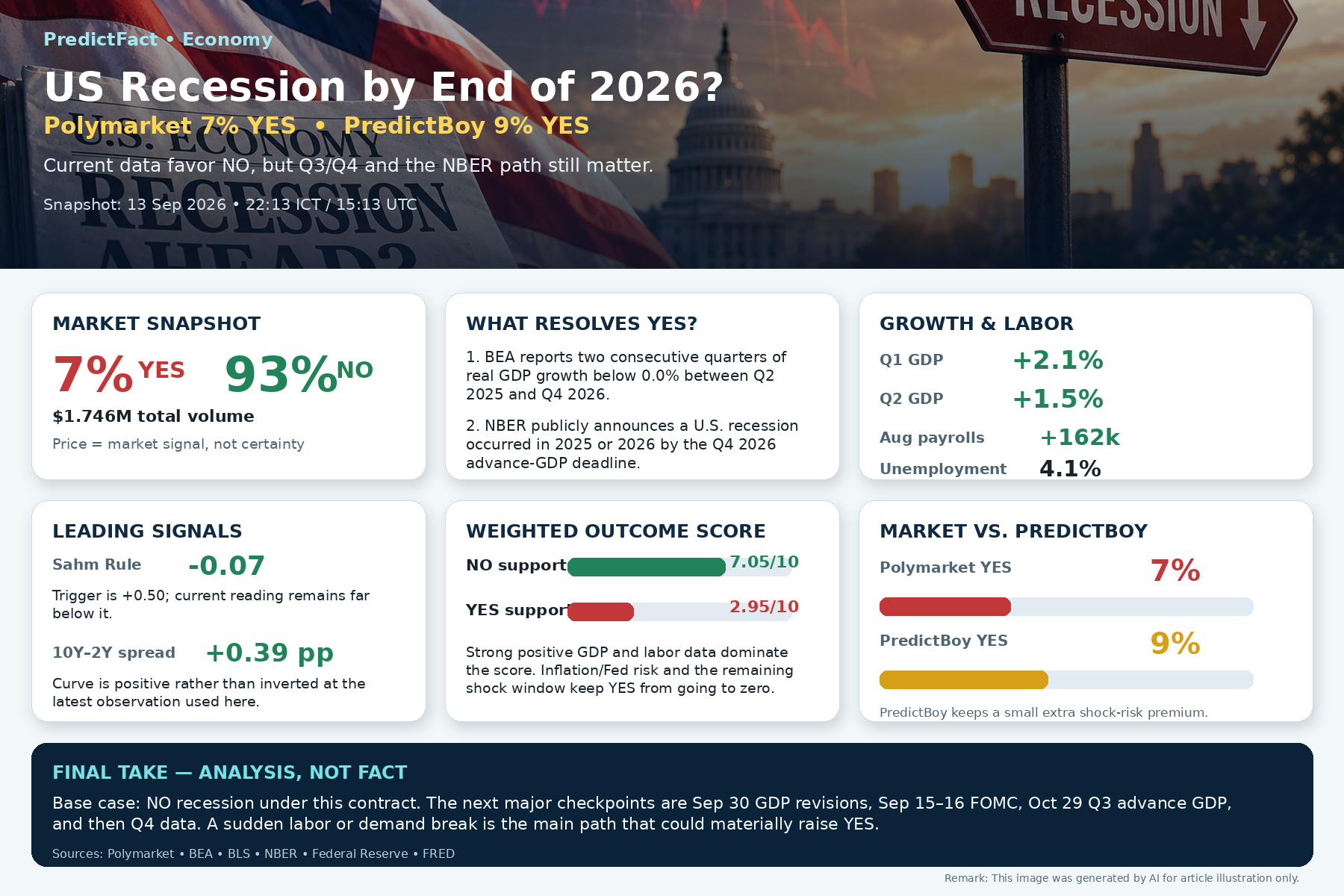
At the locked snapshot, Polymarket displayed about 7% Yes and 93% No with roughly $1.75 million in total volume. I treat that price as a market signal, not a guarantee. This article separates verified facts, market-implied probabilities, analytical assumptions and my own PredictBoy interpretation. It is analytical information, not financial advice.
What This Polymarket Market Asks
The question is whether the United States will satisfy Polymarket’s recession definition for the 2025–2026 window. It is a simple Yes/No market, but its definition is narrower and more mechanical than the everyday use of the word “recession.”
Resolution Rules and What Counts
Polymarket says the market resolves Yes if either of two conditions is met:
- The seasonally adjusted annualized percent change in quarterly U.S. real GDP from the previous quarter is below 0.0% for two consecutive quarters between Q2 2025 and Q4 2026 inclusive, using BEA data.
- The NBER publicly announces that a recession occurred in the United States at some point during 2025 or 2026, with that announcement made by the time the BEA releases the advance estimate for Q4 2026.
Advance GDP estimates count. The market can remain open beyond December 31, 2026 while waiting for the Q4 advance estimate. If that release has not appeared by June 30, 2027 at 11:59 PM ET, the market resolves using the official information available at that time.
The rule creates an important timing asymmetry: from today’s position, Q1 and Q2 2026 are already positive, so the GDP path now requires both Q3 and Q4 2026 to be negative. A late-2026 downturn could still matter through the NBER path, but the NBER typically dates cycles retrospectively and may wait months before making a peak announcement.
Current Market Snapshot
Locked research snapshot: 2026-09-13 22:13 ICT (2026-09-13 15:13 UTC). Polymarket displayed 7% Yes, 93% No and approximately $1,746,532 total volume. Prices can move continuously; executable prices can differ from the headline probability because of spreads and order-book depth.
| Item | Latest verified reading used | Why it matters |
|---|---|---|
| Polymarket | 7% Yes / 93% No | Current crowd-priced signal |
| Q1 2026 real GDP | +2.1% annualized | Positive; cannot pair with Q2 for a two-quarter contraction |
| Q2 2026 real GDP | +1.5% annualized, second estimate | Still positive, though slower than Q1 |
| August payrolls | +162,000 | No broad employment contraction in the latest report |
| August unemployment | 4.1% | Labor market remains relatively firm |
| Sahm Rule | -0.07 | Far below the +0.50 recession trigger |
| 10Y–2Y Treasury spread | +0.39 percentage points | Curve is positive rather than inverted |
The market’s low Yes price is consistent with those readings: growth is positive, employment is expanding, and two widely watched recession signals are not flashing red. The main counterargument is that inflation remains elevated and the final two GDP quarters of 2026 have not yet been reported.
Main Outcomes
No — the current base case
No wins if the U.S. avoids the contract’s two-quarter negative-GDP test and the NBER does not make a qualifying 2025/2026 recession announcement by the Q4 advance-GDP deadline. With Q1 and Q2 both positive, this path has become easier to satisfy than it looked earlier in the year.
Yes through Q3 + Q4 contraction
The cleanest remaining GDP route is two consecutive negative readings in Q3 and Q4 2026. That requires a sharp enough slowdown to turn both quarters below zero on the BEA measure used by the rules. The October 29 Q3 advance estimate is therefore a major event for the market.
Yes through an NBER announcement
The second path does not require the Polymarket GDP test to be met first. If the NBER announces that a recession occurred in 2025 or 2026 before the Q4 advance estimate deadline, the market resolves Yes. But NBER dating is deliberately retrospective: the committee waits for enough evidence to be confident about a turning point.
Key Factors
Primary factors: Q3 and Q4 real GDP; payroll and unemployment deterioration; real consumer/private demand; and whether any broad decline becomes deep and diffuse enough for the NBER.
Secondary factors: inflation and the Federal Reserve reaction, energy/geopolitical shocks, financial conditions, revisions to GDP data, and the unusually tight timing window for a late NBER call.
Weighted Outcome Comparison
I use a seven-factor framework. Scores run from 1 to 10, where a higher score means stronger support for that outcome. The weights total 100%. The weighted score is a structured comparison, not a direct probability conversion.
| Factor | Weight | Yes score | No score | Key evidence | Impact |
|---|---|---|---|---|---|
| Current GDP momentum | 25% | 2/10 | 8/10 | Q1 +2.1%; Q2 +1.5% | Strongly favors No |
| Labor market | 20% | 2/10 | 8/10 | August payrolls +162k; unemployment 4.1% | Strongly favors No |
| Consumer / private demand | 15% | 3/10 | 7/10 | Q2 private final sales +4.2%; July real PCE roughly flat | Favors No, but watch momentum |
| Leading indicators | 10% | 3/10 | 7/10 | Sahm -0.07; 10Y–2Y +0.39 pp | Favors No |
| Inflation / Fed risk | 10% | 5/10 | 5/10 | July PCE 3.7%; core PCE 3.3% | Balanced risk |
| Remaining 2026 shock window | 10% | 5/10 | 5/10 | Q3/Q4 still ahead; external shocks can move growth quickly | Balanced uncertainty |
| Resolution / NBER timing | 10% | 3/10 | 7/10 | Late-year NBER call faces a tight announcement window | Favors No |
Weighted totals: Yes = 2.95/10; No = 7.05/10. The advantage comes from already-positive 2026 GDP and a labor market that has not broken. The largest uncertainty is that a sharp shock can change both employment and demand faster than backward-looking data suggest.

US Economic Evidence Analysis
GDP is slowing, but it is still positive
BEA’s second estimate shows real GDP grew at a 1.5% annualized rate in Q2 2026 after 2.1% in Q1. Real final sales to private domestic purchasers increased 4.2% in Q2, which is a useful measure of underlying private demand. The Q2 third estimate is due September 30, while the Q3 advance estimate is scheduled for October 29.
The labor market still argues against a recession call
BLS reported 162,000 additional nonfarm payroll jobs in August and a 4.1% unemployment rate. The latest Sahm Rule indicator was -0.07, well below its +0.50 recession signal. That does not eliminate recession risk, but it means the labor-market evidence currently looks very different from a broad contraction.
Consumer growth is less comfortable than the headline GDP picture
BEA reported July current-dollar PCE up 0.2%, while real PCE was essentially flat for the month. Personal income rose 0.4% and real disposable income rose 0.4%. That combination is not recessionary by itself, but the weak real-spending month is worth watching because consumers are the largest part of the economy.
Inflation keeps policy risk alive
July headline PCE inflation was 3.7% year over year and core PCE was 3.3%. The Federal Reserve’s June projections had a median 2026 real-GDP growth forecast of 2.2%, unemployment at 4.3% and PCE inflation at 3.6%. A new FOMC meeting and projection update is scheduled for September 15–16, so the policy outlook can still change quickly.
What the Market May Be Underestimating
The strongest case for a higher Yes probability is nonlinearity. Recessions do not need to deteriorate smoothly. A geopolitical energy shock, a sudden credit event, a labor-market break or a policy error could move Q3/Q4 growth much faster than current data imply.
The second issue is advance-estimate sensitivity. Polymarket explicitly allows advance GDP estimates to count. A quarter can later be revised, but a qualifying pair at the relevant release point can still matter under the contract wording. Traders therefore need to follow the exact BEA release sequence rather than a generic annual-growth forecast.
Bull/Bear Case for Major Outcomes
Yes case
Bull case for Yes: inflation stays sticky, policy remains restrictive, consumer demand rolls over, hiring weakens rapidly and Q3 turns negative. If Q4 also contracts, the GDP path can resolve Yes. A sufficiently broad downturn could also trigger an NBER call.
Bear case for Yes: Q3 stays positive or rebounds, payroll growth remains positive and the Fed does not need to tighten enough to crush demand. In that case, the two-quarter GDP path becomes impossible and the NBER path becomes increasingly unlikely within the contract’s deadline.
No case
Bull case for No: positive growth persists, real incomes support spending, the labor market remains stable and inflation eases without forcing a sharp tightening cycle. Bear case: a sudden shock creates two negative quarters or broad weakness serious enough for the NBER to act quickly.
Risks and Uncertainties
- GDP revisions: BEA estimates change as more complete data arrive.
- Advance-estimate timing: the market can resolve using early GDP information before later revisions.
- NBER timing: the committee can identify a recession after it has already begun, but the contract imposes its own announcement deadline.
- Inflation-policy tradeoff: elevated inflation can limit the Fed’s flexibility if growth weakens.
- External shocks: geopolitics, energy, credit stress or financial-market dislocations can change the outlook quickly.
- Prediction-market mechanics: headline prices can move on order flow and liquidity; they are not guaranteed economic probabilities.
PredictBoy Probability Assessment
PredictBoy analysis — not fact: I assign 9% to Yes and 91% to No. That is slightly more recession-cautious than the 7% Polymarket snapshot, mainly because the remaining quarter-to-quarter shock window and sticky inflation deserve a small premium. But the current data still make No the clear base case.
| Outcome | Polymarket | PredictBoy | Difference |
|---|---|---|---|
| Yes — recession under contract | 7% | 9% | +2 points |
| No — contract not triggered | 93% | 91% | -2 points |
Overall probability outlook: positive Q1/Q2 GDP and a stable labor market provide a strong cushion. The realistic Yes route is now concentrated in a sharp second-half deterioration rather than a slow, already-visible recession.
Market Odds vs. PredictBoy
The gap is small: Polymarket says 7% Yes, while I use 9%. I am not raising the probability because of a single scary headline. I am raising it because there are still two unresolved GDP quarters, inflation can constrain policy, and tail shocks are difficult to forecast. At the same time, the weighted framework is clearly on the No side.
What Could Change Before Resolution
The highest-value updates are scheduled and official: the September 15–16 FOMC meeting, the September 30 Q2 GDP third estimate and August PCE data, the October 2 September employment report, the October 29 Q3 advance GDP estimate, the November 25 Q3 second estimate, and the December 23 Q3 third estimate. After that, the Q4 advance GDP release becomes decisive if the market is still open.
A single negative Q3 print would materially change the structure because Q4 would then become the potential second consecutive negative quarter. Conversely, a positive Q3 advance estimate would make the GDP route to Yes extremely difficult, leaving the NBER path as the main remaining risk.
Final Take
PredictBoy analysis — not fact: the current evidence supports No. Q1 and Q2 GDP were positive, August payrolls increased by 162,000, unemployment was 4.1%, the Sahm Rule was negative, and the 10Y–2Y curve was positive. My estimate is 9% Yes / 91% No, slightly above Polymarket’s 7% Yes because the second half of 2026 still contains meaningful shock risk. The cleanest way to change this view would be a negative Q3 GDP print combined with fast labor-market deterioration.
Sources
- Polymarket — US recession by end of 2026? — current odds, volume and exact resolution rules.
- BEA — GDP (Second Estimate), Q2 2026 — Q1/Q2 growth and private final sales.
- BLS — Employment Situation, August 2026 — payroll growth and unemployment.
- NBER — Business Cycle Dating — recession definition and committee approach.
- FRED — Sahm Rule Recession Indicator — latest recession-indicator reading.
- FRED — 10Y minus 2Y Treasury spread — latest yield-curve reading used.
- BEA — Personal Income and Outlays, July 2026 — PCE, income and inflation.
- Federal Reserve — June 2026 SEP — GDP, unemployment and inflation projections.
- Federal Reserve — FOMC calendar — September, October and December 2026 meetings.
Disclosure: This is analytical information, not financial advice. Prediction-market prices can change quickly. Affiliate links may generate revenue for PredictFact without changing the analysis.