

Russia–Ukraine Ceasefire Agreement by…? Polymarket Analysis
What This Polymarket Market Asks
The market asks whether Russia and Ukraine will reach a qualifying ceasefire agreement by a series of deadlines. At this snapshot, the active deadlines shown by Polymarket are October 31, 2026; December 31, 2026; March 31, 2027; and June 30, 2027.
One important mechanical point: these deadline contracts are cumulative rather than mutually exclusive. If a qualifying ceasefire were agreed by October 31, it would also have been agreed by the later December, March and June deadlines. That makes the later contracts structurally easier to satisfy because they include all earlier qualifying paths plus additional time.
Resolution Rules and What Counts
Polymarket’s rule is narrower than “peace talks are improving.” A contract resolves Yes only if Russia and Ukraine reach a mutually agreed suspension of direct military engagement by the contract’s specified date, 11:59 PM ET. The agreement can be a ceasefire, truce, broader peace deal, normalization agreement, political framework or humanitarian pause, but it must contain a general mutually agreed halt to fighting that is effective on a specified date.
- Qualifies: a general, mutually agreed pause in direct military engagement with a specified effective date.
- Does not qualify: unilateral pauses, informal understandings, backchannel de-escalation, or arrangements limited to certain target types or locations.
- Timing detail: if the qualifying agreement is officially reached before the deadline, it can count even if the ceasefire starts after that deadline.
- Primary resolution sources: official information from the governments of Russia and Ukraine plus a consensus of credible reporting.
This distinction matters immediately. The temporary halt in strikes on Moscow and Kyiv around the September U.S. diplomatic visit is relevant evidence of communication, but a city-specific pause does not by itself satisfy Polymarket’s general-ceasefire rule.
Current Market Snapshot
| Deadline | Market-implied Yes | Displayed Buy Yes | Displayed Buy No | Outcome Volume |
|---|---|---|---|---|
| October 31, 2026 | 12% | 12¢ | 89¢ | $1.54M |
| December 31, 2026 | 24% | 24¢ | 77¢ | $2.56M |
| March 31, 2027 | 44% | 44¢ | 57¢ | $58K |
| June 30, 2027 | 55% | 55¢ | 46¢ | $69K |
Polymarket displayed approximately $7.35 million in total event volume at the snapshot. The active deadline curve is steep: the market assigns only a low probability to a qualifying ceasefire by the end of October, but more than a coin flip by late June 2027. The much higher volumes in the two 2026 contracts also mean those prices have attracted more trading activity than the newly extended 2027 deadlines.
Main Outcomes: Active Deadline Contracts
October 31, 2026
This is the most demanding active deadline. The diplomatic calendar has restarted, but the time available to bridge territorial, security and implementation disputes is short. A temporary pause around negotiations is not enough; the parties would need a broader mutually agreed, dated suspension of direct military engagement.
December 31, 2026
The year-end contract allows more time for repeated U.S.-mediated rounds and for proposals to mature into a text that meets the resolution rule. It still faces the same core obstacle: the sides remain far apart on territory and the conditions for a durable post-war security arrangement.
March 31, 2027
The first-quarter 2027 deadline adds a larger negotiating runway and more opportunity for battlefield, economic or political incentives to change. It is still not a simple extension of current talks: a qualifying outcome requires an explicit general ceasefire commitment, not merely a roadmap or narrow de-escalation.
June 30, 2027
This is the current market favorite among active deadlines because it contains the broadest time window. The contract can benefit from any earlier breakthrough while also capturing a settlement process that takes several additional months. That structural advantage is why I treat it as the strongest weighted deadline even while keeping substantial uncertainty.
Key Factors
1. Negotiating Momentum and Direct Channels
U.S. envoys Steve Witkoff and Jared Kushner held more than three hours of talks with Vladimir Putin in Moscow on September 5 and then met Volodymyr Zelenskyy in Kyiv on September 6. Reuters reported no immediate breakthrough in Moscow, while both the Kremlin side and U.S. envoys used constructive language about the process. That is a positive signal for continued dialogue, but it is not evidence that the core terms are close to agreement.
2. Russia’s Territorial and Strategic Demands
Reuters reported that Moscow’s position remains tied to territorial demands and what it calls the root causes of the conflict. The Kremlin has continued to point to battlefield progress, while a key unresolved dispute concerns the future of Donbas and territory still held by Ukraine. This factor is the biggest drag on near-term ceasefire probability in my framework.
3. Ukraine’s Security and Territorial Requirements
Zelenskyy has emphasized that Ukraine needs hard security guarantees from the United States and European allies as part of a durable settlement. That requirement is not a cosmetic detail: it affects what Kyiv can accept, how a ceasefire would be monitored, and whether a pause could be sold domestically as a safer path rather than a temporary freeze that invites renewed fighting.
4. U.S. and European Mediation Leverage
The renewed U.S. shuttle diplomacy is the clearest constructive catalyst in the current snapshot. Washington can carry proposals between the parties and coordinate with European governments on guarantees and implementation. The limitation is that mediation can narrow gaps but cannot by itself make either Russia or Ukraine accept terms they judge strategically unacceptable.
5. Battlefield Incentives
Front-line fighting has continued even while Moscow and Kyiv paused strikes on each other’s capitals for the diplomatic visit. Continued fighting can cut both ways: it may increase the cost of the war and therefore the incentive to negotiate, or it may encourage a side that believes the battlefield is moving in its favor to wait for better terms.
6. Resolution-Rule Fit
This factor deserves its own weight because prediction-market settlement is about the wording of the rule, not just the direction of diplomacy. A narrow air pause, maritime arrangement, humanitarian step or prisoner exchange may be politically important but still fail this contract if it does not establish a general mutually agreed suspension of direct military engagement.
Weighted Outcome Comparison
I score the four active deadlines against the same six factors on a 1–10 scale. The weighted total is an analytical score, not a probability. I deliberately do not tune these scores to match Polymarket.
| Factor | Weight | Oct 31 | Dec 31 | Mar 31 | Jun 30 | Key Evidence | Impact |
|---|---|---|---|---|---|---|---|
| Negotiating momentum | 25% | 5.5 | 6.0 | 6.5 | 7.0 | U.S. envoys completed Moscow and Kyiv meetings; no breakthrough announced | Positive, stronger with time |
| Russia terms / territory | 25% | 2.0 | 3.0 | 4.5 | 5.5 | Major territorial and strategic conditions remain unresolved | Largest near-term negative |
| Ukraine security / territory | 20% | 3.0 | 4.0 | 5.0 | 6.0 | Kyiv says hard security guarantees are essential | Raises bar for acceptable terms |
| U.S./Europe mediation leverage | 15% | 5.0 | 5.5 | 6.0 | 6.5 | Shuttle diplomacy and European involvement can structure a package | Constructive catalyst |
| Battlefield incentive to pause | 10% | 3.0 | 4.0 | 5.0 | 6.0 | Fighting continues; incentives may change over time | Ambiguous, improves with runway |
| Resolution-rule fit | 5% | 2.5 | 3.5 | 5.0 | 6.0 | General, mutual, dated ceasefire required; partial pauses fail | Near-term technical hurdle |
| Weighted total | 100% | 3.65/10 | 4.45/10 | 5.40/10 | 6.20/10 | Same framework applied consistently | Jun 30 leads because it has the most negotiation runway |
The leading weighted deadline is June 30, 2027. Its advantage is mostly structural: it captures all earlier qualifying paths and gives the parties more time to bridge disputes. The framework is still highly uncertain because military developments, leadership decisions, economic pressure, alliance commitments and the contents of any U.S. proposal can change quickly.
Diplomatic and Battlefield Evidence Analysis
The strongest positive evidence is not that a ceasefire is already near; it is that the diplomatic channel has become active again. Putin said on September 3 that he saw a chance for an agreement, and U.S. envoys subsequently met both sides. Zelenskyy has also described U.S. involvement as important and prepared proposals for the Kyiv discussions.
The strongest negative evidence is that the underlying bargaining positions remain wide apart. Reuters reported continuing disagreement over Donbas and territorial terms, while Ukraine treats security guarantees as crucial. Meanwhile, long-range strikes intensified before the visit and front-line fighting continued during the temporary capital-strike pause. That combination supports a “talking, but not yet converging” interpretation.
The latest capital-only restraint should therefore be read as a diplomatic confidence signal, not as a resolved contract condition. It shows that both sides can make narrow operational adjustments around negotiations. It does not show that they have mutually agreed to a general suspension of direct military engagement.
What the Market May Be Underestimating
There are two opposite risks that traders can underestimate. First, a negotiation process can move faster than expected once an acceptable package exists: a qualifying agreement only needs to be reached before a contract deadline, even if implementation starts later. A signed or officially announced dated ceasefire can therefore create a sharp binary repricing.
Second, the market can overreact to partial de-escalation. A pause over Moscow and Kyiv, a Black Sea arrangement, a humanitarian exchange or an agreement on selected target categories can materially improve diplomacy while still failing the Polymarket rule. The settlement language creates a gap between “peace progress” and “contract resolution.”
Bull and Bear Case for the Major Deadlines
October 31, 2026
Bull case: the current U.S. initiative quickly produces a concrete text, both sides accept a general ceasefire date, and security/monitoring terms are packaged without waiting for a full political settlement.
Bear case: the Moscow and Kyiv rounds remain exploratory; territorial demands stay incompatible; limited de-escalation continues but never expands to a general mutually agreed pause before the deadline.
December 31, 2026
Bull case: repeated diplomatic rounds through the autumn create enough movement on guarantees, territory or sequencing for a dated general ceasefire before year-end.
Bear case: Russia judges continued military pressure more valuable than freezing the front, while Ukraine rejects terms that lack credible security guarantees.
March 31 and June 30, 2027
Bull case: the additional months allow changes in battlefield incentives, economic costs and alliance arrangements to support a broader bargain. Any earlier breakthrough also counts for these later deadlines.
Bear case: the core territorial conflict remains fundamentally irreconcilable, negotiations become intermittent, or partial truces repeatedly fail to expand into the general ceasefire required by Polymarket.
Risks and Uncertainties
- Headline risk: a single statement can move prices without changing the actual probability of an agreement.
- Rule interpretation risk: a future instrument may be politically described as a truce but still need to meet Polymarket’s general, mutual and dated conditions.
- Battlefield risk: military gains or losses can alter negotiating incentives faster than static models capture.
- Security-guarantee risk: the credibility and scope of Western commitments can determine whether Kyiv accepts a ceasefire structure.
- Implementation vs. agreement risk: the contract can resolve Yes when a qualifying agreement is reached before the deadline even if implementation begins later.
- Market microstructure risk: prices are trader-generated and can be influenced by liquidity, position size and short-term news flow; they are not objective probabilities.
PredictBoy Probability Assessment
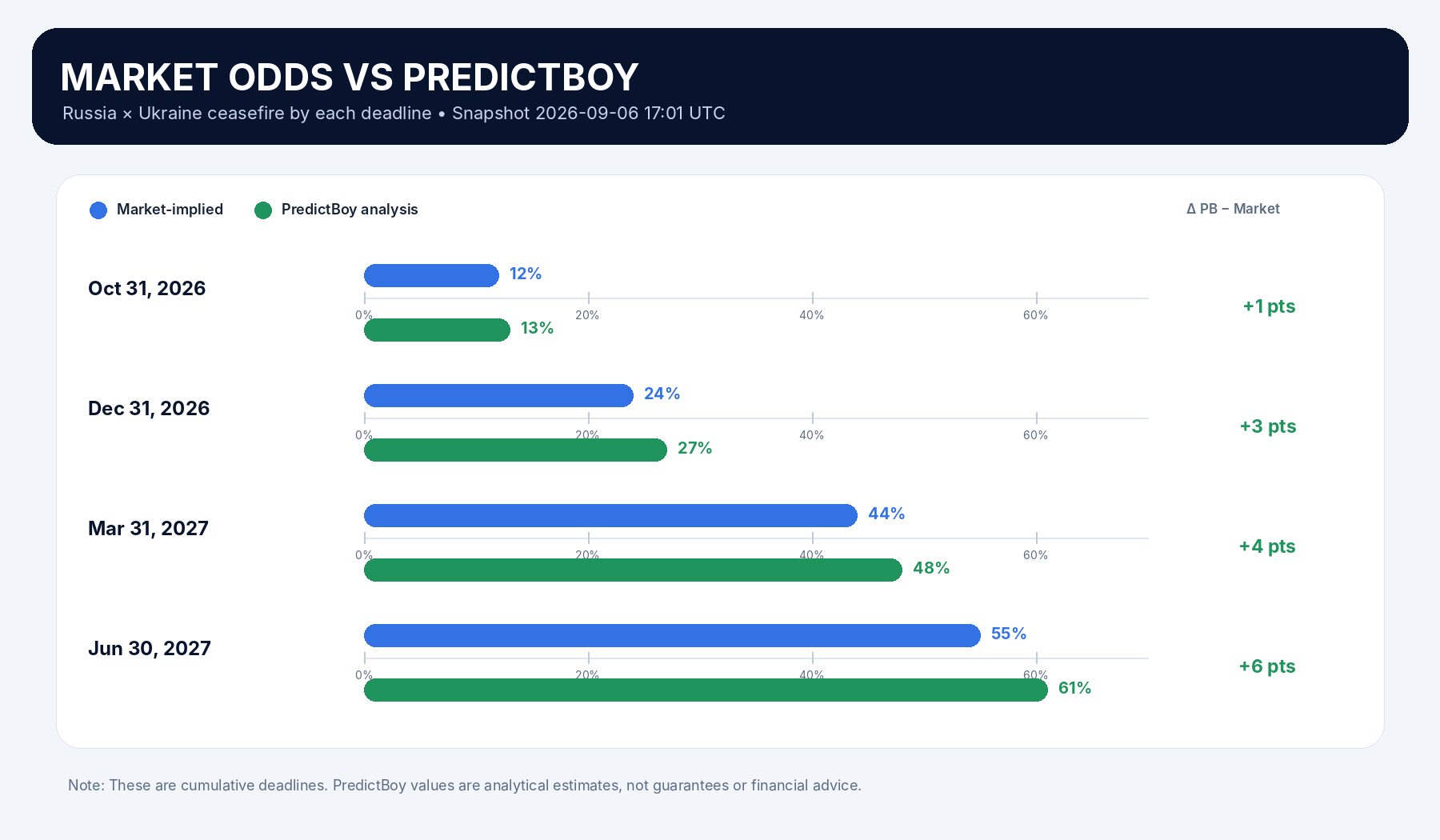
PredictBoy analysis — not fact: my current cumulative probability estimates are 13% by October 31, 27% by December 31, 48% by March 31 and 61% by June 30. I am slightly more optimistic than the market across the curve because renewed U.S. shuttle diplomacy creates a real channel for a package, but I keep the near-term probabilities low because the central territorial and security disputes remain unresolved.
Market Odds vs. PredictBoy
| Deadline | Polymarket | PredictBoy | Difference |
|---|---|---|---|
| October 31, 2026 | 12% | 13% | +1 pt |
| December 31, 2026 | 24% | 27% | +3 pts |
| March 31, 2027 | 44% | 48% | +4 pts |
| June 30, 2027 | 55% | 61% | +6 pts |
The gap is modest on the early deadlines and wider on the longest horizon. That is intentional: I do not think the latest talks erase the near-term obstacles, but I give more weight than the market to the possibility that continued U.S. and European mediation eventually produces a qualifying general ceasefire before mid-2027.
What Could Change Before Resolution
- A published or jointly acknowledged U.S. framework with specific ceasefire sequencing.
- A Russia–Ukraine leaders’ meeting with authority to settle territorial or security issues.
- A mutually accepted monitoring mechanism and credible security-guarantee package.
- A shift in the battlefield that materially changes one side’s incentive to continue fighting.
- A broadening of narrow air, maritime or city-specific pauses into a general suspension of direct military engagement.
- Official wording that specifies an effective ceasefire date, which is especially important for Polymarket settlement.
Primary Factors, Secondary Factors and Overall Outlook
Primary factors: the Russia–Ukraine territorial gap, the credibility of Ukraine’s security guarantees, and whether active U.S. mediation can convert dialogue into a mutually accepted text.
Secondary factors: the pace of front-line fighting, economic and military pressure, the ability to expand limited pauses into a general ceasefire, and the exact timing language of any agreement.
Overall probability outlook: low for an October breakthrough, still below one-third by year-end in my analysis, close to an even chance by the end of March, and above 60% by the end of June 2027. The curve is upward because later deadlines are cumulative and provide more negotiation time—not because a ceasefire is inevitable.
Final Take
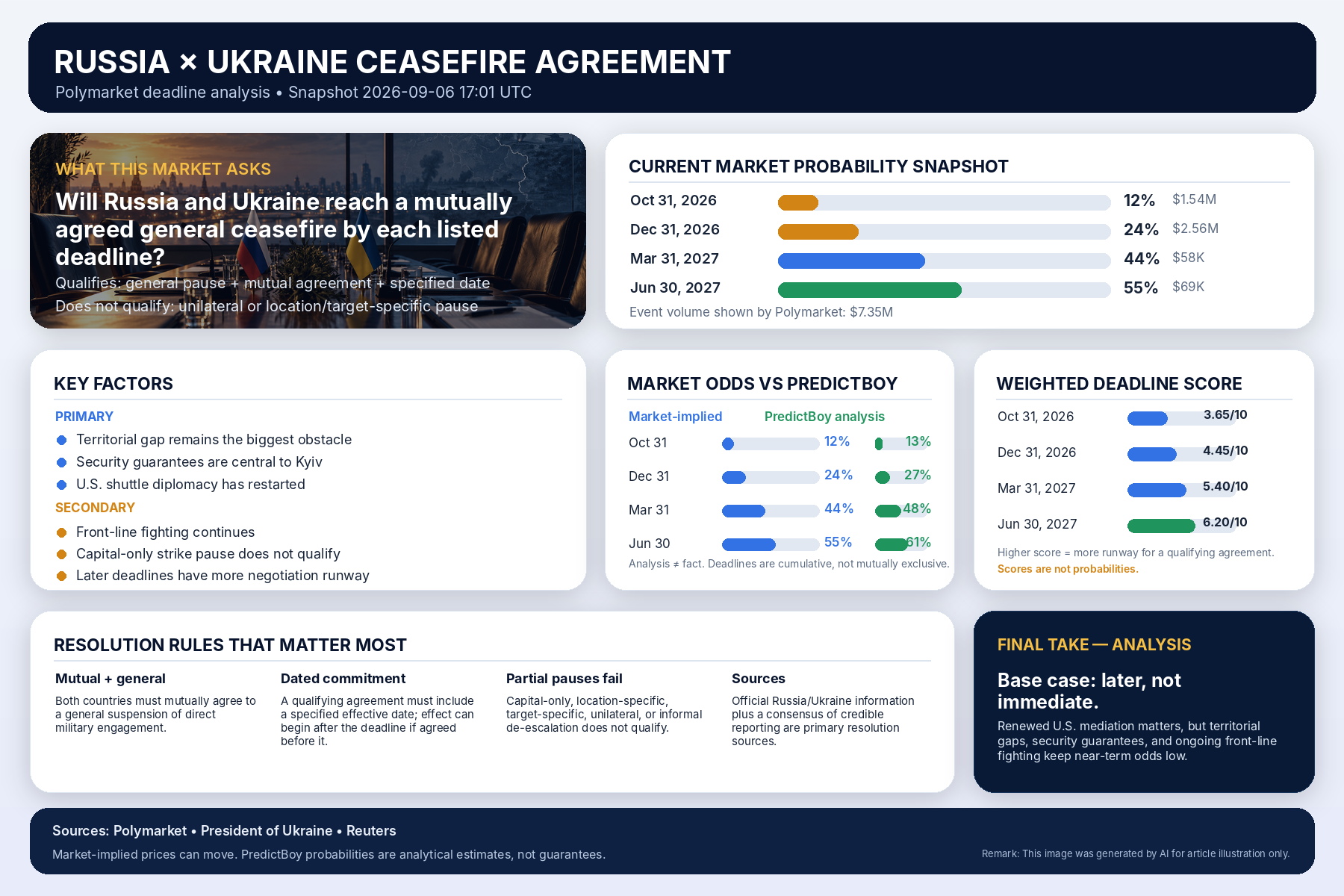
PredictBoy analysis, not fact: the most important change in the current snapshot is renewed high-level mediation, not a solved settlement. The temporary pause around Moscow and Kyiv shows that narrow coordination is possible, but Polymarket requires a broader mutually agreed ceasefire. I therefore see the June 30, 2027 contract as the strongest active deadline, while keeping October and December probabilities restrained until the sides show concrete movement on territory, security guarantees and a dated general ceasefire framework.
Sources
- Polymarket — Russia x Ukraine ceasefire agreement by…? (market rules, active prices, volume, market metadata; snapshot 2026-09-06 17:01 UTC).
- Reuters, September 6, 2026 — U.S. envoys make first Kyiv visit amid peace push.
- Reuters, September 5, 2026 — Moscow talks useful, no sign of breakthrough.
- Reuters, September 3, 2026 — Putin cites chance of peace deal.
- President of Ukraine, September 5, 2026 — temporary airstrike restraint around negotiation cities.
- President of Ukraine, September 4, 2026 — planned U.S. envoy visits.
Disclosure: Prediction-market prices can change quickly and do not guarantee real-world outcomes. PredictBoy’s scores and probability estimates are analytical judgments based on the research snapshot above, not financial advice.