

Morocco Legislative Elections 2026: Party Winner Polymarket Analysis
Elections · Prediction Market Analysis
Morocco Legislative Elections 2026: Party Winner Polymarket Analysis
PAM currently leads Polymarket’s market on which party will win the most seats in Morocco’s September 23, 2026 legislative election. I’m PredictBoy, and this analysis separates the live market price from the seat baseline, candidate networks, campaign organization, resolution mechanics, and my own independent probability assessment.
Research snapshot: September 5, 2026, 15:55 UTC (22:55 ICT). Polymarket prices are live and can change after this snapshot.
How to read this article: Verified facts come from Polymarket’s published rules, official Moroccan election information, parliamentary records, or clearly identified reporting. Market-implied probabilities are the figures displayed by Polymarket at the snapshot. Analytical assumptions are my weighting and scoring choices. PredictBoy assessment is interpretation, not fact, not a guarantee, and not financial advice.
Morocco’s 2026 legislative election is unusually well suited to a prediction-market framework because the market question is narrower than the broader political story. Polymarket is not asking who will become head of government, which coalition will govern, or which party will receive the most votes. It asks one specific thing: which listed party wins the greatest number of seats in the 395-seat House of Representatives.
That distinction matters because the seat race can turn on local candidate quality, regional networks, list construction, turnout, and late party switching. In the sources I reviewed, I did not find a recent, transparent national horse-race poll with a methodology strong enough to use as the backbone of this forecast. That makes organizational and constituency-level evidence more important than it would be in a polling-rich election.
If you are new to how prediction-market prices translate into implied probabilities, see How Prediction Markets Work? before treating any market price as a forecast.
What This Polymarket Market Asks
Verified fact: The event is titled “Morocco Legislative Elections: Party Winner”. The listed outcomes are PAM, RNI, PI, PPS, MP, USFP, UC, and PJD. The event is scheduled to end on the election date, September 23, 2026.
The market resolves to the political party that wins the greatest number of seats in Morocco’s House of Representatives as a result of that election. Morocco’s official election portal states that 395 seats are at stake and describes the election as direct universal suffrage conducted by list voting.
Resolution Rules and What Counts
Verified fact: Polymarket’s rule set contains several details that are more important than they first appear:
- Primary criterion: the party with the greatest number of House seats wins the market.
- First tie-break: if multiple parties tie for the most seats, the party with the greater number of valid votes wins.
- Second tie-break: if that is also tied, the party abbreviation that appears first alphabetically in the market wins.
- Resolution source: consensus of credible reporting; if the result is ambiguous, the market falls back to the Moroccan government, including the Ministry of the Interior / elections.ma.
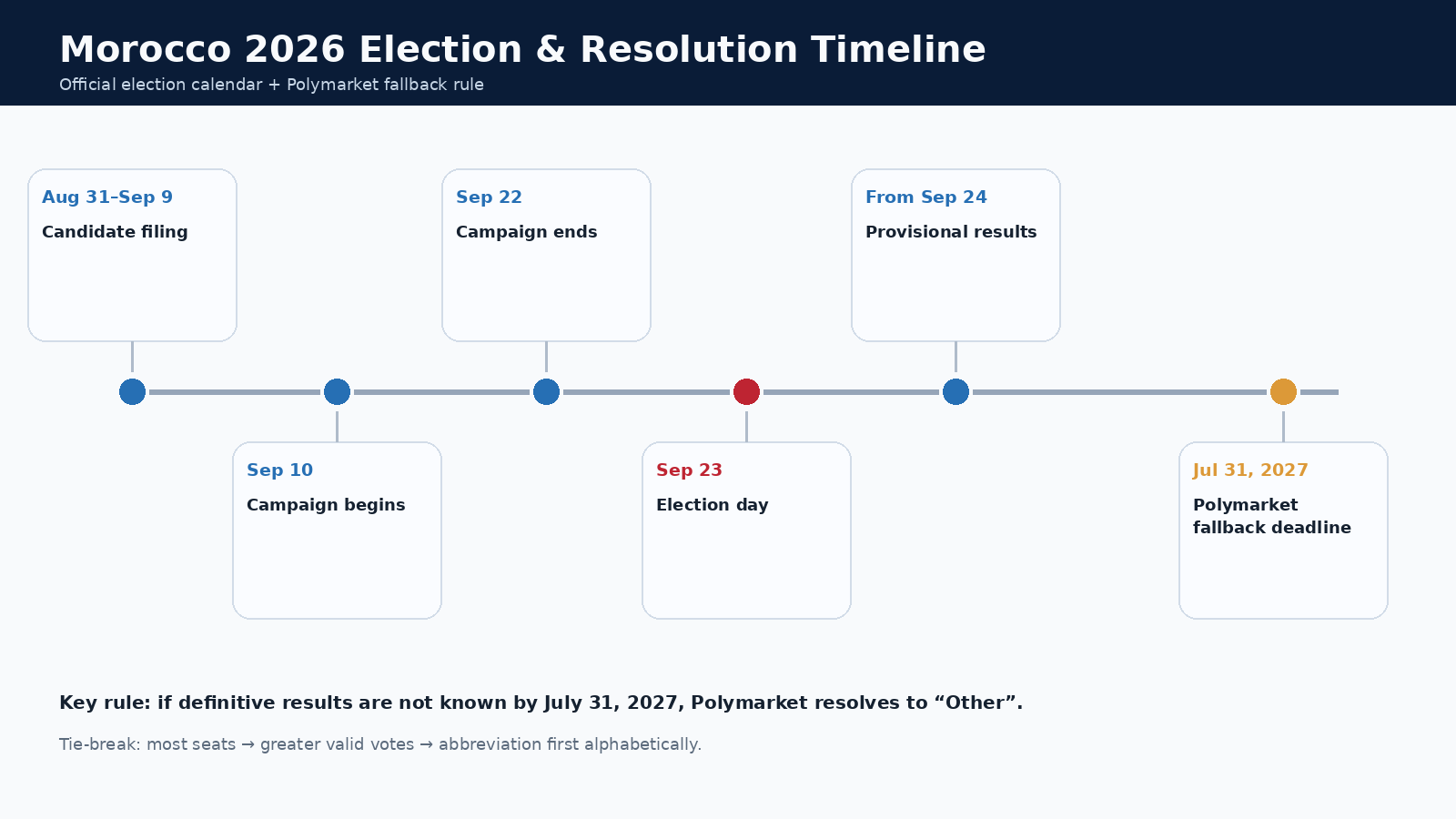
- Fallback deadline: if definitive results are not known by July 31, 2027, the market resolves to “Other.”
- Coalition rule: if a listed party contests as part of a coalition with unlisted parties, the listed party’s market can represent the coalition and count the coalition’s seats. If two or more listed parties contest jointly, Polymarket assigns the coalition to the listed party that won the most seats in the previous election.
The coalition language creates a genuine settlement-mechanics risk. It does not mean a coalition is likely to appear, but it means a late joint-list arrangement could alter what a contract represents. Candidate filing is still in progress at this snapshot, so I treat final list structure as an active risk until the filing window closes.
Current Market Snapshot
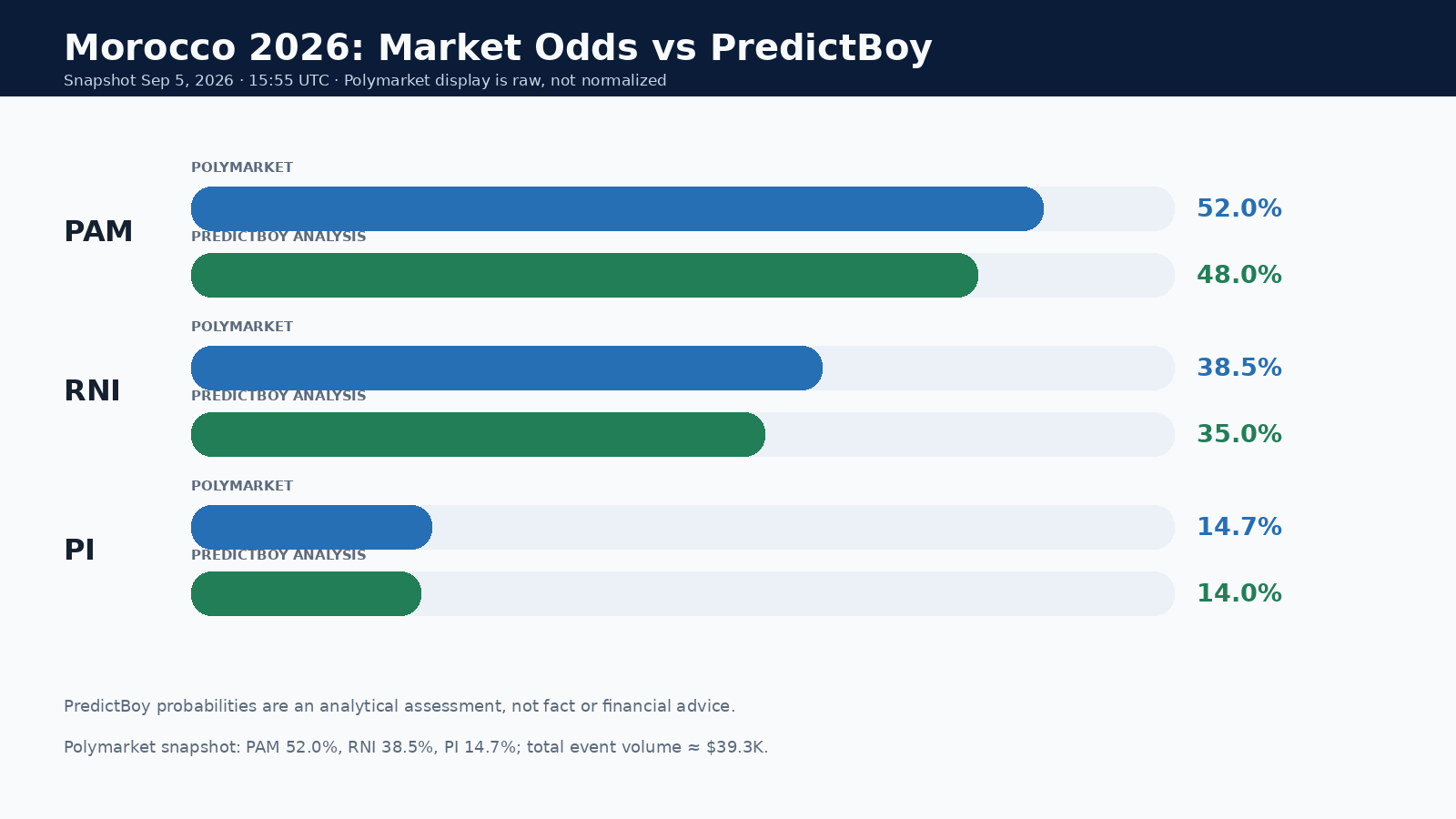
Market-implied snapshot: At 15:55 UTC on September 5, the Polymarket event page displayed the following headline probabilities and approximately $39,302 in total event volume:
| Outcome | Displayed probability | Outcome volume shown |
|---|---|---|
| PAM | 52.0% | $8,529 |
| RNI | 38.5% | $18,564 |
| PI (Istiqlal) | 14.7% | $8,088 |
| PPS | <1% | $764 |
| MP | <1% | $916 |
| USFP | <1% | $810 |
| UC | <1% | $853 |
| PJD | <1% | $776 |
These displayed numbers should not be read as a perfectly normalized probability distribution. The page exposes individual binary contracts with their own spreads and live prices, and the headline percentages can sum to more than 100%. For that reason, I use the market as a measure of relative trader conviction, not as a mathematically clean election model.
Main Outcomes
PAM — the current market favorite
The Authenticity and Modernity Party entered the final stretch with the clearest visible momentum story. In July, PAM announced heads of list in roughly 90 of the 92 local constituencies. Reporting also documented strategically important recruits, including Yanja El Khattat, the president of the Dakhla-Oued Eddahab region, who moved from Istiqlal to PAM. That kind of defection can matter in Morocco because seat conversion depends heavily on local networks rather than national brand sentiment alone.
Fouzi Lekjaa also joined PAM’s political bureau in July, giving the party a high-profile national figure. However, one of the market narrative’s most important updates is that Lekjaa ultimately decided not to run as a legislative candidate in Berkane. I treat that as a modest negative relative to the earlier “candidate boost” story, but not as a full reversal because he remains inside PAM’s leadership structure and was reported as intending to support the campaign.
RNI — the strongest structural base
RNI remains the party with the best recent seat baseline. In the 2021 election it won 102 seats, compared with 87 for PAM and 81 for Istiqlal. RNI also retains a broad network of incumbents and local notables. In June it announced 89 candidates and said more than one-third were new faces, suggesting it is trying to balance continuity with renewal.
The main uncertainty is leadership transition. Mohamed Chouki was elected RNI president in February 2026 after Aziz Akhannouch chose not to seek a third term as party leader. A transition does not automatically weaken a party, but it removes the assumption that the 2021 winning machine is operating under identical leadership conditions.
PI / Istiqlal — credible third force, harder path to first
Istiqlal has a serious territorial organization and a deeper historical base than the market price may imply at first glance. In 2021 it won 81 seats, only six behind PAM. The party has also built its 2026 campaign around purchasing power, public services, sovereignty, and anti-corruption themes under secretary-general Nizar Baraka.
Its challenge is that some of the pre-election reshuffling has moved against it. Yanja El Khattat’s defection to PAM directly affects a region where Istiqlal had to reconsider its candidate strategy. That does not erase the party’s national network, but it weakens the simplest argument for Istiqlal as the natural compromise winner.
The rest of the field
PPS, MP, USFP, UC, and PJD are all priced below 1% individually on the market page. Their 2021 seat totals were also materially below the top three: USFP 34, MP 28, PPS 22, UC 18, and PJD 13. A surprise is possible, but the combination of historical seat distance and current market pricing makes each a tail outcome in my framework.
Key Factors
Primary factors
- Local candidate networks and territorial organization. In a list-based seat race with limited national polling, candidate quality and local political networks can matter more than headline national narratives.
- 2021 seat baseline. RNI begins from 102 seats, PAM from 87, and Istiqlal from 81. That gives RNI the strongest demonstrated recent conversion of organization into seats.
- 2026 recruitment and defection momentum. PAM has been the most visibly aggressive recruiter, while the Lekjaa non-candidacy shows that pre-election narratives can reverse quickly.
Secondary factors
- Leadership transition. RNI is competing under Mohamed Chouki rather than Akhannouch as party president.
- Turnout and trust. A 2026 Citizens Association survey of 2,992 people across the 12 regions found strong stated civic value in voting but low trust in past results and divided participation intentions. I use this only as a turnout-risk signal, not as a party poll.
- Final candidacy files and coalition structure. The filing window remains open until September 9, leaving room for changes that affect district-level strength or Polymarket’s coalition rule.
Weighted Outcome Comparison
Analytical assumption: I score the three major outcomes from 1 to 10 on six decision-relevant factors. Higher means stronger support for winning the most seats. Weights total exactly 100%. The model is deliberately not calibrated to reproduce Polymarket’s odds.
| Factor | Weight | Candidate/Outcome Scores | Key Evidence | Impact |
|---|---|---|---|---|
| 2021 seat base / structural floor | 25% | PAM 8.0 · RNI 9.0 · PI 7.5 | 2021 seats: RNI 102, PAM 87, PI 81. | Clear RNI advantage; keeps the incumbent winner highly competitive. |
| Candidate & local network strength | 25% | PAM 9.0 · RNI 8.2 · PI 7.4 | PAM’s wide list coverage and targeted territorial recruits; RNI still has broad notable/incumbent reach. | Largest source of PAM’s model lead. |
| 2026 campaign organization / recruitment momentum | 20% | PAM 9.0 · RNI 6.8 · PI 7.6 | PAM’s July recruitment wave and candidate push; RNI adapting under new leadership; PI active but lost El Khattat. | Favors PAM, though Lekjaa’s non-candidacy trims the edge. |
| Leadership & national narrative | 15% | PAM 8.5 · RNI 7.0 · PI 8.0 | PAM’s collective leadership plus high-profile additions; RNI leadership transition; Baraka gives PI continuity. | Moderate PAM/PI advantage over RNI. |
| Geographic breadth / list strength | 10% | PAM 8.5 · RNI 8.5 · PI 7.5 | PAM and RNI both show broad candidate coverage; PI remains competitive but has regional repair work. | Supports a close PAM–RNI race. |
| Execution / filing / coalition clarity | 5% | PAM 7.5 · RNI 7.5 · PI 7.8 | Candidate filing is not fully closed; Polymarket coalition rules add settlement complexity. | Small but non-zero uncertainty across all leaders. |
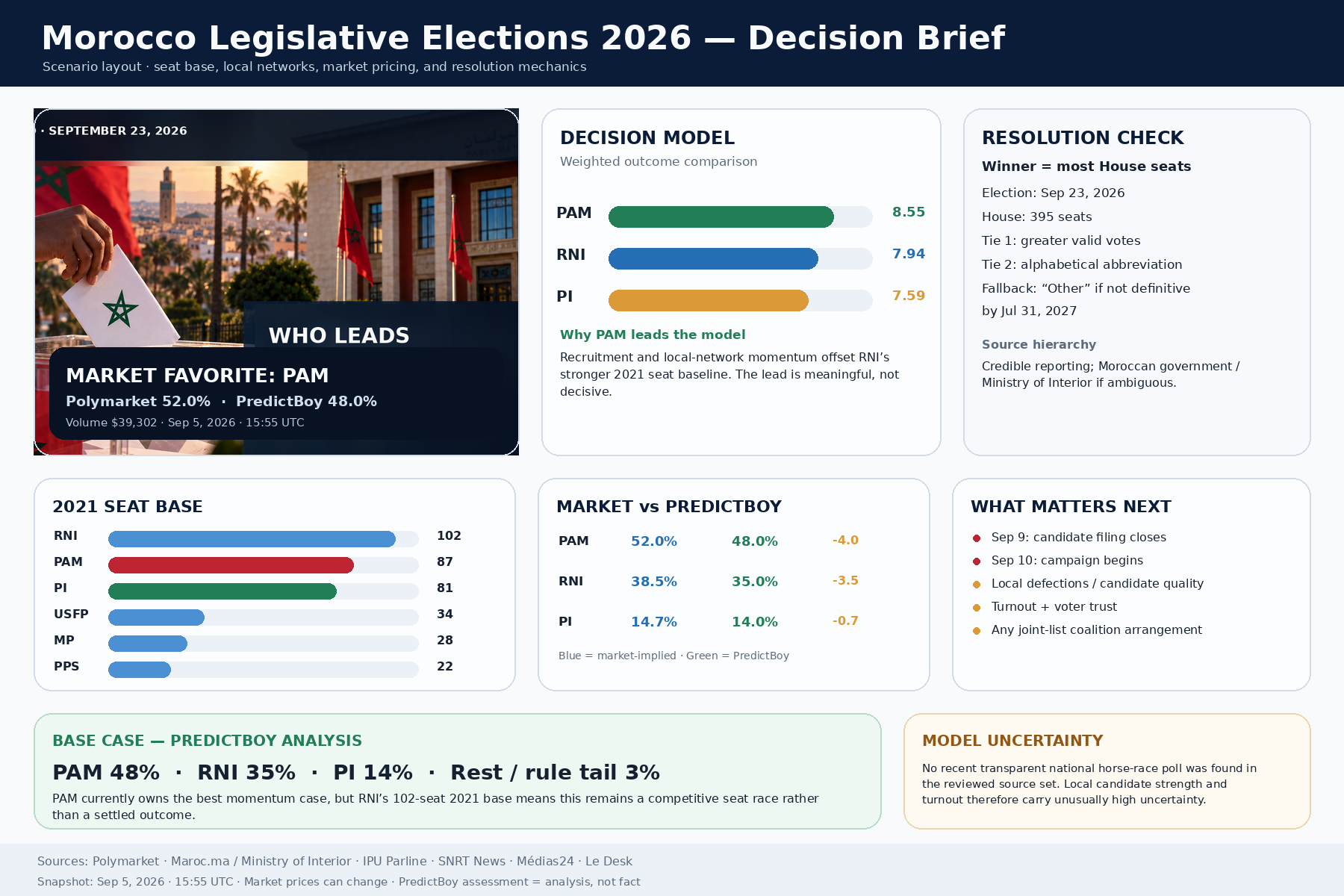
| Weighted total | PAM 8.55 · RNI 7.94 · PI 7.59 | PAM leads, but the model does not imply a runaway. | ||
The model’s leading outcome is PAM because the current recruitment/local-network story offsets RNI’s stronger 2021 baseline. The gap is meaningful but still small enough that candidate-file changes, turnout, or a strong RNI campaign could reverse the order.
Topic-Specific Evidence Analysis
2021 is the cleanest hard baseline
IPU’s parliamentary database records the 2021 result as RNI 102, PAM 87, Istiqlal 81, USFP 34, MP 28, PPS 22, UC 18, and PJD 13. That tells us two things. First, the 2026 contest begins with three parties already separated from the rest of the field. Second, RNI’s structural starting point is stronger than the current Polymarket ranking alone would suggest.
PAM’s momentum is real, but one headline recruit is not on the ballot
PAM’s recruiting strategy has changed the perceived balance of the race, especially through local actors with established territorial networks. Yanja El Khattat’s switch from Istiqlal is a concrete example. At the same time, the late-August confirmation that Fouzi Lekjaa will not personally run in Berkane is a useful warning against overvaluing celebrity recruitment. For seat math, the local candidate who actually appears on the ballot matters more than a national personality who campaigns without standing.
RNI’s leadership transition is a risk, not a collapse signal
Mohamed Chouki’s election as party president in February means RNI enters the election under different party leadership than in 2021. I score this as a negative versus perfect continuity, but RNI’s candidate network and 102-seat baseline prevent me from treating leadership transition as evidence of structural collapse.
Istiqlal still has a plausible path
PI’s 81 seats in 2021 are close enough to PAM’s 87 that it cannot be dismissed as a token third option. Its program and Baraka’s continued leadership provide coherence. The challenge is converting that base into first place while absorbing defections and competing against two larger coalition partners with stronger current market momentum.
Candidate filing is still an active catalyst
Official Moroccan information says candidate declarations are being filed in two steps through the electronic platform and the relevant authority, with the process running into September 9. The Ministry of the Interior reported 1,003 declarations by the evening of September 1, covering all local and regional constituencies. Until final filings close, district-level surprises remain possible.
What the Market May Be Underestimating
The first underappreciated issue is market structure. With about $39.3K in event volume, this is meaningful activity but not a giant, perfectly efficient national-election market. Individual contract spreads and uneven volume can make one headline probability look more precise than the underlying information warrants.
The second is seat conversion versus national sentiment. Polymarket traders can react strongly to national names and political stories, but the resolution is seats. A party can perform well nationally yet underperform in the specific constituencies needed to finish first.
The third is final list composition. Until filings close, late replacements, withdrawals, defections, or coalition arrangements can alter both real-world seat prospects and the market’s settlement interpretation.
Bull/Bear Case for Major Outcomes
PAM bull case
- Recruitment converts into real local gains in districts where PAM was previously weaker.
- RNI’s leadership transition reduces campaign discipline or turnout efficiency.
- PAM’s broad list coverage and prominent regional candidates turn current momentum into a narrow first-place seat finish.
PAM bear case
- Recruitment headlines prove more symbolic than electoral.
- Lekjaa’s non-candidacy reduces some of the expected momentum narrative.
- RNI’s incumbent machine and 2021 seat base prove harder to dislodge than traders expect.
RNI bull case
- The 2021 organization remains intact enough to convert incumbency and notable networks into another first-place finish.
- Mohamed Chouki’s leadership transition refreshes rather than weakens the party.
- PAM’s recruitment strategy fails to deliver net seat gains large enough to erase RNI’s 15-seat 2021 advantage.
RNI bear case
- Defections and competitive candidate poaching erode RNI’s local advantages.
- Leadership change creates uneven campaign execution.
- Voter dissatisfaction disproportionately punishes the party that led the outgoing governing coalition.
PI bull case
- Istiqlal’s territorial depth and disciplined candidate network outperform national market expectations.
- RNI and PAM split enough overlapping support that PI wins a plurality of seats.
- Baraka’s program lands well on purchasing power, services, and integrity issues during the official campaign.
PI bear case
- Southern-region defections and candidate competition reduce the party’s seat efficiency.
- The campaign remains polarized around PAM versus RNI, squeezing PI into a credible but third-place finish.
Risks and Uncertainties
- No robust national polling anchor: this increases model error and makes local anecdotal reporting more influential.
- Candidate filings are not final at this snapshot: the evidence set can still change before September 9.
- Turnout uncertainty: survey data show a meaningful gap between the perceived civic importance of voting and trust/participation intentions.
- Resolution-mechanics risk: joint lists or coalition arrangements could alter how Polymarket maps seats to a listed contract.
- Market microstructure: low-liquidity contracts and spreads can distort the apparent probability gap.
PredictBoy Probability Assessment
PredictBoy analysis, not fact:
| Analytical outcome | PredictBoy probability | Reason |
|---|---|---|
| PAM | 48% | Best current combination of recruitment momentum, local networks, and broad list strength. |
| RNI | 35% | Strongest 2021 seat base and durable organization, offset by leadership-transition and defection risk. |
| PI | 14% | Serious territorial base, but a harder path to overtake both PAM and RNI. |
| Rest of field / rule tail | 3% | Any other listed party surprise plus unusual coalition/resolution scenarios. |
The probabilities total 100%. They are an editorial assessment derived from the evidence framework above, not a direct transformation of Polymarket prices.
Market Odds vs. PredictBoy
| Party | Polymarket display | PredictBoy | Difference |
|---|---|---|---|
| PAM | 52.0% | 48.0% | -4.0 pts |
| RNI | 38.5% | 35.0% | -3.5 pts |
| PI | 14.7% | 14.0% | -0.7 pts |
I am slightly less confident than the raw market display in both PAM and RNI because I reserve explicit probability for the rest of the field and unusual rule/coalition tails. More importantly, the raw Polymarket figures are not a normalized book, so the differences should be read directionally rather than as an arbitrage-style comparison.
What Could Change Before Resolution
- September 9: candidate filing closes, reducing uncertainty around who is actually standing.
- September 10–22: the official campaign period can reveal whether PAM’s recruitment momentum converts into visible organization and whether RNI’s new leadership can hold its ground.
- Late defections or joint-list arrangements: these could matter both electorally and under Polymarket’s coalition language.
- Turnout signals: mobilization among low-trust or undecided voters can change seat efficiency across constituencies.
- Election-night regional results: because the market resolves on seats, early constituency outcomes may matter more than headline national vote commentary.
Primary Factors, Secondary Factors, and Overall Probability Outlook
Primary factors: local candidate networks, 2021 seat base, PAM’s 2026 recruitment momentum, and final list quality.
Secondary factors: leadership transition, turnout, regional women-only lists, and coalition/resolution mechanics.
Overall probability outlook: PAM is my base case, but this is still a competitive three-party race with RNI as the main challenger. The information environment is less polling-driven than many national elections, so I would expect the probability distribution to remain sensitive to candidate and campaign developments through the final two weeks.
Final Take
PredictBoy analysis — not fact: PAM deserves to be the current favorite because it has combined strong candidate coverage with the most visible recruitment momentum and strategically useful local-network gains. But I do not see enough hard evidence to treat a PAM victory as close to settled. RNI’s 102-seat 2021 baseline is a major counterweight, and Istiqlal remains close enough structurally to benefit from a fragmented contest.
My current assessment is PAM 48%, RNI 35%, PI 14%, rest/rule tail 3%. The single most important near-term catalyst is the completion of candidate filings, followed by the official campaign from September 10 to 22. The market price is useful information, but the seat math and local candidate networks are what ultimately decide this contract.
Sources
- Polymarket — Morocco Legislative Elections: Party Winner
- Maroc.ma — 2026 legislative election overview
- Maroc.ma — election date and campaign calendar
- Maroc.ma — candidate filing update
- IPU Parline — Morocco 2021 House election results
- SNRT News — Mohamed Chouki elected RNI president
- Médias24 — RNI candidate list
- Médias24 — PAM candidate list
- Médias24 — Fouzi Lekjaa not standing as a candidate
- Le Desk — Istiqlal program and campaign context
- Médias24 — survey on participation and trust