

Largest Company at the End of December 2026: Polymarket Odds & PredictBoy Analysis
Data snapshot: September 4, 2026 at 19:04 ICT (September 4, 2026 at 12:04 UTC; September 4, 2026 at 08:04 ET). Market capitalizations and Polymarket prices can move every trading day, so this article should be treated as a dated analytical snapshot rather than a fixed forecast.
I’m PredictBoy, and this market asks a very specific question: which company will have the largest market capitalization in the world at the close of trading on December 31, 2026? It is not asking which company has the highest revenue, profit, brand value, enterprise value or private-market valuation at some other date.
If prediction markets are new to you, start with how prediction markets work before treating a contract price as a guaranteed real-world probability.
What Does This Polymarket Market Ask?
Verified fact: Polymarket’s Largest Company end of December 2026? event resolves to the largest company in the world by market cap on December 31, 2026, as of market close.
The published resolution source is a consensus of credible reporting. That matters because the market is not tied to one specific data vendor’s intraday display. In this article I use current market-cap data as a reference snapshot, not as a substitute for the eventual resolution process.
Resolution Rules and What Actually Counts
The market lists eight outcomes: NVIDIA, Apple, Alphabet, SpaceX, Microsoft, Saudi Aramco, Tesla and Amazon. The winner is whichever of those companies is the world’s largest by market capitalization at the end-of-day market close on December 31.
PredictBoy interpretation: because this is a point-in-time market-cap contest, the key variable is not simply business quality. A company with faster revenue growth can still lose if its valuation multiple contracts, while a slower-growing company can win through share-price appreciation, buybacks, earnings surprises or a competitor’s drawdown.
Current Market Probability Snapshot
The event shows about $6,600,711 in total trading volume. Current displayed Yes signals are:
| Company | Polymarket Display | Current Market-Cap Reference | Distance Context |
|---|---|---|---|
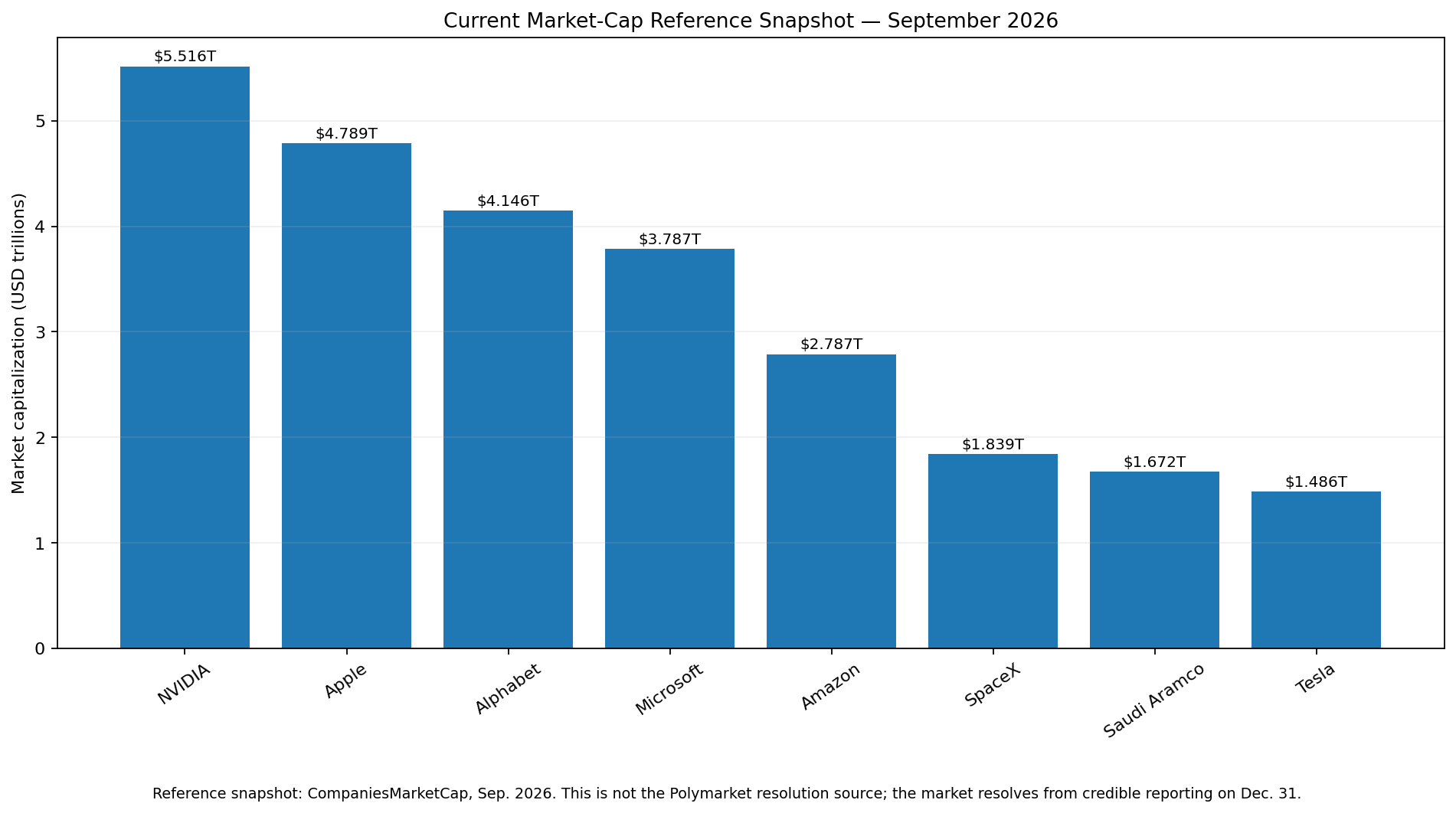
| NVIDIA | 77.0% | $5.516T | Leader |
| Apple | 15.2% | $4.789T | 15.2% catch-up if NVIDIA were flat |
| Alphabet | 8.0% | $4.146T | 33.0% catch-up if NVIDIA were flat |
| Microsoft | 0.8% | $3.787T | 45.7% catch-up if NVIDIA were flat |
| Amazon | 0.2% | $2.787T | 97.9% catch-up if NVIDIA were flat |
| SpaceX | 1.0% | $1.839T | 199.9% catch-up if NVIDIA were flat |
| Saudi Aramco | 0.2% | $1.672T | 229.9% catch-up if NVIDIA were flat |
| Tesla | 0.2% | $1.486T | 271.2% catch-up if NVIDIA were flat |
The raw displayed Yes prices sum to more than 100% because each company trades as a separate binary outcome with its own spread. I therefore show the market values as raw signals rather than force-normalizing them.
The Market Has Repriced Dramatically Since May
An observed Polymarket snapshot from May 8 showed NVIDIA at 58%, Alphabet at 30%, Apple at 6.3% and SpaceX at 2.2%. The September snapshot has NVIDIA at 77%, Apple at 15.2%, Alphabet at 8% and SpaceX around 1%.
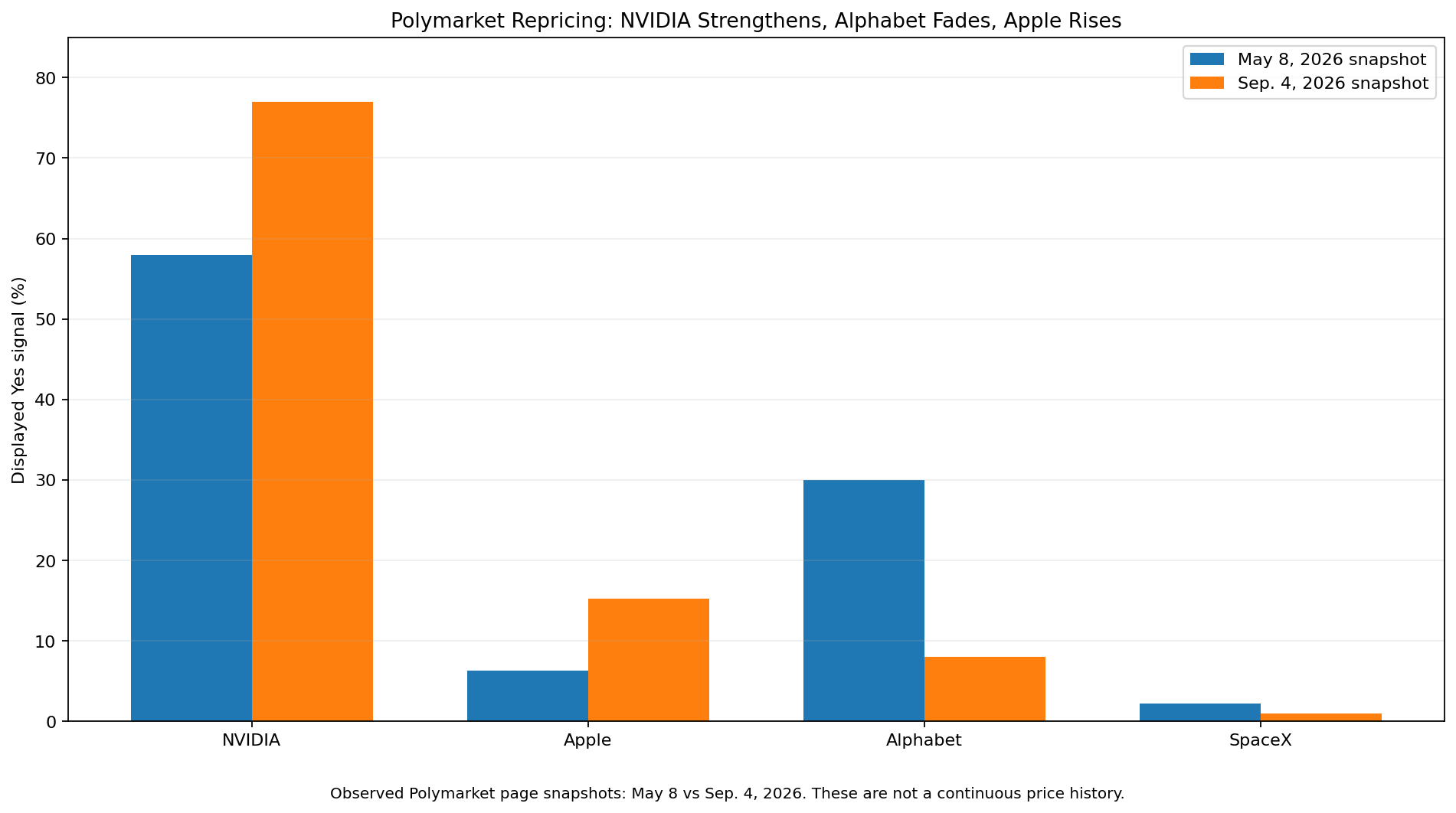
This is not a continuous historical price series, but the direction is clear: NVIDIA’s probability premium widened sharply, Alphabet lost most of its earlier market confidence, and Apple moved into the clear #2 slot.
Current Market-Cap Race
A September 2026 reference snapshot from CompaniesMarketCap places NVIDIA around $5.516 trillion, Apple around $4.789T, Alphabet $4.146T, Microsoft $3.787T, Amazon $2.787T, SpaceX $1.839T, Saudi Aramco $1.672T and Tesla $1.486T.
The gap is the most important mechanical advantage NVIDIA owns. If NVIDIA’s market cap were frozen at today’s level, Apple would need roughly 15.2% market-cap growth to catch it. Alphabet would need about 33.0%, Microsoft 45.7% and Amazon almost 98%.
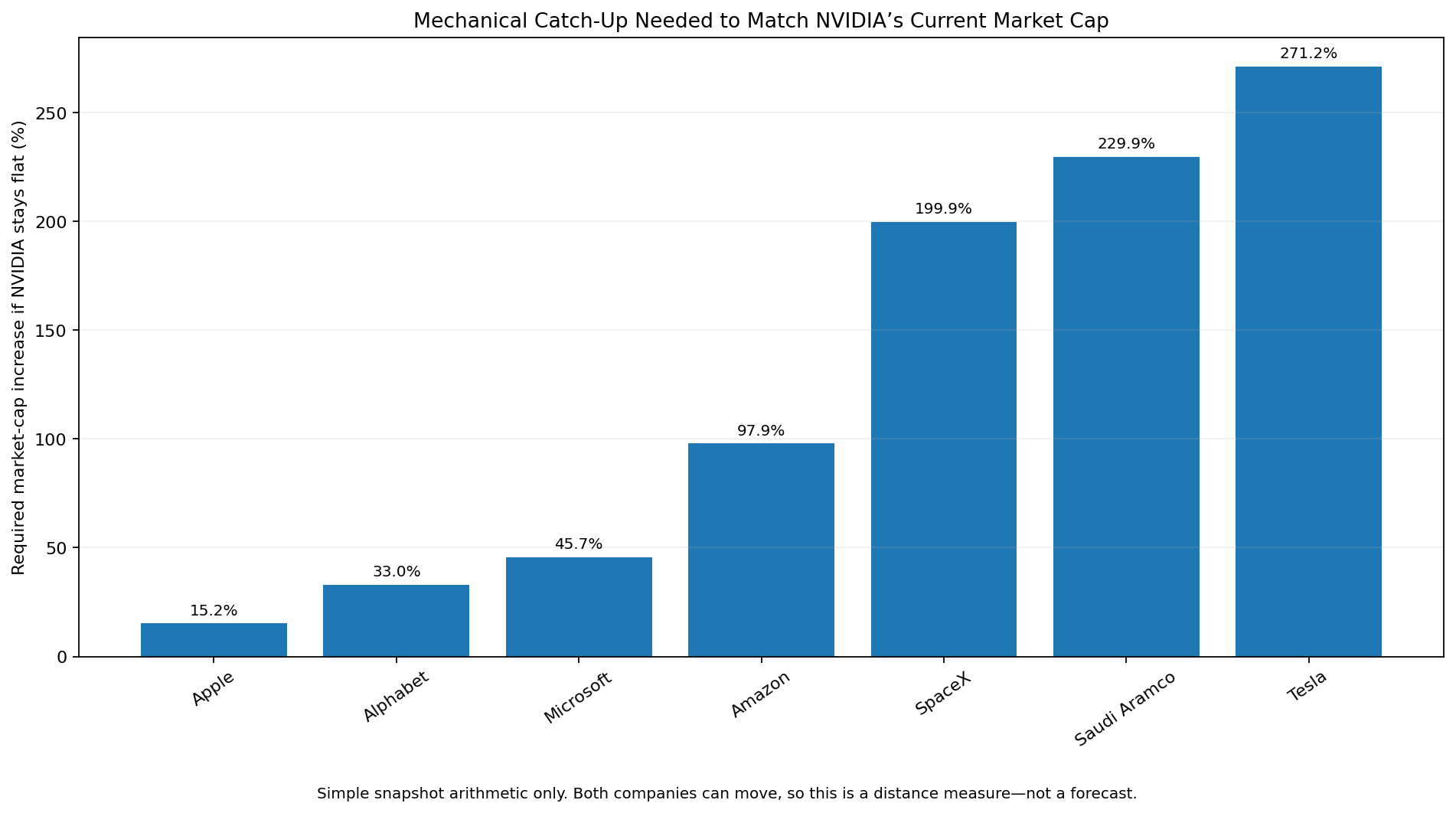
That calculation is not a prediction because NVIDIA can rise or fall too. It simply shows why Apple is the only challenger that can overtake NVIDIA with a relatively ordinary large-cap move if NVIDIA stalls.
Main Companies in the Race
NVIDIA
NVIDIA has both the largest current market cap and the strongest recent growth. Its August 26 fiscal Q2 2027 results showed revenue of $96.2 billion, up 106% year over year, while Data Center revenue reached $89.0 billion, up 117%. The company guided fiscal Q3 revenue to roughly $108 billion.
The growth case is reinforced by Vera Rubin entering full production and by the company’s expansion deeper into the AI software ecosystem, including the announced $12.9 billion acquisition of Hugging Face.
Risk: NVIDIA’s valuation embeds extraordinary growth expectations. China/export restrictions, customers building custom accelerators, AI-capex fatigue or a broad multiple compression could erase a large portion of the current lead quickly.
Apple
Apple is the closest market-cap challenger. Its fiscal Q3 2026 revenue was $109.4 billion, up 16% year over year, with record June-quarter revenue from iPhone, Mac and Services. The company also introduced an overhauled Siri AI and has a major product event scheduled for September 9.
Apple’s key advantage is not NVIDIA-style revenue growth; it is the combination of a huge installed base, recurring Services revenue, capital returns and the possibility that investors re-rate the company as its AI strategy becomes more credible.
Risk: Apple is transitioning from Tim Cook to John Ternus, and investors still debate whether Apple is catching up quickly enough in AI. If the product cycle disappoints, closing a $700B+ valuation gap will be difficult.
Alphabet
Alphabet has the fastest fundamental growth among the non-NVIDIA megacaps. Its Q2 2026 revenue rose 24% to $119.8 billion, while Google Cloud revenue surged 82% to $24.8 billion. Search revenue also grew 17%.
Alphabet therefore has a strong earnings-based rerating path. But its current market cap is roughly $1.37T below NVIDIA, so the stock needs a much larger relative move than Apple to take first place.
Risk: antitrust/regulatory exposure and enormous AI infrastructure spending can pressure the valuation multiple even if operating growth remains strong.
Microsoft
Microsoft remains one of the strongest AI/cloud businesses in the world. Fiscal Q4 2026 revenue increased 18% to $90.0 billion, Microsoft Cloud revenue grew 27%, and Azure revenue grew 43%. Commercial remaining performance obligation reached $678 billion.
Microsoft is fundamentally strong enough to stay in the conversation, but its roughly $3.79T market cap means it needs an exceptionally large relative move to catch NVIDIA by December 31.
Amazon
Amazon’s Q2 2026 net sales rose 20% to $200.6 billion, while AWS grew 37% to $42.2 billion. The company has excellent earnings momentum, but its sub-$2.8T market cap makes a year-end #1 finish a very large-distance outcome.
SpaceX, Saudi Aramco and Tesla
These are true longshots under current market-cap arithmetic. SpaceX is around $1.84T after its 2026 IPO, Saudi Aramco around $1.67T and Tesla around $1.49T. All would need enormous appreciation, a major collapse in the current leaders, or both.
SpaceX and Tesla have unusually high narrative and event-driven volatility; Saudi Aramco has a different macro path tied more directly to oil and energy markets. But the starting valuation gap is the dominant constraint.
Key Factors That Could Decide the Outcome
Primary factors: NVIDIA’s current market-cap lead, the next earnings cycle, AI infrastructure spending, valuation multiples and whether Apple or Alphabet can sustain a meaningful relative-stock rally.
Secondary factors: interest rates and bond yields, China/export policy, antitrust actions, share repurchases, product launches, AI capex sentiment, energy prices and any broad equity-market correction.
Overall probability outlook: NVIDIA deserves to be the favorite, but I do not view 77% as a certainty. Apple is close enough mechanically to win with a moderate relative move, while Alphabet has the strongest growth-based rerating case despite a larger market-cap gap.
Weighted Company Comparison
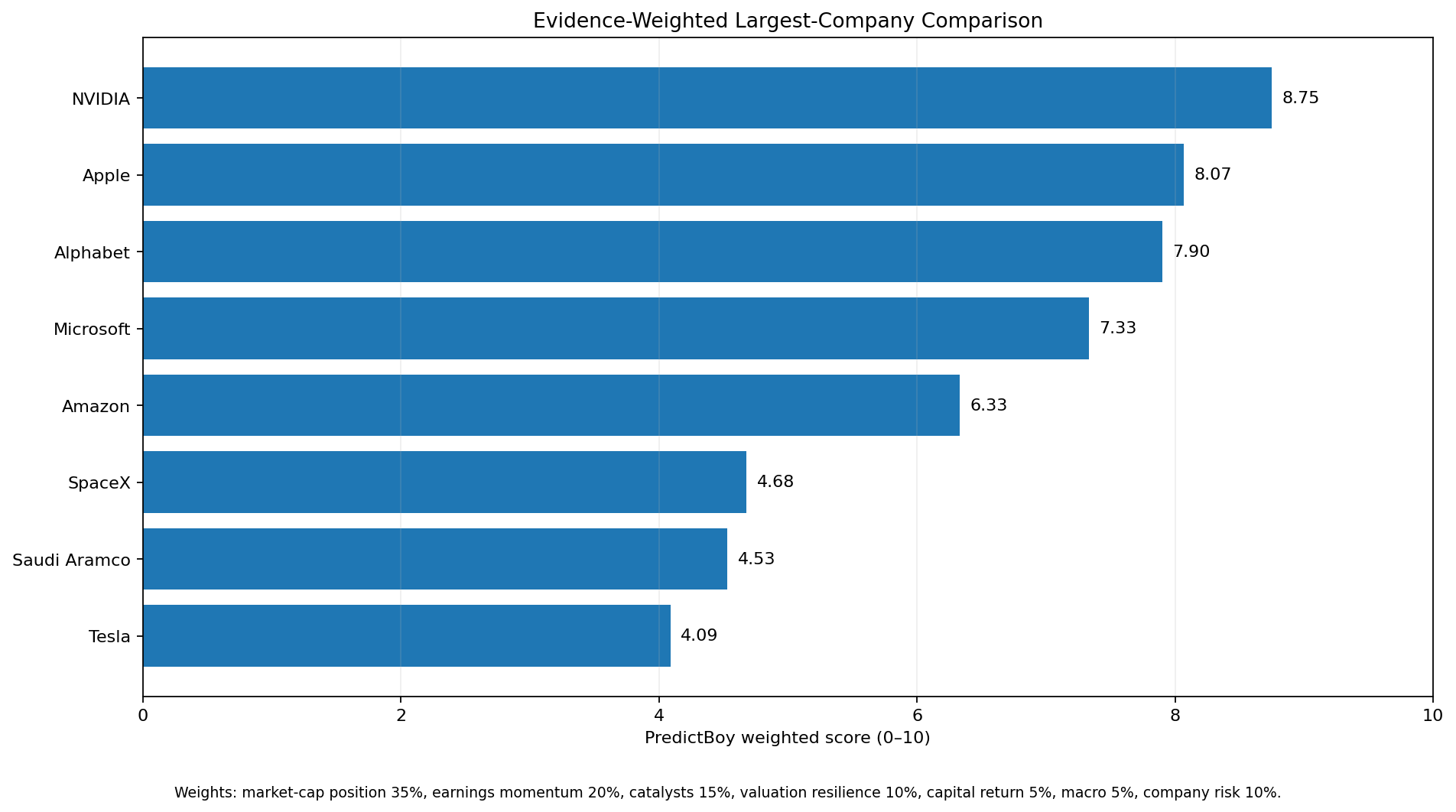
I score each listed company from 0–10 across seven factors. The weights total 100%. These are evidence scores, not copied Polymarket prices.
| Factor | Weight | Candidate Scores | Key Evidence | Impact |
|---|---|---|---|---|
| Current market-cap position & gap | 35% | NVIDIA 10.0; Apple 8.7; Alphabet 7.5; Microsoft 6.5; Amazon 4.5; SpaceX 2.8; Saudi Aramco 2.5; Tesla 2.2 | NVIDIA ≈ $5.516T, Apple ≈ $4.789T, Alphabet ≈ $4.146T and Microsoft ≈ $3.787T in the current reference snapshot. | High |
| Latest earnings / revenue momentum | 20% | NVIDIA 10.0; Apple 7.5; Alphabet 9.0; Microsoft 8.5; Amazon 8.5; SpaceX 7.0; Saudi Aramco 4.5; Tesla 5.5 | NVIDIA +106% YoY revenue; Alphabet +24%; Amazon +20%; Microsoft +18%; Apple +16% in their latest reported quarters. | High |
| Structural catalysts through year-end | 15% | NVIDIA 9.5; Apple 8.5; Alphabet 9.0; Microsoft 8.5; Amazon 8.0; SpaceX 8.0; Saudi Aramco 5.0; Tesla 7.5 | NVIDIA Vera Rubin / AI demand; Apple product cycle and new Siri AI; Alphabet cloud/AI growth; Microsoft Azure; Amazon AWS; SpaceX post-IPO growth. | Medium |
| Valuation / downside resilience | 10% | NVIDIA 5.5; Apple 7.0; Alphabet 7.5; Microsoft 7.0; Amazon 6.5; SpaceX 3.5; Saudi Aramco 7.0; Tesla 3.0 | High-growth leaders can de-rate quickly if earnings or AI capex expectations disappoint; diversified cash-flow profiles can cushion drawdowns. | Medium |
| Capital return / share-count support | 5% | NVIDIA 8.0; Apple 10.0; Alphabet 8.0; Microsoft 7.0; Amazon 5.0; SpaceX 3.0; Saudi Aramco 7.0; Tesla 4.0 | NVIDIA retains a large repurchase authorization; Apple remains an aggressive buyback story; other contenders vary in capital-return intensity. | Medium |
| Macro and rate sensitivity | 5% | NVIDIA 5.5; Apple 7.0; Alphabet 6.5; Microsoft 6.5; Amazon 6.0; SpaceX 4.0; Saudi Aramco 7.0; Tesla 4.0 | High long-term yields can compress large-cap tech multiples; oil can help Aramco while risk-off conditions can hurt growth names. | Medium |
| Company-specific / regulatory risk | 10% | NVIDIA 6.0; Apple 7.0; Alphabet 6.5; Microsoft 7.0; Amazon 6.5; SpaceX 4.0; Saudi Aramco 6.0; Tesla 4.0 | China/export controls for NVIDIA, antitrust for Alphabet/Microsoft/Amazon, leadership transition at Apple, regulatory execution risk for Tesla/SpaceX. | Medium |
Overall Weighted Scores
| Company | Weighted Score / 10 | Interpretation |
|---|---|---|
| NVIDIA | 8.75 | Current leader with the strongest growth profile |
| Apple | 8.07 | Closest market-cap challenger |
| Alphabet | 7.90 | Strongest fundamental challenger after Apple |
| Microsoft | 7.33 | Large-cap contender but substantial distance to close |
| Amazon | 6.33 | Large-cap contender but substantial distance to close |
| SpaceX | 4.68 | Longshot requiring an extraordinary re-rating |
| Saudi Aramco | 4.53 | Longshot requiring an extraordinary re-rating |
| Tesla | 4.09 | Longshot requiring an extraordinary re-rating |
Earnings and Growth Analysis
The latest reported quarterly revenue-growth comparison shows why NVIDIA retains such a strong valuation premium:
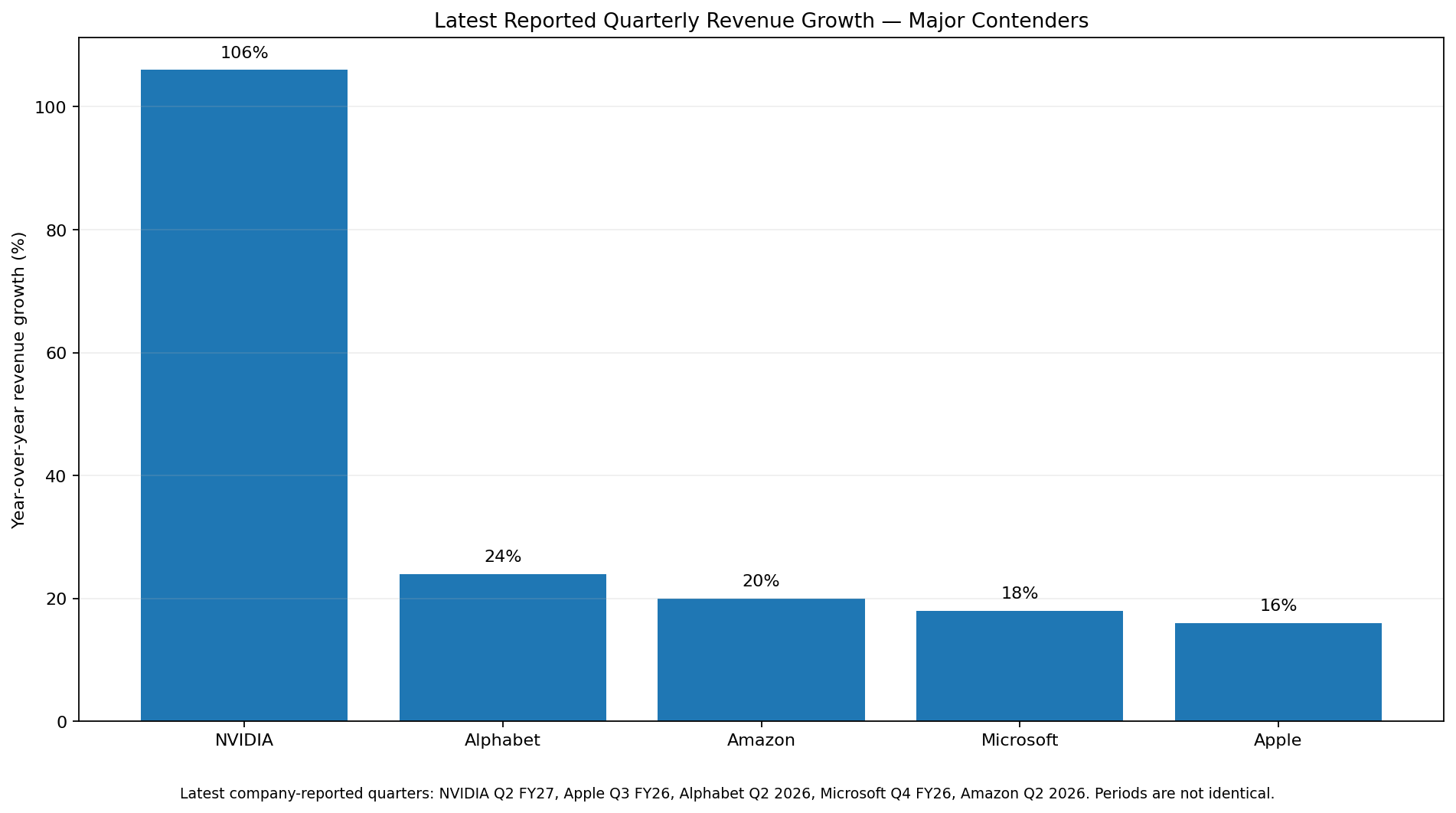
NVIDIA’s 106% growth rate is in a different category from Apple, Alphabet, Microsoft and Amazon. However, market capitalization is forward-looking: the year-end winner depends on what investors expect next, not only what companies just reported.
Alphabet is particularly interesting because 24% consolidated revenue growth and 82% Google Cloud growth create a plausible rerating mechanism. Apple’s growth is slower but its market-cap distance is much smaller. Microsoft and Amazon remain excellent businesses but need much larger share-price moves to reach first place.
What the Market May Be Underestimating
1. Apple only needs a mid-teens relative catch-up if NVIDIA goes sideways. That is not a trivial move, but it is far smaller than the gap facing every other challenger.
2. Alphabet’s cloud acceleration is unusually strong. Google Cloud’s 82% growth can change investor perception quickly, especially if AI monetization continues to broaden beyond infrastructure spending.
3. NVIDIA’s lead can shrink from the top down. The challenger does not need to gain the entire gap if NVIDIA experiences a valuation correction. A 10–15% NVIDIA decline changes the race dramatically.
4. Year-end timing creates event concentration. One quarterly earnings release, product cycle, regulatory ruling or macro shock in October/November can have an outsized effect because the market resolves on a single date.
Bull Case and Bear Case for the Major Contenders
NVIDIA
Bull case: revenue continues to grow near triple digits, Vera Rubin demand exceeds supply, AI capex remains resilient and the market continues rewarding NVIDIA’s strategic moat.
Bear case: AI spending expectations peak, custom accelerators gain share, export restrictions tighten or the valuation multiple compresses after an extraordinary run.
Apple
Bull case: the September product cycle and Siri AI restore confidence in Apple’s AI strategy, Services stays strong and buybacks amplify EPS and per-share value.
Bear case: AI/product excitement fades, leadership-transition uncertainty rises and the stock fails to generate the roughly 15% relative catch-up needed versus a flat NVIDIA.
Alphabet
Bull case: Google Cloud remains near hypergrowth levels, Search AI monetization holds up and investors re-rate the company toward the valuation of the AI infrastructure leaders.
Bear case: antitrust pressure, capex intensity or margin concerns offset the cloud-growth story.
Microsoft
Bull case: Azure stays above 40% growth, AI agents accelerate monetization and the stock re-rates as capacity constraints ease.
Bear case: the current $1.7T+ gap to NVIDIA is simply too large to close in four months without a major NVIDIA drawdown.
Amazon
Bull case: AWS growth keeps accelerating and retail margins expand enough to produce a major earnings rerating.
Bear case: even a strong rally leaves Amazon facing nearly a 100% catch-up requirement if NVIDIA holds its current valuation.
SpaceX / Saudi Aramco / Tesla
Bull case: an extraordinary company-specific catalyst combines with a major decline in the current megacap leaders.
Bear case: current valuation gaps of roughly 67%–73% below NVIDIA’s market cap make the path mathematically extreme.
Key Risks and Uncertainties
- Market-wide correction: a sharp tech selloff can reshuffle relative rankings quickly.
- Interest rates: higher long-duration yields generally pressure growth-stock valuation multiples.
- AI-capex cycle: enthusiasm can accelerate or reverse before December.
- China/export policy: NVIDIA remains exposed to semiconductor restrictions and China revenue uncertainty.
- Antitrust: Alphabet, Microsoft, Apple and Amazon all face material regulatory risk.
- Leadership transition: Apple is entering a new CEO era.
- Newly public volatility: SpaceX has limited public-market history after its June IPO.
- Point-in-time resolution: the winner is determined at one market close, so late-December moves matter disproportionately.
PredictBoy Probability Assessment
Analytical assumption: unlike the raw Polymarket Yes prices, my probabilities are normalized across the eight mutually exclusive outcomes and sum to 100%.
| Company | Polymarket Display | PredictBoy | My Read |
|---|---|---|---|
| NVIDIA | 77.0% | 68.0% | Market is more confident than my assessment |
| Apple | 15.2% | 18.0% | My assessment is higher than the displayed market signal |
| Alphabet | 8.0% | 10.0% | My assessment is higher than the displayed market signal |
| Microsoft | 0.8% | 2.0% | My assessment is higher than the displayed market signal |
| Amazon | 0.2% | 0.7% | Broadly aligned |
| SpaceX | 1.0% | 0.5% | Broadly aligned |
| Saudi Aramco | 0.2% | 0.4% | Broadly aligned |
| Tesla | 0.2% | 0.4% | Broadly aligned |
Market Odds vs. PredictBoy Assessment
I make NVIDIA the clear favorite at 68%, below Polymarket’s 77% signal. I assign 18% to Apple and 10% to Alphabet, which means I see more combined upset probability than the market currently does.
My disagreement is driven by two different challenger paths. Apple has the smallest current valuation gap, while Alphabet has the strongest non-NVIDIA growth acceleration. NVIDIA remains ahead on both current size and operating momentum, which is why it still receives more probability than every other company combined.
What Could Change Before December 31?
NVIDIA’s next earnings report: another major beat and strong guidance could widen the lead; any sign of AI-demand deceleration could compress it quickly.
Apple’s September product event and holiday cycle: a strong reception to new hardware and Siri AI could push Apple’s valuation closer to NVIDIA.
Alphabet / Microsoft / Amazon cloud results: sustained cloud acceleration can support large reratings in the challengers.
Bond yields and Federal Reserve policy: a persistent 10-year Treasury yield near or above current elevated levels can pressure high-duration tech valuations; easing financial conditions would support them.
Regulatory decisions: antitrust or export-policy actions can create company-specific price shocks.
A broad AI-bubble correction: this is the single cleanest path for NVIDIA to lose its lead without Apple or Alphabet needing extraordinary standalone gains.
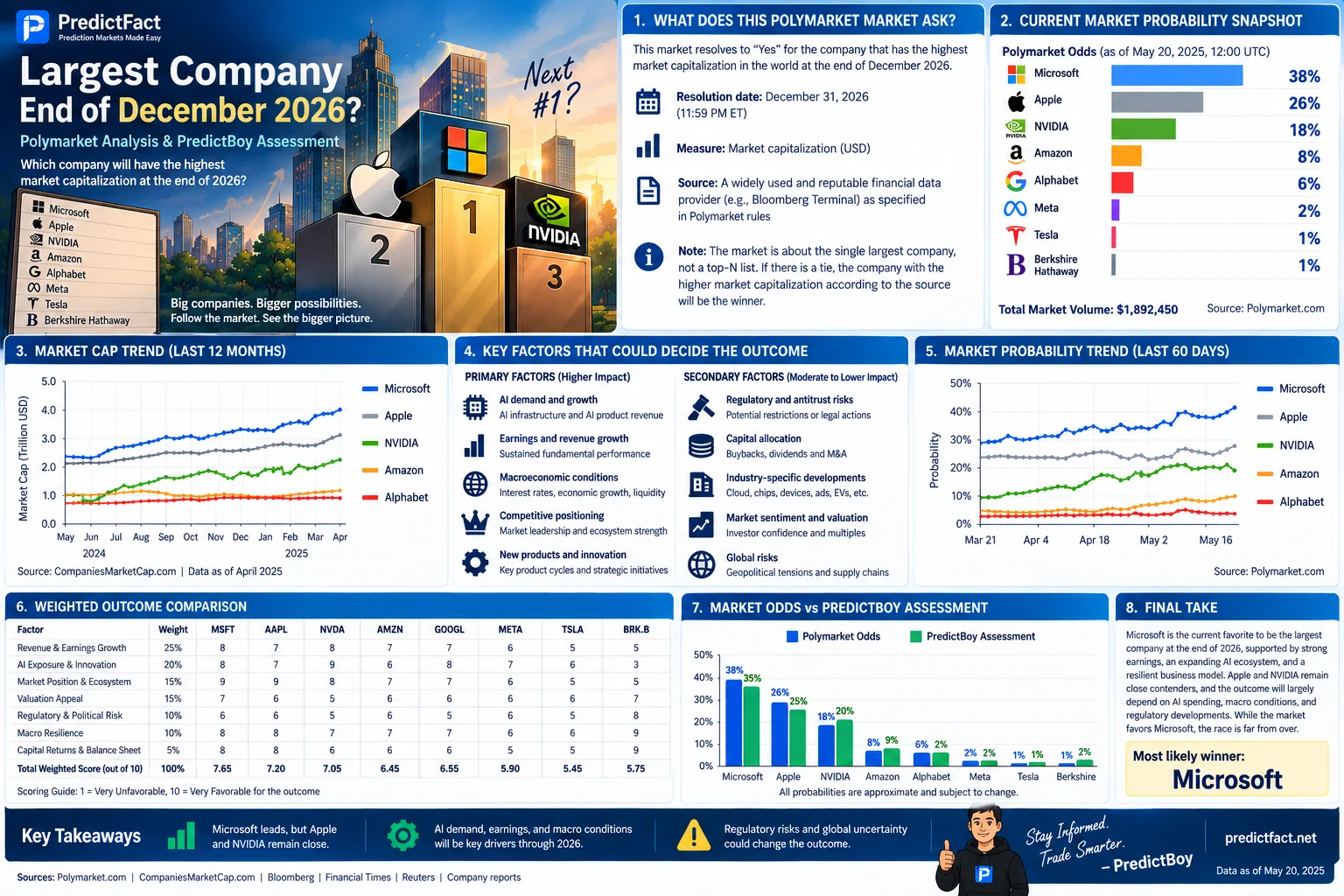
Final Take
Verified facts: NVIDIA currently has the largest market cap among the listed outcomes; Apple is second and about $0.7T behind; Alphabet is third; NVIDIA’s latest quarterly revenue grew 106% year over year; and Polymarket currently gives NVIDIA a large probability lead.
PredictBoy analysis: I make NVIDIA the favorite at 68%, followed by Apple at 18% and Alphabet at 10%. NVIDIA’s combination of market-cap lead and extraordinary earnings growth is hard to beat, but Apple is close enough in valuation for a normal large-cap rally to matter, and Alphabet’s cloud growth creates a credible rerating tail.
The practical takeaway is that this is primarily a NVIDIA vs Apple vs Alphabet market. Microsoft is a distant fourth, while Amazon, SpaceX, Saudi Aramco and Tesla require unusually large relative moves. I agree with Polymarket that NVIDIA is the favorite — I just leave more room for the two closest strategic challengers.
Editorial note: This article is analytical information and decision support. Prediction-market prices are not guaranteed real-world probabilities, and this is not financial advice.
Sources and Methodology
- Polymarket — Largest Company end of December 2026?
- CompaniesMarketCap — current global market-cap reference
- NVIDIA — Q2 Fiscal 2027 results
- Apple — Fiscal Q3 2026 results
- Alphabet — Q2 2026 earnings release
- Microsoft — Fiscal Q4 2026 results
- Amazon — Q2 2026 results
- Reuters — NVIDIA / Hugging Face acquisition
- Reuters — Apple leadership transition and valuation context
- CompaniesMarketCap — SpaceX market-cap reference
- NVIDIA Newsroom — headquarters visual reference
- Apple — Apple Park visual reference
- Google — Bay View campus visual reference