

Will China Unban Bitcoin by 2027? Polymarket Analysis
PredictBoy analysis: Polymarket currently prices a mainland-China Bitcoin policy reversal as a very low-probability event. The key reason is not simply that China has historically been restrictive. The stronger point is that China issued a fresh national virtual-currency rule in February 2026 that still classifies fiat-to-virtual-currency exchange activity as illegal financial activity. This market is unresolved, and its price is a market signal rather than a guarantee.
Introduction
The question “Will China unban Bitcoin by 2027?” sounds broad, but the Polymarket contract is much narrower than a general debate about whether China is becoming friendlier to digital assets. To resolve YES, the government of the People’s Republic of China must explicitly announce by the deadline that Chinese citizens will be allowed to legally buy Bitcoin with yuan from inside China. Hong Kong stablecoin licences, underground mining, court treatment of Bitcoin as property, or a softer tone toward blockchain would not automatically satisfy that wording.
That distinction matters because several developments can look crypto-positive without creating a legal mainland RMB-to-Bitcoin purchase channel. My framework therefore puts the exact resolution rule first, then weighs current national regulation, enforcement direction, monetary-policy compatibility, Hong Kong’s separate digital-asset regime and the possibility of a sudden top-level policy announcement.
What This Polymarket Market Asks
This means the market is not asking whether Bitcoin ownership becomes legal, whether mining expands, or whether Hong Kong develops regulated crypto products. It is asking for an explicit mainland-China retail-purchase permission involving Bitcoin + yuan + citizens + inside China.
Resolution Rules and What Counts
Polymarket states that the market resolves YES if the PRC government explicitly announces the required legal change by the deadline. The policy does not need to be implemented by then. That announcement-only clause creates a small but important tail risk for NO positions: a future-dated reform announced on December 31 could theoretically satisfy the market even if practical access starts in 2027.
Current Market Snapshot
| Metric | Snapshot | How to read it |
|---|---|---|
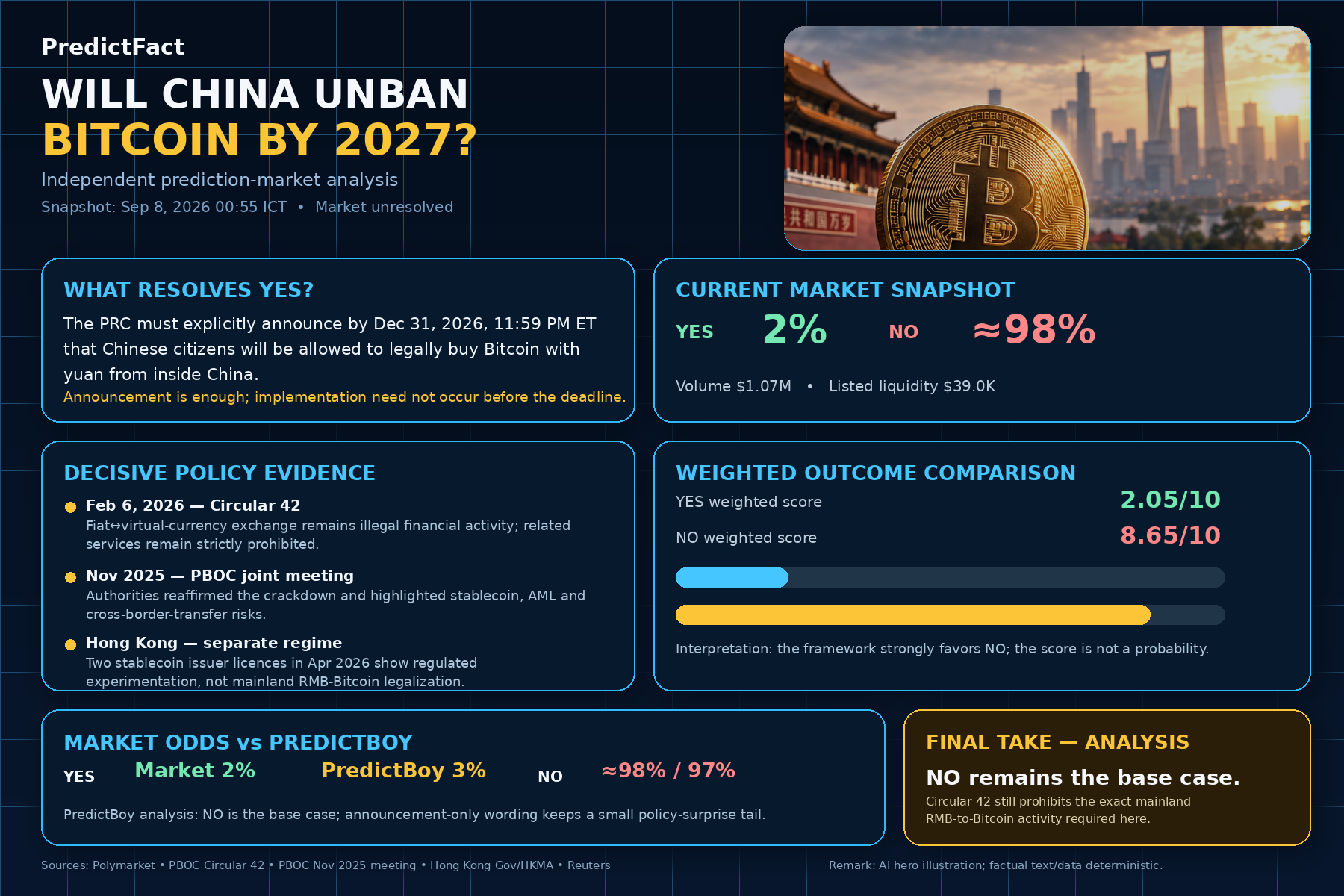
| YES | About 2% | Polymarket currently treats a qualifying policy announcement as a low-probability outcome. |
| NO | Approximately 98% | The market strongly favors no qualifying announcement before the deadline. |
| Total volume | About $1.07 million | Substantial lifetime activity for a binary geopolitical/crypto policy market. |
| Listed liquidity | About $39,000 | Current Polymarket category pages show meaningful but not unlimited depth. |
| Market opened | November 5, 2025 | The market has traded through major late-2025 and 2026 policy developments. |
Snapshot: September 8, 2026 at 00:55 ICT (September 7, 2026 at 13:55 ET). Polymarket’s displayed headline probability can move at any time. I did not find a reliable, source-identifiable historical series suitable for a trend chart in this research pass, so I do not fabricate one.
Main Outcomes
YES — China announces legal mainland RMB-to-Bitcoin buying
YES requires a genuine national policy reversal or a sufficiently explicit new framework. A narrow institutional experiment, offshore arrangement, Hong Kong-only rule or asset-disposal mechanism would not necessarily qualify. The strongest YES pathway would be a State Council/PBOC-level announcement authorizing Chinese citizens to buy Bitcoin with yuan through regulated channels inside mainland China.
NO — no qualifying announcement by the deadline
NO is the status-quo outcome. It wins if China keeps the current prohibition, if it reforms digital-asset rules without opening legal RMB-to-Bitcoin retail purchasing, or if any qualifying reform is announced only after the deadline.
Key Factors
Primary factors
- Current national law and regulation: the February 2026 Circular 42 is the single most important evidence item.
- Top-level policy direction: PBOC statements continue to emphasize supervision, illegal-finance risks and crackdown activity.
- RMB and capital-control compatibility: a legal retail fiat-to-Bitcoin rail would require a meaningful change to the existing risk-control architecture.
Secondary factors
- Hong Kong’s regulated stablecoin and digital-asset development.
- Evidence of Bitcoin mining continuing despite restrictions.
- Judicial recognition of virtual assets as property in some contexts.
- Government and court debates about handling seized cryptocurrencies.
- The contract’s announcement-only wording and the remaining time to December 31.
Weighted Outcome Comparison
I score each factor from 1 to 10 for how strongly it supports each outcome. The weighted score is a structured comparison tool, not a probability model and not a target designed to match Polymarket.
| Factor | Weight | YES score | NO score | Key evidence | Impact |
|---|---|---|---|---|---|
| Current national regulatory position | 35% | 1/10 | 10/10 | Circular 42 keeps fiat↔virtual-currency exchange illegal. | Strongest NO factor. |
| Mainland policy & enforcement signals | 20% | 1/10 | 10/10 | PBOC continues crackdown messaging and stronger virtual-currency oversight. | Reinforces status quo. |
| RMB / capital-control compatibility | 15% | 2/10 | 9/10 | Legal RMB-BTC retail rails would cut against current payment, AML and cross-border controls. | Raises reversal hurdle. |
| Time left + announcement-only contract | 10% | 3/10 | 7/10 | Only an announcement is required, but roughly four months remain. | Small YES tail remains. |
| Hong Kong digital-asset experimentation | 10% | 5/10 | 5/10 | HKMA issued two stablecoin licences in April 2026, but Hong Kong is a distinct regime. | Optionality, not mainland legalization. |
| Ownership / mining / seized-asset pressure | 10% | 4/10 | 6/10 | Mining leakage and property-treatment debates show persistent activity without a legal RMB purchase channel. | Weakly pro-change, still NO-leaning. |
China Crypto Policy Evidence Analysis
February 2026 matters more than the 2021 headline
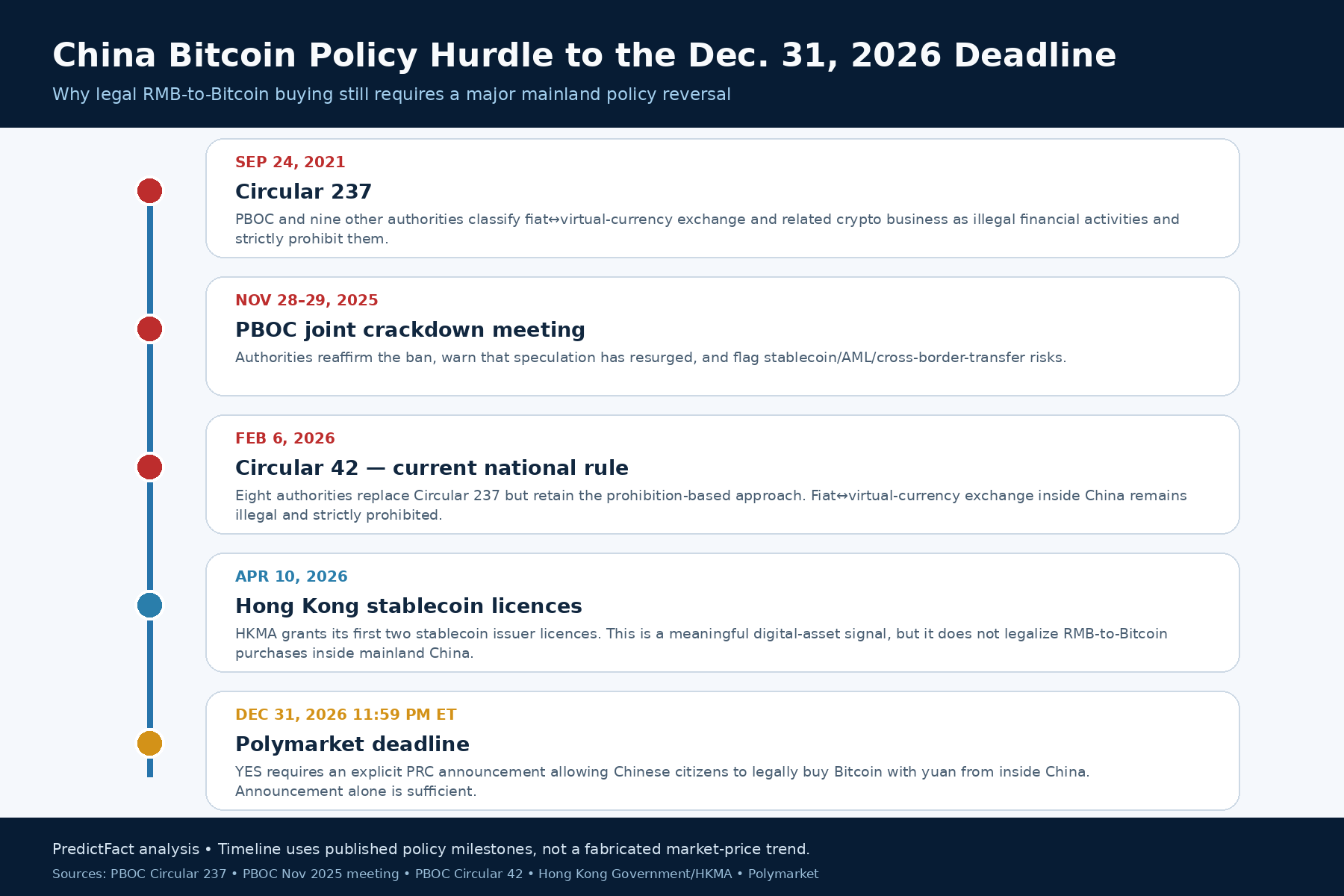
China’s 2021 rules are often summarized as “the crypto ban,” but the fresher evidence is more important. On February 6, 2026, eight authorities including the PBOC issued Circular 42. The rule states that virtual currencies such as Bitcoin do not have the same legal status as fiat currency and that virtual-currency-related business activities in China — including exchange between fiat currency and virtual currency — are illegal financial activities that are strictly prohibited. It also says overseas entities and individuals may not illegally provide virtual-currency services to domestic entities.
For this Polymarket contract, that language is unusually direct. A YES announcement would need to reverse or carve out the exact activity the current rule prohibits: buying Bitcoin with yuan inside China.
The late-2025 crackdown was reinforced, not forgotten
At a November 2025 joint meeting, the PBOC said virtual-currency speculation had resurged and reiterated that virtual-currency business activities are illegal financial activities. Stablecoins were singled out for customer-identification, anti-money-laundering and unauthorized cross-border-transfer concerns. China’s 2026 central-bank work agenda also called for stronger virtual-currency regulation and continued action against related illegal activity while steadily developing the digital yuan.
Hong Kong is the strongest policy-innovation counterpoint — but it is not mainland China
Hong Kong’s policy path is materially more open. The Hong Kong Monetary Authority granted its first two stablecoin issuer licences in April 2026, and the Hong Kong government describes a regulated digital-asset ecosystem built around licensing and risk management. This matters as a signal that Chinese policymakers can tolerate regulated digital-asset experimentation in a controlled jurisdiction.
But the Polymarket wording requires citizens to buy Bitcoin with yuan from inside China. A Hong Kong stablecoin regime does not satisfy that test. In my framework it raises optionality but does not outweigh Circular 42.
Underground mining and seized-asset debates show pressure, not legalization
Reuters reported in November 2025 that Bitcoin mining had quietly rebounded in parts of China despite the ban, with industry estimates showing meaningful hashrate operating in the country. Reuters also reported in April 2025 that authorities, courts and legal experts were debating how to handle growing stores of cryptocurrency seized from criminal cases. These developments show that prohibition does not eliminate Bitcoin from the economy.
However, enforcement leakage and asset-management problems are different from a legal retail purchase channel. A government can tolerate imperfect enforcement, recognize an asset’s economic value for confiscation purposes, or manage seized tokens while still prohibiting RMB-to-Bitcoin trading businesses.
What the Market May Be Underestimating
The market may be slightly underestimating the announcement-only clause. Polymarket does not require a mainland exchange to be operating by December 31. If Beijing announced a future regulated purchase framework before the deadline, that could be enough even if implementation starts later.
A second tail risk is the speed of top-down policy change. China can move rapidly when a policy objective changes. Hong Kong’s digital-asset framework, the need to manage seized crypto, and the persistence of mining could all provide inputs into a future redesign. None of those signals currently demonstrates that such a reversal is planned, but they keep YES above zero.
Bull/Bear Case for Major Outcomes
YES case
- A top-level PRC announcement creates a regulated, mainland RMB-to-Bitcoin purchase route for citizens.
- Hong Kong’s regulated digital-asset infrastructure becomes a model for carefully controlled mainland access.
- China decides strategic ownership or controlled crypto exposure is preferable to an unenforceable shadow market.
- Because the contract needs only an announcement, implementation can occur after the deadline.
NO case
- Circular 42 was issued only in February 2026 and explicitly preserves the prohibition on fiat-to-virtual-currency exchange.
- PBOC policy continues to prioritize financial stability, AML, capital-flow control and the digital yuan.
- Hong Kong innovation remains intentionally separate from mainland retail crypto policy.
- The remaining calendar is short relative to the size of the legal and institutional reversal required.
Risks and Uncertainties
Other uncertainties include sudden geopolitical or monetary-policy shifts, changes in capital-control strategy, regulatory responses to offshore stablecoins, and the possibility that credible reporting identifies a qualifying policy before a complete official English translation is available.
PredictBoy Probability Assessment
PredictBoy analysis, not fact: I assign 3% to YES and 97% to NO. The 3% tail is not based on evidence of a planned unban. It reflects the announcement-only contract, the possibility of sudden top-level policy change and the fact that digital-asset activity continues to create regulatory pressure. The 97% base case reflects the much stronger evidence: current national law still prohibits the exact fiat-to-crypto activity that the market requires China to legalize.
Market Odds vs. PredictBoy
| Outcome | Polymarket implied | PredictBoy | Difference | Interpretation |
|---|---|---|---|---|
| YES | ~2% | 3% | +1 pp | I keep a slightly larger policy-surprise tail than the market. |
| NO | ~98% | 97% | -1 pp | Both views overwhelmingly favor no qualifying announcement. |
The difference is small. I do not see enough evidence to argue that the market is materially mispriced; my main disagreement is only that an announcement-only contract can retain a non-zero surprise tail even under a very restrictive current policy regime.
What Could Change Before Resolution
- Direct PRC policy language: a PBOC, State Council or multi-agency announcement explicitly permitting citizens to purchase Bitcoin with yuan inside mainland China would be decisive.
- A regulated mainland pilot: if broad enough to satisfy the citizen/RMB/inside-China wording, it could materially change the market.
- Capital-control or payment-policy reform: changes that create legal fiat rails for Bitcoin would be a major signal.
- Hong Kong spillover: additional licensing by itself is not enough, but explicit linkage to mainland citizen access would matter.
- Fresh crackdown language: additional enforcement measures would reinforce NO and reduce the remaining policy-surprise window.
Final Take
PredictBoy analysis: NO is the clear base case. The market’s 2% YES price is consistent with the strongest current evidence: China did not merely leave its 2021 framework untouched; it replaced it in February 2026 with a new national circular that still defines fiat-to-virtual-currency exchange as illegal financial activity and keeps the prohibition in force. Hong Kong’s regulated digital-asset development, underground mining and asset-property debates are genuine counter-signals, but none currently satisfies the Polymarket contract. I keep a 3% YES tail because the contract requires only an explicit announcement, not implementation, and policy can change abruptly.
Sources
- Polymarket — Will China unban Bitcoin by 2027?
- People’s Bank of China and seven other authorities — Circular 42, February 6, 2026
- PBOC — Joint Meeting to Curb Speculations in Virtual Currency Trading, November 2025
- Hong Kong Government / HKMA — Development and regulation of stablecoins, June 10, 2026
- Reuters — Bitcoin mining in China rebounds, defying 2021 ban
- Reuters — China debates how to handle criminal crypto cache
- PredictFact — How Prediction Markets Work
- PredictFact — How Prediction Markets Resolve
Disclosure: This article is independent educational analysis by PredictFact. Prediction-market prices can be wrong and products can involve financial loss. This is not financial, investment, legal or tax advice.