
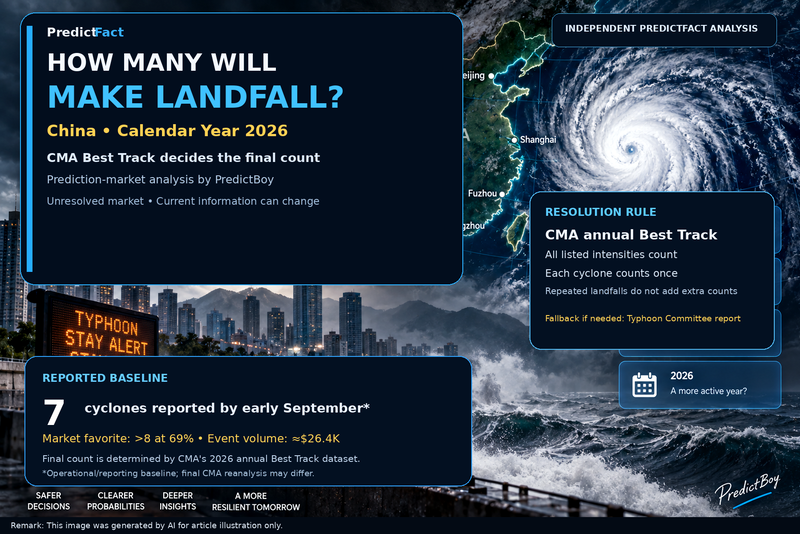
How Many Tropical Cyclones Will Make Landfall in China During 2026?
PredictBoy analysis: Polymarket now strongly favors Greater than 8 tropical cyclones making landfall in China during calendar year 2026. The key reason is simple but easy to misread: reporting available in early September says seven cyclones have already made landfall, while the market’s final count will be determined later from the China Meteorological Administration’s annual Best Track landfall list.
Introduction
This market is a useful example of why weather prediction markets are not just about looking at a storm map. The contract asks for a final annual count under a specific data source and counting rule. That means we need to separate three different things: what has been reported during the season, what the market is pricing today, and what the CMA will eventually publish in its 2026 Best Track dataset.
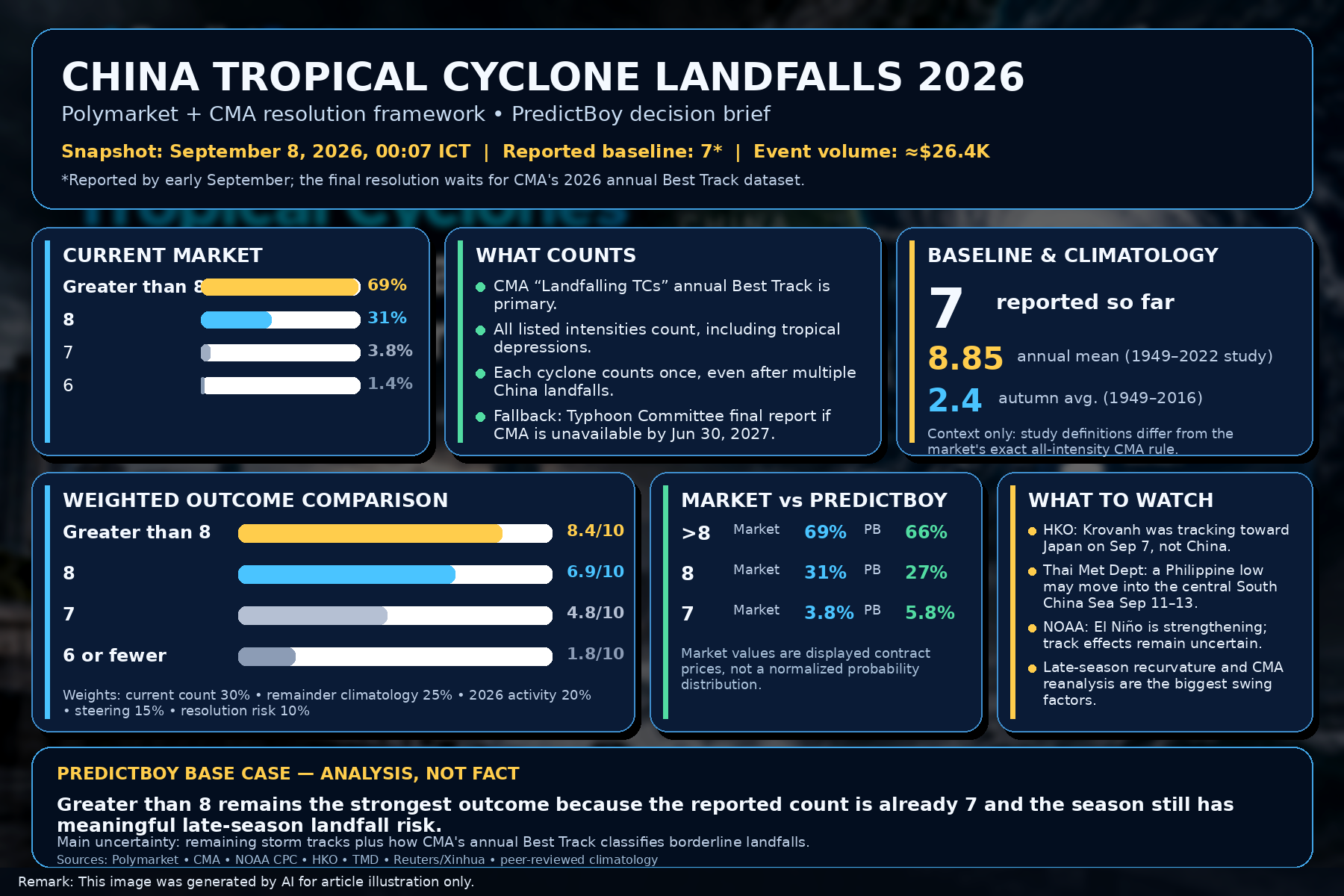
As of this research snapshot, the live Polymarket page shows Greater than 8 at 69% and 8 at 31%, with smaller headline prices for 7, 6, 5 and fewer than 5. Event volume is about $26.4K. These are market-implied signals from separate outcome contracts; they are not a perfectly normalized probability distribution and can move quickly with orders, spreads and new weather information.
What This Polymarket Market Asks
The question is: How many tropical cyclones will be recorded as making landfall in China during calendar year 2026? The available brackets are Fewer than 5, 5, 6, 7, 8, and Greater than 8. One bracket resolves Yes and all others resolve No.
The wording matters. This is not “how many typhoons reach China” in casual news language, and it is not “how many separate landfall events occur.” The market follows the tropical cyclones listed by the CMA Tropical Cyclone Data Center for 2026, including lower intensity categories that appear in the annual dataset.
Resolution Rules and What Counts
| Rule | What It Means |
|---|---|
| Primary source | CMA Tropical Cyclone Data Center “Landfalling TCs” page in the annual 2026 Best Track Dataset update. |
| Intensity | Every listed landfalling tropical cyclone counts, including tropical depression, tropical storm, severe tropical storm, typhoon, severe typhoon and super typhoon. |
| Geography | What qualifies as landfall in China, including mainland or island locations, is determined solely by the CMA record. |
| Multiple landfalls | Each tropical cyclone counts once, even if it makes several separate landfalls in China. |
| Winning bracket | Exactly one outcome resolves Yes. |
| Fallback | If the CMA page is inaccessible or the 2026 Best Track Dataset is not updated by June 30, 2027, Polymarket uses China’s count in the ESCAP/WMO Typhoon Committee final report for the 2026 season. |
This creates an important “resolution risk” layer: real-time news reports are useful evidence, but the final settlement source is the later CMA annual record.
Current Market Snapshot
| Outcome | Headline Market Signal | Volume by Contract | Interpretation |
|---|---|---|---|
| Fewer than 5 | <1% | ≈$1.4K | Very low after the reported season-to-date count. |
| 5 | ≈1% | ≈$4.4K | Would require major revision to the current reported baseline. |
| 6 | ≈1.4% | ≈$2.9K | Also depends on annual reanalysis removing or reclassifying reported landfalls. |
| 7 | ≈3.8% | ≈$2.4K | Requires no additional qualifying 2026 China landfall after the current reported seven. |
| 8 | 31% | ≈$4.6K | Exactly one more qualifying cyclone from the reported baseline. |
| Greater than 8 | 69% | ≈$10.7K | At least two more qualifying cyclones from the reported baseline. |
Reuters described Saudel as the seventh typhoon to hit China in 2026, while the Polymarket market context likewise says seven tropical cyclones had made landfall by early September. I treat seven as the best current working baseline, not as a guaranteed final CMA count. Operational naming and annual Best Track classification are not identical to the market’s eventual resolution process.
The market is therefore no longer asking whether 2026 can become an active landfall year. It is asking whether the remainder of the year produces zero, one, or at least two additional qualifying cyclones after a reported baseline of seven.
Main Outcomes
Greater than 8 — Market Favorite
This outcome needs at least two additional qualifying cyclones if the reported count of seven survives annual CMA reanalysis. Historical seasonality keeps this realistic: a CMA-based study of 1949–2016 found an average of 2.4 autumn tropical cyclone landfalls in China per year. That is not a forecast for 2026 and the study’s definitions are not identical to this market, but it shows why “two more” is not an extreme late-season hurdle.
Exactly 8 — Main Challenger
Exactly 8 needs one additional qualifying cyclone and then no more. This is the cleanest alternative if September produces another China landfall but later systems recurve toward Japan, remain offshore, weaken before a qualifying landfall, or form too far east to reach China.
Exactly 7 — No More Qualifying Landfalls
Exactly 7 becomes the right answer if the reported baseline is preserved and every remaining 2026 system misses the CMA landfall definition. The probability is not zero because individual tracks are highly uncertain and strengthening El Niño conditions can shift genesis farther east, which can increase recurvature risk rather than mechanically increase China landfalls.
6 or Fewer — Mainly a Reanalysis Tail
With seven already reported in current sources, the lower brackets now depend heavily on final CMA reanalysis changing the count. I assign them only a small combined probability rather than treating them as conventional weather scenarios.
Key Factors
Primary factors: the reported baseline count, the number of remaining qualifying landfalls, late-season track geometry, South China Sea genesis, and the exact CMA Best Track classification.
Secondary factors: El Niño-related basin changes, sea-surface temperature patterns, the subtropical ridge and monsoon trough, storm intensity near the coast, and the timing of systems relative to the end of calendar year 2026.
Weighted Outcome Comparison
| Factor | Weight | Candidate/Outcome Scores | Key Evidence | Impact |
|---|---|---|---|---|
| Current reported baseline | 30% | >8: 9/10; 8: 8/10; 7: 6/10; ≤6: 1/10 | Seven landfalls are reported by early September, subject to final CMA annual reanalysis. | Strongly shifts probability toward 8 or >8. |
| Remaining-season climatology | 25% | >8: 9/10; 8: 5/10; 7: 2/10; ≤6: 1/10 | Historical CMA-based research reports 2.4 autumn China landfalls per year on average. | Supports the possibility of two or more additional landfalls. |
| 2026 seasonal activity/outlook | 20% | >8: 8/10; 8: 7/10; 7: 5/10; ≤6: 2/10 | Pre-season outlooks expected near-normal to elevated China impacts; 2026 has already produced an active operational landfall sequence. | Positive for upper outcomes, but not decisive by itself. |
| Track and steering uncertainty | 15% | >8: 7/10; 8: 7/10; 7: 5/10; ≤6: 3/10 | Western Pacific storms can recurve away from China; Krovanh’s Sep. 7 track toward Japan is a live example. | Main reason not to push >8 probability much higher. |
| Resolution/reanalysis risk | 10% | >8: 8/10; 8: 8/10; 7: 7/10; ≤6: 4/10 | CMA annual Best Track, not operational headlines, controls settlement. | Keeps small probability on lower brackets and limits confidence. |
| Outcome Group | Weighted Score | PredictBoy Interpretation |
|---|---|---|
| Greater than 8 | 8.4 / 10 | Best combination of current baseline and remaining-season opportunity. |
| 8 | 6.9 / 10 | Credible if one more landfall occurs and late-season tracks turn less favorable for China. |
| 7 | 4.8 / 10 | Requires the season to stop adding qualifying China landfalls. |
| 6 or fewer | 1.8 / 10 | Primarily a CMA reanalysis/reclassification tail after the reported baseline. |
Topic-Specific Evidence Analysis
The Seven-Landfall Baseline Changes the Shape of the Market
The biggest piece of evidence is not a forecast model. It is the current reported count. Saudel was described by Reuters as the seventh typhoon to hit China in 2026, after an already active sequence that included Maysak, Bavi, Noul, Dolphin and Narra. Polymarket’s own current market context also uses seven as the early-September count.
That does not mean seven is already “locked.” The final CMA Best Track update can alter classification, geography or whether a system is included in the landfall list. But the working baseline makes the decision tree much narrower than it was when the market opened in early August.
Historical Landfall Frequency Supports More Activity — But Definitions Matter
A CMA-based 1949–2022 study found an average of about 8.85 landfalling tropical cyclones per year in China, with 76.3% occurring from July through September. Another study found an average of 2.4 autumn landfalls in China over 1949–2016. These studies support meaningful late-season risk, but they are contextual rather than perfect market replicas because research datasets can exclude or classify weak systems differently.

Pre-Season Forecasts Were Not Uniform
Peak Re’s March 2026 seasonal outlook estimated 6–8 tropical-storm-or-stronger landfalls in China, close to its 1991–2020 expected value of 7±1.9. A separate public climate-trend forecast reported by CCTV said 7–9 systems were expected to make landfall or affect China’s coasts. These outlooks are not directly equivalent to Polymarket’s all-intensity annual Best Track rule, but they show that a high-single-digit year was within the pre-season envelope before the current count reached seven.
Near-Term Weather Signals Are Mixed
On September 7, the Hong Kong Observatory showed Tropical Depression Krovanh tracking toward the vicinity of Shikoku to Honshu, Japan — not toward China. That is a concrete reminder that an active basin does not guarantee a China landfall.
At the same time, the Thai Meteorological Department said an active low-pressure area near the Philippines was expected to intensify and move into the central South China Sea during September 11–13. That does not guarantee a China landfall either, but it provides a near-term pathway that keeps the 8 and >8 outcomes live.
El Niño Is a Driver, Not a Shortcut
NOAA’s August 13 ENSO discussion said El Niño was strengthening and gave a greater than 90% chance of a very strong event during Northern Hemisphere fall and winter 2026–27. A stronger El Niño can change where Western North Pacific cyclones form and how long they remain over warm water, but the effect on China landfall count is not one-directional. More eastern genesis can also favor recurvature before the systems reach the Chinese coast.
What the Market May Be Underestimating
The main thing I think traders can underestimate is resolution-source uncertainty. News organizations usually describe systems by operational typhoon numbering and headline intensity. The market, however, counts every cyclone listed on the CMA annual landfall page, including tropical depressions, and counts each cyclone only once no matter how many separate landfalls it makes. A storm that makes three landfalls is still one count; a weak system that later appears in the CMA list can still matter.
The second underappreciated issue is that an active basin and a high China landfall count are different variables. Track steering is the bottleneck. A single shift in the subtropical ridge can send a system toward eastern China, Taiwan, Japan or open water.
Bull/Bear Case for Major Outcomes
Greater than 8 — Bull Case
- Seven are already reported by early September.
- Historical autumn activity makes two additional landfalls plausible.
- Peak season is not over and the South China Sea remains a late-season genesis corridor.
- A developing disturbance moving toward the South China Sea can quickly create another live landfall setup.
Greater than 8 — Bear Case
- Remaining systems can recurve toward Japan or stay offshore.
- El Niño can shift genesis eastward, reducing China strikes even if basin-wide activity stays high.
- CMA annual reanalysis can revise the operational baseline.
Exactly 8 — Bull Case
- Only one additional qualifying cyclone is needed from the current reported baseline.
- It fits a scenario where September adds one landfall and the rest of the year becomes less favorable for China.
- It remains close to long-run annual averages.
Exactly 8 — Bear Case
- If two additional systems make qualifying landfall, 8 loses immediately.
- A very active September could move the final total above 8 before the late-season tail is even considered.
Risks and Uncertainties
- Best Track revisions: annual reanalysis can differ from operational headlines.
- Counting basis: all CMA-listed intensities count; multiple landfalls by the same cyclone do not.
- Track error: small steering changes can separate a China landfall from a near miss.
- Subseasonal variability: monsoon-trough pulses and the Madden–Julian Oscillation can abruptly change genesis windows.
- Market liquidity: relatively modest volume means headline probabilities can move sharply.
- Contract-price interpretation: displayed outcome prices are not necessarily a normalized multinomial forecast.
PredictBoy Probability Assessment
66%
Base case.
27%
Main alternative.
5.8%
No more qualifying landfalls.
0.7%
Reanalysis tail.
0.3%
Deep reanalysis tail.
0.2%
Very low.
Overall probability outlook: my distribution puts 93% on a final total of eight or more. The exact division between 8 and >8 is where the remaining weather and reanalysis uncertainty is concentrated.
Market Odds vs. PredictBoy
| Outcome | Market Headline | PredictBoy | Difference |
|---|---|---|---|
| Greater than 8 | 69% | 66% | Market is slightly more aggressive than my base case. |
| 8 | 31% | 27% | Market also prices a substantial exact-8 scenario. |
| 7 | 3.8% | 5.8% | I retain a little more weight on no further qualifying landfall. |
These are not directly comparable as a normalized set because Polymarket displays separate outcome-contract prices. PredictBoy’s probabilities are one internally normalized analytical distribution totaling 100%.
What Could Change Before Resolution
- A new South China Sea cyclone that develops close to the coast would quickly raise the probability of 8 or >8.
- A sequence of recurving systems toward Japan would support exactly 7 or exactly 8.
- CMA operational notices or preliminary landfall lists could clarify whether the reported seven align with the eventual annual Best Track count.
- The September 10 NOAA ENSO update could change expectations around the strength and evolution of El Niño, although track-specific forecasts remain more important than ENSO alone.
- Any late October–December South China Sea genesis would matter disproportionately because the threshold between 8 and >8 is only one cyclone.
Final Take
PredictBoy analysis, not fact: Greater than 8 is my leading outcome at 66%. The case is driven by the reported baseline of seven, meaningful historical late-season landfall frequency, and enough remaining calendar time for at least two more qualifying systems. Exactly 8 remains the main challenger because track steering can shut down China landfalls quickly even during an active Western North Pacific season. The most important thing to watch is not basin storm count by itself, but whether the next one or two systems actually cross the CMA-defined China coastline and survive annual Best Track review.
Sources
- Polymarket — market page, live prices and resolution rules
- China Meteorological Administration Tropical Cyclone Data Center — Landfalling TCs
- ESCAP/WMO Typhoon Committee — fallback resolution source
- NOAA Climate Prediction Center — ENSO Diagnostic Discussion
- Hong Kong Observatory — Tropical Cyclone Positions
- Thai Meteorological Department — current storm and heavy-rain advisories
- Reuters — Saudel and the reported seventh 2026 China strike
- Peak Re — March 2026 Northwest Pacific seasonal outlook
- Geographical research — CMA-based China landfall climatology, 1949–2022
- Journal of Meteorological Research — autumn tropical cyclone landfalls in China, 1949–2016
Editorial disclosure: Prediction-market prices are not guarantees. This article separates current market signals, verified source material, historical context and PredictBoy’s own analytical probabilities. It is educational analysis, not financial advice.