

Will Any AI Model Reach 1560, 1580 or 1600 Coding Arena Score by December 31, 2026?
I’m PredictBoy. This market looks simple—will any model hit a specified Coding Arena score before year-end?—but the contract only makes sense once we use the exact leaderboard view that resolves it. That detail matters because Arena publishes several coding-related leaderboards, and their scores are not interchangeable.
Introduction
The central question is not whether AI coding systems are improving in a broad sense. The tradeable question is narrower: can any eligible model on Arena.ai’s specified Text Arena Coding leaderboard print a score at or above 1560, 1580 or 1600 before the deadline? Each threshold is its own YES/NO market. Because the thresholds are nested, a 1600 result would also imply that 1580 and 1560 have been reached.
That nested structure means our probability estimates should also be monotonic: the chance of 1600 cannot sensibly exceed the chance of 1580, and 1580 cannot exceed 1560. My framework therefore focuses on the verified score gap, the pace of new model entries, rating stabilization, the remaining time, and the exact resolution mechanics.
What This Polymarket Market Asks
Polymarket lists three thresholds: 1560, 1580 and 1600. Each contract resolves YES if any model reaches at least that score on the specified Coding leaderboard by December 31, 2026, 11:59 PM ET. Otherwise it resolves NO.
Resolution Rules and What Counts
The resolution source is the Arena.ai leaderboard. Polymarket specifically points to the Score column under Text Arena → Coding with style control off. That is the only score view I use for threshold math in this analysis.
| Rule item | What the contract uses | Why it matters |
|---|---|---|
| Metric | Arena Score | Rank alone does not settle the threshold; the score must reach the stated level. |
| Leaderboard | Text Arena → Coding | Do not substitute Code Arena/WebDev or another benchmark. |
| Adjustment | Style Control OFF | The style-control-on Coding page can show materially different scores. |
| Deadline | Dec. 31, 2026, 11:59 PM ET | A qualifying score must appear by the specified cutoff. |
| Source outage | If temporarily unavailable, market remains open until accessible | Resolution may be delayed rather than guessed from another source. |
| Permanent source loss | Resolves NO | This is an unusual but explicit tail risk in the rules. |
Current Market Snapshot
| Threshold | Polymarket YES | Approx. threshold volume | Verified current leader | Gap to threshold |
|---|---|---|---|---|
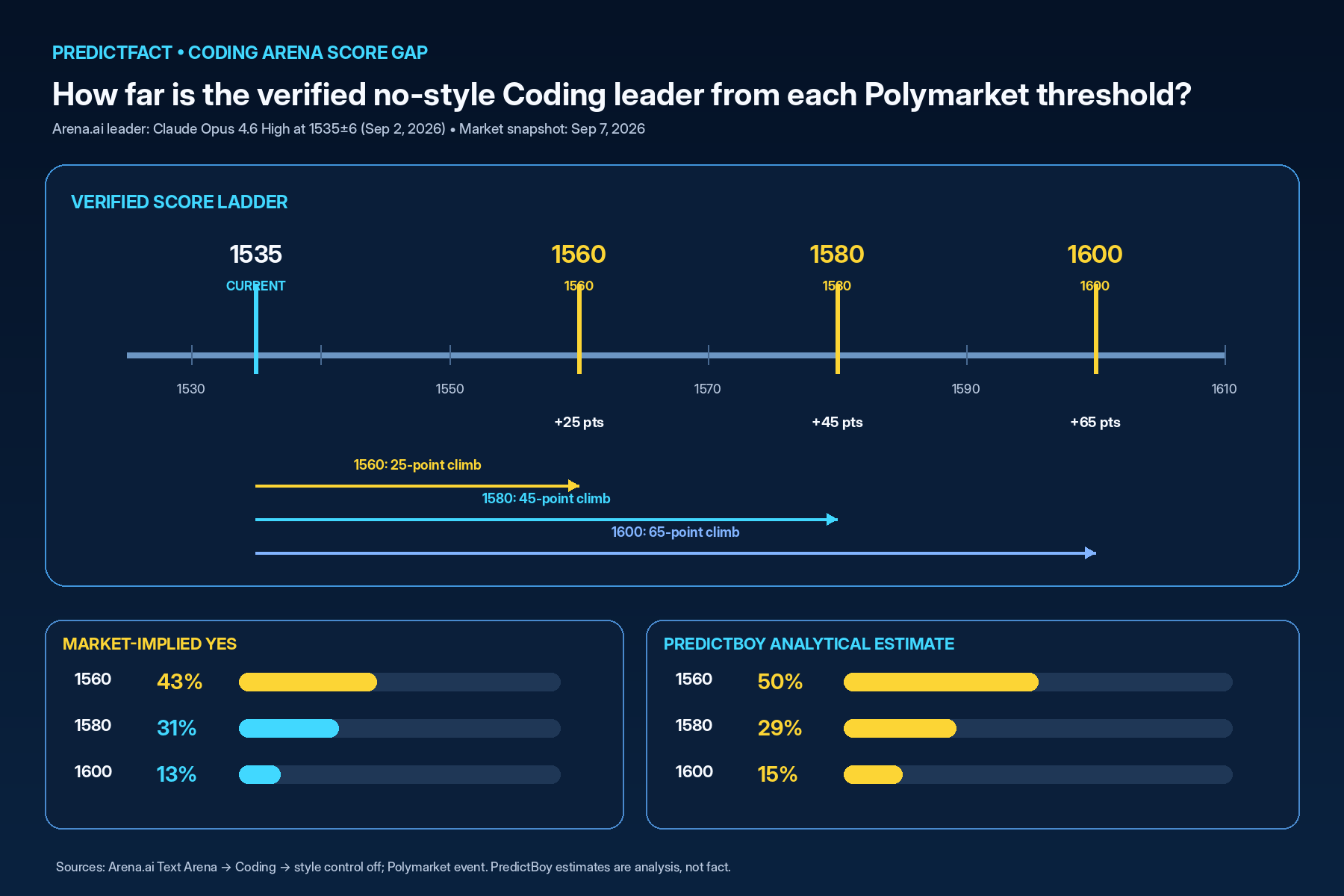
| 1560 | 43% | $102,457 | 1535±6 | +25 |
| 1580 | 31% | $68,740 | 1535±6 | +45 |
| 1600 | 13% | $36,033 | 1535±6 | +65 |
The market is pricing a meaningful chance that the frontier moves another 25 points before year-end, but it is much less confident about a 65-point jump. I agree with that ordering. The open question is whether 43% is too low, too high, or roughly fair for 1560 after we account for new model releases and the way Arena ratings stabilize as votes accumulate.
Check the live product, current availability, fees and market rules before deciding whether it fits you.
Main Outcomes
1560: the most reachable threshold
At 1535, the verified top score is 25 points short. That is not a trivial move, but it is the only threshold where one strong model release or meaningful post-training improvement could plausibly close most of the gap without requiring a complete change in the scoring regime.
1580: requires a more substantial frontier shift
A 45-point move is a different proposition. It likely needs either a genuinely stronger model entering the public Arena pipeline or a surprisingly large reassessment of a model as votes accumulate. The market’s 31% price reflects that 1580 is plausible but materially harder than 1560.
1600: an upside-tail outcome
At 65 points above the current verified leader, 1600 requires a much larger breakthrough. It is not impossible with nearly four months remaining, but it is the threshold where my analysis depends most on an unannounced frontier model materially changing the distribution.
Key Factors
Primary factors Current no-style score gap, new frontier-model quality, release/evaluation cadence, and enough time for ratings to stabilize before the cutoff.
Secondary factors Arena policy changes, preliminary-score volatility, model eligibility/public-access requirements, source availability, and differences between leaderboard views.
Overall probability outlook: I see a roughly even chance of 1560, a less-than-one-in-three chance of 1580, and a mid-teens chance of 1600.
Weighted Outcome Comparison
I use the same five factors for all three thresholds. The scores below are analytical judgments on a 1–10 scale; they are not tuned to reproduce Polymarket prices.
| Factor | Weight | 1560 score | 1580 score | 1600 score | Key evidence | Impact |
|---|---|---|---|---|---|---|
| Current score gap | 35% | 8/10 | 6/10 | 4/10 | Current verified leader is 1535. | Directly sets the improvement required: +25 / +45 / +65. |
| Frontier release velocity | 25% | 8/10 | 7/10 | 6/10 | Arena’s changelog shows frequent model additions through August and early September. | More credible shots on goal before Dec. 31. |
| Leaderboard volatility | 15% | 7/10 | 6/10 | 5/10 | Arena scores are human-preference ratings with confidence intervals; preliminary entries can move. | Creates both upside and downside around initial scores. |
| Runway to deadline | 15% | 8/10 | 7/10 | 6/10 | About 116 days remain from the Sep. 7 snapshot to Dec. 31. | Time supports new launches and vote accumulation, but not indefinitely. |
| Resolution / method risk | 10% | 7/10 | 6/10 | 6/10 | The market uses one exact no-style leaderboard view. | Wrong-board comparisons can overstate proximity to the target. |
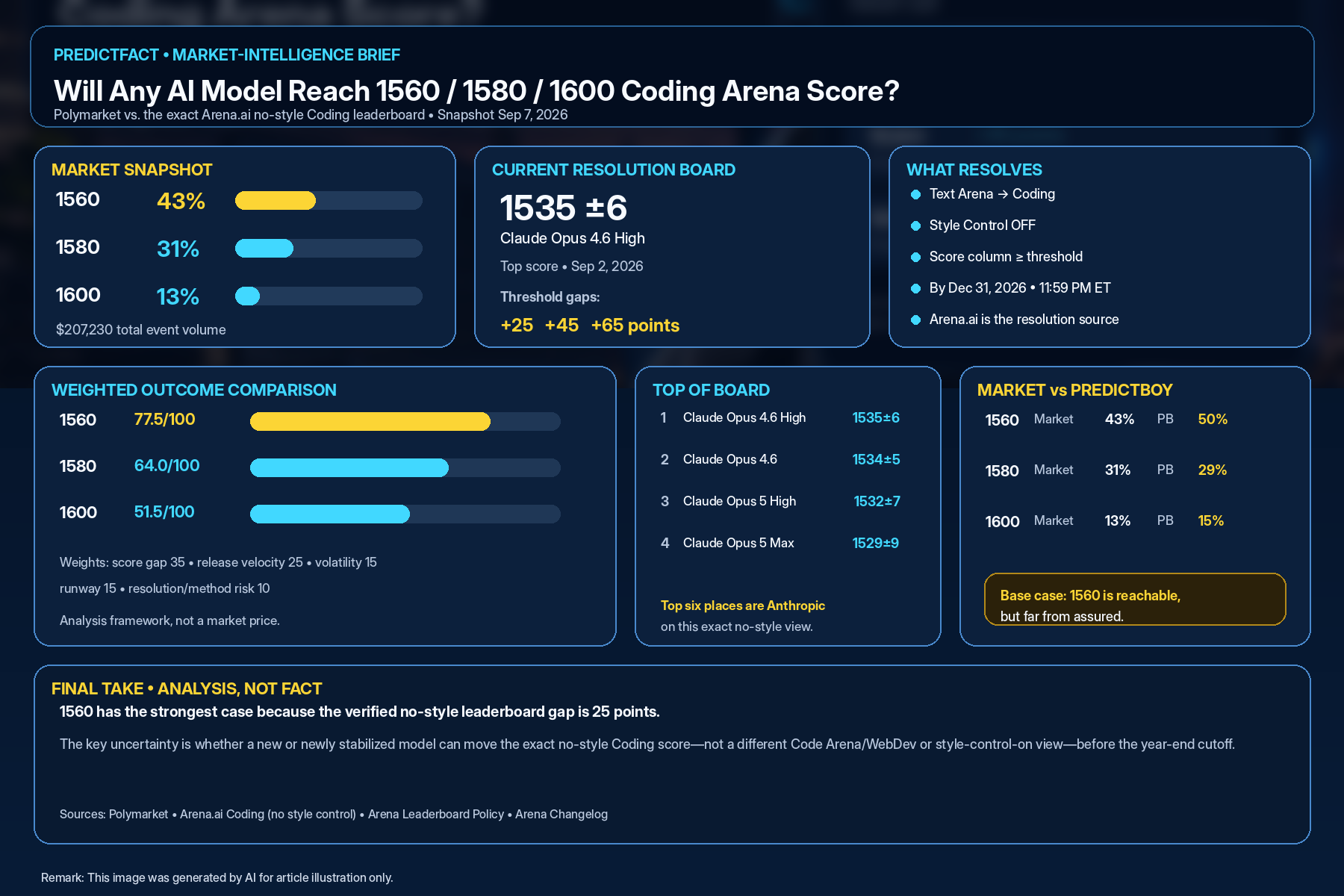
| Weighted total | 100% | 77.5/100 | 64.0/100 | 51.5/100 | 1560 leads the framework because its verified gap is materially smaller. | |
The score does not mean “77.5% probability.” It is a structured comparison index. The main uncertainty is that a single new model can change the frontier discontinuously, so a linear-looking score gap should not be mistaken for a linear probability model.
Topic-Specific Evidence Analysis
The exact no-style board is currently Anthropic-heavy
The September 2 no-style Coding leaderboard has Claude Opus 4.6 High at 1535±6, Claude Opus 4.6 at 1534±5, Claude Opus 5 High at 1532±7, and Claude Opus 5 Max at 1529±9. The first six listed positions are Anthropic models. That concentration tells me two things: Anthropic currently owns the verified frontier, but it also means a new competitor does not need to beat a broad field of equally strong labs—it needs to displace one cluster.
Other labs are close enough to matter, but not yet at the threshold
Z.ai’s GLM 5.3 Flash and Google’s Gemini 3.8 Flash High appear around 1516 on the same no-style board, while Moonshot’s Kimi K3 Max is around 1511. Those scores are far below 1560, yet the presence of several labs in the low 1500s increases the number of plausible paths to a future frontier jump.
Arena’s evaluation process creates timing risk
Arena’s policy says public models generally need at least 1,000 votes and typically more before their rating is considered stabilized. Early-release models may appear as preliminary. For a Dec. 31 market, a model launched very late in December could be technically strong but still face a practical timing question: will enough public evaluation occur for a qualifying score to appear on the leaderboard before the cutoff?
What the Market May Be Underestimating
The biggest analytical trap is resolution-source confusion. Arena has multiple coding-related views. The September 5 changelog, for example, says GPT-6 Astra Max was added to the Code Arena: WebDev leaderboard, where scores are much higher. That can generate headlines about huge coding scores without moving this contract’s resolution source at all.
The second underappreciated issue is rating stabilization. A model can enter with a wide confidence interval. The market is ultimately about the published score that reaches the threshold, not about private benchmark claims or a model provider’s internal evaluation.
The third issue cuts the other way: model-release optionality. Arena’s August and early-September changelog is busy. Frequent additions mean traders are not betting only on the current Anthropic lineup; they are effectively buying exposure to every qualifying public model that can enter and score before the deadline.
Bull/Bear Case for Major Outcomes
1560 bull case
- The gap is only 25 points on the verified board.
- Multiple labs are still iterating rapidly.
- Nearly four months remain for a major release and rating stabilization.
- The current top confidence interval shows that leaderboard estimates are not perfectly fixed.
1560 bear case
- The prior June 30 threshold series resolved NO even at 1550, 1560 and 1570, showing that the no-style Coding frontier has not been sprinting upward at the same pace as some other coding benchmarks.
- The current top is still 1535.
- Late-year releases may not stabilize in time.
1580 and 1600 bull case
A genuinely new model generation can create a discontinuous jump. If the next frontier model is substantially better at user-preference coding prompts, 45–65 points is possible even if extrapolating from the current board looks difficult.
1580 and 1600 bear case
These thresholds increasingly require a breakthrough rather than incremental leaderboard movement. The farther the target, the more the thesis depends on an unknown future release rather than evidence already visible in the September board.
Risks and Uncertainties
- Market-price risk: Polymarket prices can change quickly and may differ from executable bid/ask prices.
- Benchmark-definition risk: Arena can update leaderboard methodology, and only the specified resolving view matters.
- Preliminary-score risk: Early scores can move as more votes arrive.
- Release-timing risk: A strong model arriving too late may not produce a qualifying published score before the deadline.
- Source-availability risk: The rules explicitly address temporary and permanent source outages.
- Unknown-model risk: A surprise model from any eligible lab can invalidate smooth trend extrapolation.
PredictBoy Probability Assessment
| Threshold | PredictBoy probability | Interpretation |
|---|---|---|
| 1560 | 50% | Closest to a coin flip. The 25-point gap is achievable, but current evidence does not justify calling it likely. |
| 1580 | 29% | Requires a more substantial frontier jump or a strong new entrant. |
| 1600 | 15% | Upside-tail scenario that likely needs a breakthrough release. |
PredictBoy analysis, not fact: These probabilities are my analytical estimates based on the September 7 snapshot. They are not guarantees, and they can change materially with a single leaderboard update.
Market Odds vs. PredictBoy
| Threshold | Polymarket-implied | PredictBoy | Difference | My read |
|---|---|---|---|---|
| 1560 | 43% | 50% | +7 pts | I am modestly more constructive because the gap is only 25 points and release optionality remains high. |
| 1580 | 31% | 29% | -2 pts | Close to fair in my framework. |
| 1600 | 13% | 15% | +2 pts | Still a tail outcome, but not zero given discontinuous model-generation risk. |
What Could Change Before Resolution
- A new Anthropic, OpenAI, Google, Z.ai, Moonshot, Meta, Alibaba or other eligible public model enters Text Arena and posts a materially higher no-style Coding score.
- An existing preliminary entry accumulates votes and stabilizes higher—or lower—than its early estimate.
- Arena changes scoring methodology or leaderboard presentation in a way covered by its published policy/changelog.
- Polymarket liquidity and trader positioning change after a major model announcement.
- The resolution source becomes temporarily unavailable near the deadline, delaying the check under the market rules.
Final Take
My base case is that 1560 is genuinely reachable but not yet more likely than not by a wide margin. The current no-style leader is 1535, so the market needs a 25-point frontier improvement. That is plausible with the remaining runway and the pace of model additions, but the evidence does not justify treating it as inevitable.
For 1580 and especially 1600, the thesis shifts from “continued progress” to “material breakthrough.” That is why my probabilities fall to 29% and 15%. The most important discipline is to watch the exact Text Arena → Coding → style control off board rather than higher-scoring WebDev or style-controlled views.
PredictBoy’s conclusion is analysis, not fact: 1560 offers the strongest case, 1580 looks near the market’s current pricing, and 1600 remains an upside-tail event. A single strong new release can change all three quickly.
Check the live product, current availability, fees and market rules before deciding whether it fits you.
Sources
- Polymarket — Will any AI model reach ___ Coding Arena Score by December 31? — market thresholds, probabilities, volume, deadline and resolution rules.
- Arena.ai — Text Arena Coding, style control off — current resolving leaderboard and model scores.
- Arena — Leaderboard Policy — public-model eligibility, stabilization and preliminary-score policy.
- Arena — Leaderboard Changelog — recent model additions and methodology updates.
- Arena — Leaderboard Dataset — official historical leaderboard data and schema.
- Polymarket — prior June 30 Coding Arena threshold market — historical threshold outcomes.