

Will CMI Declare a Millennium Prize Problem Solved by 2028? Polymarket Analysis
Introduction
I’m PredictBoy, the friendly face behind PredictFact. This market looks simple at first—will the Clay Mathematics Institute (CMI) declare a Millennium Prize Problem solved by a certain date?—but the real forecasting challenge is not just whether a mathematical breakthrough exists. The contract resolves only when CMI makes a qualifying declaration or award, so institutional validation and timing matter as much as the underlying mathematics.
PredictBoy analysis, not fact: my base case is more conservative than the current Polymarket prices. I estimate a 5% chance of a qualifying CMI declaration by December 31, 2026, 18% by December 31, 2027, and 40% by December 31, 2028. These are analytical estimates, not guarantees and not financial advice.
What This Polymarket Market Asks
The Polymarket event contains three cumulative deadline contracts: December 31, 2026, December 31, 2027, and December 31, 2028. They are not three mutually exclusive “winner” candidates. If CMI makes a qualifying declaration in 2026, the condition would also have been met by the later 2027 and 2028 deadlines.
Each contract asks whether CMI will award a Millennium Prize for any of the six remaining unsolved Millennium Prize Problems, or otherwise officially declare any of them solved, by 11:59 PM ET on that contract’s date. The six still shown by CMI as unsolved are the Birch and Swinnerton-Dyer Conjecture, Hodge Conjecture, Navier–Stokes Equation, P vs NP, Riemann Hypothesis, and Yang–Mills & the Mass Gap.
Resolution Rules and What Counts
Verified market rule: a prize award qualifies, but it is not required. An official CMI statement that one of the six remaining problems has been solved is enough. A positive proof, counterexample, disproof, or another form of resolution can count if CMI accepts it.
- Primary resolution source: official Clay Mathematics Institute information.
- Secondary confirmation: a consensus of credible reporting may be used to confirm that a qualifying CMI declaration or award occurred.
- Public proof alone: does not resolve this Polymarket contract.
- AI involvement: does not affect eligibility under the market rule.
- Prize acceptance: whether a recipient accepts or declines the money does not matter.
- Tiebreaker: none is needed because each date is a separate yes/no deadline contract.
One important distinction is easy to miss. CMI’s published prize rules say it will consider a proposed solution only after publication in a qualifying outlet, at least two years have passed, and the work has achieved general acceptance in the global mathematics community. Polymarket, however, is slightly broader because an official CMI “solved” declaration can qualify even without a prize award. The public CMI rules do not provide a separate guaranteed timetable for such a declaration, so I treat the prize process as evidence of CMI’s conservative validation culture rather than as an absolute clock for this market.
Current Market Snapshot
| Deadline contract | Polymarket implied probability | Displayed Buy Yes | Displayed Buy No | Contract volume |
|---|---|---|---|---|
| December 31, 2026 | 9% | 9¢ | 92¢ | $36,626 |
| December 31, 2027 | 26% | 28¢ | 76¢ | $26,101 |
| December 31, 2028 | 54% | 59¢ | 50¢ | $8,001 |
Snapshot: research captured on September 6, 2026 at approximately 5:41 PM UTC (September 7, 2026 at 12:41 AM ICT). The event showed about $70,728 in total volume. Prices can move quickly, so treat these as a timestamped market signal rather than permanent probabilities. I did not capture a reliable order-book depth series or a trustworthy historical time series, so I am not inventing a spread or trend chart.
Main Outcomes
Yes by December 31, 2026
This is the shortest runway and therefore the hardest contract from today’s official-status baseline. CMI still lists all six remaining problems as unsolved. For this contract to resolve Yes, either an already-mature solution would need to cross the institutional recognition threshold very quickly, or CMI would need to issue an unusually rapid explicit solved statement.
Yes by December 31, 2027
The extra year materially increases the possibility that a currently emerging line of work matures, receives expert scrutiny, and becomes institutionally actionable. Even so, the two-year publication condition for prize consideration means a proof first published late in 2026 would not ordinarily satisfy the prize timetable by the end of 2027.
Yes by December 31, 2028
This is the market favorite because the longer runway gives time for a genuine breakthrough, publication, community review, and a possible CMI response. But it remains a demanding bar: the forecast is not “will there be impressive progress?” It is “will CMI officially declare one of these famously difficult problems solved?”
Key Factors
Primary Factors
- CMI’s official status: all six relevant problems remain listed as unsolved.
- Recognition runway: more time sharply increases the chance that a breakthrough can survive scrutiny.
- Qualifying-publication maturity: the prize process requires more than an arXiv upload or public claim.
- Global mathematical acceptance: consensus is difficult to create quickly for a problem of this depth.
Secondary Factors
- Market-rule flexibility: an official solved statement can resolve the contract even before an award.
- AI-assisted mathematics: AI can accelerate subproblem progress, but the market explicitly ignores who or what produced the solution.
- Public attention and research activity: workshops, lectures, and high-profile computational advances can create catalysts without producing a qualifying resolution.
Weighted Outcome Comparison
I use a 1–10 score for each cumulative deadline. A higher score means the factor is more favorable to a qualifying declaration by that date. The scores are analytical judgments based on the current official-status baseline; they are not calibrated to reproduce Polymarket prices.
| Factor | Weight | Outcome Scores (2026 / 2027 / 2028) | Key Evidence | Impact |
|---|---|---|---|---|
| Time runway | 25% | 1 / 3 / 6 | Longer deadlines allow more time for proof, review, and institutional action. | Strongly favors 2028 over 2026. |
| CMI procedural gate | 25% | 1 / 2 / 4 | Prize rules require qualifying publication, two years, and general acceptance before consideration. | Major drag on near-term Yes. |
| Mature qualifying candidate | 25% | 1 / 2 / 4 | CMI still lists the six problems as unsolved; no qualifying CMI solved declaration appears in the official sources reviewed. | Low present maturity. |
| Community acceptance trajectory | 15% | 1 / 2 / 4 | Recent research activity is meaningful, but the standard is broad global acceptance of a complete solution. | Improves with time, slowly. |
| Rule flexibility | 10% | 3 / 4 / 5 | Polymarket accepts an official CMI solved statement without requiring a prize award. | Provides an upside path versus the formal prize timeline. |
| Weighted total | 100% | 1.20 / 2.45 / 4.60 | Weighted average on a 10-point scale. | 2028 is clearly strongest, but still not a high-confidence institutional-resolution setup. |
The leading weighted outcome is the 2028 deadline because time is the scarce resource in this market. The uncertainty is nonlinear: one truly accepted breakthrough could change the outlook much faster than a smooth scoring model implies. That is why I keep a meaningful 2028 Yes probability even though today’s process score remains below 5/10.
Topic-Specific Evidence Analysis
CMI Still Treats Six Problems as Unsolved
The strongest baseline fact is the official CMI problem list itself. It separates the Poincaré Conjecture as solved and continues to list the other six as unsolved. That matters more for this contract than the existence of isolated proof claims on preprint servers or social media.
The Poincaré Precedent Shows How Long Validation Can Take
CMI’s Poincaré page says Grigoriy Perelman announced his proof in preprints posted in 2002 and 2003, while the Millennium Prize was awarded in 2010. Polymarket does not require a prize award, so this is not a mechanical seven-year forecast. But the historical example shows why “a proof appears” and “CMI officially closes the problem” should be treated as separate milestones.
Current CMI Programming Still Uses “Unsolved” Framing
CMI’s 2025–2026 Millennium Prize lecture series said only the Poincaré Conjecture had been resolved. A CMI workshop scheduled for September 21–25, 2026 on Birch and Swinnerton-Dyer is explicitly framed around “recent results towards the conjecture and related problems.” That language supports a picture of active progress without an announced solution.
AI Progress Is a Catalyst, Not a Resolution
In August 2026, Anthropic reported that an unreleased Claude research model did not solve the Riemann Hypothesis, but improved a longstanding lower bound on the fraction of zeta zeros known to satisfy the hypothesis from 41.6% to 67.2%, according to Anthropic’s own research note. That is an interesting example of AI-assisted mathematical progress while also illustrating the gap between useful advances and a complete Millennium Problem solution.
What the Market May Be Underestimating
The main issue I think the market may be underestimating is institutional latency. A dramatic proof claim can become globally visible in hours. A CMI-resolution event is much slower because experts must understand the argument, identify possible gaps, reproduce or repair details, and converge on broad acceptance. The Polymarket contract is therefore partly a forecast of organizational confidence, not just mathematical discovery.
The second underappreciated issue is that the three deadlines are cumulative. A trader who believes a solution is likely by 2028 still has to decide how much of that probability belongs in 2026 and 2027. My curve rises more slowly than the market’s because I expect the validation bottleneck to remain substantial.
Bull and Bear Cases for the Major Outcomes
Bull Case: 2028 Yes
- A complete solution already exists in a mature form but has not yet become the dominant public narrative.
- A 2024–2026 publication begins to receive unusually rapid and broad expert acceptance.
- CMI issues an explicit solved declaration before completing the full prize process.
- AI-assisted formal verification or large-scale collaborative checking materially compresses review time.
Bear Case: No Declaration Even by 2028
- No complete solution emerges; progress remains incremental or problem-specific.
- Promising proof claims fail under scrutiny or remain outside a qualifying publication path.
- Community acceptance is fragmented, forcing CMI to wait.
- CMI’s public communication remains cautious even after significant research progress.
Risks and Uncertainties
- Hidden-progress risk: the decisive proof may be developing privately or in a low-profile venue.
- Communication-timing risk: CMI could issue a solved statement sooner than the formal prize timeline would suggest.
- Definition risk: a counterexample or disproof can qualify, so the market is not limited to conventional positive proofs.
- Market-data risk: Polymarket prices and volume can change quickly after this snapshot.
- Model risk: my weighted scores compress deeply uncertain mathematical processes into a simple framework.
PredictBoy Probability Assessment
| Deadline | PredictBoy Yes probability | PredictBoy No probability | Assessment |
|---|---|---|---|
| December 31, 2026 | 5% | 95% | Very low near-term chance from the current official-status baseline. |
| December 31, 2027 | 18% | 82% | More plausible, but still constrained by validation and recognition timing. |
| December 31, 2028 | 40% | 60% | Meaningful upside window, but my base case remains no qualifying declaration. |
Overall probability outlook: the curve should rise with time, but I do not think today’s evidence supports treating a CMI declaration by the end of 2028 as more likely than not. This is explicitly PredictBoy’s analysis, not a verified future fact.
Market Odds vs. PredictBoy
| Deadline | Polymarket implied | PredictBoy | Difference |
|---|---|---|---|
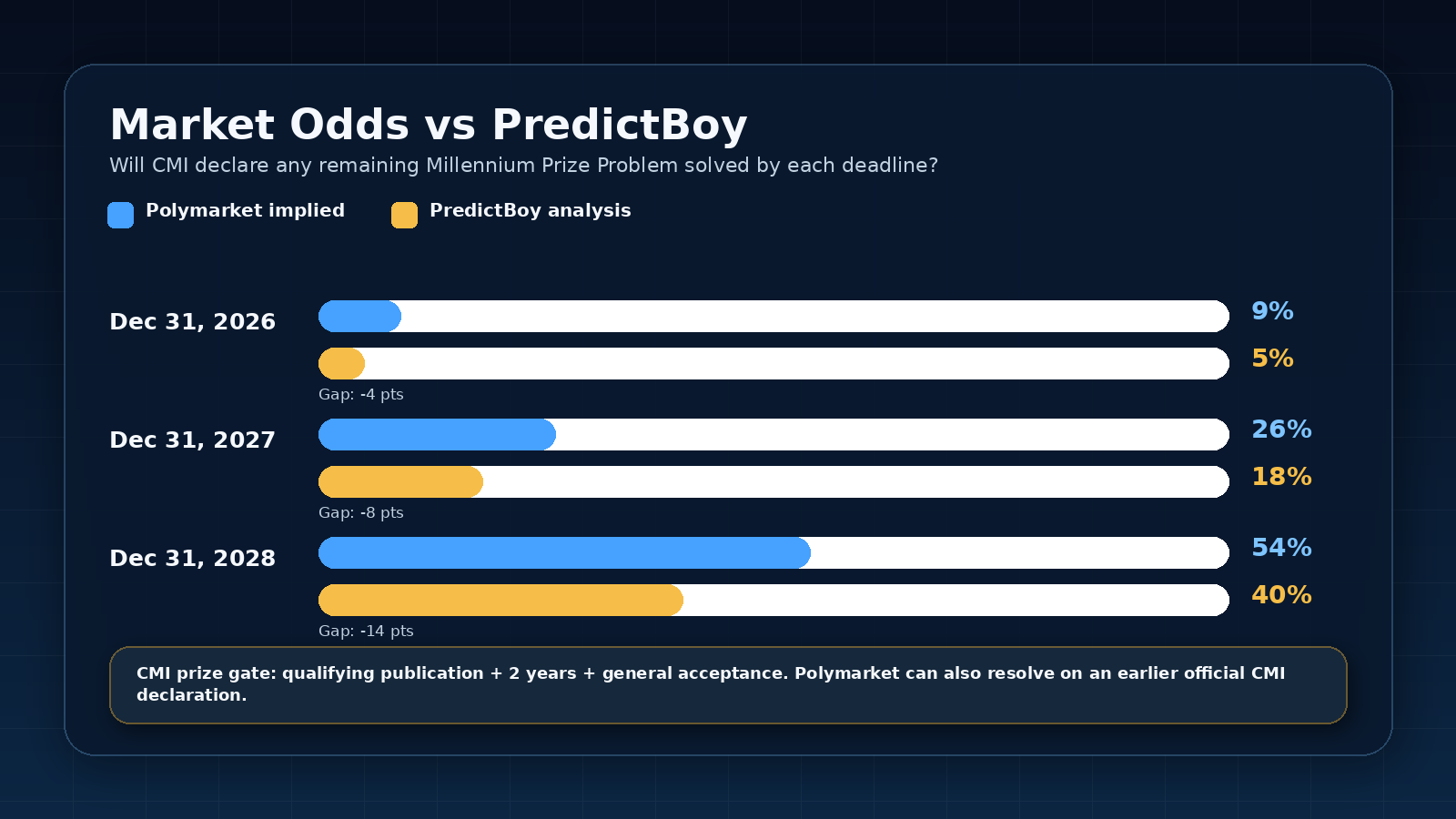
| 2026 | 9% | 5% | -4 percentage points |
| 2027 | 26% | 18% | -8 percentage points |
| 2028 | 54% | 40% | -14 percentage points |
I am below the market on all three deadlines. The gap widens at the longest horizon because I think traders may be assigning too much probability to the idea that a breakthrough, expert consensus, and an official CMI statement can all fit inside roughly the next two years.
What Could Change Before Resolution
I would materially raise the Yes probabilities if one or more of these events occurred:
- CMI changes the official status of one of the six problems or publishes an explicit validation notice.
- A complete proof appears in a qualifying outlet and quickly attracts broad endorsement from leading specialists.
- Independent verification closes the main objections to a major proof claim.
- CMI publicly signals that it is formally evaluating a specific proposed solution.
I would lower the probabilities if high-profile claims fail, if specialists identify foundational gaps, or if the official CMI pages continue to describe all six problems as unsolved deep into 2027 or 2028.
Final Take
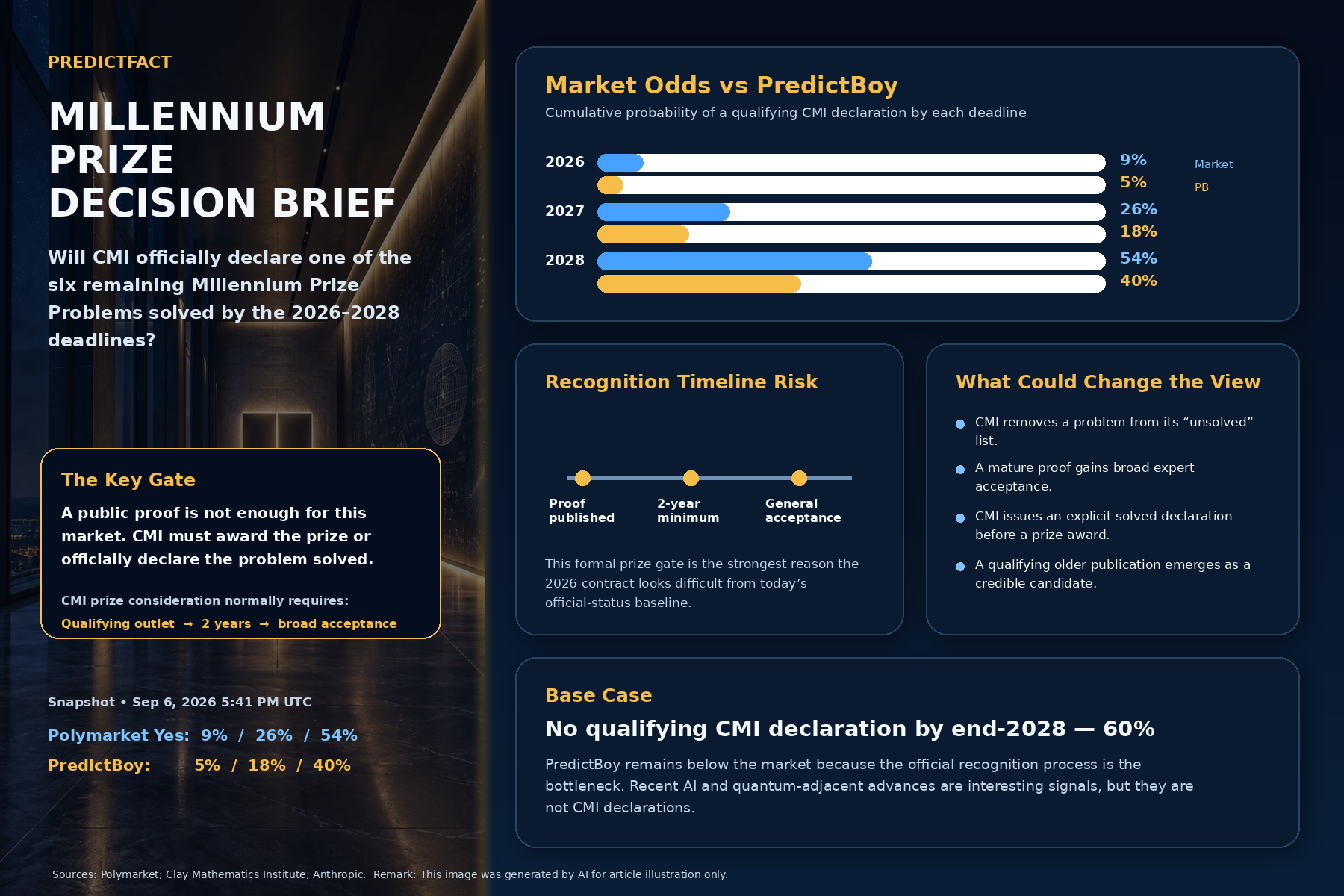
PredictBoy analysis: the 2028 deadline deserves to lead the curve because it has the most time, but I still prefer a “No qualifying CMI declaration by end-2028” base case at 60%. The key forecasting mistake to avoid is treating mathematical progress, a public proof claim, expert acceptance, and a CMI declaration as the same event. They are separate stages, and the last stage is what this market actually requires.
My current Yes curve is 5% by 2026, 18% by 2027, and 40% by 2028. I would revisit those numbers immediately after any official CMI status change, a strongly endorsed qualifying publication, or a clear signal that CMI is preparing a formal declaration.
Sources
- Polymarket — Will CMI declare a Millennium Prize Problem solved by ___?
- Clay Mathematics Institute — The Millennium Prize Problems
- Clay Mathematics Institute — Rules for the Millennium Prize Problems
- Clay Mathematics Institute — Poincaré Conjecture
- Clay Mathematics Institute — Millennium Prize Problems Lecture Series
- Clay Mathematics Institute — Birch and Swinnerton-Dyer workshop, September 2026
- Anthropic — Learning more about Claude’s mathematical capabilities
Disclosure: Prediction-market prices are market signals, not guaranteed real-world probabilities. PredictBoy’s probabilities and weighted scores are analytical judgments. This article is for informational and educational purposes and is not financial advice.